
Compound Monograph
Cauloside D
Cauloside D is a hederagenin-type triterpene (oleanane) saponin of blue cohosh (Caulophyllum thalictroides), studied mainly as a cytochrome-P450 (CYP3A4) inhibitor at high concentration — one strand of the herb's drug-interaction potential — alongside the general membrane-active, cytotoxic profile shared by the cauloside saponins.

Sources · 1
Where Does It Come From?
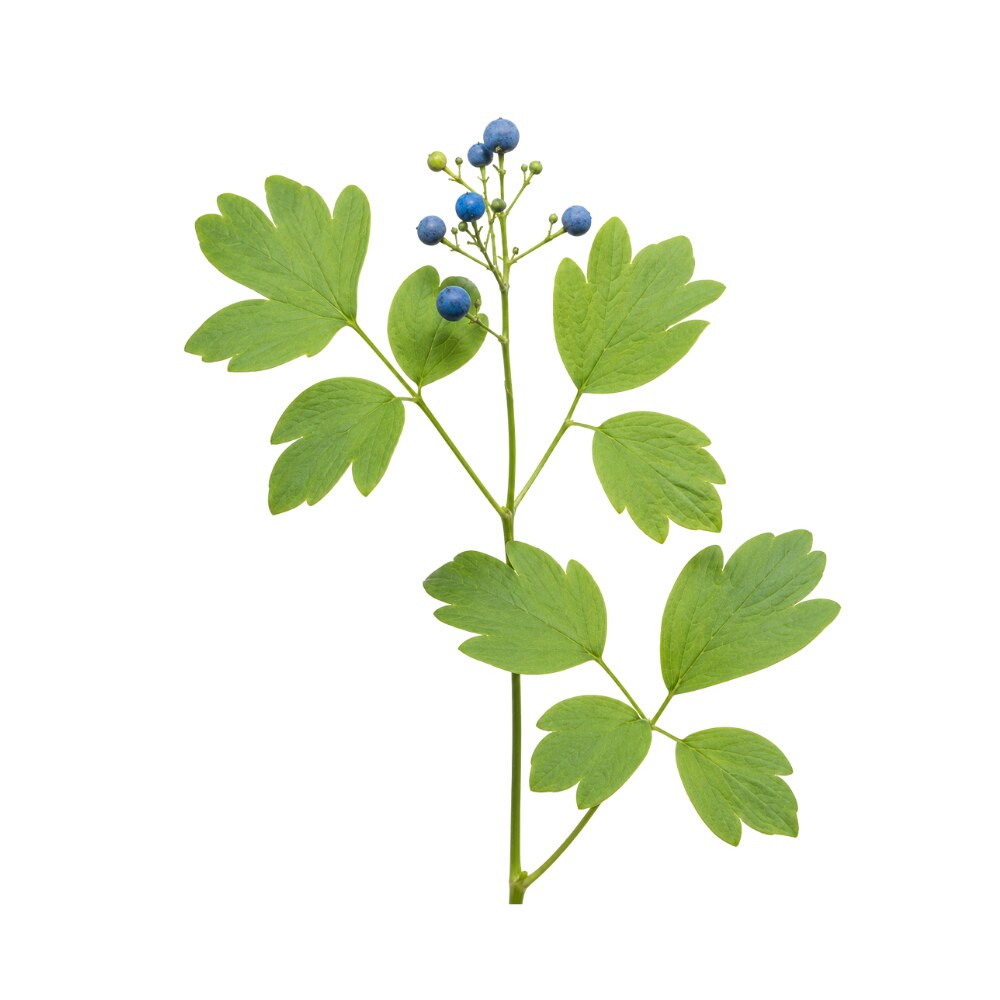
Cauloside D is a naturally occurring triterpenoid saponin (hederagenin glycoside; oleanane type), found in Blue cohosh. It is flagged as moderately toxic.
Concentration
Content by Source
Concentrations not reported. No percent-dry-weight or mg/g figures have been published for this compound in its source plants.
Cauloside D at a Glance
Cauloside D is a triterpene saponin of blue cohosh (Caulophyllum thalictroides) — one member of the cauloside family of hederagenin-type oleanane glycosides that make up the plant’s saponin fraction 2,
The molecule has a thin, narrow evidence base. Its one specific research finding is that, like several other blue-cohosh saponins, it inhibits the drug-metabolising enzyme cytochrome P450 3A4 (CYP3A4) — but only at high concentration 1Reference 1In vitroAlkaloids and saponins as cytochrome P450 inhibitors from blue cohosh (Caulophyllum thalictroides) in an in vitro assayView study →. That places it among the constituents contributing to blue cohosh’s herb-drug-interaction potential, though the effect is an in-vitro isolate signal, not a demonstrated clinical interaction. Beyond that, cauloside D inherits the membrane-active, cytotoxic character documented for its better-studied siblings cauloside A and cauloside C 5,
A Hederagenin Saponin of Blue Cohosh With CYP3A4-Inhibition Relevance
Cauloside D belongs to the cauloside / caulosaponin series — oleanane-type triterpene glycosides built on a hederagenin aglycone and characterised from blue-cohosh root by the University of Mississippi group 2Reference 2Alkaloids and saponins from blue cohoshView study →. This saponin family (caulosides A–H, leonticin D, saponin PE and others) is credited, largely by inference, with blue cohosh’s traditional uterine-stimulant reputation, though which individual saponins drive that is unresolved 3Reference 3Determination of saponins and alkaloids in Caulophyllum thalictroides (blue cohosh) by high-performance liquid chromatography and evaporative light scattering detectionView study →.
Cauloside D’s own claim to a page is the CYP3A4 finding. In an in-vitro cytochrome-P450 assay, blue-cohosh saponins — cauloside D among them — inhibited CYP3A4, but the inhibition was seen at high concentrations rather than at levels obviously reachable from normal intake 1Reference 1In vitroAlkaloids and saponins as cytochrome P450 inhibitors from blue cohosh (Caulophyllum thalictroides) in an in vitro assayView study →. CYP3A4 metabolises a large share of prescription drugs, so a high-concentration inhibitor is a plausible but unproven contributor to interaction risk. The honest reading: this is a mechanistic flag from an isolate assay, not evidence of a clinical interaction, and blue cohosh’s better-characterised hazards belong to its quinolizidine alkaloids (nicotinic toxicity and teratogenicity), not its saponins.
What It's Used For
The evidence for cauloside D specifically is limited to a single in-vitro enzyme-inhibition finding; the rest of its profile is read across from the cauloside family.
Support is an experimental score — weighted by study type (human > animal > in vitro) and volume. A beta, not a validated metric. Both rows are thin: one rests on a single isolate assay, the other on read-across from sibling saponins.
The molecule’s one specific finding. In an in-vitro cytochrome-P450 inhibition assay of blue-cohosh alkaloids and saponins, cauloside D was among the saponins that inhibited CYP3A4 — but the inhibition appeared only at high concentrations 1Reference 1In vitroAlkaloids and saponins as cytochrome P450 inhibitors from blue cohosh (Caulophyllum thalictroides) in an in vitro assayView study →.
This is an isolated-compound result (the constituents were tested individually in an enzyme assay, not as whole extract in people). CYP3A4 handles the metabolism of a large fraction of medicines, so a high-concentration inhibitor is a mechanistic reason for caution about combining concentrated blue-cohosh products with CYP3A4 substrates.
Gap: the effect is high-concentration and in-vitro only — there is no data on whether cauloside D reaches inhibitory concentrations in the gut or liver at realistic intake, no in-vivo confirmation, and no reported clinical interaction attributable to this saponin 1Reference 1In vitroAlkaloids and saponins as cytochrome P450 inhibitors from blue cohosh (Caulophyllum thalictroides) in an in vitro assayView study →.
Cauloside D is grouped with the membrane-permeabilising, surface-active cytotoxins typical of triterpene saponins. This character is documented for its siblings, not for cauloside D itself: cauloside C is a pH-dependent membrane-permeabilising cytotoxin (more active in acidic media) 5Reference 5The effect of pH on biological activity of plant cytotoxin cauloside CView study →, and the blue-cohosh saponin fraction disrupts cellular respiration and mitochondrial membrane potential 6Reference 6Toxins in botanical dietary supplements: blue cohosh components disrupt cellular respiration and mitochondrial membrane potentialView study →.
By structural analogy cauloside D is presumed to behave similarly, but no cytotoxicity, haemolysis, or membrane assay has been run on the isolated molecule.
Gap: entirely inferential for cauloside D — no isolate cytotoxicity data, no potency comparison against caulosides A/C, and no evidence linking this specific saponin to any biological outcome 5,
Mechanisms
| Target / pathway | Effect | Relevant to |
|---|---|---|
| Cytochrome P450 3A4 (CYP3A4) | inhibition at high concentration (in-vitro isolate) | drug-interaction relevance |
| Cell / mitochondrial membranes | membrane permeabilisation and disruption typical of the cauloside saponins (shown for siblings) | cytotoxicity / membrane activity |
| Estrogen receptor | no estrogenic activity for the cauloside-type triterpene glycosides in a yeast two-hybrid assay | rules out an estrogenic mechanism |
The CYP3A4 row is the only mechanism demonstrated for cauloside D itself; the others are family-level context. The absence of estrogen-receptor activity for these triterpene glycosides 7Reference 7Estrogenic activity of triterpene glycosides in yeast two-hybrid assayView study → argues against a hormonal explanation for blue cohosh’s reproductive reputation, pointing instead to the alkaloids and to direct saponin membrane effects.
Pharmacokinetics
No pharmacokinetic data exist for cauloside D. Absorption, oral bioavailability, metabolism, distribution and half-life are all uncharacterised. As a large, polar triterpene glycoside it would be expected to have poor oral absorption (the general fate of dietary saponins), which — if true — would further undercut the practical reach of the high-concentration in-vitro CYP3A4 signal, but this has not been measured for the molecule.
Clinical Trials
There are no clinical trials of cauloside D. It has never been administered as an isolated compound to humans or animals; all human exposure is incidental, as a minor saponin within whole blue-cohosh root products.
| Completed | Planned | Terminated | Preclinical |
|---|---|---|---|
| — | — | — | In-vitro CYP3A4 inhibition; family-level membrane/cytotoxicity 1, |
Last checked: July 2026.
Isolate vs. Plant Studies
The little direct evidence there is comes from the isolated compound: the CYP3A4 finding tested blue-cohosh constituents individually in an enzyme assay 1Reference 1In vitroAlkaloids and saponins as cytochrome P450 inhibitors from blue cohosh (Caulophyllum thalictroides) in an in vitro assayView study →. Everything else is whole-fraction or sibling-molecule work — the saponin fraction’s mitochondrial disruption 6Reference 6Toxins in botanical dietary supplements: blue cohosh components disrupt cellular respiration and mitochondrial membrane potentialView study → and cauloside C’s membrane cytotoxicity 5Reference 5The effect of pH on biological activity of plant cytotoxin cauloside CView study → — extrapolated to cauloside D by structural analogy. No study has isolated cauloside D and demonstrated a biological effect of its own beyond the CYP inhibition, and no human or animal study has used it. The transferability caveat is therefore large: cauloside D’s profile is assumed from its family, not established.
Prevalence in Nature
Cauloside D occurs in the root and rhizome of blue cohosh (Caulophyllum thalictroides, Berberidaceae), as one of the triterpene saponins resolved analytically from that tissue 2,
Discovery & Synthesis
Cauloside D was characterised as one of the cauloside triterpene saponins of Caulophyllum — the saponin series (caulosides A–H, leonticin D, saponin PE) worked out by phytochemical isolation from blue-cohosh root, notably by the University of Mississippi group 2Reference 2Alkaloids and saponins from blue cohoshView study →, and quantified against alkaloids by HPLC methods for quality control 3,
Patents: not yet researched.
Toxicity & Safety
Cauloside D carries a moderate flag — a conservative, data-limited call. It is a membrane-active triterpene saponin (a class that is broadly surface-active, haemolytic and cytotoxic in vitro) and a high-concentration CYP3A4 inhibitor 1Reference 1In vitroAlkaloids and saponins as cytochrome P450 inhibitors from blue cohosh (Caulophyllum thalictroides) in an in vitro assayView study →, yet it has no isolate toxicity, genotoxicity, or reproductive dataset of its own, and it is only ever encountered as a minor component of a botanical whose principal hazards lie elsewhere. The badge reflects the plausible membrane/enzyme activity plus the near-total absence of safety data, not a demonstrated toxicity ceiling.
Two framing points matter. First, blue cohosh’s serious, documented dangers — the nicotinic toxidrome and teratogenicity — are driven by its quinolizidine alkaloids (N-methylcytisine, anagyrine and relatives), not by the caulosides; cauloside D should not be blamed for, or credited with, those effects. Second, the saponins are the plausible basis of the uterine-stimulant reputation by inference, but no isolated cauloside has been shown to cause it, and these triterpene glycosides showed no estrogen-receptor activity in a yeast two-hybrid assay 7Reference 7Estrogenic activity of triterpene glycosides in yeast two-hybrid assayView study →.
- No estrogenic activity for the cauloside-type triterpene glycosides in a yeast two-hybrid screen — argues against a hormonal mechanism 7Reference 7Estrogenic activity of triterpene glycosides in yeast two-hybrid assayView study →.
- High-concentration CYP3A4 inhibitor in vitro — a mechanistic drug-interaction flag for concentrated blue-cohosh products taken with CYP3A4 substrates, though clinical relevance is unproven 1Reference 1In vitroAlkaloids and saponins as cytochrome P450 inhibitors from blue cohosh (Caulophyllum thalictroides) in an in vitro assayView study →.
- Membrane-active saponin by family — presumed cytotoxic/membrane-permeabilising like caulosides A/C, but never tested as an isolate 5,
6Reference 5The effect of pH on biological activity of plant cytotoxin cauloside CView study →Reference 6Toxins in botanical dietary supplements: blue cohosh components disrupt cellular respiration and mitochondrial membrane potentialView study → . - Essentially no safety data on the isolate — no PK, no genotoxicity, no reproductive dataset; the badge is a conservative data-absence call. Blue cohosh’s real toxicity is alkaloid-driven, and pregnancy/intake decisions belong to the blue cohosh herb page.
Dosage
There is no dose for cauloside D — it is not sold or used as an isolated compound, and no research has administered it. Human exposure is entirely indirect, as a minor saponin within whole blue-cohosh root products, whose total saponin content varies more than 100-fold between preparations (roughly 6–302 mg estimated daily intake) 4Reference 4Analytical methods for determination of magnoflorine and saponins from roots of Caulophyllum thalictroides (L.) Michx. using UPLC, HPLC and HPTLCView study →. Any intake decision concerns the whole herb, not this molecule; see the blue cohosh monograph. This is descriptive information, not a personal recommendation.
References
- Madgula VL, Ali Z, Smillie T, et al. (2009). Alkaloids and saponins as cytochrome P450 inhibitors from blue cohosh (Caulophyllum thalictroides) in an in vitro assay. Planta Medica. https://pubmed.ncbi.nlm.nih.gov/19137500/
- Ali Z, Khan IA (2008). Alkaloids and saponins from blue cohosh. Phytochemistry. https://pubmed.ncbi.nlm.nih.gov/18048069/
- Ganzera M, Dharmaratne HR, Nanayakkara NP, et al. (2003). Determination of saponins and alkaloids in Caulophyllum thalictroides (blue cohosh) by high-performance liquid chromatography and evaporative light scattering detection. Phytochemical Analysis. https://pubmed.ncbi.nlm.nih.gov/12597249/
- Avula B, Wang YH, Rumalla CS, et al. (2011). Analytical methods for determination of magnoflorine and saponins from roots of Caulophyllum thalictroides (L.) Michx. using UPLC, HPLC and HPTLC. Journal of Pharmaceutical and Biomedical Analysis. https://pubmed.ncbi.nlm.nih.gov/21872415/
- Aminin DL, Agafonova IG, Gnedoi SN (1999). The effect of pH on biological activity of plant cytotoxin cauloside C. Comparative Biochemistry and Physiology Part A. https://pubmed.ncbi.nlm.nih.gov/10216931/
- Datta S, Mahdi F, Ali Z, et al. (2014). Toxins in botanical dietary supplements: blue cohosh components disrupt cellular respiration and mitochondrial membrane potential. Journal of Natural Products. https://pubmed.ncbi.nlm.nih.gov/24328138/
- Kovalchuk SN, Kozhemyako VB, Atopkina LN, et al. (2006). Estrogenic activity of triterpene glycosides in yeast two-hybrid assay. The Journal of Steroid Biochemistry and Molecular Biology. https://pubmed.ncbi.nlm.nih.gov/16973351/



