
Compound Monograph
Cauloside C
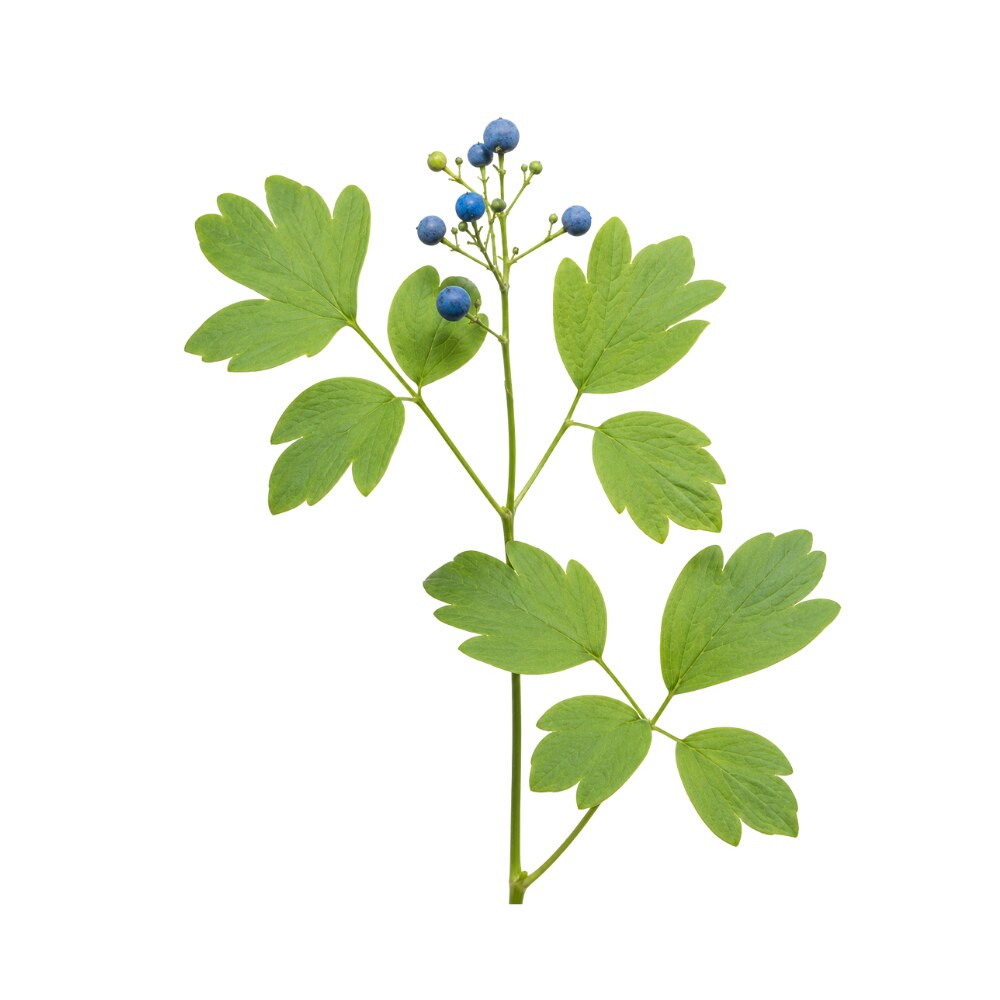
Cauloside C is a hederagenin triterpene saponin of blue cohosh (Caulophyllum thalictroides) root. In vitro it behaves as a pH-dependent membrane-permeabilising cytotoxin — stronger in acidic media — and, notably for a blue cohosh constituent, shows no estrogen-receptor activity. Human data are absent; it has been studied only as an isolated molecule.

Sources · 2
Where Does It Come From?
Cauloside C is a naturally occurring triterpenoid (oleanane) saponin — hederagenin glycoside, found in Blue cohosh and 1 other source. It is flagged as moderately toxic.
Concentration
Content by Source
Concentrations not reported. No percent-dry-weight or mg/g figures have been published for this compound in its source plants.
Cauloside C at a Glance
Cauloside C is a triterpene saponin — a hederagenin-based glycoside — from the root and rhizome of blue cohosh (Caulophyllum thalictroides). It is one member of the “cauloside” saponin series that characterises the genus Caulophyllum, alongside its siblings cauloside A and cauloside D.
The molecule’s documented biology is narrow but distinctive. In vitro it is a pH-dependent membrane-permeabilising cytotoxin: it opens transient pores in cell membranes, and that permeabilising action is markedly stronger under acidic conditions 1Reference 1The effect of pH on biological activity of plant cytotoxin cauloside CView study →. Separately — and worth stating plainly given blue cohosh’s traditional use in women’s health — cauloside C showed no appreciable estrogen-receptor activity when screened in a yeast two-hybrid assay 2Reference 2Estrogenic activity of triterpene glycosides in yeast two-hybrid assayView study →. It is not a phytoestrogen.
Everything known about cauloside C is from isolated-molecule, in-vitro work. There are no human studies, no animal pharmacology, and no pharmacokinetic data. Blue cohosh’s well-known serious toxicity — teratogenicity and nicotinic effects — belongs to the herb’s alkaloids (N-methylcytisine, anagyrine), not to its saponins 7Reference 7In vitroDetecting potential teratogenic alkaloids from blue cohosh rhizomes using an in vitro rat embryo cultureView study →, and that distinction runs throughout.
A Hederagenin Saponin — pH-Dependent Membrane-Permeabilising Cytotoxin, No ER Activity
The single most-studied property of cauloside C is that it permeabilises cell membranes in a pH-sensitive way. In cultured human embryo fibroblasts, cauloside C at low concentration (around 1 ng/mL) opened the plasma membrane transiently — for roughly two minutes at the optimal dose — allowing directed entry of small effector molecules such as cAMP and Ca²⁺ 1Reference 1The effect of pH on biological activity of plant cytotoxin cauloside CView study →. At acidic pH (≈5.6) the compound increased potassium leakage and calcium uptake and was cytotoxic; shifting the medium back to neutral pH (7.4) restored viability, so the permeabilising/cytotoxic effect was amplified by acidity and partly reversible 1Reference 1The effect of pH on biological activity of plant cytotoxin cauloside CView study →. This is the classic membrane-active behaviour of a saponin — a surfactant-like triterpene glycoside that interacts with membrane lipids — rendered unusually pH-tunable.
The second load-bearing finding is a negative one, and an honest one to surface. Because blue cohosh has a long folk reputation in menstrual and labour-related use, one might expect its constituents to be estrogenic. When cauloside C was tested in a yeast two-hybrid estrogen-receptor assay, it showed no appreciable estrogenic activity — in the same panel, only ginsenoside Rh2 registered weak phytoestrogen activity (~30% of 17β-estradiol) 2Reference 2Estrogenic activity of triterpene glycosides in yeast two-hybrid assayView study →. Cauloside C does not act through the estrogen receptor.
These two facts — a pH-dependent membrane cytotoxin that is not a phytoestrogen — are the identity of this molecule in the current literature.
What It's Used For
The evidence base is small and entirely preclinical/in-vitro on the isolated glycoside. There is no therapeutic application here — the “applications” below are the two laboratory activities that have actually been measured.
Support is an experimental score — weighted by study type (human > animal > in vitro) and volume. A beta, not a validated metric. Both rows are isolated-molecule, in-vitro findings; the second is a documented negative (a screen that returned no activity), scored low by design.
The molecule’s defining activity, and the reason for its moderate toxicity flag. Working with the isolated glycoside on cultured human embryo fibroblasts, Aminin and colleagues showed cauloside C makes the plasma membrane transiently permeable — permitting directed transport of low-molecular-weight effectors (cAMP, Ca²⁺) into the cell for about two minutes at an optimal concentration near 1 ng/mL 1Reference 1The effect of pH on biological activity of plant cytotoxin cauloside CView study →.
At acidic pH (5.6) it drove potassium leakage and calcium uptake and was cytotoxic, whereas returning the medium to pH 7.4 recovered cell viability — so the effect is both acid-amplified and partly reversible 1Reference 1The effect of pH on biological activity of plant cytotoxin cauloside CView study →.
Mechanistically this is a saponin’s membrane-surfactant action given a pH sensitivity that may matter in acidic micro-environments. No animal or human confirmation exists.
Gap: this is a single in-vitro study on an isolated molecule and one cell type; there is no dose–response in a whole organism, no confirmation the same behaviour occurs at the trace levels present in blue cohosh preparations, and no downstream biological consequence (e.g. selective anti-tumour effect) has been demonstrated for cauloside C itself.
Included because the absence of an effect is informative here. Cauloside C was one of several triterpene glycosides run through a yeast two-hybrid estrogen-receptor assay; it produced no appreciable estrogenic activity, while the only compound in the panel to show even weak phytoestrogen behaviour was ginsenoside Rh2 (~30% of 17β-estradiol’s potency) 2Reference 2Estrogenic activity of triterpene glycosides in yeast two-hybrid assayView study →.
Given that blue cohosh is traditionally associated with menstrual and labour uses, a reader might reasonably assume its constituents act like estrogens — this isolated-molecule screen says cauloside C does not 2Reference 2Estrogenic activity of triterpene glycosides in yeast two-hybrid assayView study →.
Gap: a single in-vitro receptor screen (a yeast reporter system) rules out only that one mechanism at the tested concentrations; it does not address other hormonal pathways, and it says nothing about what the whole herb does. It is evidence of a non-effect for this molecule, not a safety clearance for blue cohosh.
Mechanisms
| Target / pathway | Effect | Relevant to |
|---|---|---|
| Plasma-membrane lipids (saponin surfactant action) | transient permeabilisation — K⁺ efflux, Ca²⁺ influx, entry of low-MW effectors; amplified at acidic pH, reversible at neutral pH | membrane-permeabilising cytotoxicity |
| Estrogen receptor (yeast two-hybrid reporter) | no appreciable activation — not a phytoestrogen | the honest negativerelevant to blue cohosh’s traditional use |
| CYP3A4 | inhibition at high concentration in vitro | theoretical drug-interaction / toxicity flag |
The membrane-permeabilisation row is the load-bearing finding; the estrogen-receptor row is a documented null; the CYP3A4 row is an in-vitro liability seen only at high concentration and has not been shown to matter at dietary intake.
Pharmacokinetics
No absorption, distribution, metabolism, or excretion data exist for cauloside C in humans or animals. As a large, polar triterpene glycoside it would be expected to behave like saponins generally — poorly absorbed from the gut, with the sugar chains subject to gut-microbial hydrolysis — but this has not been measured for cauloside C and no oral bioavailability figure is available. The only metabolism-adjacent data point is in vitro: cauloside C inhibited CYP3A4 at high concentration in a blue cohosh saponin/alkaloid screen 3Reference 3In vitroAlkaloids and saponins as cytochrome P450 inhibitors from blue cohosh (Caulophyllum thalictroides) in an in vitro assayView study →. Because bioavailability is unknown, that in-vitro liability cannot be translated into a real-world interaction risk.
Clinical Trials
There are no clinical trials of cauloside C, and no registered human studies. All available data are preclinical, in vitro, on the isolated molecule.
| Completed | Planned | Terminated | Preclinical |
|---|---|---|---|
| — | — | — | In-vitro membrane permeabilisation 1Reference 1The effect of pH on biological activity of plant cytotoxin cauloside CView study →; ER-receptor screen 2Reference 2Estrogenic activity of triterpene glycosides in yeast two-hybrid assayView study →; CYP3A4 inhibition 3Reference 3In vitroAlkaloids and saponins as cytochrome P450 inhibitors from blue cohosh (Caulophyllum thalictroides) in an in vitro assayView study → |
Last checked: July 2026.
Isolate vs. Plant Studies
This molecule sits firmly on the isolate side. Every biological finding — the pH-dependent cytotoxicity 1Reference 1The effect of pH on biological activity of plant cytotoxin cauloside CView study →, the estrogen-receptor screen 2Reference 2Estrogenic activity of triterpene glycosides in yeast two-hybrid assayView study →, the CYP3A4 inhibition 3Reference 3In vitroAlkaloids and saponins as cytochrome P450 inhibitors from blue cohosh (Caulophyllum thalictroides) in an in vitro assayView study → — was generated with purified cauloside C in vitro, not with blue cohosh extract. On the plant side, cauloside C’s role is only as a documented constituent: it is one of the triterpene saponins resolved analytically from Caulophyllum thalictroides root 4Reference 4Alkaloids and saponins from blue cohoshView study →, and it belongs to a total-saponin pool that varies more than 100-fold between commercial products 5,
Prevalence in Nature
Cauloside C occurs in the root and rhizome of blue cohosh (Caulophyllum thalictroides), where it is one of a family of oleanane triterpene (hederagenin) saponins — the caulosides and related caulosaponins — that give the genus its characteristic saponin chemistry 4Reference 4Alkaloids and saponins from blue cohoshView study →. Analytical surveys of blue cohosh quantify the total saponin content (roughly 6–302 mg/day across commercial products, a >100-fold spread driven by extract type and manufacturing) and the alkaloids, but individual minor saponins such as cauloside C are typically identified rather than separately quantified 5,
Discovery & Synthesis
Cauloside C is one of the cauloside triterpene saponins named for the genus Caulophyllum; a precise first-isolation date and discoverer for cauloside C are not well documented in the literature reviewed here. In blue cohosh specifically, the saponins — including the caulosides — were isolated and structurally characterised from the root by the University of Mississippi group 4Reference 4Alkaloids and saponins from blue cohoshView study →, and quantified as a fraction by HPLC/ELSD and UPLC methods 5,
Patents: not yet researched.
Toxicity & Safety
Cauloside C carries a moderate flag. That rating rests on a genuine, reproducible in-vitro property — it is a membrane-permeabilising cytotoxin (potassium leakage, calcium influx, transient pore formation), with the effect stronger in acidic media 1Reference 1The effect of pH on biological activity of plant cytotoxin cauloside CView study → — tempered by the fact that there is no whole-animal or human toxicity data for the isolated molecule and its concentration in blue cohosh is trace-level. It is not rated higher because nothing establishes an in-vivo toxic dose; it is not rated lower because a demonstrated membrane cytotoxin should not be presumed harmless.
Two honest framings matter here. First, blue cohosh’s serious, well-documented toxicity — teratogenicity and nicotinic (autonomic/cardiac) effects — is driven by its alkaloids (N-methylcytisine, anagyrine), not by its saponins 7Reference 7In vitroDetecting potential teratogenic alkaloids from blue cohosh rhizomes using an in vitro rat embryo cultureView study →; those warnings should not be transferred onto cauloside C, nor should cauloside C’s own cytotoxicity be read as safe. Second, cauloside C showed no estrogen-receptor activity 2Reference 2Estrogenic activity of triterpene glycosides in yeast two-hybrid assayView study →, so it is not the basis for any hormonal effect.
- Not a phytoestrogen. A yeast two-hybrid screen found no appreciable estrogen-receptor activity — relevant given blue cohosh’s traditional women’s-health use 2Reference 2Estrogenic activity of triterpene glycosides in yeast two-hybrid assayView study →.
- In-vitro membrane-permeabilising cytotoxin. Opens transient membrane pores (K⁺ efflux, Ca²⁺ influx) and is cytotoxic to cultured cells, with the effect amplified in acidic media; no whole-animal data exist 1Reference 1The effect of pH on biological activity of plant cytotoxin cauloside CView study →.
- CYP3A4 inhibition in vitro at high concentration. A theoretical drug-interaction flag only — bioavailability is unknown and it has not been shown to matter at dietary intake 3Reference 3In vitroAlkaloids and saponins as cytochrome P450 inhibitors from blue cohosh (Caulophyllum thalictroides) in an in vitro assayView study →.
- Don’t confuse the molecule with the herb. Blue cohosh’s teratogenic and nicotinic toxicity is alkaloidal, not from the caulosides 7Reference 7In vitroDetecting potential teratogenic alkaloids from blue cohosh rhizomes using an in vitro rat embryo cultureView study →; and no pregnancy/lactation decision should be based on this molecule page.
Dosage
There is no established or studied dose for isolated cauloside C — it is a research compound, not a supplement ingredient. Human exposure is indirect and trace-level: cauloside C is one unquantified saponin within blue cohosh root, whose total saponin content varies more than 100-fold between products 5,
References
- Aminin DL, Agafonova IG, Gnedoi SN, et al. (1999). The effect of pH on biological activity of plant cytotoxin cauloside C. Comparative Biochemistry and Physiology A: Molecular & Integrative Physiology. https://pubmed.ncbi.nlm.nih.gov/10216931/
- Kovalchuk SN, Kozhemyako VB, Atopkina LN, et al. (2006). Estrogenic activity of triterpene glycosides in yeast two-hybrid assay. Journal of Steroid Biochemistry and Molecular Biology. https://pubmed.ncbi.nlm.nih.gov/16973351/
- Madgula VL, Ali Z, Smillie T, et al. (2009). Alkaloids and saponins as cytochrome P450 inhibitors from blue cohosh (Caulophyllum thalictroides) in an in vitro assay. Planta Medica. https://pubmed.ncbi.nlm.nih.gov/19137500/
- Ali Z, Khan IA (2008). Alkaloids and saponins from blue cohosh. Phytochemistry. https://pubmed.ncbi.nlm.nih.gov/18048069/
- Ganzera M, Dharmaratne HRW, Nanayakkara NPD, Khan IA (2003). Determination of saponins and alkaloids in Caulophyllum thalictroides (blue cohosh) by high-performance liquid chromatography and evaporative light scattering detection. Phytochemical Analysis. https://pubmed.ncbi.nlm.nih.gov/12597249/
- Avula B, Wang YH, Ali Z, et al. (2011). Analytical methods for determination of magnoflorine and saponins from roots of Caulophyllum thalictroides (L.) Michx. using UPLC, HPLC and HPTLC. Journal of Pharmaceutical and Biomedical Analysis. https://pubmed.ncbi.nlm.nih.gov/21872415/
- Kennelly EJ, Flynn TJ, Mazzola EP, et al. (1999). Detecting potential teratogenic alkaloids from blue cohosh rhizomes using an in vitro rat embryo culture. Journal of Natural Products. https://pubmed.ncbi.nlm.nih.gov/10543898/



