
Compound Monograph
Cryptospirolepine
Cryptospirolepine is the largest and most structurally complex alkaloid isolated from Cryptolepis sanguinolenta — a dimeric, spiro-fused indoloquinoline whose fame is structural, not pharmacological: its originally proposed 1993 structure was famously misassigned and later revised by modern NMR.

Sources · 1
Where Does It Come From?
Cryptospirolepine is a naturally occurring indoloquinoline alkaloid (dimeric spiro-fused), found in Cryptolepis. It is well tolerated orally (low toxicity).
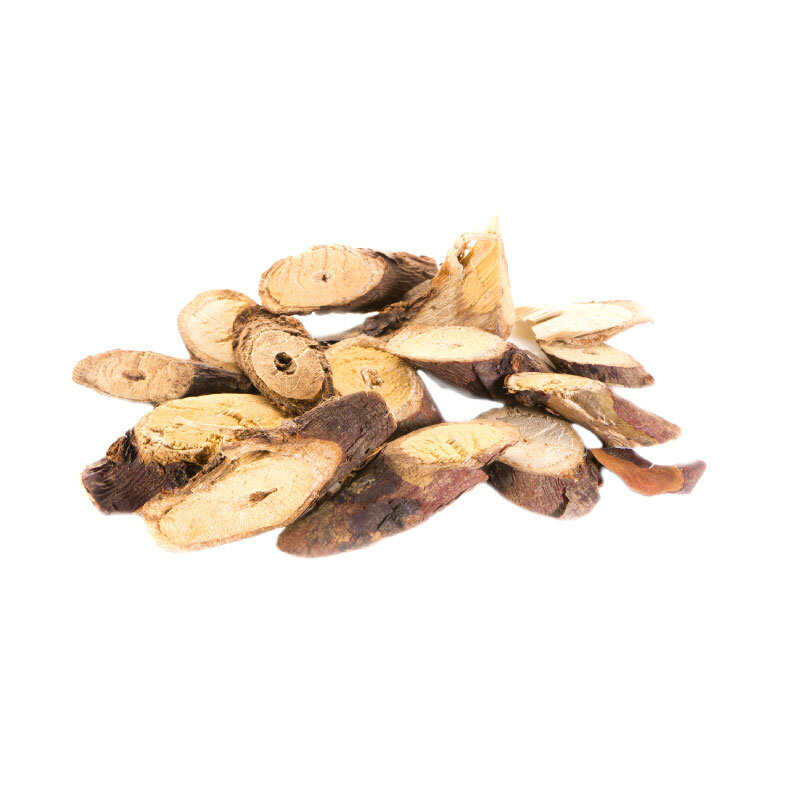
Concentration
Content by Source
Concentrations not reported. No percent-dry-weight or mg/g figures have been published for this compound in its source plants.
Cryptospirolepine at a Glance
Cryptospirolepine is the largest and most structurally complex alkaloid so far isolated from Cryptolepis sanguinolenta, the West African root used to make the traditional antimalarial decoction. It belongs to the same indoloquinoline family as the plant’s flagship molecule cryptolepine, but where cryptolepine is a simple flat tetracyclic system, cryptospirolepine is a dimeric, spiro-fused architecture built from two indoloquinoline-type units 1Reference 1Cryptospirolepine, a unique spiro-nonacyclic alkaloid isolated from Cryptolepis sanguinolentaView study →.
Its significance is structural, not pharmacological. It is a landmark of natural-product structure elucidation: the molecule was first characterised in 1993, its proposed structure was later found to be misassigned, and it became a famous test case for modern NMR methods when the structure was revised in 2015 1,
A Structural Landmark
Cryptospirolepine’s importance is that it is hard — one of the most demanding small-molecule structures organic chemists have tried to solve by nuclear magnetic resonance. It carries the empirical formula C₃₄H₂₄N₄O and was originally described as a spiro-nonacyclic system: nine fused rings arranged around a central spiro carbon that joins two indoloquinoline-derived halves 1Reference 1Cryptospirolepine, a unique spiro-nonacyclic alkaloid isolated from Cryptolepis sanguinolentaView study →. That makes it, in effect, a dimer of the smaller Cryptolepis alkaloids — twice the size and complexity of monomers such as cryptolepine or quindoline, and structurally in a different league from the plant’s other reported dimer, biscryptolepine.
The combination of a spiro junction, a highly condensed polycyclic framework, and only a handful of protons relative to its many quaternary carbons is exactly what makes such a molecule difficult to pin down: there are few C–H handles for conventional NMR correlations to exploit. That difficulty is the whole story of the molecule (see Discovery & Synthesis).
What It's Used For
There is no pharmacology to report. Unlike its siblings — cryptolepine (antiplasmodial, antibacterial, cytotoxic), neocryptolepine, isocryptolepine and others — cryptospirolepine has not been put through antimalarial, antimicrobial, anticancer, or any other bioassay in the literature reviewed. It was isolated and characterised as a structure-elucidation target, and the subsequent work on it has been entirely about getting its structure right, not about what it does 1,
Mechanisms
None characterised. No molecular target, pathway, or mode of action has been reported for cryptospirolepine.
Pharmacokinetics
No data. Absorption, distribution, metabolism, bioavailability and half-life are all unstudied — unsurprising for a trace constituent that has never been advanced as a drug candidate or supplement.
Clinical Trials
None. Cryptospirolepine has never been the subject of a clinical trial and there is no preclinical efficacy programme behind it.
| Completed | Planned | Terminated | Preclinical |
|---|---|---|---|
| — | — | — | — |
Last checked: July 2026.
Prevalence in Nature
Cryptospirolepine has been reported only from Cryptolepis sanguinolenta (family Apocynaceae), the same West African root — cryptolepis — that yields the better-known indoloquinoline alkaloids 1Reference 1Cryptospirolepine, a unique spiro-nonacyclic alkaloid isolated from Cryptolepis sanguinolentaView study →. It is a minor component of the alkaloid fraction: the roots are far richer in the monomeric alkaloids (cryptolepine dominates), and cryptospirolepine is one of the larger, rarer, dimeric constituents rather than a bulk one. Its concentration in the root has not been quantified in the literature reviewed here, so no “Content by Source” figure is given — that quantitation is an open gap. No occurrence outside C. sanguinolenta has been reported, and there is no verified figure for how much of the plant it represents.
Discovery & Synthesis
Cryptospirolepine’s real claim to fame is a cautionary tale about structure elucidation.
First isolation (1993). The alkaloid was isolated from Cryptolepis sanguinolenta and characterised by Tackie, Sharaf, Schiff, Martin and co-workers, who assigned it as a novel spiro-nonacyclic indoloquinoline of formula C₃₄H₂₄N₄O using the homonuclear and inverse-detected 2D NMR experiments available at the time 1Reference 1Cryptospirolepine, a unique spiro-nonacyclic alkaloid isolated from Cryptolepis sanguinolentaView study →. It was presented as the most structurally complex alkaloid then known from the genus.
The doubt (2000s). Roughly a decade later, characterisation of degradants that had formed in the original sealed NMR sample called the validity of the proposed structure into question — the archival material was no longer behaving as the assigned structure predicted 2Reference 2Homodecoupled 1,1- and 1,n-ADEQUATE: pivotal NMR experiments for the structure revision of cryptospirolepineView study →.
The revision (2015). With only about 700 µg of the alkaloid remaining, the structure was re-examined using newly developed homodecoupled 1,1- and 1,n-ADEQUATE (HD-ADEQUATE) NMR experiments — methods designed precisely to trace carbon–carbon connectivity through proton-poor, quaternary-carbon-rich frameworks like this one — and the connectivity was revised 2Reference 2Homodecoupled 1,1- and 1,n-ADEQUATE: pivotal NMR experiments for the structure revision of cryptospirolepineView study →. The case became a well-known demonstration of how far NMR methodology had advanced, and of how a complex natural-product structure can survive years in the literature before correction.
The retrospective (2025). A computational study later asked whether the original misassignment could have been avoided: DFT-based prediction of the ¹H and ¹³C chemical shifts distinguished the 1993 and 2015 structures, indicating that modern computer-assisted structure-elucidation methods would have flagged the error 3Reference 3Computational NMR study of Cryptolepis alkaloids: could the structural misassignment of cryptospirolepine have been avoided? International Journal of Molecular Sciences. https://pubmed.ncbi.nlm.nih.gov/40076736/View study →.
Total synthesis. No total synthesis of cryptospirolepine has been reported in the literature reviewed here — consistent with a rare, architecturally daunting molecule of purely academic (structural) interest. Manufacture is not relevant: it is not produced, sold, or used.
Patents: not yet researched.
Toxicity & Safety
Toxicity is not established. Cryptospirolepine has never been through a toxicology assay, and there is no human-exposure, genotoxicity, or reproductive-toxicity dataset for the isolated molecule. The traditional preparation that contains it — a C. sanguinolenta water decoction — carries its own herb-level safety profile, but nothing in that record is attributable to this trace constituent specifically. The conservative reading is simply that we do not know; absence of reported harm is not evidence of safety.
- No documented hazard. No toxicity, genotoxicity, or adverse-effect data have been reported for cryptospirolepine — it has no history of causing harm because it has essentially never been tested or consumed as an isolate.
- Toxicity genuinely not established. With zero bioassay or exposure data, no safety claim can be made in either direction; treat it as unknown, not as “safe.”
- Not a supplement or drug. Cryptospirolepine is a structural-chemistry target, not a product — there is no reason for deliberate human exposure to the isolated compound.
Dosage
There is no dosage. Cryptospirolepine is not used therapeutically, is not sold as a supplement, and has no studied dose. Whatever trace amount occurs in a traditional Cryptolepis decoction is incidental and unquantified. Nothing here is a recommendation for intake.
References
- Tackie AN, et al. (1993). Cryptospirolepine, a unique spiro-nonacyclic alkaloid isolated from Cryptolepis sanguinolenta. Journal of Natural Products. https://doi.org/10.1021/np50095a001
- Saurí J, et al. (2015). Homodecoupled 1,1- and 1,n-ADEQUATE: pivotal NMR experiments for the structure revision of cryptospirolepine. Angewandte Chemie International Edition. https://pubmed.ncbi.nlm.nih.gov/26178441/
- Semenov VA, Krivdin LB, Martin GE (2025). Computational NMR study of Cryptolepis alkaloids: could the structural misassignment of cryptospirolepine have been avoided? International Journal of Molecular Sciences. https://pubmed.ncbi.nlm.nih.gov/40076736/



