
Compound Monograph
Cyanidin-3-Sophoroside
Cyanidin-3-sophoroside is a cyanidin diglycoside — the aglycone cyanidin carrying a sophorose (2-O-β-glucosyl-glucose) sugar at the 3-position. It is the predominant red pigment of red raspberry and a characteristic anthocyanin of red-flowered ornamental hibiscus. As an isolate it has almost no human data: its health story is borrowed from whole anthocyanin-rich extracts and from its cyanidin core and phenolic-acid metabolites.

Sources · 6
Where Does It Come From?
Cyanidin-3-Sophoroside is a naturally occurring anthocyanin (cyanidin 3-o-diglycoside), found in Red raspberry, Ornamental hibiscus, Black raspberry and other Rubus species and 3 other sources. It is well tolerated orally (low toxicity).
Concentration
Content by Source
Reported concentrations across the plants that contain cyanidin-3-sophoroside — the bar marks the typical level, the line shows the reported range.
Literature figures for varying plant parts and preparations. Read them as a comparative guide, not exact assays.
Cyanidin-3-Sophoroside at a Glance
Cyanidin-3-sophoroside is an anthocyanin — a coloured plant pigment built from the aglycone cyanidin carrying a sophorose sugar (two glucose units joined 1→2) at the 3-position. That extra sugar is what distinguishes it from the far better-known monoglycoside cyanidin-3-glucoside.
Its clearest real-world role is as a pigment. It is the predominant anthocyanin of red raspberry fruit 2Reference 2Environmental and seasonal influences on red raspberry anthocyanin antioxidant contents and identification of quantitative trait loci (QTL)View study → and a characteristic red pigment of red- and pink-flowered ornamental hibiscus (Hibiscus rosa-sinensis), where it is present in coloured cultivars and absent from white and yellow ones 1Reference 1Color, antioxidant capacity and flavonoid composition in Hibiscus rosa-sinensis cultivarsView study →.
As a subject of health research it is data-thin. There is essentially no study of the isolated molecule in people. Almost everything that reads as a benefit here is really about whole anthocyanin-rich extracts, about its cyanidin core, or about the phenolic-acid metabolites (chiefly protocatechuic acid) that anthocyanins are broken down into. Like other anthocyanins it is also poorly bioavailable and pH-unstable, which caps how much of any test-tube activity can translate. This page keeps that honesty front and centre.
A Hibiscus & Raspberry Anthocyanin
Cyanidin-3-sophoroside sits inside a specific plant story, and the species detail matters.
Red raspberry (Rubus idaeus). This is the molecule’s headline source: across cultivars, seasons and environments, cyanidin-3-sophoroside is the single most abundant anthocyanin in red raspberry fruit, measured alongside cyanidin-3-glucoside, cyanidin-3-rutinoside and the glucosylrutinoside by HPLC 2Reference 2Environmental and seasonal influences on red raspberry anthocyanin antioxidant contents and identification of quantitative trait loci (QTL)View study →. It occurs across the Rubus genus more broadly — including black raspberry (Rubus occidentalis), though there it is a minor component behind cyanidin-3-rutinoside rather than the dominant pigment.
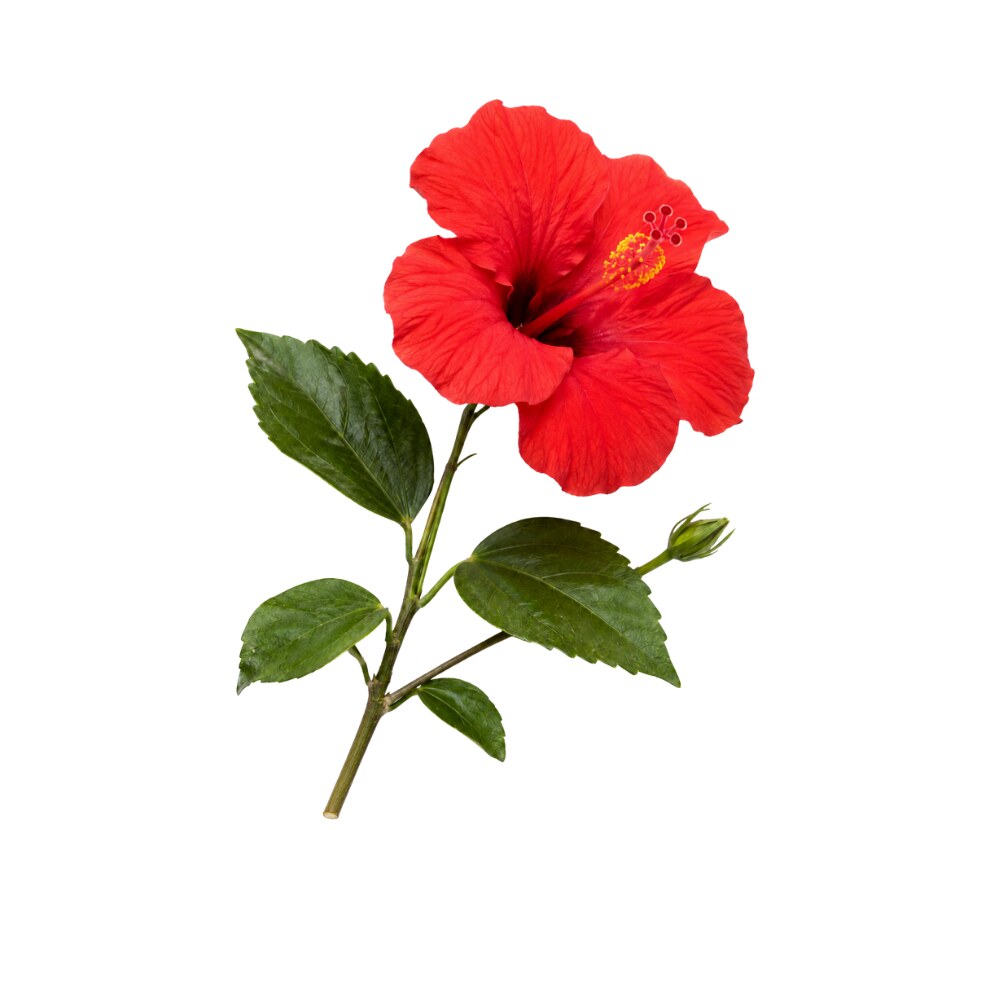
Ornamental hibiscus (Hibiscus rosa-sinensis). In this ornamental, cyanidin-sophoroside is a cultivar-dependent red pigment: it was detected in lilac, pink, orange and red flowers and not in white or yellow ones, and its content runs inversely to the flavonols (quercetin, kaempferol), so anthocyanin-rich and flavonol-rich cultivars trade off. That anthocyanin fraction drives the cultivar-dependent antioxidant capacity of the petals 1Reference 1Color, antioxidant capacity and flavonoid composition in Hibiscus rosa-sinensis cultivarsView study →.
The roselle caveat — read this before trusting any “hibiscus” health claim. The famous human hibiscus literature — the blood-pressure trials and meta-analyses — is for roselle, Hibiscus sabdariffa, a different species whose calyces are dominated by the sambubioside anthocyanins, chiefly delphinidin-3-sambubioside and cyanidin-3-sambubioside 3Reference 3Isolation and characterization of anthocyanins from Hibiscus sabdariffa flowersView study →. Cyanidin-3-sophoroside is not the pigment those trials were standardised to. So while it is fair to call this a “hibiscus anthocyanin,” it would be wrong to inherit roselle’s cardiovascular record for it. The honest position: most activity here is whole-extract or class-level, not this isolate.
Sophoroside vs. Other Cyanidin Glycosides
All cyanidin glycosides share the same coloured cyanidin core; they differ only in the sugar hung at the 3-position, and that sugar changes solubility, stability and how the molecule is handled in the gut.
| Cyanidin glycoside | 3-position sugar | Typical source |
|---|---|---|
| Cyanidin-3-glucoside (C3G) | single glucose | the most common dietary anthocyanin; black rice, berries |
| Cyanidin-3-sophoroside (C3S) | sophorose (glucose-1→2-glucose) | red raspberry; red ornamental hibiscus |
| Cyanidin-3-sambubioside | sambubiose (glucose-1→2-xylose) | roselle (Hibiscus sabdariffa), elderberry |
| Cyanidin-3-rutinoside | rutinose (glucose-1→6-rhamnose) | black raspberry, blackcurrant |
The practical upshot of the diglycoside structure is metabolic. Anthocyanins are largely deglycosylated and degraded in the gut before absorption, so the intact diglycoside barely reaches the circulation. Where it converges with its siblings is downstream: the shared cyanidin aglycone and its cleavage product protocatechuic acid are what actually circulate, which is why the cyanidin glycosides tend to be discussed together rather than as distinct drugs 7Reference 7Protocatechuic acid is the major human metabolite of cyanidin-glucosidesView study →. Antioxidant chemistry runs the other way — adding sugars reduces radical-scavenging activity, so a diglycoside like C3S is a weaker scavenger in the test tube than the aglycone or even the monoglycoside 4Reference 4Antioxidant activity of anthocyanins and their aglyconsView study →.
What It's Used For
The evidence base for cyanidin-3-sophoroside specifically is very thin. What exists splits into cell-free chemistry, whole-extract or class-level findings, and read-across from the cyanidin core — not isolated human trials.
Support is an experimental score — weighted by study type (human > animal > in vitro) and volume. A beta, not a validated metric. This molecule has essentially no isolated human data, so scores stay low by design; read each row’s basis.
As a cyanidin glycoside, C3S carries the catechol (ortho-dihydroxy) B-ring that makes anthocyanins hydrogen-atom and electron donors, and it is part of the anthocyanin fraction that drives the cultivar-dependent antioxidant capacity of red hibiscus petals 1Reference 1Color, antioxidant capacity and flavonoid composition in Hibiscus rosa-sinensis cultivarsView study → and red raspberry fruit 2Reference 2Environmental and seasonal influences on red raspberry anthocyanin antioxidant contents and identification of quantitative trait loci (QTL)View study →. But the structure–activity rule cuts against it: antioxidant activity falls as sugars are added, so this diglycoside is a weaker radical scavenger than cyanidin-3-glucoside and much weaker than the free aglycone 4Reference 4Antioxidant activity of anthocyanins and their aglyconsView study →.
Gap: these are cell-free / whole-extract in-vitro measures where C3S is one pigment among many; no antioxidant benefit has been demonstrated in humans for the isolated molecule, which is barely bioavailable (see Pharmacokinetics) 4,
The reason people associate “hibiscus” with blood pressure is a genuine human signal — but it belongs to whole roselle (Hibiscus sabdariffa) extract, not to this molecule. Meta-analyses of randomised trials report that roselle lowers systolic blood pressure by roughly 4–7 mmHg versus placebo 8,
Those extracts are standardised to roselle’s sambubioside anthocyanins 3Reference 3Isolation and characterization of anthocyanins from Hibiscus sabdariffa flowersView study →, and the effect is attributed to the whole polyphenol matrix, not to cyanidin-3-sophoroside.
Gap: wrong species and whole-extract — cyanidin-3-sophoroside is neither roselle’s characteristic pigment nor an isolated intervention in any of these trials; there is no blood-pressure data for the isolate 3,
Anthocyanins and anthocyanin-rich extracts (including Rubus/raspberry material, where C3S is a major pigment) show anti-carcinogenic activity in cell culture and animal tumour models, as summarised in an anthocyanin cancer-prevention review that itself flags poor translation to human epidemiology 9Reference 9Anthocyanins and their role in cancer preventionView study →.
Gap: mixtures and extracts, not the isolated molecule, with no confirmed human efficacy; the active species in vivo is more likely the aglycone and phenolic-acid metabolites than intact C3S 7,
Mechanisms
| Target / pathway | Effect | Relevant to |
|---|---|---|
| Catechol B-ring H-atom/electron donation | direct radical scavenging (attenuated by the 3-diglycoside) | antioxidant |
| Anthocyanin fraction of plant tissue | contributes to cultivar-dependent antioxidant capacity of petals/fruit | antioxidantplant biology |
| Deglycosylation → cyanidin → ring fission | generates protocatechuic acid and other phenolic acids that dominate systemic exposure | pharmacokineticsdownstream activity |
| Whole-extract polyphenol matrix (roselle) | class-level cardiometabolic effect — not shown for this isolate | cardiometabolic (attribute to extract) |
The load-bearing point: as an intact diglycoside, C3S is largely a colourant and a metabolic precursor. What acts systemically is its breakdown products, so mechanism claims should be attributed to cyanidin/protocatechuic acid or to whole extracts, not to the molecule itself.
Pharmacokinetics
Like anthocyanins generally, cyanidin-3-sophoroside is expected to be poorly bioavailable. Direct human PK for C3S is not established, but the class picture is well characterised: in the definitive ¹³C-labelled human tracer study of the sibling cyanidin-3-glucoside (500 mg oral), relative bioavailability was ~12% with only trace parent in serum, the label appearing mostly as downstream metabolites 5Reference 5Human metabolism and elimination of the anthocyanin cyanidin-3-glucoside: a ¹³C-tracer studyView study →, and human PK work confirms intact anthocyanins circulate at nanomolar levels while phenolic-acid metabolites dominate exposure 6Reference 6The pharmacokinetics of anthocyanins and their metabolites in humansView study →. Anthocyanins are also pH-unstable — the coloured flavylium cation that predominates at acidic pH converts to colourless carbinol and chalcone forms near neutral pH — so little intact pigment survives at physiological pH. The major human anthocyanin metabolite is protocatechuic acid, which in one study accounted for the majority of ingested cyanidin-glucosides, with serum protocatechuic acid vastly exceeding intact anthocyanin 7Reference 7Protocatechuic acid is the major human metabolite of cyanidin-glucosidesView study →. Much of any activity attributed to “cyanidin-3-sophoroside” in vivo is therefore likely to be that of its metabolites.
Clinical Trials
There are no trials of isolated cyanidin-3-sophoroside. Human data adjacent to it are either sibling/class anthocyanin PK studies 5,
| Completed | Planned | Terminated | Preclinical |
|---|---|---|---|
| —(isolate); whole-extract/class only | — | — | In-vitro / preclinical |
Last checked: July 2026.
Isolate vs. Plant Studies
This molecule is almost entirely a plant/extract story. There are no human trials — and essentially no isolated-molecule studies — of cyanidin-3-sophoroside itself. Where it appears in the literature, it is one pigment among many in a whole extract: the anthocyanin fraction of red raspberry fruit 2Reference 2Environmental and seasonal influences on red raspberry anthocyanin antioxidant contents and identification of quantitative trait loci (QTL)View study → or of coloured Hibiscus rosa-sinensis petals 1Reference 1Color, antioxidant capacity and flavonoid composition in Hibiscus rosa-sinensis cultivarsView study →, measured for identification and antioxidant capacity, not tested as a purified intervention. The human cardiovascular evidence often reached for is roselle extract, a different species carrying different (sambubioside) anthocyanins 3,
Prevalence in Nature
Cyanidin-3-sophoroside occurs as a red/purple anthocyanin pigment across several plant families. Its best-quantified source is red raspberry (Rubus idaeus), where it is the predominant anthocyanin of the fruit across cultivars and growing conditions, sitting alongside cyanidin-3-glucoside, cyanidin-3-rutinoside and cyanidin-3-glucosylrutinoside 2Reference 2Environmental and seasonal influences on red raspberry anthocyanin antioxidant contents and identification of quantitative trait loci (QTL)View study →. It occurs more widely in the Rubus genus (blackberries, black raspberry), typically as a minor component where rutinosides dominate.
In ornamental hibiscus (Hibiscus rosa-sinensis) it is a cultivar-dependent petal pigment — detected in lilac, pink, orange and red flowers but absent from white and yellow cultivars, and inversely related to flavonol content 1Reference 1Color, antioxidant capacity and flavonoid composition in Hibiscus rosa-sinensis cultivarsView study →. Its abundance is not comprehensively quantified across sources; the cleanest figure is for red raspberry fruit, whose anthocyanin content (largely cyanidin-3-sophoroside) runs on the order of hundreds of µg/g fresh weight 2Reference 2Environmental and seasonal influences on red raspberry anthocyanin antioxidant contents and identification of quantitative trait loci (QTL)View study →.
A prevalence caution worth repeating: roselle (H. sabdariffa), the medicinally famous hibiscus, is not a notable source of this molecule — its calyces are dominated by delphinidin-3-sambubioside and cyanidin-3-sambubioside instead 3Reference 3Isolation and characterization of anthocyanins from Hibiscus sabdariffa flowersView study →.
Discovery & Synthesis
Cyanidin-3-sophoroside was characterised as a raspberry/Rubus pigment through the twentieth-century development of anthocyanin chemistry, in which the various cyanidin glycosides were separated and their sugars assigned; an exact first-isolation date and discoverer are not well documented in the accessible literature. Its name is purely structural — cyanidin (the aglycone) esterified at the 3-position with sophorose, a β-1,2-linked diglucose.
There is no meaningful synthetic-manufacture story: cyanidin-3-sophoroside is not produced industrially as an isolate or sold as a supplement. It is encountered as a natural constituent of raspberries, coloured hibiscus flowers and other anthocyanin-rich plant tissue, and — where a purified standard is needed — obtained by extraction and chromatographic isolation from those sources rather than by total synthesis.
Patents: not yet researched.
Toxicity & Safety
Cyanidin-3-sophoroside carries a low flag. It is an ordinary dietary anthocyanin, eaten routinely in red raspberries and other coloured fruits, and anthocyanins as a class are regarded as safe at normal food-level intakes with no significant toxicity. Its poor bioavailability further limits any systemic-toxicity concern — very little intact molecule reaches the circulation.
There are no established drug interactions for the isolated molecule and no isolate-specific toxicology package; any theoretical additive antioxidant or mild vascular effects from anthocyanin-rich intake are unconfirmed and are properly considered at the level of the food or whole extract, not this pigment. Reproductive and developmental data for the isolate do not exist; note separately that whole roselle (H. sabdariffa) extract carries its own blood-pressure-lowering and pregnancy-caution literature at the whole-extract level — a consideration for roselle products, not a property demonstrated for cyanidin-3-sophoroside. Such intake decisions belong on the relevant herb or product page, not on this molecule page.
- An ordinary dietary anthocyanin. Eaten routinely in red raspberries and coloured fruits; anthocyanins are regarded as safe at food-level intakes.
- Low systemic exposure. Poor bioavailability and pH-instability mean little intact molecule reaches the bloodstream.
- Don’t inherit roselle’s profile. The blood-pressure effects and pregnancy cautions attached to Hibiscus sabdariffa extract are for that whole extract and its sambubioside pigments — not for this isolate.
- No isolate toxicology. No dedicated safety, interaction or reproductive dataset exists for the purified molecule; absence of data is not evidence of safety at supra-dietary doses.
Dosage
There is no established or recommended dose for isolated cyanidin-3-sophoroside — it is not sold or studied as a stand-alone supplement, and it is chemically unstable outside acidic plant tissue. Human exposure is dietary and indirect, as one pigment among many in red raspberries and other anthocyanin-rich foods; typical Western total anthocyanin intake is on the order of ~200 mg/day across all anthocyanins 9Reference 9Anthocyanins and their role in cancer preventionView study →.
The dosing figures often attached to “hibiscus” belong to whole roselle (H. sabdariffa) extract or tea, standardised to its sambubioside anthocyanins in the blood-pressure trials 8,
References
- Mejía JJ, et al. (2023). Color, antioxidant capacity and flavonoid composition in Hibiscus rosa-sinensis cultivars. Molecules. https://pubmed.ncbi.nlm.nih.gov/36838766/
- Kassim A, et al. (2009). Environmental and seasonal influences on red raspberry anthocyanin antioxidant contents and identification of quantitative trait loci (QTL). Molecular Nutrition & Food Research. https://pubmed.ncbi.nlm.nih.gov/19156716/
- Grajeda-Iglesias C, et al. (2016). Isolation and characterization of anthocyanins from Hibiscus sabdariffa flowers. Journal of Natural Products. https://pubmed.ncbi.nlm.nih.gov/27312226/
- Kähkönen MP, Heinonen M (2003). Antioxidant activity of anthocyanins and their aglycons. Journal of Agricultural and Food Chemistry. https://pubmed.ncbi.nlm.nih.gov/12537433/
- Czank C, et al. (2013). Human metabolism and elimination of the anthocyanin cyanidin-3-glucoside: a ¹³C-tracer study. The American Journal of Clinical Nutrition. https://pubmed.ncbi.nlm.nih.gov/23604435/
- de Ferrars RM, et al. (2014). The pharmacokinetics of anthocyanins and their metabolites in humans. British Journal of Pharmacology. https://pubmed.ncbi.nlm.nih.gov/24602005/
- Vitaglione P, et al. (2007). Protocatechuic acid is the major human metabolite of cyanidin-glucosides. The Journal of Nutrition. https://pubmed.ncbi.nlm.nih.gov/17709440/
- Ellis LR, et al. (2022). A systematic review and meta-analysis of the effects of Hibiscus sabdariffa on blood pressure and cardiometabolic markers. Nutrition Reviews. https://pubmed.ncbi.nlm.nih.gov/34927694/
- Wang LS, Stoner GD (2008). Anthocyanins and their role in cancer prevention. Cancer Letters. https://pubmed.ncbi.nlm.nih.gov/18571839/
- Najafpour Boushehri S, et al. (2020). The efficacy of sour tea (Hibiscus sabdariffa L.) on selected cardiovascular disease risk factors: a systematic review and meta-analysis of randomized clinical trials. Phytotherapy Research. https://pubmed.ncbi.nlm.nih.gov/31943427/



