
Compound Monograph
Dehydrosoyasaponin I
Dehydrosoyasaponin I (DHS-I) is the triterpene saponin from Desmodium adscendens that gave pharmacology its first high-affinity opener of the BK (maxi-K) potassium channel — Ki 120 nM, active at 10 nM, and dependent on the smooth-muscle beta-1 subunit. It is a landmark tool compound and a near-certain non-drug: it works only from the inside of the cell, and its saponin class is barely absorbed.

Sources · 3
Where Does It Come From?
Dehydrosoyasaponin I is a naturally occurring triterpenoid saponin (oleanane; soyasapogenol e aglycone — the 22-oxo analogue of soyasaponin i), found in Tick trefoil and 2 other sources. Its toxicity is not yet characterized.
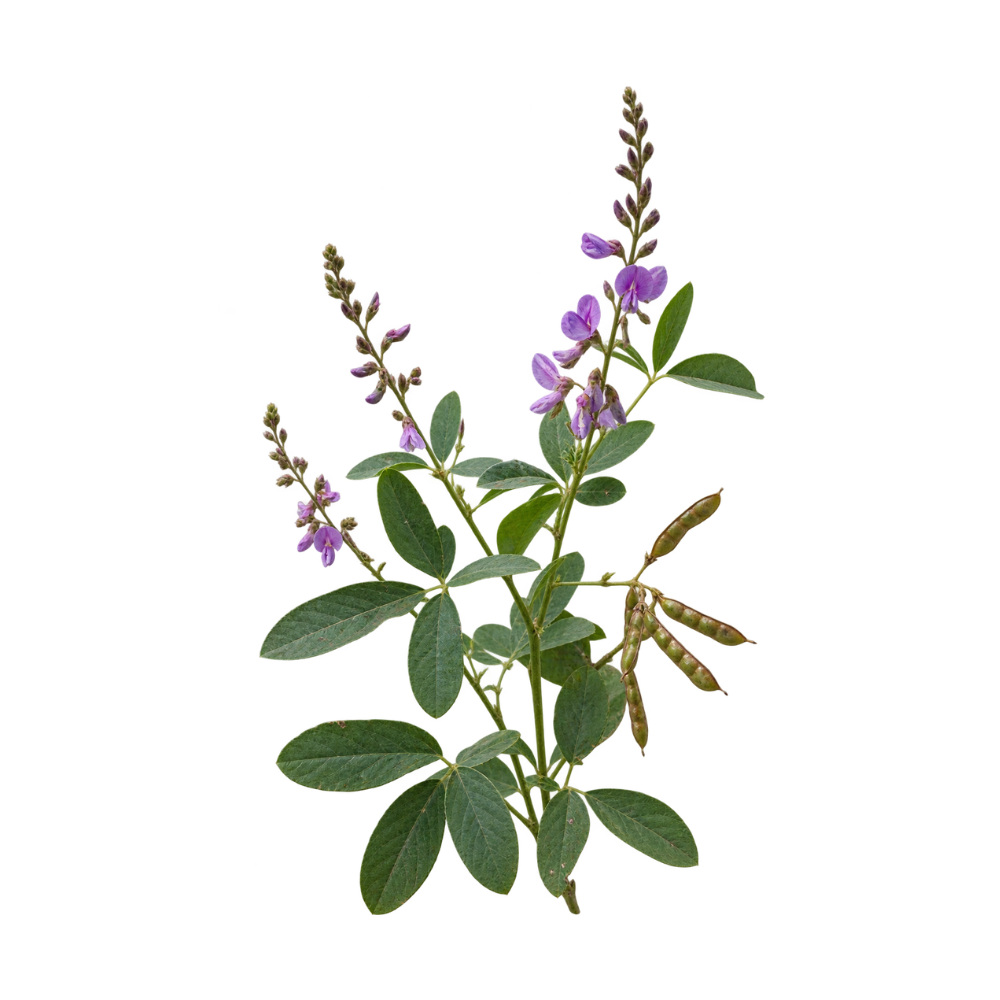
Concentration
Content by Source
Concentrations not reported. No percent-dry-weight or mg/g figures have been published for this compound in its source plants.
Dehydrosoyasaponin I at a Glance
Dehydrosoyasaponin I (DHS-I) is a triterpene saponin from Desmodium adscendens, the West African herb used traditionally for asthma.
It has a genuine place in pharmacology history: it was the first high-affinity opener of the BK (maxi-K) potassium channel ever found — Ki 120 nM, active at 10 nM, and dependent on the smooth-muscle beta-1 subunit. Before DHS-I there was no potent pharmacological tool for opening that channel.
Opening BK channels hyperpolarises smooth muscle and relaxes it, which is a coherent mechanism for the plant’s traditional airway use — and the compound remains primarily a research tool rather than a therapeutic candidate.
What It's Used For
Dehydrosoyasaponin I is one of the most interesting molecules here and almost certainly not a medicine. In 1993 a Merck group screening a Ghanaian anti-asthma herb — Desmodium adscendens, taken as a decoction for asthma — isolated three triterpene saponins and found that one of them, DHS-I, was the first high-affinity activator of calcium-dependent potassium channels ever described 1Reference 1In vitroAn activator of calcium-dependent potassium channels isolated from a medicinal herb — in vitroView study →.
That is a genuinely rare event in herbal pharmacology: a traditional respiratory remedy resolving to a named molecule acting on a named ion channel, in the tissue the tradition points at. The literature that followed characterised the mechanism in unusual depth 2,
Everything below is in vitro. Read it as a mechanism story and a tool-compound story, not as a reason to drink the tea.
Support is an experimental score I’m building — a composite weighted by study type (human > animal > in vitro > review) and study volume, tempered for isolate-vs-plant match and bioavailability. It’s a beta: a fast way to rank strength of evidence at a glance, not a validated metric. Each application name links down to its write-up.
Screening bovine tracheal smooth muscle membranes for compounds that displace charybdotoxin, McManus and colleagues isolated three triterpenoid glycosides from D. adscendens: DHS-I, soyasaponin I and soyasaponin III. DHS-I was much the most potent, with Ki = 120 nM and a maximum of 62% inhibition of toxin binding, and in planar lipid bilayers it increased channel open probability at concentrations as low as 10 nM applied to the intracellular side 1Reference 1In vitroAn activator of calcium-dependent potassium channels isolated from a medicinal herb — in vitroView study →. The paper described it as the first example of a high-affinity activator of calcium-dependent potassium channels — the point being that toxin blockers of these channels were well known and openers were not.
The 1998 follow-up in bovine aortic smooth muscle worked out how 2Reference 2In vitroMechanism of maxi-K channel activation by dehydrosoyasaponin-I — in vitroView study →.
Hill analysis (slopes 2.4–2.9) indicates three to four DHS-I molecules bind to maximally activate one channel, fitting a model of four identical non-interacting sites where DHS-I binds the open conformation with 10–20-fold higher affinity than the closed one — a textbook conformational-selection mechanism. Functionally, 100 nM DHS-I produced a threefold drop in the calcium concentration needed for half-maximal opening and shifted voltage-dependent activation up to −105 mV hyperpolarically, affecting voltage gating more than calcium gating. In single-channel records this appears as discrete episodes of very high open probability interrupting otherwise normal behaviour — literally watching the molecule bind and unbind.
Then the twist that matters most therapeutically: the β1 subunit is required. In Xenopus oocytes, channels expressing both α and β subunits responded to DHS-I while α-alone channels were insensitive 3Reference 3In vitroFunctional role of the beta subunit of high conductance calcium-activated potassium channels — in vitroView study →. β1 is the smooth-muscle-associated subunit, so a β1-dependent opener would be intrinsically tissue-selective — exactly the selectivity a bronchodilator or antihypertensive would want. A later review notes this dependence is established in smooth-muscle membranes but that whether other subunits confer it as well remains unclear 4Reference 4ReviewPharmacological consequences of the coexpression of BK channel α and auxiliary β subunits — reviewView study →.
Gap: all of it is in vitro, at excised patches or reconstituted bilayers, with the compound applied directly to the cytoplasmic face. No cell-based, tissue, animal or human study of DHS-I exists.
Fractionating yellow field pea (Pisum sativum) extracts against the rice weevil (Sitophilus oryzae) in a flour-disk antifeedant bioassay, DHS-I emerged as the active component — while soyasaponin I and mixtures of the ordinary soyasaponins were inactive 8Reference 8In vitroInsecticidal components from field pea extracts — soyasaponins and lysolecithins — in vitro bioassayView study →. Lysolecithin phospholipids from the same extract had no activity alone but enhanced DHS-I’s insecticidal effect.
That negative control is the useful part. The structural difference between DHS-I and soyasaponin I is a single C-22 ketone, and the same oxidation that distinguishes it in a potassium-channel assay distinguishes it in an insect-feeding assay. Whether the two activities share a mechanism is unknown, but it does say the 22-oxo group is doing real work rather than being an incidental variation.
Gap: a single study on one pest species, with no mechanism proposed. It supports a chemical-ecology reading of why legumes make this molecule at all, and nothing about human pharmacology.
This is the application the molecule is famous for and the one it has the least direct evidence for. Aqueous and ethanolic extracts of D. adscendens, given orally to guinea pigs, reduced anaphylactic contractions, interfered with histamine-induced contraction and lowered the release of smooth-muscle-stimulating substances from lung tissue 5Reference 5AnimalEffects of the extracts of Desmodium adscendens on anaphylaxis — animal model (guinea pig)View study → — a coherent anti-asthmatic profile that supports the Ghanaian tradition. But that paper predates the 1993 isolation by nearly a decade and names no active constituent; the anti-anaphylactic activity is an extract property, not a DHS-I property.
BK-channel opening is a legitimate route to airway smooth-muscle relaxation — hyperpolarising the cell closes voltage-gated calcium channels and the muscle relaxes — so the mechanistic story is coherent. It is also, so far, a hypothesis: no study has shown DHS-I relaxing an airway, in any preparation, at any dose.
Gap: nobody has closed the loop. An isolated-DHS-I tracheal-ring or whole-animal airway study is the single missing experiment, and it does not appear to have been done in thirty years.
Mechanisms
| Target / pathway | Effect | Relevant to |
|---|---|---|
| BK (maxi-K, KCa1.1) channel, intracellular face | ↑ open probability; Ki 120 nM; effects from 10 nM | channel activationairway hypothesis |
| Binding stoichiometry — 3–4 molecules, 4 non-interacting sites | open-state selective (10–20× higher affinity) | channel activation |
| Voltage gating | up to −105 mV hyperpolarising shift | channel activation |
| Calcium gating | ~3-fold ↓ in Ca²⁺ needed for half-maximal opening | channel activation |
| β1 auxiliary subunit | required — α-alone channels are insensitive | tissue selectivity (smooth muscle) |
| Membrane hyperpolarisation → voltage-gated Ca²⁺ channels close | smooth-muscle relaxation (inferred, not demonstrated) | airway hypothesis |
Pharmacokinetics
No pharmacokinetic study of DHS-I exists, and the reason to state that up front is that two independent facts make oral activity close to impossible — which is the most decision-relevant thing here.
First, the site of action is inside the cell. DHS-I activates the channel from the intracellular side of the membrane 1,
Second, its class is barely absorbed. In the only human study located, eight women ingested 434 µmol of group B soyasaponins; neither the saponins nor their metabolites appeared in 24-hour urine, and 36.3 ± 10.2 µmol of the aglycone soyasapogenol B was recovered from a 5-day faecal collection 7Reference 7Clinical trialSoyasaponin I and sapogenol B have limited absorption by Caco-2 intestinal cells and limited bioavailability in women — human study and in vitroView study →. In the matched Caco-2 work, mucosal transfer of soyasaponin I was 0.5–2.9% 7Reference 7Clinical trialSoyasaponin I and sapogenol B have limited absorption by Caco-2 intestinal cells and limited bioavailability in women — human study and in vitroView study →. Soyasaponins are poorly absorbed in the small intestine and are instead deglycosylated by colonic bacteria to their aglycones. DHS-I itself was not measured in that study — it is a 22-oxo (soyasapogenol E) saponin rather than a group B one — so this is an inference across a closely related family, and it is stated as such. But it points hard in one direction: the molecule would have to survive the gut, be absorbed against a 1–3% ceiling, escape microbial deglycosylation, distribute to airway smooth muscle, and then cross into the cytoplasm.
That chain is why DHS-I’s thirty-year career has been as a research tool — the reagent you use to open a BK channel in a bilayer — rather than as a drug candidate or a rationale for a herbal product.
Clinical trials
No registered clinical trials of dehydrosoyasaponin I were identified, and no human study of the isolated compound exists. The evidence base is in-vitro electrophysiology and binding work.
| Completed | Planned | Terminated | Preclinical |
|---|---|---|---|
| 0 | 0 | 0 | ~10 |
Last checked: August 2026.
Isolate vs. Plant Studies
The split here is unusually clean and unusually awkward. Every result about DHS-I used the purified molecule at an isolated membrane — no extract, no cell, no animal 1,
So the familiar claim — “Desmodium works for asthma because it contains a BK-channel opener” — is an inference stacked on two unbridged bodies of work. Both halves are real. The bridge is not there, and the pharmacokinetics 7Reference 7Clinical trialSoyasaponin I and sapogenol B have limited absorption by Caco-2 intestinal cells and limited bioavailability in women — human study and in vitroView study → suggest it may not be buildable by the oral route.
One further discipline applies to this whole page: Desmodium is a genus, not a plant. The BK-channel work belongs specifically to D. adscendens, the West African anti-asthma species. It does not read across to D. gangeticum, the Ayurvedic Salaparni marked by gangetin, whose cardioprotective and antiulcer literature is entirely separate 9Reference 9ReviewAn ethnomedicinal, phytochemical and pharmacological profile of Desmodium gangeticum (L.) DC. and Desmodium adscendens (Sw.) DC — reviewView study →.
Prevalence in Nature
Dehydrosoyasaponin I is an oleanane-type triterpenoid saponin — a pentacyclic triterpene aglycone carrying a sugar chain at C-3. Structurally it is the 22-oxo analogue of soyasaponin I: same trisaccharide, but the C-22 hydroxyl of soyasapogenol B is oxidised to a ketone, giving the soyasapogenol E aglycone. That single carbonyl is what separates a pharmacologically remarkable molecule from an ordinary legume saponin, in both the channel work 1Reference 1In vitroAn activator of calcium-dependent potassium channels isolated from a medicinal herb — in vitroView study → and the insect work 8Reference 8In vitroInsecticidal components from field pea extracts — soyasaponins and lysolecithins — in vitro bioassayView study →.
Its occurrence is a legume (Fabaceae) story. It was isolated from tick trefoil (Desmodium adscendens) 1Reference 1In vitroAn activator of calcium-dependent potassium channels isolated from a medicinal herb — in vitroView study → and is reported as a minor component of field pea (Pisum sativum) and soybean (Glycine max), while being absent from chickpea 8Reference 8In vitroInsecticidal components from field pea extracts — soyasaponins and lysolecithins — in vitro bioassayView study →. Soyasaponins generally are widespread across the family — soybean, pea, lupin, liquorice relatives — and function as constitutive chemical defences; the antifeedant result 8Reference 8In vitroInsecticidal components from field pea extracts — soyasaponins and lysolecithins — in vitro bioassayView study → fits that role. Biosynthetically these come from the mevalonate/oleanane route via β-amyrin, followed by oxidation and glycosylation, with the C-22 oxidation state distinguishing the soyasapogenol B and E series.
Abundance is not quantified. No mg/g or %-dry-weight figure for DHS-I was located in Desmodium, pea or soy. Every source that mentions its level calls it minor, and a patent exists specifically for producing plant compositions enriched in DHS-I — which is itself evidence that the natural concentration is inconveniently low.
Discovery & Synthesis
First isolation, 1993, and the circumstances are worth the detail. A team spanning Merck Research Laboratories and academic collaborators — including M. E. Addy, the Ghanaian researcher whose earlier work had documented the plant’s anti-anaphylactic activity 5Reference 5AnimalEffects of the extracts of Desmodium adscendens on anaphylaxis — animal model (guinea pig)View study → — went after D. adscendens precisely because it was “a medicinal herb used in Ghana as a treatment for asthma” 1Reference 1In vitroAn activator of calcium-dependent potassium channels isolated from a medicinal herb — in vitroView study →. They screened for displacement of charybdotoxin from bovine tracheal smooth-muscle membranes, isolated three triterpene glycosides, and found DHS-I to be the first high-affinity opener of calcium-dependent potassium channels reported. The name is descriptive: the dehydro prefix marks it as the oxidised form of soyasaponin I.
No total synthesis of note was located, which is unsurprising — a glycosylated pentacyclic triterpene is a hard target and the demand is a few milligrams of research reagent, not tonnes. It is supplied commercially as an assay reagent, and the practical production route is extraction; a patent covers methods for producing plant compositions enriched in DHS-I, reflecting how little of it the plants make.
Patents: not yet researched (future patent-loop pass).
Toxicity & Safety
No toxicity study of isolated dehydrosoyasaponin I was located — no acute, repeat-dose, genotoxicity or reproductive data. Nothing here should be read as reassurance; it means nobody has looked, which for a molecule with essentially no oral exposure is unsurprising rather than alarming.
Two things can be said honestly. At the whole-extract level there is a real interaction signal: subchronic aqueous D. adscendens leaf extract induced hepatic CYP enzymes in rats 6Reference 6AnimalAcute and subchronic toxicity studies of aqueous extract of Desmodium adscendens (Sw) DC — animal model (rat)View study → — the most actionable safety finding for the source herb, though not attributed to this molecule. And saponins as a class are locally irritant and haemolytic in vitro at high concentration, which is a class-level caveat rather than a finding about DHS-I; in practice it is moot for a compound with 0.5–2.9% intestinal transfer 7Reference 7Clinical trialSoyasaponin I and sapogenol B have limited absorption by Caco-2 intestinal cells and limited bioavailability in women — human study and in vitroView study →.
Dosage
No human dose exists, and none is plausible by mouth. DHS-I has never been administered to a person or to a whole animal. Every figure below is a bath concentration at an isolated membrane or a bioassay endpoint.
| Context | Preparation | Concentration | Source |
|---|---|---|---|
| Charybdotoxin-binding displacement | Bovine tracheal smooth-muscle membranes | Ki 120 nM; 62% maximum inhibition | 1Reference 1In vitroAn activator of calcium-dependent potassium channels isolated from a medicinal herb — in vitroView study → |
| Single-channel activation | Planar lipid bilayer, intracellular side | Effects from 10 nM | 1Reference 1In vitroAn activator of calcium-dependent potassium channels isolated from a medicinal herb — in vitroView study → |
| Calcium sensitivity shift | Bovine aortic smooth muscle, bilayer | 100 nM → ~3-fold ↓ in Ca²⁺ for half-maximal opening | 2Reference 2In vitroMechanism of maxi-K channel activation by dehydrosoyasaponin-I — in vitroView study → |
| Voltage-gating shift | Bovine aortic smooth muscle, bilayer | up to −105 mV | 2Reference 2In vitroMechanism of maxi-K channel activation by dehydrosoyasaponin-I — in vitroView study → |
| Insect antifeedant | Rice weevil flour-disk bioassay | active fraction; potentiated by lysolecithins | 8Reference 8In vitroInsecticidal components from field pea extracts — soyasaponins and lysolecithins — in vitro bioassayView study → |
These are concentrations used in research and are not a personal recommendation. For the herb itself, dosing is discussed on the tick trefoil page.
Scope Disclosure
- Interactions assessed? Not for this molecule. The documented signal — hepatic CYP induction — belongs to the whole aqueous extract of D. adscendens in rats 6Reference 6AnimalAcute and subchronic toxicity studies of aqueous extract of Desmodium adscendens (Sw) DC — animal model (rat)View study →, not to DHS-I.
- Pregnancy/lactation assessed? No. No reproductive or developmental data for isolated DHS-I were located. Guidance for the source herb lives on the tick trefoil page, where intake is actually decided.
References
- McManus, O. B., Harris, G. H., Giangiacomo, K. M., Feigenbaum, P., Reuben, J. P., Addy, M. E., Burka, J. F., Kaczorowski, G. J., & Garcia, M. L. (1993). An activator of calcium-dependent potassium channels isolated from a medicinal herb — in vitro. Biochemistry. https://pubmed.ncbi.nlm.nih.gov/7685635/
- Giangiacomo, K. M., Kamassah, A., Harris, G., & McManus, O. B. (1998). Mechanism of maxi-K channel activation by dehydrosoyasaponin-I — in vitro. Journal of General Physiology. https://pubmed.ncbi.nlm.nih.gov/9758866/
- McManus, O. B., Helms, L. M., Pallanck, L., Ganetzky, B., Swanson, R., & Leonard, R. J. (1995). Functional role of the beta subunit of high conductance calcium-activated potassium channels — in vitro. Neuron. https://pubmed.ncbi.nlm.nih.gov/7695911/
- Torres, Y. P., Granados, S. T., & Latorre, R. (2014). Pharmacological consequences of the coexpression of BK channel α and auxiliary β subunits — review. Frontiers in Physiology. https://doi.org/10.3389/fphys.2014.00383
- Addy, M. E., & Awumey, E. M. (1984). Effects of the extracts of Desmodium adscendens on anaphylaxis — animal model (guinea pig). Journal of Ethnopharmacology. https://pubmed.ncbi.nlm.nih.gov/6482479/
- Quaye, O., et al. (2017). Acute and subchronic toxicity studies of aqueous extract of Desmodium adscendens (Sw) DC — animal model (rat). Journal of Evidence-Based Complementary & Alternative Medicine. https://pubmed.ncbi.nlm.nih.gov/29228815/
- Hu, J., Reddy, M. B., Hendrich, S., & Murphy, P. A. (2004). Soyasaponin I and sapogenol B have limited absorption by Caco-2 intestinal cells and limited bioavailability in women — human study and in vitro. Journal of Nutrition. https://pubmed.ncbi.nlm.nih.gov/15284368/
- Taylor, W. G., Fields, P. G., & Sutherland, D. H. (2004). Insecticidal components from field pea extracts — soyasaponins and lysolecithins — in vitro bioassay. Journal of Agricultural and Food Chemistry. https://pubmed.ncbi.nlm.nih.gov/15675793/
- Rastogi, S., Pandey, M. M., & Rawat, A. K. (2011). An ethnomedicinal, phytochemical and pharmacological profile of Desmodium gangeticum (L.) DC. and Desmodium adscendens (Sw.) DC — review. Journal of Ethnopharmacology. https://pubmed.ncbi.nlm.nih.gov/21530632/



