
Compound Monograph
Senkirkine
Senkirkine is the otonecine-type pyrrolizidine alkaloid of coltsfoot, and the compound to which coltsfoot's rat liver-cancer result was attributed. It is chemically the odd one out of its class — N-methylated rather than N-oxidisable, and slower to kill cells than its retronecine-type relatives — but it forms the same DNA adducts and is mutagenic on the same activation pathway.

Sources · 4
Where Does It Come From?
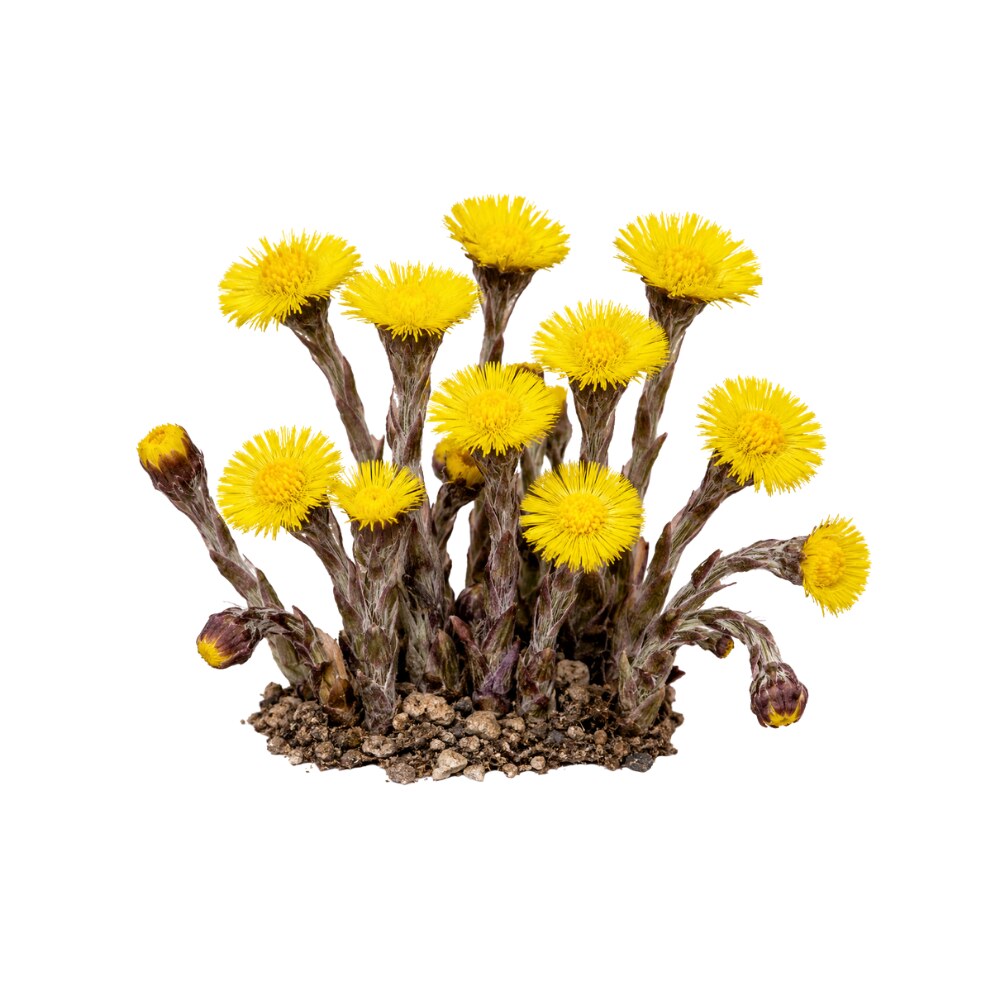
Senkirkine is a naturally occurring otonecine-type dehydropyrrolizidine alkaloid (macrocyclic diester), found in Coltsfoot, Butterbur and 2 other sources. It is flagged as toxic and a known carcinogen.
Concentration
Content by Source
Concentrations not reported. No percent-dry-weight or mg/g figures have been published for this compound in its source plants.
Senkirkine at a Glance
Senkirkine is the pyrrolizidine alkaloid that gave coltsfoot its reputation as a liver carcinogen. When pre-blooming coltsfoot flowers were fed to rats for 600 days, 8 of 12 animals in the highest-dose group developed haemangioendothelial sarcoma of the liver, and the chemical analysis of the material pointed at senkirkine as the responsible compound 1Reference 1AnimalCarcinogenic activity of coltsfoot, Tussilago farfara L. — rat in vivoView study →.
Chemically it is the odd one out of its class. Most toxic pyrrolizidines — senecionine, lycopsamine, intermedine — are retronecine-type, with a bridgehead nitrogen that plants routinely store as an N-oxide. Senkirkine is otonecine-type: the ring is opened and the nitrogen carries a methyl group, so it does not travel with an N-oxide partner the way the others do, and analytical panels for butterbur quantify senecionine and seneciphylline with their N-oxides but senkirkine alone 4Reference 4Simultaneous investigation of sesquiterpenes, pyrrolizidine alkaloids and N-oxides in Butterbur (Petasites hybridus) with an offline 2D-combination of HPLC-UV and LC-MMI-ToF-MS — analyticalView study →.
That structural difference shows up in cells as a difference in speed rather than in kind. In human liver cells, retronecine-type alkaloids were cytotoxic and pro-apoptotic after a single 24-hour exposure while senkirkine was not — but after 14 days of repeated dosing all of them were, senkirkine included 3Reference 3In vitroStructure-dependent induction of apoptosis by hepatotoxic pyrrolizidine alkaloids in the human hepatoma cell line HepaRG: Single versus repeated exposure — in vitroView study →. And in rats, senkirkine produces exactly the same four DNA adducts as the other tumorigenic pyrrolizidines 7Reference 7AnimalPyrrolizidine alkaloid-derived DNA adducts as a common biological biomarker of pyrrolizidine alkaloid-induced tumorigenicity — rat in vivoView study →. It reaches the same place by a slower road.
The hepatic mechanism it shares with the rest of the class — bioactivation to a reactive pyrrole, destruction of the liver’s sinusoidal endothelial cells, veno-occlusive disease — is set out in full on the senecionine page rather than repeated here.
An Otonecine-Type Alkaloid
Pyrrolizidine alkaloids divide by their necine base, the bicyclic core they are built on, and the division is not cosmetic.
Retronecine-type alkaloids have an intact bicyclic amine with a bridgehead nitrogen. That nitrogen is readily oxidised, so plants store large fractions of these alkaloids as N-oxides — which are not themselves reactive but are reduced back to the parent alkaloid by gut bacteria, making them a delayed rather than a defused form.
Otonecine-type alkaloids like senkirkine have a ring-opened, N-methylated eight-membered necine base with a ketone. The nitrogen is a tertiary amine bearing a methyl group and does not give the same N-oxide chemistry, which is why butterbur analytical methods list senecionine N-oxide and seneciphylline N-oxide but no senkirkine N-oxide 4Reference 4Simultaneous investigation of sesquiterpenes, pyrrolizidine alkaloids and N-oxides in Butterbur (Petasites hybridus) with an offline 2D-combination of HPLC-UV and LC-MMI-ToF-MS — analyticalView study →. To become the reactive pyrrole, an otonecine-type alkaloid must first undergo oxidative N-demethylation — an extra metabolic step the retronecine-type alkaloids do not need.
That extra step is the most plausible explanation for the timing difference in cells. Tested in human HepaRG hepatoma cells, retronecine-type alkaloids (echimidine, senecionine) and the heliotridine-type heliotrine behaved differently from senkirkine: after 24 hours only the retronecine-type alkaloids were cytotoxic, disrupting mitochondrial membrane potential and cleaving caspases, whereas after 14 days of repeated exposure all four alkaloids produced those effects, and the authors concluded retronecine-type alkaloids are the more potent apoptosis inducers 3Reference 3In vitroStructure-dependent induction of apoptosis by hepatotoxic pyrrolizidine alkaloids in the human hepatoma cell line HepaRG: Single versus repeated exposure — in vitroView study →. Senkirkine is slower, not safe — and repeated low-level exposure is exactly the pattern that herbal use produces.
The Coltsfoot Result
Coltsfoot is one of the few herbs whose carcinogenicity was tested directly, and the result is the reason senkirkine has a reputation at all.
Inbred ACI rats were fed diets containing pre-blooming coltsfoot flowers for 600 days. The high-dose group received 32% coltsfoot for four days and 16% thereafter; 8 of 12 rats developed hepatic haemangioendothelial sarcoma. At 8% coltsfoot, 1 of 10 rats developed the tumour. At 4%, none did. Chemical analysis of the flowers used led the authors to conclude that the carcinogenicity was “most probably due to senkirkine” 1Reference 1AnimalCarcinogenic activity of coltsfoot, Tussilago farfara L. — rat in vivoView study →.
Three qualifications belong with that study. The dose was enormous — 16% of the diet is not a herbal exposure, and the dose-response fell away sharply, to a single tumour at 8% and none at 4%. The material was flower buds, the part richest in alkaloids. And the attribution to senkirkine was inferential, from the chemistry of the material rather than from dosing the pure alkaloid.
What the study nonetheless established is that a coltsfoot preparation can be carcinogenic in a mammal, on the same target organ and the same tumour type that pyrrolizidine alkaloids produce elsewhere. Modern analysis confirms senkirkine and senecionine are both present in Tussilago farfara, with senkirkine detectable even in a simple acid extract 2Reference 2Sensitive determination of pyrrolizidine alkaloids in Tussilago farfara L. by field-amplified, sample-stacking, sweeping micellar electrokinetic chromatography — analyticalView study →. Coltsfoot’s traditional use as a cough herb now sits under that finding, and PA-free cultivars have been developed in response.
What It's Used For
Senkirkine has no therapeutic pharmacology. Its literature is genotoxicity, the coltsfoot bioassay, and analytical chemistry.
The strongest evidence attaching to this molecule. In a 600-day feeding study in ACI rats, pre-blooming coltsfoot flowers at 32%-then-16% of the diet produced hepatic haemangioendothelial sarcoma in 8 of 12 rats, with 1 of 10 at 8% coltsfoot and none at 4%; the authors attributed the effect to senkirkine on the basis of the chemistry of the flowers used 1Reference 1AnimalCarcinogenic activity of coltsfoot, Tussilago farfara L. — rat in vivoView study →.
Direct evidence for the molecule itself comes from adduct work. Female rats were gavaged for three consecutive days with each of eleven pyrrolizidine compounds at 4.5 and 24 µmol/kg. Senkirkine — along with riddelliine, retrorsine, monocrotaline, lasiocarpine, heliotrine and clivorine — produced the four characteristic DHP-deoxyguanosine and DHP-deoxyadenosine adducts in liver DNA, while the non-tumorigenic pyrrolizidine platyphylline and the necine base retronecine produced none 7Reference 7AnimalPyrrolizidine alkaloid-derived DNA adducts as a common biological biomarker of pyrrolizidine alkaloid-induced tumorigenicity — rat in vivoView study →.
The adducts are proposed as a common biomarker of pyrrolizidine-induced liver tumour formation.
Gap: no two-year bioassay of purified senkirkine exists. The rat cancer result is for whole coltsfoot at extreme dietary levels, and the molecular evidence is adduct formation rather than tumours.
Senkirkine was among seven pyrrolizidine alkaloids shown to be mutagenic to Salmonella typhimurium TA100 in a modified Ames test, alongside clivorine, fukinotoxin, heliotrine, lasiocarpine and others. Pre-incubation of the alkaloids with the S9 metabolic activation mix and the bacteria in liquid medium was essential — without activation there is no mutagenicity, which is the expected result for a compound that has to be converted to a reactive pyrrole first 6Reference 6In vitroMutagenicity of pyrrolizidine alkaloids in the Salmonella/mammalian-microsome test — in vitroView study →.
Structurally senkirkine is a macrocyclic diester, the subtype that ranked most genotoxic in a sixteen-alkaloid comparison spanning roughly a thousandfold, far above the 7-hydroxy monoesters such as lycopsamine 8Reference 8AnimalStructure/activity relationships of the genotoxic potencies of sixteen pyrrolizidine alkaloids assayed for the induction of somatic mutation and recombination in wing cells of Drosophila melanogaster — animal modelView study →.
Gap: the bacterial result and the structural ranking both point the same way, but no quantitative potency comparison of senkirkine against senecionine in the same genotoxicity assay was found.
Senkirkine’s cellular toxicity has been measured directly against its retronecine-type relatives, and the finding is about timing. In human HepaRG cells, a single 24-hour exposure made only the retronecine-type alkaloids cytotoxic — loss of membrane asymmetry, disrupted mitochondrial membrane potential, caspase and PARP cleavage — with senkirkine inactive. After 14 days of repeated dosing, senkirkine produced all the same effects. Caspase 3, 8 and 9 activation and DNA fragmentation appeared only for retronecine-type alkaloids after single exposure, leading the authors to rank retronecine-type as the more potent apoptosis inducers, with both extrinsic and intrinsic pathways involved 3Reference 3In vitroStructure-dependent induction of apoptosis by hepatotoxic pyrrolizidine alkaloids in the human hepatoma cell line HepaRG: Single versus repeated exposure — in vitroView study →.
The organ-level mechanism is the class mechanism: hepatic bioactivation to a reactive pyrrole, destruction of the sinusoidal endothelial cells lining the small hepatic veins, and sinusoidal obstruction syndrome — established in detail for senecionine and not repeated here.
Gap: no in-vivo hepatotoxicity study of purified senkirkine was found; the cell work is a single laboratory’s comparison, and the extra N-demethylation step means rodent-to-human extrapolation is even less secure than usual for this class.
Senkirkine is detected analytically in coltsfoot, where a purpose-built electrophoretic method found both senkirkine and senecionine in the total alkaloid fraction and senkirkine directly in a simple acid extract of the herb 2Reference 2Sensitive determination of pyrrolizidine alkaloids in Tussilago farfara L. by field-amplified, sample-stacking, sweeping micellar electrokinetic chromatography — analyticalView study →. In butterbur rhizome it appears with senecionine, seneciphylline and the N-oxides of the latter two 4Reference 4Simultaneous investigation of sesquiterpenes, pyrrolizidine alkaloids and N-oxides in Butterbur (Petasites hybridus) with an offline 2D-combination of HPLC-UV and LC-MMI-ToF-MS — analyticalView study →, and the commercial butterbur extract Ze 339 is quantified against a five-alkaloid panel including senkirkine, with a limit of quantification of 2 ppb and none detected in the batches tested 5Reference 5UPLC TOF MS for sensitive quantification of naturally occurring pyrrolizidine alkaloids in Petasites hybridus extract (Ze 339) — analyticalView study → — the industrial-depletion distinction that separates a modern butterbur product from the raw plant.
Exposure is not limited to what people deliberately take. Stream water beside invasive butterbur stands carried about 70 ng/L of pyrrolizidine alkaloids, rising tenfold after heavy rain, and up to 230 ng/L in seepage water from groundwater wells, with senkirkine among the dominant alkaloids detected in both plant and water 9Reference 9The invasive butterbur contaminates stream and seepage water in groundwater wells with toxic pyrrolizidine alkaloids — analyticalView study →.
Gap: no survey concentration of senkirkine in commercial coltsfoot or butterbur material exists — the analytical papers report method performance and detection rather than a content range, so how much a given batch carries is unknown.
None. No therapeutic use of senkirkine has been proposed; it is studied as a toxin and as an analytical marker of pyrrolizidine contamination.
Mechanisms
| Target / pathway | Effect | Relevant to |
|---|---|---|
| Oxidative N-demethylation (hepatic P450) | The extra activation step otonecine-type alkaloids require before forming the reactive pyrrole | Slower onset of toxicity than retronecine-type |
| Reactive pyrrole (DHP) | Alkylates proteins and DNA | Hepatotoxicitygenotoxicity |
| DNA (deoxyguanosine, deoxyadenosine) | Forms DHP-dG-3/-4 and DHP-dA-3/-4 adducts in rat liver | Carcinogenicity; the class biomarker |
| Mitochondria, caspases 3/8/9 | Apoptosis in human liver cells after repeated, not single, exposure | Cumulative injury from ongoing intake |
| Liver sinusoidal endothelium | Class effect — see senecionine | Veno-occlusive disease |
The otonecine ring buys time, not safety: the same adducts, the same tumour type, on a slower schedule.
Pharmacokinetics
No dedicated pharmacokinetic study of senkirkine was found, and its disposition is inferred from its structural class. Two differences from the retronecine-type alkaloids are worth stating. First, it does not carry the N-oxide problem — the plant does not store it as an N-oxide requiring gut reduction, so the free alkaloid is what is ingested. Second, activation requires oxidative N-demethylation before the reactive pyrrole can form, an extra step that is the likeliest reason for the slower cell-level toxicity 3Reference 3In vitroStructure-dependent induction of apoptosis by hepatotoxic pyrrolizidine alkaloids in the human hepatoma cell line HepaRG: Single versus repeated exposure — in vitroView study →. Downstream, its reactive metabolite behaves exactly like the others, forming the same DHP-DNA adducts in rat liver 7Reference 7AnimalPyrrolizidine alkaloid-derived DNA adducts as a common biological biomarker of pyrrolizidine alkaloid-induced tumorigenicity — rat in vivoView study →. Human data do not exist and will not be generated.
Clinical Trials
None, and none is possible. The human evidence is class-level poisoning literature and analytical exposure assessment 5,
| Completed | Planned | Terminated | Preclinical |
|---|---|---|---|
| None | — | — | Rat carcinogenicity of coltsfoot; rat DNA adducts; human cell-line comparison |
Last checked: September 2026.
Isolate vs. Plant Studies
The evidence splits neatly and unusually. The carcinogenicity result is a plant study — whole coltsfoot flowers in the diet, with senkirkine named by inference from the chemistry 1Reference 1AnimalCarcinogenic activity of coltsfoot, Tussilago farfara L. — rat in vivoView study →. The mechanistic and genotoxicity results are isolate studies — purified senkirkine in the Ames test 6Reference 6In vitroMutagenicity of pyrrolizidine alkaloids in the Salmonella/mammalian-microsome test — in vitroView study →, gavaged into rats for adduct analysis 7Reference 7AnimalPyrrolizidine alkaloid-derived DNA adducts as a common biological biomarker of pyrrolizidine alkaloid-induced tumorigenicity — rat in vivoView study →, and dosed to human liver cells beside its structural relatives 3Reference 3In vitroStructure-dependent induction of apoptosis by hepatotoxic pyrrolizidine alkaloids in the human hepatoma cell line HepaRG: Single versus repeated exposure — in vitroView study →.
Neither side can be substituted for the other. The coltsfoot bioassay cannot prove senkirkine caused the tumours, since the flowers also contained senecionine; the adduct and mutagenicity work proves senkirkine does the chemistry a liver carcinogen does, without producing a tumour incidence for it. Together they make a coherent case, and they are why coltsfoot’s status changed.
Prevalence in Nature
Senkirkine is an alkaloid of the tribe Senecioneae in the Asteraceae. Its best-known source is coltsfoot (Tussilago farfara), where it is the principal pyrrolizidine alkaloid, concentrated in the flower buds and detectable alongside senecionine in leaf material 1,
Its environmental footprint follows the plants. In a Danish study of invasive butterbur, senkirkine was among the dominant alkaloids found not only in the plants but in the stream water and groundwater-well seepage around them 9Reference 9The invasive butterbur contaminates stream and seepage water in groundwater wells with toxic pyrrolizidine alkaloids — analyticalView study →.
Coltsfoot’s other pyrrolizidine, tussilagine, is a non-toxic necine-base alkaloid without the 1,2-unsaturation, and should not be confused with senkirkine — the presence of “pyrrolizidine alkaloids” in a plant says nothing until the subtype is known.
Discovery & Synthesis
Senkirkine was isolated and characterised in the mid-twentieth century as part of the broad survey of pyrrolizidine alkaloids driven by livestock poisoning, and it became significant in 1976, when the coltsfoot feeding study identified it as the probable carcinogen of a widely used cough herb 1Reference 1AnimalCarcinogenic activity of coltsfoot, Tussilago farfara L. — rat in vivoView study →. Its mutagenicity was confirmed three years later in the then-new Ames test 6Reference 6In vitroMutagenicity of pyrrolizidine alkaloids in the Salmonella/mammalian-microsome test — in vitroView study →.
There is no synthesis or manufacture of interest. Senkirkine is isolated from plant material as an analytical reference standard, and the technical effort around it is entirely detection — methods sensitive enough to find it at parts per billion in herbal extracts and at nanograms per litre in water 5,
Toxicity & Safety
Senkirkine is flagged toxic and carcinogen. It is a 1,2-unsaturated macrocyclic diester pyrrolizidine alkaloid, mutagenic on metabolic activation 6Reference 6In vitroMutagenicity of pyrrolizidine alkaloids in the Salmonella/mammalian-microsome test — in vitroView study →, adduct-forming in rat liver 7Reference 7AnimalPyrrolizidine alkaloid-derived DNA adducts as a common biological biomarker of pyrrolizidine alkaloid-induced tumorigenicity — rat in vivoView study →, and the compound named for coltsfoot’s rat liver-tumour result 1Reference 1AnimalCarcinogenic activity of coltsfoot, Tussilago farfara L. — rat in vivoView study →.
The class assessment applies to it in full. There is no safe intake: the European evaluation of 1,2-unsaturated pyrrolizidine alkaloids works from a BMDL₁₀ of 237 µg/kg body weight per day and names herbal teas as the main dietary source 10Reference 10ReviewRisk assessment of pyrrolizidine alkaloids in food of plant and animal origin — reviewView study →, and a proposed acute reference dose of 1 µg/kg body weight per day has since been derived 11Reference 11ReviewRisk assessment of short-term intake of pyrrolizidine alkaloids in food: derivation of an acute reference dose — reviewView study →. Regulatory limits for herbal medicines now sit low enough to require parts-per-billion analytical methods 5Reference 5UPLC TOF MS for sensitive quantification of naturally occurring pyrrolizidine alkaloids in Petasites hybridus extract (Ze 339) — analyticalView study →.
Two points specific to senkirkine are worth carrying. First, slow is not safe: its inactivity after a single cell exposure and full activity after fourteen days 3Reference 3In vitroStructure-dependent induction of apoptosis by hepatotoxic pyrrolizidine alkaloids in the human hepatoma cell line HepaRG: Single versus repeated exposure — in vitroView study → matches the exposure pattern of a herb taken daily, which is the wrong way round for reassurance. Second, the herb it defines is a cough remedy — coltsfoot has been used for inflamed airways for centuries, and this alkaloid is the reason that use is now restricted or reformulated in several countries. Whether a specific coltsfoot or butterbur product is acceptable depends on its measured alkaloid content, and that judgement belongs on the herb or product page.
- Named as the carcinogen behind coltsfoot’s rat liver tumours — 8 of 12 rats developed haemangioendothelial sarcoma on a high-coltsfoot diet.
- Genotoxic on activation. Mutagenic in Ames TA100 with S9, and forms the pyrrolizidine class’s four signature DNA adducts in rat liver.
- Slower, not safer. Not cytotoxic to human liver cells after one exposure; fully cytotoxic after fourteen days of repeated dosing.
- No safe intake. Assessed with the 1,2-unsaturated pyrrolizidine class; proposed acute reference dose 1 µg/kg body weight per day.
- Depleted extracts are a different product. The butterbur extract Ze 339 showed no senkirkine down to a 2 ppb limit of quantification.
Dosage
There is no dose. No preparation should be taken to obtain senkirkine; the figures below are limits and measurements.
| Context | Figure |
|---|---|
| Proposed acute reference dose (PA class) | 1 µg/kg body weight/day 11Reference 11ReviewRisk assessment of short-term intake of pyrrolizidine alkaloids in food: derivation of an acute reference dose — reviewView study → |
| Chronic assessment point of departure (BMDL₁₀, riddelliine) | 237 µg/kg body weight/day 10Reference 10ReviewRisk assessment of pyrrolizidine alkaloids in food of plant and animal origin — reviewView study → |
| Butterbur extract Ze 339 | Not detected; limit of quantification 2 ppb 5Reference 5UPLC TOF MS for sensitive quantification of naturally occurring pyrrolizidine alkaloids in Petasites hybridus extract (Ze 339) — analyticalView study → |
| Rat DNA-adduct dosing | 4.5 and 24 µmol/kg by gavage, three days 7Reference 7AnimalPyrrolizidine alkaloid-derived DNA adducts as a common biological biomarker of pyrrolizidine alkaloid-induced tumorigenicity — rat in vivoView study → |
| Coltsfoot carcinogenicity study | 16–32% of diet → sarcoma in 8/12 rats; 8% → 1/10; 4% → none 1Reference 1AnimalCarcinogenic activity of coltsfoot, Tussilago farfara L. — rat in vivoView study → |
| Stream and well water near butterbur | ~70 ng/L; up to 230 ng/L in seepage 9Reference 9The invasive butterbur contaminates stream and seepage water in groundwater wells with toxic pyrrolizidine alkaloids — analyticalView study → |
References
- Hirono I, Mori H, Culvenor CC (1976). Carcinogenic activity of coltsfoot, Tussilago farfara L. — rat in vivo. Gan. https://pubmed.ncbi.nlm.nih.gov/1269853/
- Cao K, Xu Y, Mu X, et al. (2016). Sensitive determination of pyrrolizidine alkaloids in Tussilago farfara L. by field-amplified, sample-stacking, sweeping micellar electrokinetic chromatography — analytical. J Sep Sci. https://pubmed.ncbi.nlm.nih.gov/27673325/
- Waizenegger J, Braeuning A, Templin M, et al. (2018). Structure-dependent induction of apoptosis by hepatotoxic pyrrolizidine alkaloids in the human hepatoma cell line HepaRG: Single versus repeated exposure — in vitro. Food Chem Toxicol. https://pubmed.ncbi.nlm.nih.gov/29458164/
- Aydın AA, Letzel T (2013). Simultaneous investigation of sesquiterpenes, pyrrolizidine alkaloids and N-oxides in Butterbur (Petasites hybridus) with an offline 2D-combination of HPLC-UV and LC-MMI-ToF-MS — analytical. J Pharm Biomed Anal. https://pubmed.ncbi.nlm.nih.gov/23906985/
- Schenk A, Siewert B, Toff S, et al. (2015). UPLC TOF MS for sensitive quantification of naturally occurring pyrrolizidine alkaloids in Petasites hybridus extract (Ze 339) — analytical. J Chromatogr B Analyt Technol Biomed Life Sci. https://pubmed.ncbi.nlm.nih.gov/26094206/
- Yamanaka H, Nagao M, Sugimura T, et al. (1979). Mutagenicity of pyrrolizidine alkaloids in the Salmonella/mammalian-microsome test — in vitro. Mutat Res. https://pubmed.ncbi.nlm.nih.gov/390394/
- Xia Q, Zhao Y, Von Tungeln LS, et al. (2013). Pyrrolizidine alkaloid-derived DNA adducts as a common biological biomarker of pyrrolizidine alkaloid-induced tumorigenicity — rat in vivo. Chem Res Toxicol. https://pubmed.ncbi.nlm.nih.gov/23937665/
- Frei H, Lüthy J, Brauchli J, et al. (1992). Structure/activity relationships of the genotoxic potencies of sixteen pyrrolizidine alkaloids assayed for the induction of somatic mutation and recombination in wing cells of Drosophila melanogaster — animal model. Chem Biol Interact. https://pubmed.ncbi.nlm.nih.gov/1643665/
- Kisielius V, Hama JR, Skrbic N, et al. (2020). The invasive butterbur contaminates stream and seepage water in groundwater wells with toxic pyrrolizidine alkaloids — analytical. Sci Rep. https://pubmed.ncbi.nlm.nih.gov/33188248/
- Dusemund B, Nowak N, Sommerfeld C, et al. (2018). Risk assessment of pyrrolizidine alkaloids in food of plant and animal origin — review. Food Chem Toxicol. https://pubmed.ncbi.nlm.nih.gov/29524571/
- Eckert E, Lepper H, Hintzsche H (2023). Risk assessment of short-term intake of pyrrolizidine alkaloids in food: derivation of an acute reference dose — review. Food Addit Contam Part A Chem Anal Control Expo Risk Assess. https://pubmed.ncbi.nlm.nih.gov/36794362/



