
Compound Monograph
Wogonin
Wogonin (5,7-dihydroxy-8-methoxyflavone) is a monomethoxy free-B-ring flavone characteristic of skullcap root (Scutellaria baicalensis / Huang Qin). Its signature action is positive modulation of the benzodiazepine site of the GABA-A receptor — a classic skullcap nervine mechanism that is anxiolytic in rodents without the sedation or myorelaxation of benzodiazepines — alongside well-documented anti-inflammatory, antiallergic, antiviral and pro-apoptotic anticancer activity. The evidence is almost entirely preclinical.

Sources · 3
Where Does It Come From?
Wogonin is a naturally occurring flavonoid (monomethoxy free-b-ring flavone), found in Chinese skullcap, American skullcap and 1 other source. It is well tolerated orally (low toxicity).
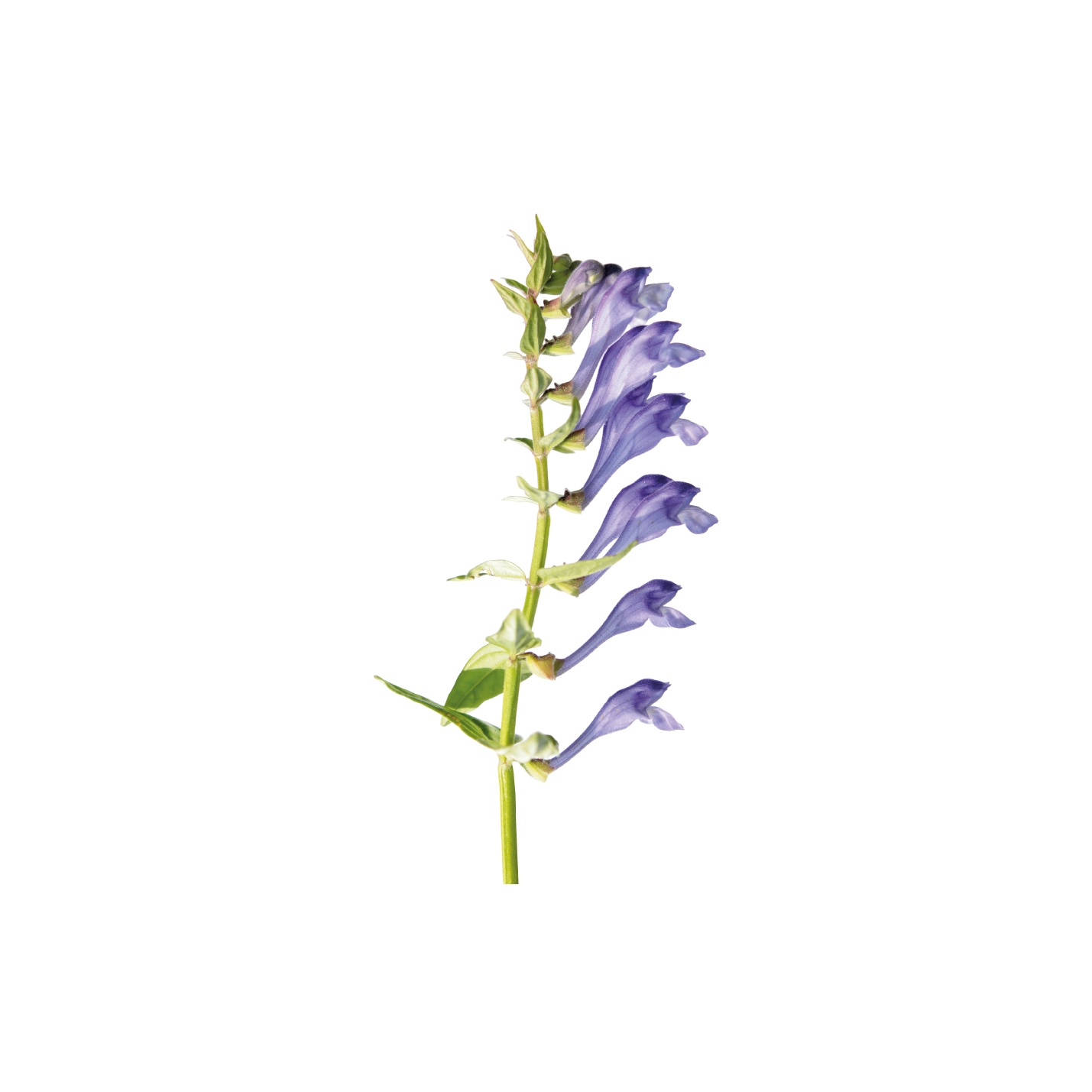 Principal source Chinese Skullcap Scutellaria baicalensis Herb monograph →
Photo coming soon
Source American Skullcap Scutellaria lateriflora Herb monograph →
Concentration
Content by Source
Reported concentrations across the plants that contain wogonin — the bar marks the typical level, the line shows the reported range.
Literature figures for varying plant parts and preparations. Read them as a comparative guide, not exact assays.
Wogonin at a Glance
Wogonin is a monomethoxy flavone (5,7-dihydroxy-8-methoxyflavone) and one of the free-B-ring flavones largely unique to the genus Scutellaria. It is a characteristic constituent of the dried root of Chinese skullcap (Scutellaria baicalensis, Huang Qin), where it accompanies the far more abundant baicalin and baicalein, and it also occurs in the aerial parts of American skullcap (S. lateriflora) 10,
Its signature — and the reason it earns a page of its own — is that it is a positive modulator at the benzodiazepine site of the GABA-A receptor: the same nervine mechanism that gives the skullcaps their traditional calming reputation. In rodents this produces a diazepam-like anxiolytic effect, but, notably, without the sedation, muscle-relaxation or dependence that define the classical benzodiazepines 1,
The honest headline is that almost all of this is preclinical — cell and rodent work on the isolated molecule. There are no controlled human efficacy trials of wogonin, and its human safety at purified doses is not established.
GABA-A Benzodiazepine-Site Modulation — The Anxiolytic Signature
This is the defining pharmacology of wogonin and the mechanism that ties it to the skullcaps’ nervine tradition. In the foundational study, wogonin bound the benzodiazepine site (BZD-S) of the GABA-A receptor complex with an affinity (Kᵢ) of about 0.92 µM, and in electrophysiological recordings it enhanced the GABA-activated chloride current in rat dorsal-root-ganglion neurons and in Xenopus oocytes expressing recombinant GABA-A receptors — an enhancement partly reversed by the benzodiazepine-site antagonist flumazenil (Ro15-1788) 1Reference 1Anxiolytic effect of wogonin, a benzodiazepine receptor ligand isolated from Scutellaria baicalensis GeorgiView study →.
The behavioural picture matched the receptor pharmacology. Oral wogonin (7.5–30 mg/kg) produced a dose-dependent, diazepam-like anxiolytic response in the elevated plus-maze, and that effect was blocked by co-administration of flumazenil — confirming it runs through the benzodiazepine site. Crucially, in the same animals wogonin showed no signs of sedation (holeboard test) and no myorelaxant effect (horizontal-wire test), and its acute toxicity was low (oral LD₅₀ ≈ 3.9 g/kg in mice) 1Reference 1Anxiolytic effect of wogonin, a benzodiazepine receptor ligand isolated from Scutellaria baicalensis GeorgiView study →.
That combination — genuine anxiolysis via positive allosteric modulation of GABA-A, decoupled from the sedative/myorelaxant/amnestic burden of benzodiazepines — is exactly why wogonin has been repeatedly floated as a template for “next-generation” anxiolytics 2Reference 2Therapeutic potential of wogonin: a naturally occurring flavonoidView study →. The load-bearing caveat is equally clear: this is a rodent and receptor-level result. There is no controlled human anxiety trial of isolated wogonin, and whether an oral human dose reaches anxiolytic brain concentrations is a pharmacokinetic question the isolate has not fully answered 3Reference 3AnimalBrain uptake of bioactive flavones in Scutellariae Radix and its relationship to anxiolytic effect in miceView study →.
What It's Used For
Beyond the anxiolytic signature, wogonin has a broad and internally consistent preclinical profile. The discipline is that the evidence splits by how far it has travelled — a receptor-level and in-vivo anxiolytic story, robust in-vitro/in-vivo anti-inflammatory and antiallergic work, a very large but entirely preclinical anticancer literature, and narrower antiviral and antioxidant signals.
Support is an experimental score — weighted by study type (human > animal > in vitro) and volume. A beta, not a validated metric. No application here has human efficacy data, so scores reflect preclinical depth and are capped accordingly; read the per-row basis.
The marquee application, and the one with the tightest mechanism-to-behaviour chain. The isolated molecule binds the GABA-A benzodiazepine site (Kᵢ ≈ 0.92 µM), potentiates GABA-gated chloride current in a flumazenil-reversible way, and — given orally at 7.5–30 mg/kg — produces a diazepam-like anxiolytic response in the elevated plus-maze that flumazenil abolishes, all without sedation or myorelaxation 1Reference 1Anxiolytic effect of wogonin, a benzodiazepine receptor ligand isolated from Scutellaria baicalensis GeorgiView study →.
A brain-uptake study of Scutellaria flavones tied the CNS penetration of the aglycones (wogonin among them) to the anxiolytic effect in mice, reinforcing that the lipophilic free flavone — not its polar glucuronide — is the CNS-active species 3Reference 3AnimalBrain uptake of bioactive flavones in Scutellariae Radix and its relationship to anxiolytic effect in miceView study →.
Reviews position wogonin as a lead for benzodiazepine-site anxiolytics with a cleaner side-effect profile 2Reference 2Therapeutic potential of wogonin: a naturally occurring flavonoidView study →.
Gap: rodent and receptor-level only — no controlled human anxiety trial of isolated wogonin, and the translation from a mg/kg mouse dose to an effective, CNS-penetrant human dose is unproven 1,
A robust and mechanistically coherent isolate signal. In cultured human endothelium and in mice, wogonin (tested alongside baicalin and baicalein) blunted LPS-driven vascular inflammation — reducing adhesion-molecule expression, monocyte adhesion/migration and barrier disruption — through suppression of NF-κB and COX-2 with lower TNF-α and IL-6 4Reference 4In vitroAnti-inflammatory effects of baicalin, baicalein, and wogonin in vitro and in vivoView study →. Its most distinctive anti-inflammatory action is pro-resolution: wogonin induced eosinophil apoptosis and thereby attenuated allergic airway inflammation in a mouse asthma model, a mechanism that maps neatly onto skullcap’s traditional use for allergic complaints 5Reference 5Wogonin induces eosinophil apoptosis and attenuates allergic airway inflammationView study →.
Gap: in-vitro and mouse models only; the airway and vascular findings are isolate studies with no human confirmation, and the plant-level contribution is confounded by co-occurring flavones 4,
The largest slice of the wogonin literature by volume — and the least clinically mature. Across leukemia, breast, colon, lung and cervical lines the isolated molecule induces apoptosis and cell-cycle arrest, largely by suppressing NF-κB and modulating p53 and the tumour microenvironment; in HPV-16 cervical cancer cells it suppressed the viral E6/E7 oncoproteins and triggered intrinsic (mitochondrial) apoptosis 7Reference 7Wogonin induces apoptosis by suppressing E6 and E7 expressions and activating intrinsic signaling pathways in HPV-16 cervical cancer cellsView study →.
Two systematic reviews judge wogonin and its analogues promising as chemopreventive/adjuvant candidates while flagging the near-total absence of clinical data 6Reference 6Systematic reviewWogonin and its analogs for the prevention and treatment of cancer: a systematic reviewView study →.
Gap: entirely preclinical (cell lines and animal xenografts); human exposure exists only through multi-herb formulas, not wogonin given as a cancer treatment, and effective concentrations may exceed achievable plasma levels 6,
A narrower but genuinely in-vivo-relevant activity. Isolated wogonin showed anti-hepatitis-B-virus activity both in vitro and in vivo, consistent with skullcap’s traditional use in inflammatory liver conditions 8Reference 8In vitroAnti-hepatitis B virus activity of wogonin in vitro and in vivoView study →. This sits within a broader (mostly baicalein/baicalin) Scutellaria antiviral picture spanning influenza, RSV and HIV entry, but for wogonin specifically the anti-HBV work is the cleanest isolate evidence 8Reference 8In vitroAnti-hepatitis B virus activity of wogonin in vitro and in vivoView study →.
Gap: preclinical (cell and animal HBV models); no human antiviral trial of wogonin, and the antiviral concentrations are not benchmarked against achievable oral exposure 8Reference 8In vitroAnti-hepatitis B virus activity of wogonin in vitro and in vivoView study →.
As a Scutellaria flavone, wogonin contributes to the radical-scavenging capacity of the extracts it appears in; comparative phytochemistry across S. baicalensis, S. lateriflora and S. racemosa quantified wogonin among the antioxidant flavones of the genus 10Reference 10Comparisons of Scutellaria baicalensis, Scutellaria lateriflora and Scutellaria racemosa: genome size, antioxidant potential and phytochemistryView study →.
Gap: in-vitro, whole-extract assays where wogonin is one flavone among many and is rarely isolated or quantified as the driver; no human antioxidant outcome rests on it specifically 10Reference 10Comparisons of Scutellaria baicalensis, Scutellaria lateriflora and Scutellaria racemosa: genome size, antioxidant potential and phytochemistryView study →.
Mechanisms
| Target / pathway | Effect | Relevant to |
|---|---|---|
| Benzodiazepine site (BZD-S) of the GABA-A receptor | positive allosteric modulation (Kᵢ ≈ 0.92 µM); enhances GABA-gated Cl⁻ current, reversed by flumazenil | anxiolytic (the signature) |
| NF-κB signalling / COX-2 | suppression → ↓ TNF-α, IL-6, adhesion molecules, prostaglandins | anti-inflammatoryantiallergicanticancer |
| Eosinophil apoptosis | drives programmed eosinophil death, resolving allergic airway inflammation | antiallergic / asthma |
| Intrinsic (mitochondrial) apoptosis; p53; HPV E6/E7 | pro-apoptotic across cancer lines; suppresses E6/E7 in HPV-16 cervical cells | anticancer |
| Hepatitis-B virus replication / antigen expression | inhibits HBV in vitro and in vivo | antiviral |
| Phenolic radical scavenging | contributes to antioxidant capacity of Scutellaria extracts | antioxidant |
The GABA-A benzodiazepine-site modulation is the load-bearing, molecule-specific mechanism — direct, flumazenil-reversible and tied to an in-vivo behavioural effect. The NF-κB axis is shared with its sibling flavones and underlies most of the anti-inflammatory, antiallergic and anticancer signals.
Pharmacokinetics
Wogonin is a lipophilic aglycone, which is central to its CNS story: the free flavone crosses the blood–brain barrier far more readily than its polar glucuronide, and brain uptake of the Scutellaria aglycones (wogonin included) correlates with the anxiolytic effect 3Reference 3AnimalBrain uptake of bioactive flavones in Scutellariae Radix and its relationship to anxiolytic effect in miceView study →. Systemically, however, its free fraction is limited by extensive phase-II metabolism: in rats wogonin is rapidly and heavily glucuronidated — chiefly to wogonoside (wogonin 7-O-glucuronide) — is highly plasma-protein-bound, distributes widely into tissues and is eliminated quickly, with substantial biliary/enterohepatic handling 9Reference 9AnimalPharmacokinetics, tissue distribution, excretion and plasma protein binding studies of wogonin in ratsView study →. The practical consequence is the familiar flavone-aglycone problem: oral bioavailability of the free molecule is low, so in-vitro potencies do not straightforwardly translate to systemic exposure. Robust human ADME — Cₘₐₓ, half-life and an oral bioavailability figure for isolated wogonin — is not well established; the quantitative PK is rodent, and human intake is as one flavone within a whole skullcap matrix 9Reference 9AnimalPharmacokinetics, tissue distribution, excretion and plasma protein binding studies of wogonin in ratsView study →.
Clinical Trials
There are no controlled clinical efficacy trials of isolated wogonin. Within skullcap chemistry, human trials have gone to other constituents — baicalein reached Phase I/IIa and oroxylin A completed a Phase I — but wogonin itself has not entered human efficacy testing, and all of the applications above rest on cell and animal work.
| Completed | Planned | Terminated | Preclinical |
|---|---|---|---|
| —(none for the isolate) | — | — | Extensive: anxiolytic (GABA-A), anti-inflammatory/antiallergic, anticancer, anti-HBV |
Last checked: July 2026.
Isolate vs. Plant Studies
Wogonin is a case where the evidence is overwhelmingly the isolated molecule — a strength for mechanism, a limit for real-world relevance. The anxiolytic receptor/behaviour work 1Reference 1Anxiolytic effect of wogonin, a benzodiazepine receptor ligand isolated from Scutellaria baicalensis GeorgiView study →, the anti-inflammatory vascular study 4Reference 4In vitroAnti-inflammatory effects of baicalin, baicalein, and wogonin in vitro and in vivoView study →, the eosinophil-apoptosis airway model 5Reference 5Wogonin induces eosinophil apoptosis and attenuates allergic airway inflammationView study →, the anti-HBV work 8Reference 8In vitroAnti-hepatitis B virus activity of wogonin in vitro and in vivoView study → and the anticancer literature 6,
Prevalence in Nature
Wogonin is one of the free-B-ring flavones largely restricted to the genus Scutellaria — flavones lacking the usual B-ring hydroxyl and instead carrying an 8-methoxy group, a chemotype the genus produces through a root-specific biosynthetic route 12Reference 12ReviewA comprehensive review on phytochemistry, pharmacology, and flavonoid biosynthesis of Scutellaria baicalensisView study →. Its richest source is the dried root of Chinese skullcap (Scutellaria baicalensis, Huang Qin), where it makes up roughly 1.3% of dry weight — a minor partner to the dominant baicalin (~8–12%), its aglycone baicalein (~5%) and wogonin’s own glucuronide wogonoside (~3.5%) 12Reference 12ReviewA comprehensive review on phytochemistry, pharmacology, and flavonoid biosynthesis of Scutellaria baicalensisView study →. Much of the root’s wogonin is in fact stored as wogonoside and liberated as the free aglycone by hydrolysis during processing and digestion.
It also occurs in the aerial parts of American skullcap (S. lateriflora) and across other Scutellaria species (S. racemosa, S. amoena), quantified in comparative phytochemical surveys of the genus, though generally as a minor flavone rather than a dominant one 10Reference 10Comparisons of Scutellaria baicalensis, Scutellaria lateriflora and Scutellaria racemosa: genome size, antioxidant potential and phytochemistryView study →. These free-B-ring flavones carry much of the antiallergic, anti-inflammatory and antiviral activity ascribed to skullcap 12Reference 12ReviewA comprehensive review on phytochemistry, pharmacology, and flavonoid biosynthesis of Scutellaria baicalensisView study →.
Major Natural Sources
| Source | Plant part | Reported wogonin content |
|---|---|---|
| Chinese skullcap (Scutellaria baicalensis) | dried root | ~1.3% dry weight 12Reference 12ReviewA comprehensive review on phytochemistry, pharmacology, and flavonoid biosynthesis of Scutellaria baicalensisView study → |
| American skullcap (Scutellaria lateriflora) | aerial parts | minor (quantified across the genus) 10Reference 10Comparisons of Scutellaria baicalensis, Scutellaria lateriflora and Scutellaria racemosa: genome size, antioxidant potential and phytochemistryView study → |
| Other Scutellaria (S. racemosa, S. amoena) | root / aerial parts | present, minor 10Reference 10Comparisons of Scutellaria baicalensis, Scutellaria lateriflora and Scutellaria racemosa: genome size, antioxidant potential and phytochemistryView study → |
Percentages are of the dried plant material and vary with species, origin, plant age and post-harvest processing.
Discovery & Synthesis
Wogonin is 5,7-dihydroxy-8-methoxyflavone, named for its occurrence in Scutellaria (the drug “wogon”/Huang Qin) and first characterised as a constituent of the skullcap root; the precise date of its first isolation is not well documented here and is a future research-loop item. Biosynthetically it belongs to the free-B-ring flavone class that is a chemotaxonomic marker of the genus — these 8-methoxy flavones (baicalein, wogonin and their glycosides) are produced largely in the root through a Scutellaria-specific branch of flavone biosynthesis, distinct from the ordinary 4′-hydroxylated flavones of most plants 12Reference 12ReviewA comprehensive review on phytochemistry, pharmacology, and flavonoid biosynthesis of Scutellaria baicalensisView study →. Manufacture today is by extraction from Scutellaria baicalensis root, typically as part of a flavone fraction and often by liberating the aglycone from its glucuronide wogonoside; there is no significant total-synthesis supply chain, and wogonin is used chiefly as a research chemical and phytochemical reference standard rather than a bulk commercial ingredient.
Patents: not yet researched.
Toxicity & Safety
Wogonin carries a low toxicity flag. Its acute toxicity is genuinely low — an oral LD₅₀ of about 3.9 g/kg in mice — and, importantly, its rodent anxiolytic doses were non-sedating and non-myorelaxant, i.e. it did not reproduce the impairing side-effects of benzodiazepines even while acting at their receptor site 1Reference 1Anxiolytic effect of wogonin, a benzodiazepine receptor ligand isolated from Scutellaria baicalensis GeorgiView study →. It is a minor constituent of a herb (skullcap) with long traditional use. The honest limits are that purified, high-dose human safety has not been characterised, and — as a benzodiazepine-site modulator and a flavone that can affect drug-metabolising enzymes — its interaction profile in people is essentially unstudied.
- Low acute toxicity. Oral LD₅₀ ≈ 3.9 g/kg in mice, and anxiolytic doses were non-sedating and non-myorelaxant in rodents 1Reference 1Anxiolytic effect of wogonin, a benzodiazepine receptor ligand isolated from Scutellaria baicalensis GeorgiView study →.
- Human safety of purified wogonin is not established. Essentially all data are cell and rodent studies; no human safety or dose-finding record exists for the isolate.
- Additive CNS effects are plausible. As a benzodiazepine-site positive modulator it could in principle compound alcohol and other CNS depressants — untested in humans, and more relevant to concentrated extracts than to the trace amount in a whole-herb preparation 1Reference 1Anxiolytic effect of wogonin, a benzodiazepine receptor ligand isolated from Scutellaria baicalensis GeorgiView study →.
- Drug-metabolism interactions uncharacterised for the isolate. Scutellaria free-B-ring flavones can influence CYP and UGT enzymes; wogonin-specific human interaction data are lacking.
Reproductive and developmental safety data for isolated wogonin are not characterised. Pregnancy and lactation decisions belong to the herb or product page where intake is decided, not to this molecule page; no isolate-specific verdict is issued here.
Dosage
There is no established or recommended human dose for isolated wogonin. The figures below are research doses, given to show the exposures at which effects were observed — not a personal recommendation.
| Application (research) | Model | Dose studied |
|---|---|---|
| Anxiolytic | mouse, oral | ~7.5–30 mg/kg (diazepam-like in the elevated plus-maze) 1Reference 1Anxiolytic effect of wogonin, a benzodiazepine receptor ligand isolated from Scutellaria baicalensis GeorgiView study → |
| Anti-inflammatory / antiallergic | mouse, in vivo | preclinical mg/kg dosing 4, |
| Anti-HBV | in vitro / animal | preclinical 8Reference 8In vitroAnti-hepatitis B virus activity of wogonin in vitro and in vivoView study → |
Human exposure to wogonin is indirect — as a minor flavone within whole Chinese skullcap or American skullcap preparations, whose flavonoid content varies severalfold between products. These are doses studied in research and are not a personal recommendation.
References
- Hui KM, Huen MS, Wang HY, Zheng H, Sigel E, Baur R, Ren H, Li ZW, Wong JT, Xue H (2002). Anxiolytic effect of wogonin, a benzodiazepine receptor ligand isolated from Scutellaria baicalensis Georgi. Biochemical Pharmacology. https://pubmed.ncbi.nlm.nih.gov/12392823/
- Tai MC, Tsang SY, Chang LY, Xue H (2005). Therapeutic potential of wogonin: a naturally occurring flavonoid. CNS Drug Reviews. https://pubmed.ncbi.nlm.nih.gov/16007236/
- Fong SYK, Li C, Ho YC, Li R, Wang Q, Wong YC, Xue H, Zuo Z (2017). Brain uptake of bioactive flavones in Scutellariae Radix and its relationship to anxiolytic effect in mice. Molecular Pharmaceutics. https://pubmed.ncbi.nlm.nih.gov/28426226/
- Lee W, Ku SK, Bae JS (2015). Anti-inflammatory effects of baicalin, baicalein, and wogonin in vitro and in vivo. Inflammation. https://pubmed.ncbi.nlm.nih.gov/25249339/
- Lucas CD, Dorward DA, Sharma S, Rennie J, Felton JM, Alessandri AL, Duffin R, Schwarze J, Haslett C, Rossi AG (2015). Wogonin induces eosinophil apoptosis and attenuates allergic airway inflammation. American Journal of Respiratory and Critical Care Medicine. https://pubmed.ncbi.nlm.nih.gov/25629436/
- Banik K, Khatoon E, Harsha C, Rana V, Parama D, Thakur KK, Bishayee A, Kunnumakkara AB (2022). Wogonin and its analogs for the prevention and treatment of cancer: a systematic review. Phytotherapy Research. https://pubmed.ncbi.nlm.nih.gov/35102626/
- Kim MS, Bak Y, Park YS, Lee DH, Kim JH, Kang JW, Song HH, Oh SR, Yoon DY (2013). Wogonin induces apoptosis by suppressing E6 and E7 expressions and activating intrinsic signaling pathways in HPV-16 cervical cancer cells. Cell Biology and Toxicology. https://pubmed.ncbi.nlm.nih.gov/23955116/
- Guo Q, Zhao L, You Q, Yang Y, Gu H, Song G, Lu N, Xin J (2007). Anti-hepatitis B virus activity of wogonin in vitro and in vivo. Antiviral Research. https://pubmed.ncbi.nlm.nih.gov/17280723/
- Talbi A, Zhao D, Liu Q, Li J, Fan A, Yang W, Han X, Chen X (2014). Pharmacokinetics, tissue distribution, excretion and plasma protein binding studies of wogonin in rats. Molecules. https://pubmed.ncbi.nlm.nih.gov/24786691/
- Cole IB, Cao J, Alan AR, Saxena PK, Murch SJ (2008). Comparisons of Scutellaria baicalensis, Scutellaria lateriflora and Scutellaria racemosa: genome size, antioxidant potential and phytochemistry. Planta Medica. https://pubmed.ncbi.nlm.nih.gov/18484546/
- Awad R, Arnason JT, Trudeau V, Bergeron C, Budzinski JW, Foster BC, Merali Z (2003). Phytochemical and biological analysis of skullcap (Scutellaria lateriflora L.): a medicinal plant with anxiolytic properties. Phytomedicine. https://pubmed.ncbi.nlm.nih.gov/14692724/
- Wang ZL, Wang S, Kuang Y, Hu ZM, Qiao X, Ye M (2018). A comprehensive review on phytochemistry, pharmacology, and flavonoid biosynthesis of Scutellaria baicalensis. Pharmaceutical Biology. https://doi.org/10.1080/13880209.2018.1492620



