
Compound Monograph
Wogonoside
Wogonoside is the 7-O-glucuronide of wogonin — a flavone glycoside abundant in Chinese skullcap root that is deglucuronidated to its aglycone wogonin before it acts, and which also carries its own preclinical anti-inflammatory (NF-κB / NLRP3) and anti-angiogenic data. Human evidence for the isolate is essentially absent.

Sources · 4
Where Does It Come From?
Wogonoside is a naturally occurring flavonoid (flavone glucuronide), found in Chinese skullcap, Skullcap and 2 other sources. It is well tolerated orally (low toxicity).
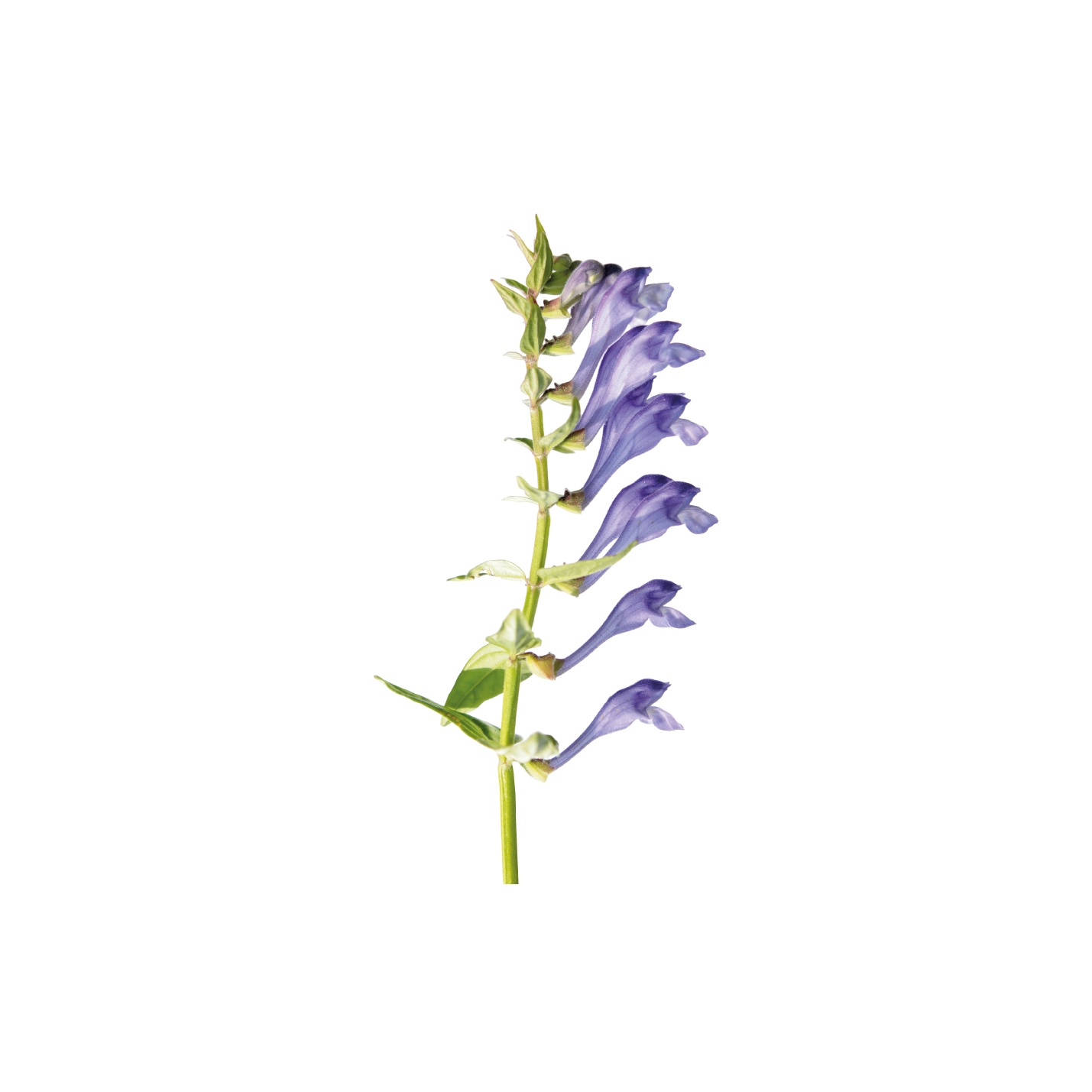 Principal source Chinese Skullcap Scutellaria baicalensis Herb monograph →
Photo coming soon
Source American Skullcap Scutellaria lateriflora Herb monograph →
Concentration
Content by Source
Reported concentrations across the plants that contain wogonoside — the bar marks the typical level, the line shows the reported range.
Literature figures for varying plant parts and preparations. Read them as a comparative guide, not exact assays.
Wogonoside at a Glance
Wogonoside is a flavone glucuronide — the 7-O-glucuronide of wogonin — and one of the four signature flavonoids of Chinese skullcap (Scutellaria baicalensis) root, alongside baicalin, baicalein and wogonin 2Reference 2ReviewA comprehensive review on phytochemistry, pharmacology, and flavonoid biosynthesis of Scutellaria baicalensisView study →. It is the glycoside twin of wogonin in exactly the way baicalin is the glycoside twin of baicalein: a sugar-conjugated storage form that the body largely converts back to the aglycone before it works.
That conversion is the point. Like other flavone glucuronides, wogonoside is polar and poorly absorbed intact; in the gut it is deglucuronidated to wogonin, the smaller, more lipophilic, better-absorbed aglycone that carries most of the downstream activity 3,
Wogonoside is not merely an inert pro-drug, though. The isolated glycoside itself has a consistent preclinical anti-inflammatory signal — repeatedly shown to suppress NF-κB and the NLRP3 inflammasome across colitis, acute liver injury, spinal-cord injury and asthma models — plus anti-angiogenic and anticancer data in leukaemia and breast-cancer models 5,
Wogonoside vs. Wogonin — The Glycoside-Aglycone Relationship
This is the load-bearing section, and the single most important thing to understand about the molecule.
Wogonoside is wogonin with a glucuronic-acid sugar attached at the 7-position. That glucuronide group makes the molecule water-soluble and poorly permeable, so relatively little of the intact glycoside crosses the intestinal wall. The active, absorbed species is the aglycone, wogonin — liberated when the sugar is cleaved by β-glucuronidase 3,
Where the deglucuronidation happens is less obvious than the textbook “gut bacteria do it” story. Two complementary routes are documented:
- Bacterial β-glucuronidase in the lower gut. Colonic microbiota hydrolyse wogonoside to wogonin; in a decoction study, this microbial conversion ran faster in a diarrhoeal gut flora (enriched in Escherichia spp.) than in a healthy one — direct evidence that the gut microbiome sets the conversion rate 4Reference 4Comparative metabolism of the eight main bioactive ingredients of gegen qinlian decoction by the intestinal flora of diarrhoeal and healthy pigletsView study →.
- A “local recycling” loop in the upper small intestine. A four-site rat-perfusion study found wogonoside and wogonin interconvert throughout the small intestine, with hydrolysis at the upper small intestine driven by host (mucosal/S9) β-glucuronidase, not bacteria — blocked by the glucuronidase inhibitor saccharolactone but unaffected by antibiotics. Absorbed wogonin is re-glucuronidated and effluxed back into the lumen, then re-cleaved, prolonging residence time in the gut 3Reference 3A novel local recycling mechanism that enhances enteric bioavailability of flavonoids and prolongs their residence time in the gutView study →.
The practical consequences for reading any wogonoside study:
- Oral wogonoside is, to a large degree, a delivery form for wogonin. Its systemic effects after oral dosing are partly the aglycone’s.
- Interpersonal variation is real. Gut-flora composition and glucuronidase activity change how much wogonin is generated, so exposure is not fixed across individuals 3,
4Reference 3A novel local recycling mechanism that enhances enteric bioavailability of flavonoids and prolongs their residence time in the gutView study →Reference 4Comparative metabolism of the eight main bioactive ingredients of gegen qinlian decoction by the intestinal flora of diarrhoeal and healthy pigletsView study → . - Injected wogonoside is a different exposure from oral wogonoside. Most of the anti-inflammatory and anticancer studies below dose the glycoside intraperitoneally or in vitro, bypassing the gut conversion — so they test the glycoside more directly than an oral human dose ever would 5,
6, .9Reference 5AnimalWogonoside protects against dextran sulfate sodium-induced experimental colitis in mice by inhibiting NF-κB and NLRP3 inflammasome activationView study →Reference 6Wogonoside alleviates inflammation induced by traumatic spinal cord injury by suppressing NF-κB and NLRP3 inflammasome activationView study →Reference 9Wogonoside impedes the progression of acute myeloid leukemia through inhibiting bone marrow angiogenesisView study →
What It's Used For
Beyond its role as a wogonin precursor, isolated wogonoside has a coherent — but entirely preclinical — pharmacology, weighted heavily toward inflammation.
Support is an experimental score — weighted by study type (human > animal > in vitro) and volume. A beta, not a validated metric. Every row here is preclinical, and much of it dosed by injection (bypassing the gut deglucuronidation), so read each basis against the aglycone-conversion caveat.
The molecule’s best-evidenced action, and unusually consistent across unrelated tissues. In DSS-induced murine colitis, isolated wogonoside dose-dependently reduced weight loss, colon shortening and neutrophil infiltration, working through dual inhibition of NF-κB and the NLRP3 inflammasome — cutting IL-1β, TNF-α and IL-6 in serum, colon and PMA-differentiated THP-1 monocytes 5Reference 5AnimalWogonoside protects against dextran sulfate sodium-induced experimental colitis in mice by inhibiting NF-κB and NLRP3 inflammasome activationView study →.
The same NF-κB/NLRP3 mechanism reappears in a traumatic spinal-cord-injury model (↓TLR4, NLRP3, caspase-1; improved locomotor recovery) 6Reference 6Wogonoside alleviates inflammation induced by traumatic spinal cord injury by suppressing NF-κB and NLRP3 inflammasome activationView study → and in LPS/D-galactosamine acute liver injury, where it additionally activated Nrf2/HO-1 antioxidant signalling 7Reference 7AnimalProtective mechanisms of wogonoside against lipopolysaccharide/D-galactosamine-induced acute liver injury in miceView study →.
A study of the Qing-Fei-Pai-Du decoction isolated wogonoside as an anti-inflammatory component acting by promoting proteasomal degradation of the transcription factor ATF2 11Reference 11Qing-Fei-Pai-Du decoction and wogonoside exert anti-inflammatory action through down-regulating USP14 to promote the degradation of activating transcription factor 2View study →.
Gap: every study is rodent or cell-based and several inject the glycoside (bypassing gut conversion to wogonin); no human anti-inflammatory data exist for the isolate, and the shared NF-κB/NLRP3 mechanism overlaps that reported for wogonin and other skullcap flavones, so the effect is not uniquely wogonoside’s 5,
A mechanistically specific but early-stage oncology signal centred on angiogenesis. In acute myeloid leukaemia, wogonoside suppressed bone-marrow microvessel density and blocked the JAK2–STAT3 pathway in AML and stromal cells (reducing IL-8-driven angiogenesis), slowing disease progression in vivo 9Reference 9Wogonoside impedes the progression of acute myeloid leukemia through inhibiting bone marrow angiogenesisView study →.
In breast cancer it lowered VEGF secretion from MCF-7 cells and inhibited angiogenesis in chick-chorioallantoic-membrane and xenograft assays by suppressing Wnt/β-catenin signalling, with an effect compared to bevacizumab in one model 10Reference 10Wogonoside inhibits angiogenesis in breast cancer via suppressing Wnt/β-catenin pathwayView study →.
Reviews of the molecule list anti-tumour and anti-angiogenic activity among its recognised properties 5Reference 5AnimalWogonoside protects against dextran sulfate sodium-induced experimental colitis in mice by inhibiting NF-κB and NLRP3 inflammasome activationView study →.
Gap: in-vitro plus mouse-xenograft evidence only — micromolar cell-culture concentrations and injected doses, with no clinical oncology data; and, as with the anti-inflammatory work, the anticancer literature on skullcap flavones is dominated by the aglycones (wogonin, baicalein), so wogonoside is one contributor in a crowded field 9,
A distinct application with a clean mechanism. In an ovalbumin-induced murine acute-asthma model, wogonoside (10 and 20 mg/kg) reduced airway inflammatory-cell infiltration, goblet-cell hyperplasia and mucus (MUC5AC) hypersecretion, improved pulmonary function, and lowered Th2 cytokines (IL-4, IL-5, IL-13) and serum IgE — via downregulation of NF-κB/STAT6 phosphorylation in lung tissue and in human bronchial epithelial (16HBE) cells 8Reference 8AnimalWogonoside ameliorates airway inflammation and mucus hypersecretion via NF-κB/STAT6 signaling in ovalbumin-induced murine acute asthmaView study →.
This extends the NF-κB anti-inflammatory theme into an allergic, STAT6-dependent context.
Gap: a single OVA-asthma model in mice plus one epithelial cell line; no human respiratory data, and the dosing was systemic rather than the oral-then-deglucuronidated route a person would experience 8Reference 8AnimalWogonoside ameliorates airway inflammation and mucus hypersecretion via NF-κB/STAT6 signaling in ovalbumin-induced murine acute asthmaView study →.
The weakest-evidenced of the four. Wogonoside contributes to the antioxidant activity of Scutellaria extracts in which it occurs 1Reference 1Comparisons of Scutellaria baicalensis, Scutellaria lateriflora and Scutellaria racemosa: genome size, antioxidant potential and phytochemistryView study →, and in the LPS/D-GalN liver-injury model it induced Nrf2 and downstream antioxidant enzymes (NQO-1, GCLC, HO-1) while lowering hepatic malondialdehyde — a cytoprotective, redox-modulating action distinct from direct radical scavenging 7Reference 7AnimalProtective mechanisms of wogonoside against lipopolysaccharide/D-galactosamine-induced acute liver injury in miceView study →.
Gap: the direct antioxidant data are mostly at the whole-extract level (where wogonoside is one flavonoid among many), and the Nrf2 finding rides inside a single anti-inflammatory liver-injury study; no isolate-specific antioxidant outcome is established in humans 1,
Mechanisms
| Target / pathway | Effect | Relevant to |
|---|---|---|
| NF-κB (p65) signalling | suppresses phosphorylation/nuclear translocation → ↓TNF-α, IL-6, IL-1β transcription | anti-inflammatory (the recurring core mechanism) |
| NLRP3 inflammasome / caspase-1 | inhibits assembly and IL-1β maturation | colitisliverspinal-cord injury |
| STAT6 | ↓phosphorylation → reduced Th2/allergic response and MUC5AC | airway / allergic inflammation |
| Nrf2 / HO-1 / NQO-1 | induces antioxidant-response element genes | cytoprotection (liver injury) |
| JAK2–STAT3 (+ IL-8) | blocks angiogenic signalling in AML and stromal cells | anti-leukaemic / anti-angiogenic |
| Wnt/β-catenin (+ VEGF) | suppresses tumour angiogenesis | breast-cancer models |
| ATF2 | promotes proteasomal degradation | anti-inflammatory (decoction study) |
| β-glucuronidase (host + microbial) | substrate — cleaved to the aglycone wogonin | pharmacokinetics / bioavailability |
The through-line is anti-inflammatory transcriptional control — NF-κB with NLRP3 — reappearing across four unrelated injury models. The final row is the load-bearing pharmacokinetic fact: wogonoside is itself a β-glucuronidase substrate, so a share of every “wogonoside” effect after oral dosing is really wogonin’s.
Pharmacokinetics
Wogonoside is a polar flavone glucuronide with low intrinsic membrane permeability, so intact oral absorption is limited and its disposition is dominated by deglucuronidation to wogonin. Two enzyme sources do the cleaving: host β-glucuronidase in the upper-small-intestinal mucosa (a “local recycling” loop in which absorbed wogonin is re-glucuronidated, effluxed and re-hydrolysed, prolonging gut residence) 3Reference 3A novel local recycling mechanism that enhances enteric bioavailability of flavonoids and prolongs their residence time in the gutView study →, and bacterial β-glucuronidase in the colon, whose activity — and therefore the wogonin yield — rises with a dysbiotic, Escherichia-enriched flora 4Reference 4Comparative metabolism of the eight main bioactive ingredients of gegen qinlian decoction by the intestinal flora of diarrhoeal and healthy pigletsView study →. Because the conversion is enzyme- and microbiome-dependent, systemic exposure to the active aglycone varies between individuals and gut states 3,
Clinical Trials
There are no controlled clinical trials of isolated wogonoside. Its only human context is as a quantified flavone marker within whole Scutellaria baicalensis extracts and multi-herb formulas; even there, the pharmacologically relevant circulating species is substantially wogonin. All efficacy evidence is animal or in-vitro.
| Completed | Planned | Terminated | Preclinical |
|---|---|---|---|
| None(isolate) | — | — | Anti-inflammatory (NF-κB/NLRP3), anti-angiogenic/anticancer, airway, antioxidant/Nrf2 |
Last checked: July 2026.
Isolate vs. Plant Studies
Wogonoside sits at the honest end of the isolate-vs-plant spectrum: the mechanistic work is genuinely on the isolated glycoside — the DSS-colitis 5Reference 5AnimalWogonoside protects against dextran sulfate sodium-induced experimental colitis in mice by inhibiting NF-κB and NLRP3 inflammasome activationView study →, spinal-cord-injury 6Reference 6Wogonoside alleviates inflammation induced by traumatic spinal cord injury by suppressing NF-κB and NLRP3 inflammasome activationView study →, liver-injury 7Reference 7AnimalProtective mechanisms of wogonoside against lipopolysaccharide/D-galactosamine-induced acute liver injury in miceView study →, asthma 8Reference 8AnimalWogonoside ameliorates airway inflammation and mucus hypersecretion via NF-κB/STAT6 signaling in ovalbumin-induced murine acute asthmaView study →, AML 9Reference 9Wogonoside impedes the progression of acute myeloid leukemia through inhibiting bone marrow angiogenesisView study → and breast-cancer 10Reference 10Wogonoside inhibits angiogenesis in breast cancer via suppressing Wnt/β-catenin pathwayView study → studies all dose purified wogonoside — which is a real strength for attributing the mechanism. But two caveats pull the other way. First, the human efficacy evidence is entirely absent for the isolate; wogonoside’s presence in people is as a constituent of whole skullcap extracts and classical formulas (Gegen Qinlian, Qing-Fei-Pai-Du) 4,
Prevalence in Nature
Wogonoside is characteristically a root flavonoid of Scutellaria (Lamiaceae). Its richest and best-quantified source is Chinese skullcap (Scutellaria baicalensis), where it is one of the four principal flavonoids of the dried root — roughly 3.5% by dry weight, behind baicalin (the dominant constituent at ~8–12%) and baicalein, and ahead of wogonin 2Reference 2ReviewA comprehensive review on phytochemistry, pharmacology, and flavonoid biosynthesis of Scutellaria baicalensisView study →. It co-occurs with these flavones because they share the same biosynthetic branch: the pathway builds the flavone aglycones (baicalein, wogonin) and then glucuronidates them at the 7-position to the storage glycosides (baicalin, wogonoside) 2Reference 2ReviewA comprehensive review on phytochemistry, pharmacology, and flavonoid biosynthesis of Scutellaria baicalensisView study →.
The molecule is also reported from other Scutellaria used medicinally — American skullcap (Scutellaria lateriflora), where comparative phytochemical surveys of the genus detect the same flavone set 1Reference 1Comparisons of Scutellaria baicalensis, Scutellaria lateriflora and Scutellaria racemosa: genome size, antioxidant potential and phytochemistryView study →, and Scutellaria barbata — though at lower and less consistently quantified levels than in S. baicalensis root. Content across the genus varies with species, plant part (root ≫ aerial), age and post-harvest processing, the same drivers that move baicalin 2Reference 2ReviewA comprehensive review on phytochemistry, pharmacology, and flavonoid biosynthesis of Scutellaria baicalensisView study →.
Discovery & Synthesis
Wogonoside entered the literature as a flavone glucuronide of Scutellaria baicalensis root — the 7-O-glucuronide of wogonin, named for its aglycone (wogonin itself is named from wogon, a Japanese reading of the Chinese drug name for skullcap root, 黄芩). A precise first-isolation date and author are not well documented in the accessible record; it was characterised as part of the broad twentieth-century phytochemical work on skullcap flavones that also defined baicalin, baicalein and wogonin 2Reference 2ReviewA comprehensive review on phytochemistry, pharmacology, and flavonoid biosynthesis of Scutellaria baicalensisView study →. In nature it is made biosynthetically rather than by chemists: the plant assembles the wogonin aglycone on the flavone pathway and then attaches glucuronic acid at the 7-hydroxyl via a UDP-glucuronosyltransferase, giving the water-soluble glucuronide 2Reference 2ReviewA comprehensive review on phytochemistry, pharmacology, and flavonoid biosynthesis of Scutellaria baicalensisView study →. Practical supply today is by extraction and chromatographic isolation from S. baicalensis root, the same feedstock that yields baicalin and baicalein; dedicated total-synthesis routes are not the commercial source.
Patents: not yet researched.
Toxicity & Safety
Wogonoside carries a low toxicity flag. It is a flavone glucuronide from a herb (Scutellaria baicalensis) with a long record of traditional use, it is poorly absorbed intact, and across the rodent anti-inflammatory and anticancer studies above it was generally well tolerated at the doses tested with no signature organ toxicity reported 5,
- A well-tolerated flavone glycoside from a long-used herb. No serious toxicity signal in the preclinical models, and low intrinsic absorption of the intact glucuronide.
- Human safety data for the isolate are absent. Purified, high-dose wogonoside has not been characterised in people; “long traditional use” covers the whole herb, not the concentrated single molecule.
- It is really a wogonin pro-drug. Effects and any risks after oral dosing track the absorbed aglycone wogonin, and the amount generated varies with gut flora and β-glucuronidase activity 3,
4Reference 3A novel local recycling mechanism that enhances enteric bioavailability of flavonoids and prolongs their residence time in the gutView study →Reference 4Comparative metabolism of the eight main bioactive ingredients of gegen qinlian decoction by the intestinal flora of diarrhoeal and healthy pigletsView study → . - Herb–drug metabolism interactions are plausible. Skullcap flavones influence flavonoid transport/metabolism, and co-administered herbs measurably shift wogonoside/baicalin bioavailability 12,
13Reference 12AnimalInfluence of Coptis chinensis on pharmacokinetics of flavonoids after oral administration of Radix Scutellariae in ratsView study →Reference 13AnimalPharmacokinetics difference of multiple active constituents from decoction and maceration of Fuzi Xiexin Tang after oral administration in rats by UPLC-MS/MSView study → ; the additive-sedation caution that applies to skullcap preparations applies here too.
Pregnancy/lactation is a per-herb / per-supplement decision and is not adjudicated on this molecule page; dedicated human reproductive data for isolated wogonoside are not established, and no isolate-specific verdict is issued here.
Dosage
There is no established or recommended human dose for isolated wogonoside. The figures in the literature are preclinical research doses — commonly around 10–50 mg/kg in rodents by intraperitoneal injection or gavage (e.g. 10–20 mg/kg in the asthma model, 12–50 mg/kg in the spinal-cord-injury model), and micromolar concentrations in cell culture 6,
In practice, human exposure to wogonoside is indirect — as a flavone constituent of standardised Scutellaria baicalensis root extracts and classical formulas, where it is quantified as a marker and where most of it is deglucuronidated to wogonin before absorption 3,
References
- Cole IB, Cao J, Alan AR, Saxena PK, Murch SJ (2008). Comparisons of Scutellaria baicalensis, Scutellaria lateriflora and Scutellaria racemosa: genome size, antioxidant potential and phytochemistry. Planta Medica. https://pubmed.ncbi.nlm.nih.gov/18484546/
- Wang ZL, Wang S, Kuang Y, Hu ZM, Qiao X, Ye M (2018). A comprehensive review on phytochemistry, pharmacology, and flavonoid biosynthesis of Scutellaria baicalensis. Pharmaceutical Biology. https://pubmed.ncbi.nlm.nih.gov/31070530/
- Xia B, Zhou Q, Zheng Z, Ye L, Hu M, Liu Z (2012). A novel local recycling mechanism that enhances enteric bioavailability of flavonoids and prolongs their residence time in the gut. Molecular Pharmaceutics. https://pubmed.ncbi.nlm.nih.gov/23033922/
- Liu CS, Liang X, Wei XH, Chen FL, Tang QF, Tan XM (2019). Comparative metabolism of the eight main bioactive ingredients of gegen qinlian decoction by the intestinal flora of diarrhoeal and healthy piglets. Biomedical Chromatography. https://pubmed.ncbi.nlm.nih.gov/30362136/
- Sun Y, Zhao Y, Yao J, Zhao L, Wu Z, Wang Y, Pan D, Miao H, Guo Q, Lu N (2015). Wogonoside protects against dextran sulfate sodium-induced experimental colitis in mice by inhibiting NF-κB and NLRP3 inflammasome activation. Biochemical Pharmacology. https://pubmed.ncbi.nlm.nih.gov/25677765/
- Zhu Y, Zhu H, Wang Z, Gao F, Wang J, Zhang W (2017). Wogonoside alleviates inflammation induced by traumatic spinal cord injury by suppressing NF-κB and NLRP3 inflammasome activation. Experimental and Therapeutic Medicine. https://pubmed.ncbi.nlm.nih.gov/28966691/
- Gao YZ, Zhao LF, Ma J, Xue WH, Zhao H (2016). Protective mechanisms of wogonoside against lipopolysaccharide/D-galactosamine-induced acute liver injury in mice. European Journal of Pharmacology. https://pubmed.ncbi.nlm.nih.gov/26921756/
- Yu X, Cai B, Yu L, Li N, Wu C, Hu Z, Tang D, Chen R, Qiu C (2024). Wogonoside ameliorates airway inflammation and mucus hypersecretion via NF-κB/STAT6 signaling in ovalbumin-induced murine acute asthma. Journal of Agricultural and Food Chemistry. https://pubmed.ncbi.nlm.nih.gov/38507725/
- Lin B, Zhao K, Yang D, Bai D, Liao Y, Zhou Y, Yu Z, Yu X, Guo Q, Lu N (2019). Wogonoside impedes the progression of acute myeloid leukemia through inhibiting bone marrow angiogenesis. Journal of Cellular Physiology. https://pubmed.ncbi.nlm.nih.gov/30105796/
- Huang Y, et al. (2016). Wogonoside inhibits angiogenesis in breast cancer via suppressing Wnt/β-catenin pathway. Molecular Carcinogenesis. https://pubmed.ncbi.nlm.nih.gov/26387984/
- Xu X, Xia J, Zhao S, Wang Q, Ge G, Xu F, Liu X, Zhang W, Yang Y (2021). Qing-Fei-Pai-Du decoction and wogonoside exert anti-inflammatory action through down-regulating USP14 to promote the degradation of activating transcription factor 2. FASEB Journal. https://pubmed.ncbi.nlm.nih.gov/34436790/
- Shi R, Zhou H, Liu Z, Ma Y (2009). Influence of Coptis chinensis on pharmacokinetics of flavonoids after oral administration of Radix Scutellariae in rats. Biopharmaceutics & Drug Disposition. https://pubmed.ncbi.nlm.nih.gov/19688740/
- Zhang Q, Ma YM, Wang ZT, Wang CH (2014). Pharmacokinetics difference of multiple active constituents from decoction and maceration of Fuzi Xiexin Tang after oral administration in rats by UPLC-MS/MS. Journal of Pharmaceutical and Biomedical Analysis. https://pubmed.ncbi.nlm.nih.gov/24469098/



