
Materia Medica
American Skullcap
Scutellaria lateriflora
American skullcap is a small North American wetland mint whose leaves and flowering tops are a classic nervine of Western herbal medicine, taken for anxiety, nervous exhaustion and poor sleep. Its aerial parts are rich in the flavones baicalin and baicalein.
What Is American Skullcap?
American skullcap is a small, blue-flowered wetland mint and one of the classic nervines of Western herbal medicine. Its leaves and flowering tops are taken to calm and restore the nervous system, especially in anxiety, nervous exhaustion, tension and poor sleep.
Scutellaria lateriflora is native across much of North America, where it grows in marshes, wet meadows and along the shores of rivers and lakes 20,
The aerial parts are rich in the flavones baicalin and baicalein 3,
American skullcap is a different plant from Chinese skullcap (Scutellaria baicalensis), whose root is the Chinese medicine huang qin. American skullcap has also been adulterated in trade with germander (Teucrium species), a plant with potentially liver-toxic compounds 14,
How Is American Skullcap Used?
American skullcap is used as the dried or fresh aerial parts, harvested in flower.
- Tea — an infusion of the dried herb.
- Tincture or fresh-plant extract — the most common preparation in Western practice.
- Capsules and standardised extracts — the form used in the clinical trials 2,
5Reference 2RCTAmerican Skullcap (Scutellaria lateriflora): a randomised, double-blind placebo-controlled crossover study of its effects on mood in healthy volunteersView study →Reference 5RCTEfficacy and tolerability of a chemically characterized Scutellaria lateriflora L. extract-based food supplement for sleep management: a single-center, controlled, randomised, crossover, double-blind clinical trialView study → . - Formulas — often combined with valerian, passionflower, oats and lemon balm in restorative nervine blends.
It is usually taken steadily over weeks rather than as a single dose.
Traditional Uses
Western Herbal Medicine
The medicine is the aerial parts, cut in flower. Western herbalism classes it as a nervine tonic, a mild sedative and an antispasmodic, and as a trophorestorative: a herb given to rebuild an exhausted nervous system over time.
It is given for anxiety, low mood, chronic stress, nervous exhaustion, insomnia, muscular tension, headache, twitching and the fatigue that follows long overstimulation. The Eclectic physicians used it for “nervous irritability”, exhaustion after illness and functional nervous disorders. It is matched to people who are tense and depleted at the same time.
It is taken as an infusion, a tincture or a fresh-plant extract, usually in a formula with valerian, passionflower, oats and lemon balm. The traditional pattern is steady use over weeks.
North American Indigenous and Folk Medicine
Native Americans used American skullcap to promote circulation, ease nervous tension and treat nervous disorders 5Reference 5RCTEfficacy and tolerability of a chemically characterized Scutellaria lateriflora L. extract-based food supplement for sleep management: a single-center, controlled, randomised, crossover, double-blind clinical trialView study →. In North America it came to be taken as an infusion or in capsules for epilepsy, insomnia, anxiety and neuralgia, and for withdrawal from tranquillisers and barbiturates 5Reference 5RCTEfficacy and tolerability of a chemically characterized Scutellaria lateriflora L. extract-based food supplement for sleep management: a single-center, controlled, randomised, crossover, double-blind clinical trialView study →.
Its common name, mad-dog skullcap, comes from an old belief that it could cure rabies 20Reference 20Mad-Dog Skullcap (Scutellaria lateriflora) — species description, range and habitatView study →.
Indications
- Anxiety and nervous tension [aerial parts; Western herbal medicine] Caution: In the larger trial, in mostly mildly anxious volunteers, anxiety scores did not fall more than on placebo, although mood improved 2.
- Low mood with exhaustion [aerial parts; Western herbal medicine]
- Nervous exhaustion, chronic stress and burnout [aerial parts; Western herbal medicine]
- Insomnia and restless sleep [aerial parts; standardised extract]
- Muscular tension and twitching [aerial parts; Western herbal medicine]
- Tension headache [aerial parts; Western herbal medicine]
- Irritability and restlessness [aerial parts; Western herbal medicine]
- Chronic fatigue [aerial parts; Western herbal medicine]
- Epilepsy and neuralgia [aerial parts; North American folk use]
Botany
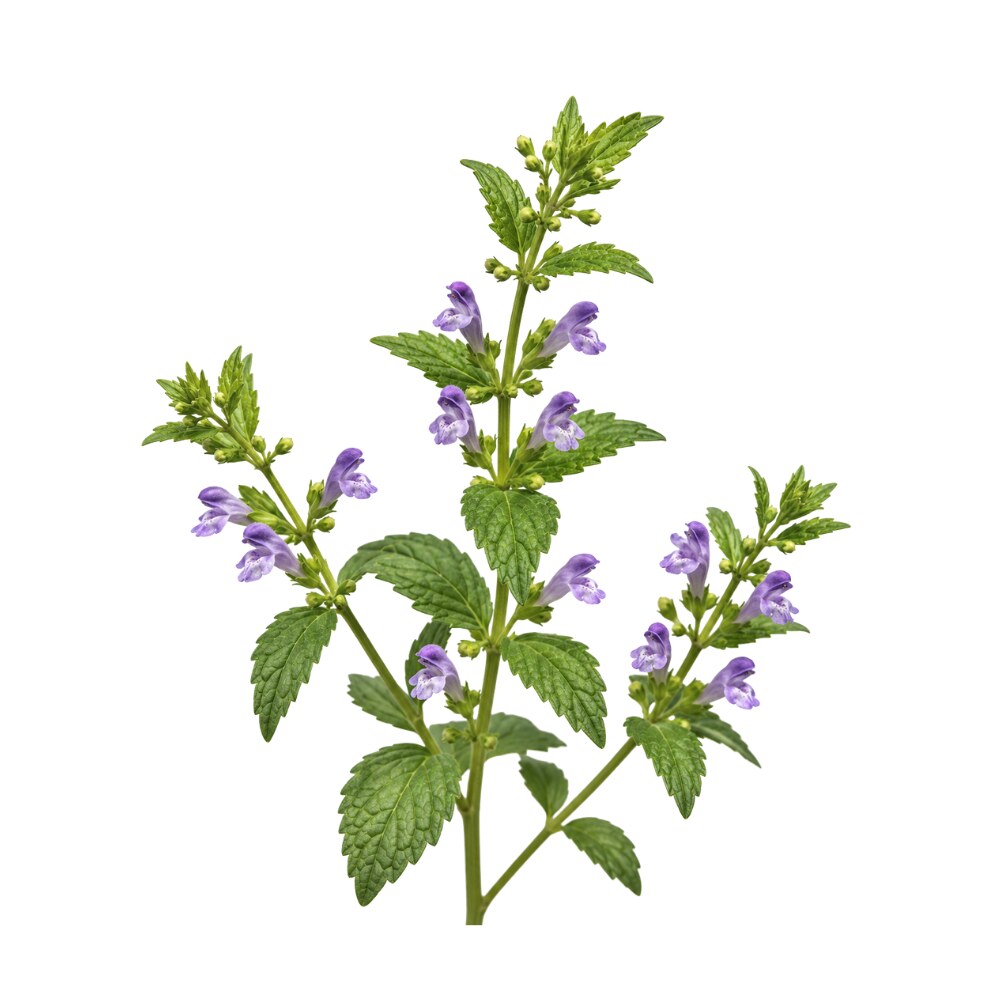
American skullcap is a perennial herb in the mint family (Lamiaceae). It grows 30–70 cm tall and branches occasionally 20,
Its stems are square, light green to pale reddish-green, and hairless or finely hairy. They tend to sprawl 20Reference 20Mad-Dog Skullcap (Scutellaria lateriflora) — species description, range and habitatView study →.
The leaves grow in opposite pairs on slender stalks up to 2.5 cm long. They are heart-shaped-oval to broadly lance-shaped, up to 7.5 cm long and 5 cm wide, with coarsely toothed edges and a clear network of veins 20Reference 20Mad-Dog Skullcap (Scutellaria lateriflora) — species description, range and habitatView study →.
The flowers grow in slender racemes up to 15 cm long, from the leaf axils and the stem tips, with the flowers mostly on one side 20,
The calyx has two lobes, with a small dish-like ridge on the upper one, typical of skullcaps. Each flower gives four nutlets in a two-lobed pod whose hollowed lobes resemble a skullcap, which gives the genus its common name 20Reference 20Mad-Dog Skullcap (Scutellaria lateriflora) — species description, range and habitatView study →.
The plant has a taproot and spreads by rhizomes or runners, forming small colonies 20Reference 20Mad-Dog Skullcap (Scutellaria lateriflora) — species description, range and habitatView study →.
American skullcap is a different species from Chinese skullcap (Scutellaria baicalensis). In Chinese skullcap the root is the medicine; in American skullcap it is the leaves and flowering tops 13,
Distribution
American skullcap is native to much of the United States, including Alaska, and to Canada 21Reference 21Scutellaria lateriflora — Native Plant Database (duration, size, bloom time, distribution)View study →. It grows in marshes, swamps, wet meadows, the shores of rivers and lakes, and the edges of wetlands 22Reference 22Scutellaria lateriflora (mad dog skullcap) — Go Botany species pageView study →.
It also grows in sedge meadows, soggy thickets, bogs, seeps and springs, and at the edges of ponds, often in partly shaded wetland openings 20Reference 20Mad-Dog Skullcap (Scutellaria lateriflora) — species description, range and habitatView study →.
Growing Conditions
Cultivation snapshot for American Skullcap
- Thrives in consistently moist to wet soil — it is a true wetland plant, at home along pond edges, streambanks and in rain gardens.
- Prefers full sun but tolerates light afternoon shade.
- Cold-hardy across a wide range (roughly USDA zones 3–9), dying back in winter and returning from its rootstock.
- Spreads by rhizomes and runners, forming loose colonies where moisture is reliable.
Grow it yourself
Farm Wiki is our cultivation-focused sister site, also run by Justin Cooke.
Pharmacology & Research
Research on American skullcap centres on the nervous system. Its flavones baicalin and baicalein bind the benzodiazepine site of the GABA-A receptor, its extracts bind the 5-HT7 serotonin receptor, and rats given the extract behaved as if less anxious 3,
Three small randomised trials in people have looked at anxiety, mood and sleep 1,
-
Best-supported: anxiolytic and mood-calming activity, with two small human RCTs and consistent animal data on a GABA-A / 5-HT7 mechanism 1,
2, ; and a first human RCT signal for sleep quality in primary insomnia 5Reference 5RCTEfficacy and tolerability of a chemically characterized Scutellaria lateriflora L. extract-based food supplement for sleep management: a single-center, controlled, randomised, crossover, double-blind clinical trialView study →.3, 4Reference 1RCTAn investigation into the efficacy of Scutellaria lateriflora in healthy volunteers — a double-blind, placebo-controlled randomised trialView study →Reference 2RCTAmerican Skullcap (Scutellaria lateriflora): a randomised, double-blind placebo-controlled crossover study of its effects on mood in healthy volunteersView study →Reference 3AnimalPhytochemical and biological analysis of skullcap (Scutellaria lateriflora L.): a medicinal plant with anxiolytic properties — animal modelView study →Reference 4In vitroInhibition of [3H]-LSD binding to 5-HT7 receptors by flavonoids from Scutellaria lateriflora — in vitroView study → -
Emerging, worth watching: antioxidant and neuroprotective effects in rodent brain tissue and a prion-disease mouse model 7,
10Reference 7AnimalAnti-oxidative and DNA protecting effects of flavonoids-rich Scutellaria lateriflora — mouse brain tissueView study →Reference 10In vitroA medicinal herb Scutellaria lateriflora inhibits PrP replication in vitro and delays the onset of prion disease in mice — in vivo animal modelView study → ; in-vitro inhibition of adrenal cortisol release 6Reference 6In vitroIn vitro assessment of cortisol release inhibition, bioaccessibility and bioavailability of a chemically characterized Scutellaria lateriflora L. hydroethanolic extract — in vitroView study →. - Mechanistically thin: anti-inflammatory activity rests largely on isolated baicalin in unrelated disease models rather than on the whole aerial-parts herb 11Reference 11In vitroBaicalin modulates the inflammatory response of macrophages activated by LPS via the calcium–CHOP pathway — in vitro. https://pubmed.ncbi.nlm.nih.gov/36231038/View study →.
-
The caveat: no standardised dose, wide product-to-product flavonoid variation, and a history of germander adulteration. The trials used specific characterised extracts 13,
14Reference 13Validation of a HPLC method for flavonoid biomarkers in skullcap (Scutellaria) and its use to illustrate wide variability in the quality of commercial tinctures — analytical study. https://pubmed.ncbi.nlm.nih.gov/18445366/View study →Reference 14Comparison of the phenolic component profiles of skullcap (Scutellaria lateriflora) and germander (Teucrium canadense and T. chamaedrys), a potentially hepatotoxic adulterantView study → .
Products vary widely. In one analysis of commercial tinctures, baicalin ranged from none at all to 12.66 mg/mL 13Reference 13Validation of a HPLC method for flavonoid biomarkers in skullcap (Scutellaria) and its use to illustrate wide variability in the quality of commercial tinctures — analytical study. https://pubmed.ncbi.nlm.nih.gov/18445366/View study →. Skullcap has also been adulterated with germander 14Reference 14Comparison of the phenolic component profiles of skullcap (Scutellaria lateriflora) and germander (Teucrium canadense and T. chamaedrys), a potentially hepatotoxic adulterantView study →. A trial result applies to the extract tested, not to every product sold as skullcap.
1. Anxiolytic
This is the herb’s best-studied use. In rats, extracts of the aerial parts increased entries into the centre of an open-field arena and the time spent on the open arms of the elevated plus-maze, a classic anxiolytic profile 3Reference 3AnimalPhytochemical and biological analysis of skullcap (Scutellaria lateriflora L.): a medicinal plant with anxiolytic properties — animal modelView study →.
The same study measured baicalin at 40 mg/g of a 50% ethanol extract, its aglycone baicalein at 33 mg/g of a 95% ethanol extract, and GABA at about 1.6 mg/g of water and ethanol extracts. Baicalin and baicalein bind the benzodiazepine site of the GABA-A receptor 3Reference 3AnimalPhytochemical and biological analysis of skullcap (Scutellaria lateriflora L.): a medicinal plant with anxiolytic properties — animal modelView study →.
In humans, an early double-blind, placebo-controlled trial in healthy volunteers reported noteworthy anxiolytic effects 1Reference 1RCTAn investigation into the efficacy of Scutellaria lateriflora in healthy volunteers — a double-blind, placebo-controlled randomised trialView study →.
A later double-blind, placebo-controlled crossover trial gave 43 healthy volunteers 350 mg three times daily for two weeks. Most (81%) were mildly anxious or less. Anxiety scores did not differ from placebo (p = 0.191). Total mood disturbance fell significantly from starting levels on skullcap (p < 0.001) but not on placebo, with no loss of energy or thinking 2Reference 2RCTAmerican Skullcap (Scutellaria lateriflora): a randomised, double-blind placebo-controlled crossover study of its effects on mood in healthy volunteersView study →.
A 2013 review of plant medicines for anxiety counted American skullcap among the herbs with some human trial support, while noting small samples, short trials and no replication 12Reference 12ReviewPlant-based medicines for anxiety disorders, part 2: a review of clinical studies with supporting preclinical evidence — reviewView study →.
Gap: the two RCTs are small, used healthy or minimally anxious volunteers rather than a diagnosed anxiety population, and one was null on its primary anxiety scale — no trial has yet tested it in clinically anxious patients.
2. Sedative / Sleep
American skullcap is traditionally used for insomnia and nervous tension 5Reference 5RCTEfficacy and tolerability of a chemically characterized Scutellaria lateriflora L. extract-based food supplement for sleep management: a single-center, controlled, randomised, crossover, double-blind clinical trialView study →. In a double-blind, placebo-controlled crossover trial, 66 adults aged 18–70 with mild-to-moderate primary insomnia took 400 mg a day of a dried extract standardised to 10% baicalin, or placebo, for 56 days each. Sleep quality on the Pittsburgh Sleep Quality Index improved, along with the time taken to fall asleep, sleep efficiency and total sleep time. No participant reported side effects 5Reference 5RCTEfficacy and tolerability of a chemically characterized Scutellaria lateriflora L. extract-based food supplement for sleep management: a single-center, controlled, randomised, crossover, double-blind clinical trialView study →.
The mechanism may overlap with the anxiolytic one, through the action of baicalin and baicalein at the GABA-A receptor 3Reference 3AnimalPhytochemical and biological analysis of skullcap (Scutellaria lateriflora L.): a medicinal plant with anxiolytic properties — animal modelView study →.
Gap: a single trial of one standardised extract; the result may not carry over to teas or other tinctures.
3. Antioxidant
Ethanol and water extracts scavenged DPPH radicals. The ethanol extract lowered reactive oxygen species and lipid peroxides in mouse brain tissue and protected plasmid DNA from damage by peroxide and UV light 7Reference 7AnimalAnti-oxidative and DNA protecting effects of flavonoids-rich Scutellaria lateriflora — mouse brain tissueView study →.
In an ORAC comparison of 55 medicinal herbs, S. lateriflora was among those with the highest radical-scavenging activity, alongside olive leaf, black cohosh, rhubarb and licorice 8Reference 8In vitroAntioxidant capacity of 55 medicinal herbs traditionally used to treat the urinary system — in vitro comparisonView study →.
A comparison of American, Chinese and S. racemosa skullcaps found no significant difference in antioxidant potential between the three, and measured baicalin, baicalein, scutellarin and wogonin in their leaves and stems 9Reference 9In vitroComparisons of Scutellaria baicalensis, Scutellaria lateriflora and Scutellaria racemosa: genome size, antioxidant potential and phytochemistry — in vitroView study →.
All of this is in vitro or in tissue samples. No human study has measured an antioxidant endpoint after taking skullcap.
4. Neuroprotective
Beyond the antioxidant effects in brain tissue 7Reference 7AnimalAnti-oxidative and DNA protecting effects of flavonoids-rich Scutellaria lateriflora — mouse brain tissueView study →, S. lateriflora extract and its flavones baicalein and baicalin reduced the build-up of infectious prion protein in scrapie-infected cell cultures. Skullcap tea given by mouth significantly delayed the onset of disease in scrapie-infected mice 10Reference 10In vitroA medicinal herb Scutellaria lateriflora inhibits PrP replication in vitro and delays the onset of prion disease in mice — in vivo animal modelView study →.
A hot-water extract inhibited binding at the 5-HT7 serotonin receptor by 87% at 100 µg/mL. Scutellarin was among the active flavones, with an IC50 of about 63 µM 4Reference 4In vitroInhibition of [3H]-LSD binding to 5-HT7 receptors by flavonoids from Scutellaria lateriflora — in vitroView study →. This receptor is involved in mood and circadian rhythm.
All of this is preclinical, in unrelated models, with no human evidence.
5. Anti-Inflammatory
Most of the anti-inflammatory evidence concerns isolated flavones. Baicalin, at 10–50 µM, lowered inflammatory cytokines and reactive oxygen species in mouse macrophages stimulated with bacterial endotoxin, through a calcium–CHOP pathway 11Reference 11In vitroBaicalin modulates the inflammatory response of macrophages activated by LPS via the calcium–CHOP pathway — in vitro. https://pubmed.ncbi.nlm.nih.gov/36231038/View study →.
The only whole-herb human data come from a randomised, placebo-controlled trial of a chewing gum combining S. lateriflora with Cistus × incanus. In 60 adults with gingivitis, gum bleeding and inflammation scores improved over three months 16Reference 16RCTEfficacy and tolerability of a Scutellaria lateriflora L. and Cistus × incanus L.-based chewing gum on the symptoms of gingivitis: a monocentric, randomised, double-blind, placebo-controlled clinical trialView study →. Because it was a combination product, the effect cannot be attributed to skullcap alone.
Gap: the herb-specific evidence is one combination trial; the rest is constituent-level work at concentrations a cup of skullcap tea would not reach.
Mechanisms
The flavones baicalin and baicalein bind the benzodiazepine site of the GABA-A receptor, and the flavones in the extract, including scutellarin, bind the 5-HT7 serotonin receptor 3,
A hydroethanolic extract inhibited cortisol release from human adrenal cells in vitro. In a model of digestion and gut absorption, oroxylin A and its glucuronide were the only constituents that crossed the gut-cell layer 6Reference 6In vitroIn vitro assessment of cortisol release inhibition, bioaccessibility and bioavailability of a chemically characterized Scutellaria lateriflora L. hydroethanolic extract — in vitroView study →.
| Mechanism | Drives | Key compounds |
|---|---|---|
| GABA-A receptor (benzodiazepine site) binding | anxiolyticsedative / sleep | baicalin, baicalein |
| 5-HT7 serotonin-receptor binding | anxiolyticneuroprotective | scutellarin |
| Free-radical scavenging (DPPH/ROS ↓, lipid peroxidation ↓) | antioxidantneuroprotective | flavonoid-rich extract |
| Adrenal cortisol-release inhibition (in vitro) | anti-stress | hydroethanolic extract |
| Inflammatory cytokines ↓ in macrophages | anti-inflammatory | baicalin |
Clinical Trials
Three small human trials of S. lateriflora on its own have been completed, for anxiety, mood and sleep, plus one combination oral-health trial. A ClinicalTrials.gov search returned two registered entries, both completed and neither a skullcap-only product.
| Completed | Planned | Terminated | Preclinical |
|---|---|---|---|
| 4 | 0 | 0 | ~30+ |
Last checked: July 2026.
Phytochemistry
The aerial parts of American skullcap are rich in flavones and their glycosides. A 70% ethanol extract is dominated by baicalin, lateriflorin, dihydrobaicalin and baicalein 18Reference 18Analysis of Scutellaria lateriflora and its adulterants Teucrium canadense and Teucrium chamaedrys by LC-UV/MS, TLC, and digital photomicroscopyView study →. Lateriflorin was first isolated from this species 4Reference 4In vitroInhibition of [3H]-LSD binding to 5-HT7 receptors by flavonoids from Scutellaria lateriflora — in vitroView study →.
The aerial parts hold more of these flavonoids than the root 15Reference 15Comparison of the major flavonoid content of S. baicalensis, S. lateriflora, and their commercial products — comparative studyView study →. Scutellarin, wogonin and the neurohormones melatonin and serotonin have been measured in the leaves and stems 9Reference 9In vitroComparisons of Scutellaria baicalensis, Scutellaria lateriflora and Scutellaria racemosa: genome size, antioxidant potential and phytochemistry — in vitroView study →. Oroxylin A and its glucuronide are present in extracts 6Reference 6In vitroIn vitro assessment of cortisol release inhibition, bioaccessibility and bioavailability of a chemically characterized Scutellaria lateriflora L. hydroethanolic extract — in vitroView study →. Wogonoside, chrysin, apigenin and scutellarein are also listed among its flavones.
Germander, the known adulterant, has a different profile. Its main phenolics are the phenylethanoids verbascoside and teucrioside, which are absent from skullcap, and this difference is used to detect adulteration 14,
Flavonoid content varies widely between products. In seven commercial tinctures of American skullcap, baicalin ranged from 0 to 12.66 mg/mL 13Reference 13Validation of a HPLC method for flavonoid biomarkers in skullcap (Scutellaria) and its use to illustrate wide variability in the quality of commercial tinctures — analytical study. https://pubmed.ncbi.nlm.nih.gov/18445366/View study →.
Constituent Summary
Amounts are mg per gram of dried herb, from a freeze-dried commercial sample. Lateriflorin (†) is characteristic of S. lateriflora.
Flavonoids11 compounds3 with data
Dosage
The human trials used whole aerial-parts capsules and a standardised extract.
| Indication | Preparation | Dose | Est. dried-herb equivalent | Source |
|---|---|---|---|---|
| Anxiety / mood | S. lateriflora capsule | 350 mg three times daily (1,050 mg/day), 2 weeks | ~1 g/day, if the capsule held whole dried herb | 2Reference 2RCTAmerican Skullcap (Scutellaria lateriflora): a randomised, double-blind placebo-controlled crossover study of its effects on mood in healthy volunteersView study → |
| Sleep / primary insomnia | Dried extract standardised to 10% baicalin | 400 mg/day, 56 days | — (extract ratio not stated) | 5Reference 5RCTEfficacy and tolerability of a chemically characterized Scutellaria lateriflora L. extract-based food supplement for sleep management: a single-center, controlled, randomised, crossover, double-blind clinical trialView study → |
Traditional Dosage
Western herbal practice uses the dried aerial parts, most often as a tincture or fresh-plant extract. Fresh, well-kept material is preferred.
| System | Preparation | Dose |
|---|---|---|
| Western herbal | Tincture (1:2 fluid extract) | 15–30 mL/week (≈2–4 mL/day) |
| Western herbal | Tincture (1:5) | 2–5 mL, up to three times daily |
| Western herbal | Dried herb infusion (tea) | 1–2 g per cup, 1–3 cups daily |
Safety & Pregnancy
American skullcap is well tolerated when it is correctly identified. The main cautions are its mild sedative action and the risk of buying germander in its place.
- Well tolerated. No serious side effects were reported in the human trials 1,
2, .5Reference 1RCTAn investigation into the efficacy of Scutellaria lateriflora in healthy volunteers — a double-blind, placebo-controlled randomised trialView study →Reference 2RCTAmerican Skullcap (Scutellaria lateriflora): a randomised, double-blind placebo-controlled crossover study of its effects on mood in healthy volunteersView study →Reference 5RCTEfficacy and tolerability of a chemically characterized Scutellaria lateriflora L. extract-based food supplement for sleep management: a single-center, controlled, randomised, crossover, double-blind clinical trialView study → - Adulteration. Skullcap has been adulterated with germander, which contains potentially liver-toxic compounds — buy botanically verified material 14,
19Reference 14Comparison of the phenolic component profiles of skullcap (Scutellaria lateriflora) and germander (Teucrium canadense and T. chamaedrys), a potentially hepatotoxic adulterantView study →Reference 19Skullcap and germander: preventing potential toxicity through the application of hyperspectral imaging and multivariate image analysis as a novel quality control method — analytical studyView study → . - Sedative interactions. A mild sedative — take care with sedatives, sleep medication or alcohol.
- Pregnancy & breastfeeding. Not studied; use with caution.
Full Safety & Interactions Detail
Tolerability. No serious side effects were reported in the completed trials of characterised products, and no participant in the sleep trial reported any 1,
Germander adulteration. Reports of liver injury from skullcap products have been attributed to adulteration 19Reference 19Skullcap and germander: preventing potential toxicity through the application of hyperspectral imaging and multivariate image analysis as a novel quality control method — analytical studyView study →. Germander (Teucrium canadense and T. chamaedrys), which contains potentially liver-toxic diterpenes, is the documented adulterant 14,
Product quality. Flavonoid content varies widely between products, and some commercial tinctures contain no measurable baicalin 13,
Sedatives. As a mild sedative, American skullcap may add to the effect of sedative drugs, sleep medication or alcohol. No formal drug-interaction study has been done.
Use with caution. There are no studies of American skullcap in pregnancy or breastfeeding.
References
- Wolfson, P., & Hoffmann, D. L. (2003). An investigation into the efficacy of Scutellaria lateriflora in healthy volunteers — a double-blind, placebo-controlled randomised trial. Alternative Therapies in Health and Medicine. https://pubmed.ncbi.nlm.nih.gov/12652886/
- Brock, C., Whitehouse, J., Tewfik, I., & Towell, T. (2014). American Skullcap (Scutellaria lateriflora): a randomised, double-blind placebo-controlled crossover study of its effects on mood in healthy volunteers. Phytotherapy Research. https://pubmed.ncbi.nlm.nih.gov/23878109/
- Awad, R., Arnason, J. T., Trudeau, V., et al. (2003). Phytochemical and biological analysis of skullcap (Scutellaria lateriflora L.): a medicinal plant with anxiolytic properties — animal model. Phytomedicine. https://pubmed.ncbi.nlm.nih.gov/14692724/
- Gafner, S., Bergeron, C., Batcha, L. L., et al. (2003). Inhibition of [3H]-LSD binding to 5-HT7 receptors by flavonoids from Scutellaria lateriflora — in vitro. Journal of Natural Products. https://pubmed.ncbi.nlm.nih.gov/12713409/
- Di Minno, A., Morone, M. V., Buccato, D. G., et al. (2025). Efficacy and tolerability of a chemically characterized Scutellaria lateriflora L. extract-based food supplement for sleep management: a single-center, controlled, randomised, crossover, double-blind clinical trial. Nutrients. https://pubmed.ncbi.nlm.nih.gov/40362800/
- Buccato, D. G., Ullah, H., De Lellis, L. F., et al. (2024). In vitro assessment of cortisol release inhibition, bioaccessibility and bioavailability of a chemically characterized Scutellaria lateriflora L. hydroethanolic extract — in vitro. Molecules. https://pubmed.ncbi.nlm.nih.gov/38338331/
- Lohani, M., Ahuja, M., Buabeid, M. A., et al. (2013). Anti-oxidative and DNA protecting effects of flavonoids-rich Scutellaria lateriflora — mouse brain tissue. Natural Product Communications. https://pubmed.ncbi.nlm.nih.gov/24354189/
- Wojcikowski, K., Stevenson, L., Leach, D., et al. (2007). Antioxidant capacity of 55 medicinal herbs traditionally used to treat the urinary system — in vitro comparison. Journal of Alternative and Complementary Medicine. https://pubmed.ncbi.nlm.nih.gov/17309384/
- Cole, I. B., Cao, J., Alan, A. R., et al. (2008). Comparisons of Scutellaria baicalensis, Scutellaria lateriflora and Scutellaria racemosa: genome size, antioxidant potential and phytochemistry — in vitro. Planta Medica. https://pubmed.ncbi.nlm.nih.gov/18484546/
- Eiden, M., Leidel, F., Strohmeier, B., et al. (2012). A medicinal herb Scutellaria lateriflora inhibits PrP replication in vitro and delays the onset of prion disease in mice — in vivo animal model. Prion. https://pubmed.ncbi.nlm.nih.gov/22363300/
- An, H. J., Lee, J. Y., Park, W., et al. (2022). Baicalin modulates the inflammatory response of macrophages activated by LPS via the calcium–CHOP pathway — in vitro. https://pubmed.ncbi.nlm.nih.gov/36231038/
- Sarris, J., McIntyre, E., & Camfield, D. A. (2013). Plant-based medicines for anxiety disorders, part 2: a review of clinical studies with supporting preclinical evidence — review. CNS Drugs. https://pubmed.ncbi.nlm.nih.gov/23653088/
- Gao, J., Sanchez-Medina, A., Pendry, B. A., et al. (2008). Validation of a HPLC method for flavonoid biomarkers in skullcap (Scutellaria) and its use to illustrate wide variability in the quality of commercial tinctures — analytical study. https://pubmed.ncbi.nlm.nih.gov/18445366/
- Lin, L. Z., Harnly, J. M., & Upton, R. (2009). Comparison of the phenolic component profiles of skullcap (Scutellaria lateriflora) and germander (Teucrium canadense and T. chamaedrys), a potentially hepatotoxic adulterant. Phytochemical Analysis. https://pubmed.ncbi.nlm.nih.gov/19402188/
- Makino, T., Hishida, A., Goda, Y., et al. (2008). Comparison of the major flavonoid content of S. baicalensis, S. lateriflora, and their commercial products — comparative study. Journal of Natural Medicines. https://pubmed.ncbi.nlm.nih.gov/18404307/
- Di Minno, A., Ullah, H., De Lellis, L. F., et al. (2024). Efficacy and tolerability of a Scutellaria lateriflora L. and Cistus × incanus L.-based chewing gum on the symptoms of gingivitis: a monocentric, randomised, double-blind, placebo-controlled clinical trial. Nutrients. https://pubmed.ncbi.nlm.nih.gov/38542772/
- Shen, J., Li, P., Liu, S., et al. (2021). Traditional uses, ten-years research progress on phytochemistry and pharmacology, and clinical studies of the genus Scutellaria — systematic review. Journal of Ethnopharmacology. https://pubmed.ncbi.nlm.nih.gov/32739568/
- Gafner, S., Bergeron, C., Batcha, L. L., et al. (2003). Analysis of Scutellaria lateriflora and its adulterants Teucrium canadense and Teucrium chamaedrys by LC-UV/MS, TLC, and digital photomicroscopy. Journal of AOAC International. https://pubmed.ncbi.nlm.nih.gov/12852558/
- Sandasi, M., Vermaak, I., Chen, W., & Viljoen, A. M. (2014). Skullcap and germander: preventing potential toxicity through the application of hyperspectral imaging and multivariate image analysis as a novel quality control method — analytical study. Planta Medica. https://pubmed.ncbi.nlm.nih.gov/25184892/
- Hilty, J. Mad-Dog Skullcap (Scutellaria lateriflora) — species description, range and habitat. Illinois Wildflowers. https://www.illinoiswildflowers.info/wetland/plants/md_skullcap.htm
- Lady Bird Johnson Wildflower Center. Scutellaria lateriflora — Native Plant Database (duration, size, bloom time, distribution). The University of Texas at Austin. https://www.wildflower.org/plants/result.php?id_plant=SCLA2
- Native Plant Trust. Scutellaria lateriflora (mad dog skullcap) — Go Botany species page. https://gobotany.nativeplanttrust.org/species/scutellaria/lateriflora/



