
Materia Medica
Henbane ☠️
Hyoscyamus niger
Henbane (Hyoscyamus niger) is a sticky, foul-smelling nightshade of disturbed ground. Every part carries the tropane alkaloids hyoscyamine and scopolamine, and its root has been dug and eaten in mistake for parsnip.
What Is Henbane?
Henbane is a poisonous nightshade of waste ground, and the one most often dug up and eaten by mistake.
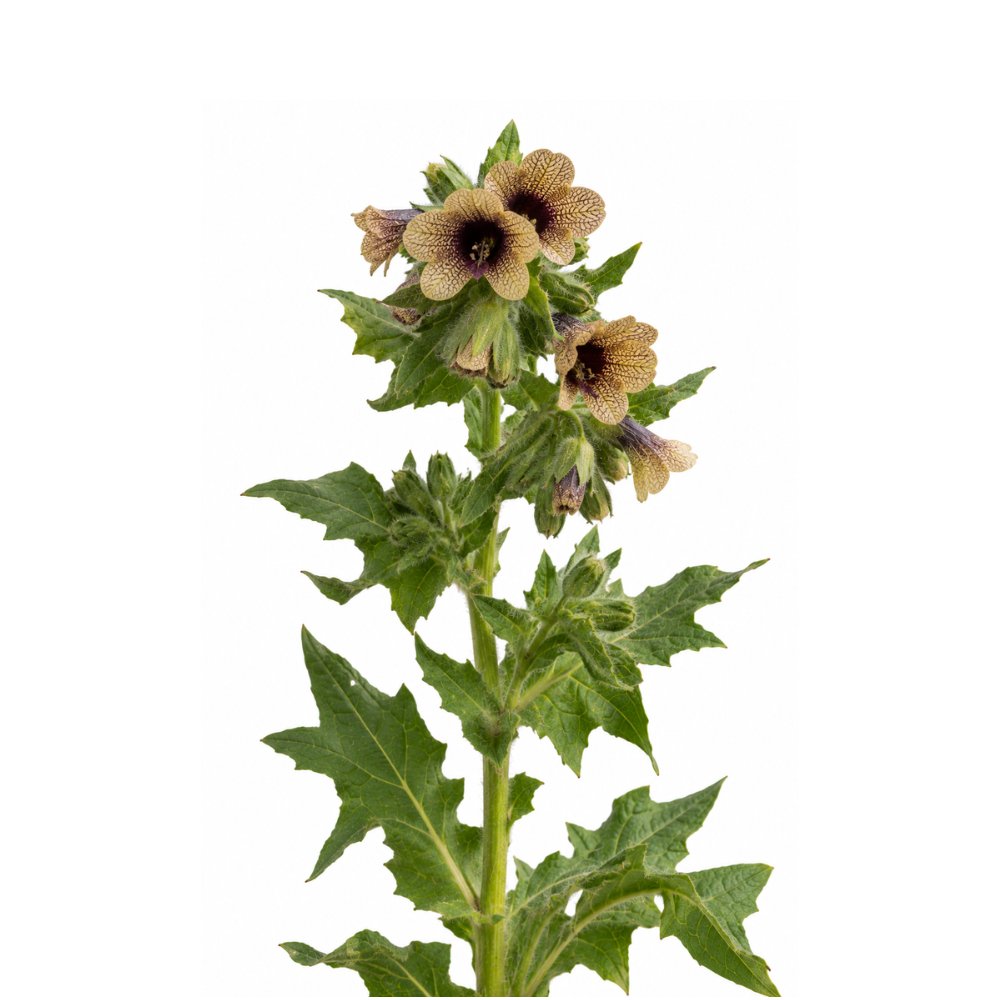
Hyoscyamus niger is a sprawling, sticky, foul-smelling annual or biennial of waste ground, dunes, farmyards and disturbed soil across Europe and western Asia. Its flowers are pale cream-yellow funnels laced with a dense network of purple veins, with a dark purple throat.
It sits alongside deadly nightshade, mandrake and datura among the classical soporific poisons, and it shares their tropane alkaloids: hyoscyamine, scopolamine and atropine.
Its particular danger is the root. Thick, pale and fleshy, it has repeatedly been dug and cooked in mistake for parsnip, salsify or chicory. Because a root is shared around a meal, henbane produces family-cluster poisonings in a way berry-eating rarely does.
It has no modern herbal use. Scopolamine and hyoscine butylbromide are extracted and given as measured pharmaceuticals. The plant itself left the pharmacy because its alkaloid content cannot be judged by eye and the margin between an active and a dangerous dose is narrow.
Identification & Lookalikes
The root is what gets eaten, and a root has nothing to identify it by once it is out of the ground. That is why henbane poisonings tend to involve several people at once.
| Confused with | How it actually differs |
|---|---|
| Parsnip and salsify | The classic and best-documented confusion. Both are pale fleshy taproots; henbane’s foliage is sticky-hairy and foul-smelling where parsnip’s is not — but the foliage is usually discarded before anyone looks |
| Chicory root | Also dug from rough ground and roasted. Chicory has blue daisy-like flowers and a milky sap; henbane has veined cream funnels and no latex |
| Burdock root | Another commonly foraged taproot from disturbed ground; burdock’s leaves are huge, soft and grey-woolly beneath, with hooked burs later |
| Comfrey | Gathered for the root as well as the leaf, from similar ground. Comfrey is a clump-forming perennial covered in rough bristly hairs, with a stout purplish-brown root. Its upper leaves run down the stem in narrow wings, and its small tubular flowers, 1.4–1.5 cm long and purple, red or cream, come in many-flowered clusters 10Reference 10Zhu, G., Riedl, H., & Kamelin, R. V. Symphytum officinale Linnaeus — species description and distribution — flora. In Wu, Z. Y., & Raven, P. H. (eds.), Flora of China, Vol. 16 (Boraginaceae). http://www.efloras.org/florataxon.aspx?flora_id=2&taxon_id=200019185View study →. Henbane is sticky-hairy all over, its leaves are coarsely toothed or lobed and clasp the stem, and its pale yellow bells are 2–3 cm long and usually veined in purple 7Reference 7Zhang, Z. Y., Lu, A. M., & D’Arcy, W. G. Hyoscyamus niger Linnaeus — species description and distribution — flora. In Wu, Z. Y., & Raven, P. H. (eds.), Flora of China, Vol. 17 (Solanaceae). http://www.efloras.org/florataxon.aspx?flora_id=2&taxon_id=200020521View study → |
Smell, hairs and seed capsules. The whole plant is covered in sticky glandular hairs and smells strongly and unpleasantly, described as anything from foetid to “like stale sweat.” The smell is a genuine warning sign and the source of one of its common names, stinking nightshade. Its seed capsules are distinctive: urn-shaped, arranged in a one-sided row, and opening by a neat lid.
⚠ Cooking removes the smell. Once the leaves are gone and the root is in a pot, the one warning the plant gives has been thrown away. Identify a root in the ground, with its leaves and flowers attached, or do not eat it.
Botany
Henbane belongs to the nightshade family, Solanaceae, alongside deadly nightshade, datura, mandrake and the food nightshades 6Reference 6Vincent, M. A. Hyoscyamus niger Linnaeus — species description, habitat and distribution — flora. In Flora of North America Editorial Committee (eds.), Flora of North America North of Mexico, Vol. 14 (Solanaceae; family treatment by J. R. Sullivan). http://www.efloras.org/florataxon.aspx?flora_id=1&taxon_id=200020521View study →.
Henbane is an annual or biennial herb that grows 30 cm to 1.2 m tall 6Reference 6Vincent, M. A. Hyoscyamus niger Linnaeus — species description, habitat and distribution — flora. In Flora of North America Editorial Committee (eds.), Flora of North America North of Mexico, Vol. 14 (Solanaceae; family treatment by J. R. Sullivan). http://www.efloras.org/florataxon.aspx?flora_id=1&taxon_id=200020521View study →. The whole plant is covered in sticky glandular hairs 7Reference 7Zhang, Z. Y., Lu, A. M., & D’Arcy, W. G. Hyoscyamus niger Linnaeus — species description and distribution — flora. In Wu, Z. Y., & Raven, P. H. (eds.), Flora of China, Vol. 17 (Solanaceae). http://www.efloras.org/florataxon.aspx?flora_id=2&taxon_id=200020521View study →. It grows from a taproot that can be stout and fleshy, 2–3 cm across 7Reference 7Zhang, Z. Y., Lu, A. M., & D’Arcy, W. G. Hyoscyamus niger Linnaeus — species description and distribution — flora. In Wu, Z. Y., & Raven, P. H. (eds.), Flora of China, Vol. 17 (Solanaceae). http://www.efloras.org/florataxon.aspx?flora_id=2&taxon_id=200020521View study →.
Its leaves are 5–30 cm long and coarsely toothed or lobed 6Reference 6Vincent, M. A. Hyoscyamus niger Linnaeus — species description, habitat and distribution — flora. In Flora of North America Editorial Committee (eds.), Flora of North America North of Mexico, Vol. 14 (Solanaceae; family treatment by J. R. Sullivan). http://www.efloras.org/florataxon.aspx?flora_id=1&taxon_id=200020521View study →. The upper leaves clasp the stem at their base, and the lower leaves sometimes form a rosette 6,
The flowers grow in a leafy terminal spike. Each corolla is a funnel 2.5–4.5 cm long, pale yellow to greenish yellow, with purple veins and a purple throat 6Reference 6Vincent, M. A. Hyoscyamus niger Linnaeus — species description, habitat and distribution — flora. In Flora of North America Editorial Committee (eds.), Flora of North America North of Mexico, Vol. 14 (Solanaceae; family treatment by J. R. Sullivan). http://www.efloras.org/florataxon.aspx?flora_id=1&taxon_id=200020521View study →.
The fruit is a capsule held inside the rigid, urn-shaped calyx, which ends in sharp-tipped lobes 6,
All parts are poisonous, with the root generally richest and the seeds also highly concentrated.
Distribution
Henbane grows across Europe, North Africa and temperate Asia, from southwest Asia and the Caucasus through Central Asia, the Himalaya and Siberia to China, Korea and Japan 6,
It grows on light, disturbed, fertile ground: roadsides, field margins, sand dunes, rabbit warrens, refuse tips, old gravel pits and waste places, mostly on chalky or free-draining soils 8,
Henbane was probably brought to North America in the 17th century as a medicinal and ornamental plant 9Reference 9Black henbane: identification, biology and integrated management — North American introduction, noxious-weed listings and Montana distributionView study →. It is now recorded in 27 US states and through much of Canada, and it is also introduced in South America, southern Africa and Australia 6Reference 6Vincent, M. A. Hyoscyamus niger Linnaeus — species description, habitat and distribution — flora. In Flora of North America Editorial Committee (eds.), Flora of North America North of Mexico, Vol. 14 (Solanaceae; family treatment by J. R. Sullivan). http://www.efloras.org/florataxon.aspx?flora_id=1&taxon_id=200020521View study →.
In North America it is a listed noxious weed. It is state-listed in California, Colorado, Idaho, Kansas, Nevada, New Mexico, South Dakota, Utah, Washington and Wyoming 9Reference 9Black henbane: identification, biology and integrated management — North American introduction, noxious-weed listings and Montana distributionView study →. In Montana it had been reported in 49 of 56 counties by 2025, and it is on the noxious-weed lists of 14 counties there 9Reference 9Black henbane: identification, biology and integrated management — North American introduction, noxious-weed listings and Montana distributionView study →. The concern is livestock poisoning and the invasion of pasture and rangeland 9Reference 9Black henbane: identification, biology and integrated management — North American introduction, noxious-weed listings and Montana distributionView study →.
In Britain it is classified as Vulnerable 8Reference 8D., Smart, SView study →. Its occurrences have almost halved since 2000 8Reference 8D., Smart, SView study →. The decline is put down to herbicides and weed control on farmland (because the plant poisons livestock), the tidying of waste and derelict land, and the long decline in its cultivation as a medicine 8Reference 8D., Smart, SView study →.
Sourcing: henbane material in trade comes from the introduced weedy range or from cultivation, not from the declining European populations.
Phytochemistry
Henbane’s chemistry is the tropane alkaloids: hyoscyamine and scopolamine, with atropine appearing largely as a racemisation product of hyoscyamine during extraction.
Compared with deadly nightshade, henbane is generally the richer source of scopolamine. Scopolamine is the more centrally active of the two, and its poisonings lean toward delirium and sedation.
Content varies with plant part, age and provenance. The seeds and root carry the highest concentrations.
Toxicology
Class of poison. Tropane alkaloids, which are competitive muscarinic acetylcholine receptor antagonists.
Mechanism. Hyoscyamine and scopolamine competitively block muscarinic receptors, shutting down parasympathetic signalling in the body. Scopolamine crosses the blood–brain barrier readily, so the brain is affected as well. The presentation is the antimuscarinic toxidrome: hyperthermia, dilated unreactive pupils, dry mouth and skin, flushing, tachycardia, urinary retention, absent bowel sounds and delirium.
Course. Onset comes within 30 minutes to a few hours, and the poisoning is prolonged. Central effects run 24 to 48 hours, and visual disturbance persists longer. Henbane’s scopolamine-weighted profile tends to produce marked sedation and confusion alongside the agitation, and amnesia for the episode is usual.
The cluster pattern. The root is the part most often eaten, and it is cooked into a shared meal. Henbane therefore characteristically poisons several members of a household at once. This presentation has repeatedly been mistaken for food poisoning or an infectious outbreak before the plant was identified.
Potency. No reliable figure exists for plant material. Seeds and root carry the highest alkaloid load, and content varies several-fold with provenance and season.
Antidote — yes. Physostigmine reverses central antimuscarinic delirium and is given under cardiac monitoring. Otherwise care is supportive: benzodiazepines for agitation, cooling, catheterisation for urinary retention, and heart-rhythm monitoring.
Fatalities. Deaths are documented but less common than severe non-fatal poisoning. Most cases recover with supportive care.
Traditional & Historical Use
European Folk Medicine
Medicine and anaesthesia. Henbane belongs to the same historical tradition as mandrake and belladonna: the soporific and surgical anaesthetic group of the pre-modern European pharmacy.
It was an ingredient of the spongia somnifera, the “sleeping sponge” of medieval surgery. The sponge was soaked in a decoction of henbane, mandrake and opium, dried, and moistened again to be held under a patient’s nose before an operation.
It was also used against pain, particularly toothache. The seeds were thrown onto hot coals and the smoke was directed at the affected tooth. The practice persisted into the nineteenth century as a travelling-quack remedy, in which “tooth worms” were produced as proof of cure.
Nineteenth-century pharmacy carried henbane leaf and its tincture as official drugs. They were displaced once the alkaloids could be isolated and assayed.
Witchcraft, Ritual and Beer
Henbane appears in the flying-ointment literature alongside belladonna and mandrake, its alkaloids absorbed through the skin.
It also has a documented role in brewing. Before hops became standard, gruit ales in parts of northern Europe were bittered with mixtures that could include henbane. The Bavarian purity law of 1516 is sometimes read as targeting that practice. The German town of Pilsen takes its brewing name from a root related to Bilsenkraut, the German name for the plant.
The Drugs Derived From It
Henbane is a commercial source of scopolamine (hyoscine), which remains a working pharmaceutical.
Scopolamine is used as a transdermal patch for motion sickness and for post-operative nausea, and as an antisecretory agent in palliative care. Its quaternary derivative, hyoscine butylbromide, cannot cross into the brain and is widely used as an antispasmodic for gut and urinary cramping.
The doses are micrograms to low milligrams, formulated for controlled delivery. No preparation of the plant can be dosed that precisely, which is why the plant left the pharmacy.
Safety & Pregnancy
Henbane is lethally poisonous in every part, with the root and seed richest. It has no safe preparation and no herbal use.
- Never ingest any part. The root is the part most often eaten by accident and among the most concentrated.
- A root poisons a whole household. Cooked into a shared meal, henbane characteristically presents as a cluster — do not assume food poisoning.
- Suspected ingestion is an emergency. Symptoms are delayed and the delirium lasts days.
- Burning seeds releases active alkaloids. The smoke is a genuine exposure route, historically used deliberately.
- Avoid in pregnancy and lactation entirely.
- An antidote exists. Physostigmine reverses the central syndrome.
Full Safety Detail
The root. Every part of Hyoscyamus niger carries tropane alkaloids, with the root and seed richest. Most real-world poisonings come from the root dug in mistake for parsnip, salsify or chicory. The confusion recurs in the case literature and characteristically affects several people from one meal.
The clinical picture. Poisoning produces the antimuscarinic toxidrome, weighted toward the central effects because henbane is comparatively rich in scopolamine. Sedation, confusion, agitated delirium, hallucination and amnesia are usual, alongside dilated pupils, dry skin, urinary retention and a fast heart rate. Effects persist for 24 to 48 hours, and visual disturbance lasts longer.
Smoke. Burning the seed releases the alkaloids into the smoke, and breathing it in is an effective route of exposure. It was once used deliberately for toothache, and it is a hazard wherever seed-bearing plants are burned.
Treatment. Physostigmine is an effective antidote for the central syndrome, given under cardiac monitoring. Care is otherwise supportive.
Drug interactions. There is no herbal preparation, so there is no herb–drug interaction profile. The relevant interactions belong to the isolated pharmaceutical alkaloids.
Avoid entirely. Tropane alkaloids cross the placenta, and no exposure is appropriate at any stage of pregnancy or lactation.
References
- Alizadeh, A., Moshiri, M., Alizadeh, J., & Balali-Mood, M. (2014). Black henbane and its toxicity — a descriptive review. Avicenna Journal of Phytomedicine, 4(5), 297–311. https://pubmed.ncbi.nlm.nih.gov/25386392/
- Sands, J. M., & Sands, R. (1976). Henbane chewing — anticholinergic poisoning from the seeds. Medical Journal of Australia. https://pubmed.ncbi.nlm.nih.gov/979798/
- Doneray, H., Orbak, Z., & Karakelleoglu, C. (2007). Clinical outcomes in children with Hyoscyamus niger intoxication not receiving physostigmine. European Journal of Emergency Medicine. https://pubmed.ncbi.nlm.nih.gov/17968201/
- Dawson, A. H., & Buckley, N. A. (2016). Pharmacological management of anticholinergic delirium — theory, evidence and practice. British Journal of Clinical Pharmacology, 81(3), 516–524. https://pubmed.ncbi.nlm.nih.gov/26589572/
- Lee, M. R. (2006). Solanaceae III: henbane, hags and Hawley Harvey Crippen — historical review. Journal of the Royal College of Physicians of Edinburgh. https://pubmed.ncbi.nlm.nih.gov/17526134/
- Vincent, M. A. Hyoscyamus niger Linnaeus — species description, habitat and distribution — flora. In Flora of North America Editorial Committee (eds.), Flora of North America North of Mexico, Vol. 14 (Solanaceae; family treatment by J. R. Sullivan). http://www.efloras.org/florataxon.aspx?flora_id=1&taxon_id=200020521
- Zhang, Z. Y., Lu, A. M., & D’Arcy, W. G. Hyoscyamus niger Linnaeus — species description and distribution — flora. In Wu, Z. Y., & Raven, P. H. (eds.), Flora of China, Vol. 17 (Solanaceae). http://www.efloras.org/florataxon.aspx?flora_id=2&taxon_id=200020521
- Dines, T. D., Smart, S. M., & Walker, K. J. Hyoscyamus niger L. — status, habitat, trend and GB Red List category. BSBI Online Plant Atlas 2020, Botanical Society of Britain and Ireland. https://bsbi.org/taxa/2cd4p9h.fcr/hyoscyamus-niger
- Pokorny, M., Mangold, J., & Stoy, D. (2026). Black henbane: identification, biology and integrated management — North American introduction, noxious-weed listings and Montana distribution. MontGuide MT201005AG (revised 03/26), Montana State University Extension. https://extension-store.montana.edu/assets/publications/montguidepdfs/mt201005ag-black-henbane-rev03.26.pdf
- Zhu, G., Riedl, H., & Kamelin, R. V. Symphytum officinale Linnaeus — species description and distribution — flora. In Wu, Z. Y., & Raven, P. H. (eds.), Flora of China, Vol. 16 (Boraginaceae). http://www.efloras.org/florataxon.aspx?flora_id=2&taxon_id=200019185



