
Materia Medica
Deadly Nightshade ☠️
Atropa belladonna
Deadly nightshade (Atropa belladonna) is a poisonous European nightshade whose sweet, glossy black berries children eat willingly. It is the plant source of atropine and carries the tropane alkaloids hyoscyamine and scopolamine.
What Is Deadly Nightshade?
Deadly nightshade is a poisonous European nightshade whose sweet black berries children eat willingly.
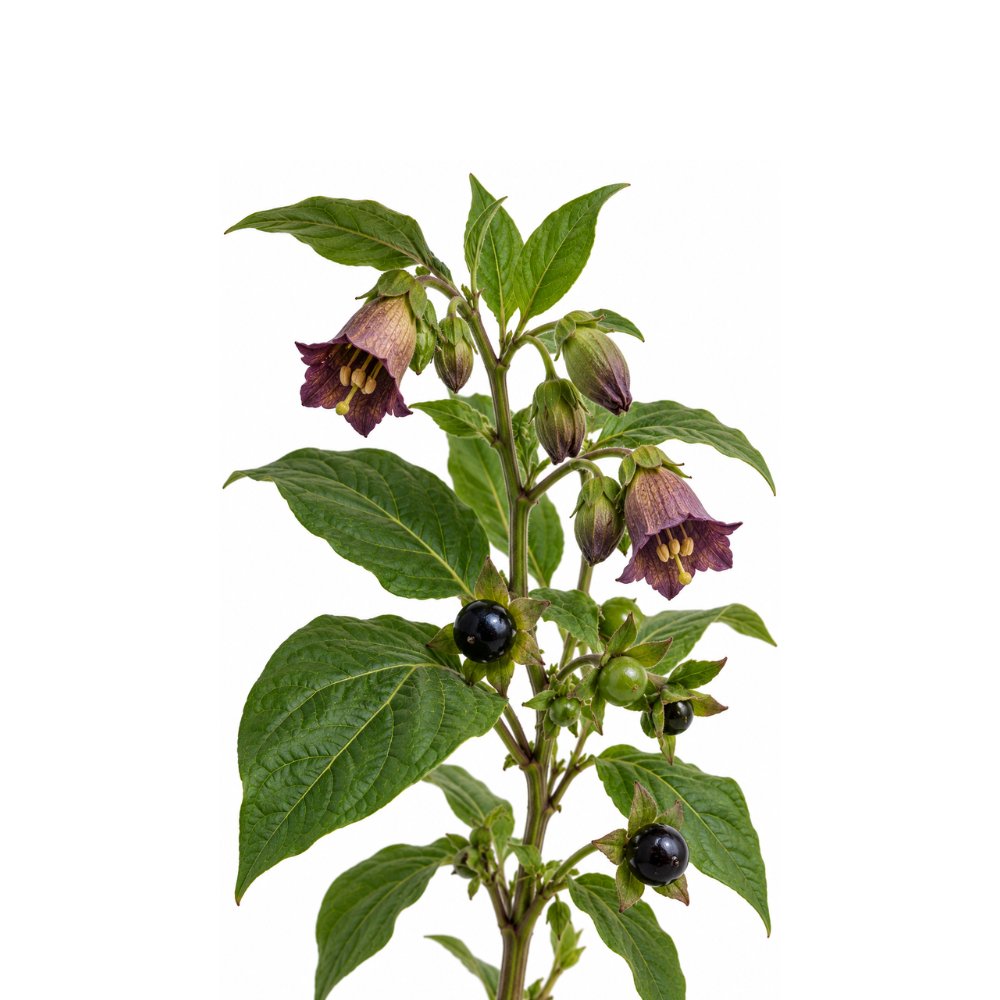
Atropa belladonna is a stout herbaceous perennial of European woodland edges and old disturbed ground, with dull purple bell-shaped flowers and glossy black berries the size of a small cherry. It is the source of atropine, and it is among the most consistently lethal plants in the European flora.
Almost every other dangerous plant is bitter, acrid or nauseating enough to stop a child after one mouthful. These berries are not, and children eat them in quantity. Two to five are cited as a fatal dose for a child, though alkaloid content varies and the figure is an indication rather than a threshold.
Its genus name comes from Atropos, the Fate who cut the thread of life 6Reference 6Li, Z., & Vincent, M. A. Atropa belladonna Linnaeus and genus Atropa — species description, etymology and distribution — flora. In Flora of North America Editorial Committee (eds.), Flora of North America North of Mexico, Vol. 14 (Solanaceae; family treatment by J. R. Sullivan). http://www.efloras.org/florataxon.aspx?flora_id=1&taxon_id=200020511 (genus: http://www.efloras.org/florataxon.aspx?flora_id=1&taxon_id=103112)View study →. The species name records that Renaissance women used it cosmetically to dilate their pupils (bella donna, “beautiful lady”). The same effect blurs vision and, repeated, damages sight.
It has no modern herbal use. Atropine is extracted, purified and given by injection in defined micrograms as an emergency drug.
Identification & Lookalikes
The berry is what gets eaten, so the berry is what matters. Deadly nightshade’s fruit is a single glossy black berry sitting in a distinctive five-pointed green calyx that flares behind it like a star. It grows singly, not in bunches.
| Confused with | How it actually differs |
|---|---|
| Blackcurrant / wild cherry | The commonest fatal confusion, and the reason it kills children. Currants hang in bunches; belladonna berries sit singly on the stem with a flared green star behind |
| Bilberry / blueberry | Bilberries are smaller, dusty-blue rather than glossy black, and carry a small crown at the tip rather than a leafy calyx behind |
| Black nightshade (Solanum nigrum) | A different and far less toxic relative, with berries in small clusters. The two common names are often used interchangeably, but they are different plants |
| Elderberry | Elder berries hang in flat many-branched heads on a woody shrub; belladonna is a soft-stemmed herb |
Leaves, flowers and smell. The whole plant is dull rather than glossy, and grows to about 1.3 m 6Reference 6Li, Z., & Vincent, M. A. Atropa belladonna Linnaeus and genus Atropa — species description, etymology and distribution — flora. In Flora of North America Editorial Committee (eds.), Flora of North America North of Mexico, Vol. 14 (Solanaceae; family treatment by J. R. Sullivan). http://www.efloras.org/florataxon.aspx?flora_id=1&taxon_id=200020511 (genus: http://www.efloras.org/florataxon.aspx?flora_id=1&taxon_id=103112)View study →. Its upper leaves grow in unequal pairs, a large leaf and a small one together at each node 8Reference 8Atropa belladonna — Plant Finder (leaf arrangement: upper leaves in unequal pairs)View study →. The flowers are solitary, drooping, brownish-purple bells. The plant smells faintly unpleasant when bruised, but not enough to warn anyone.
⚠ Nothing about the berry warns you. It is sweet, it is not bitter, and the delay before symptoms means a child can eat several before anyone notices. If ingestion is suspected, treat it as an emergency without waiting for signs.
Botany
Deadly nightshade belongs to the nightshade family, Solanaceae. The family includes tomato, potato, aubergine and chilli, as well as datura, mandrake and henbane. Its staple foods and lethal poisons differ in which alkaloids each genus makes.
Kew’s World Checklist of Vascular Plants spells the accepted name Atropa bella-donna. Atropa belladonna is the spelling in near-universal use in pharmacy and herbal literature, and the two names refer to the same plant.
Deadly nightshade is a herbaceous perennial that grows 0.5–1.3 m tall from a thick rootstock and dies back each winter 6,
The flowers are solitary and pendulous, with a purple bell-shaped corolla 2–3 cm long 6Reference 6Li, Z., & Vincent, M. A. Atropa belladonna Linnaeus and genus Atropa — species description, etymology and distribution — flora. In Flora of North America Editorial Committee (eds.), Flora of North America North of Mexico, Vol. 14 (Solanaceae; family treatment by J. R. Sullivan). http://www.efloras.org/florataxon.aspx?flora_id=1&taxon_id=200020511 (genus: http://www.efloras.org/florataxon.aspx?flora_id=1&taxon_id=103112)View study →. The calyx enlarges and flares widely as the fruit ripens 6Reference 6Li, Z., & Vincent, M. A. Atropa belladonna Linnaeus and genus Atropa — species description, etymology and distribution — flora. In Flora of North America Editorial Committee (eds.), Flora of North America North of Mexico, Vol. 14 (Solanaceae; family treatment by J. R. Sullivan). http://www.efloras.org/florataxon.aspx?flora_id=1&taxon_id=200020511 (genus: http://www.efloras.org/florataxon.aspx?flora_id=1&taxon_id=103112)View study →. The berries are 11–14 mm across and ripen from green to a shining black; rarely they are yellow 6Reference 6Li, Z., & Vincent, M. A. Atropa belladonna Linnaeus and genus Atropa — species description, etymology and distribution — flora. In Flora of North America Editorial Committee (eds.), Flora of North America North of Mexico, Vol. 14 (Solanaceae; family treatment by J. R. Sullivan). http://www.efloras.org/florataxon.aspx?flora_id=1&taxon_id=200020511 (genus: http://www.efloras.org/florataxon.aspx?flora_id=1&taxon_id=103112)View study →.
All of it is toxic: root, leaf, stem, flower and berry, with the root generally richest.
Distribution
Deadly nightshade is native to Europe, western Asia and North Africa 6Reference 6Li, Z., & Vincent, M. A. Atropa belladonna Linnaeus and genus Atropa — species description, etymology and distribution — flora. In Flora of North America Editorial Committee (eds.), Flora of North America North of Mexico, Vol. 14 (Solanaceae; family treatment by J. R. Sullivan). http://www.efloras.org/florataxon.aspx?flora_id=1&taxon_id=200020511 (genus: http://www.efloras.org/florataxon.aspx?flora_id=1&taxon_id=103112)View study →.
In Britain it is native only on calcareous soils, especially over chalk and limestone 7Reference 7Dines, T. D. Atropa belladonna L. — status, habitat, soils and trend in Britain. BSBI Online Plant Atlas 2020, Botanical Society of Britain and Ireland. https://bsbi.org/taxa/2cd4p9h.8c4/atropa-belladonnaView study →. It grows on dry disturbed ground, field margins, grassland, hedgerows and open woodland in the lowlands 7Reference 7Dines, T. D. Atropa belladonna L. — status, habitat, soils and trend in Britain. BSBI Online Plant Atlas 2020, Botanical Society of Britain and Ireland. https://bsbi.org/taxa/2cd4p9h.8c4/atropa-belladonnaView study →. It also turns up on other soils as an escape, often a relic of its old cultivation as a medicinal herb 7Reference 7Dines, T. D. Atropa belladonna L. — status, habitat, soils and trend in Britain. BSBI Online Plant Atlas 2020, Botanical Society of Britain and Ireland. https://bsbi.org/taxa/2cd4p9h.8c4/atropa-belladonnaView study →. It is long-lived where established, but it has declined with agricultural improvement and, in some places, deliberate eradication 7Reference 7Dines, T. D. Atropa belladonna L. — status, habitat, soils and trend in Britain. BSBI Online Plant Atlas 2020, Botanical Society of Britain and Ireland. https://bsbi.org/taxa/2cd4p9h.8c4/atropa-belladonnaView study →.
It has been grown commercially as a pharmaceutical crop for atropine and hyoscyamine, so some of the material in circulation is cultivated rather than wild.
In North America it is established in Michigan, New Jersey and Washington 6Reference 6Li, Z., & Vincent, M. A. Atropa belladonna Linnaeus and genus Atropa — species description, etymology and distribution — flora. In Flora of North America Editorial Committee (eds.), Flora of North America North of Mexico, Vol. 14 (Solanaceae; family treatment by J. R. Sullivan). http://www.efloras.org/florataxon.aspx?flora_id=1&taxon_id=200020511 (genus: http://www.efloras.org/florataxon.aspx?flora_id=1&taxon_id=103112)View study →. Reports from New York, Oregon and Newfoundland have not been verified, and in California it is known as an agricultural weed but is not established 6Reference 6Li, Z., & Vincent, M. A. Atropa belladonna Linnaeus and genus Atropa — species description, etymology and distribution — flora. In Flora of North America Editorial Committee (eds.), Flora of North America North of Mexico, Vol. 14 (Solanaceae; family treatment by J. R. Sullivan). http://www.efloras.org/florataxon.aspx?flora_id=1&taxon_id=200020511 (genus: http://www.efloras.org/florataxon.aspx?flora_id=1&taxon_id=103112)View study →. It is also introduced in South America 6Reference 6Li, Z., & Vincent, M. A. Atropa belladonna Linnaeus and genus Atropa — species description, etymology and distribution — flora. In Flora of North America Editorial Committee (eds.), Flora of North America North of Mexico, Vol. 14 (Solanaceae; family treatment by J. R. Sullivan). http://www.efloras.org/florataxon.aspx?flora_id=1&taxon_id=200020511 (genus: http://www.efloras.org/florataxon.aspx?flora_id=1&taxon_id=103112)View study →. It is not aggressive, but its berries near houses are a recognised poisoning hazard.
It has no conservation concern across its range.
Phytochemistry
The plant’s chemistry is the tropane alkaloids: principally hyoscyamine, with scopolamine and smaller amounts of related esters. Atropine is largely an artefact of extraction, because hyoscyamine racemises during processing to give the mixture pharmacists call atropine.
Total alkaloid content varies widely with plant part, season and provenance. Roots commonly carry the most, and the figures reported across the literature span several-fold, so no crude preparation can be dosed.
Toxicology
Class of poison. Tropane alkaloids, which are competitive muscarinic acetylcholine receptor antagonists.
Mechanism. Hyoscyamine, scopolamine and atropine competitively block muscarinic receptors, shutting down parasympathetic signalling throughout the body. Scopolamine crosses the blood–brain barrier readily, so the brain is affected as well. The result is the antimuscarinic toxidrome: hyperthermia, widely dilated unreactive pupils with lost near vision, dry mouth and skin, flushing, tachycardia, urinary retention, absent bowel sounds, and delirium.
Course. Onset comes within 30 minutes to two hours, and the poisoning is prolonged. Central effects commonly persist 24 to 48 hours, and dilated pupils and blurred vision last for days afterwards. The delirium is a true one: hallucinations indistinguishable from reality at the time, agitation, and amnesia for the episode.
Potency. Two to five berries are the figure repeated for a child, and ten to twenty for an adult. These are compilation figures carried through the toxicology literature rather than experimentally established doses, and the underlying alkaloid content varies several-fold.
Antidote — yes. Physostigmine is a reversible cholinesterase inhibitor that crosses into the brain. It reverses central antimuscarinic delirium and is given under cardiac monitoring. Care is otherwise supportive: benzodiazepines for agitation, active cooling for hyperthermia, and monitoring for arrhythmia and rhabdomyolysis.
Fatalities. Deaths are documented and recurrent, overwhelmingly in children eating the berries. Death comes from hyperthermia, arrhythmia, respiratory failure or injury sustained during the delirium.
Traditional & Historical Use
European Folk Medicine
Medicine and witchcraft. Belladonna was one of the ingredients of the “flying ointments” of early modern European witchcraft. These were tropane-alkaloid preparations absorbed through the skin, producing a sensation of flight along with the delirium. It appears throughout the folklore of poisoning, and in medieval English the name dwale was attached to it for a soporific draught.
It was used as a surgical soporific alongside mandrake and henbane, given before operations, and later as an antispasmodic. Nineteenth-century pharmacy carried belladonna leaf and root as official drugs.
These uses were displaced once the alkaloids could be isolated and assayed. As with foxglove and meadow saffron, the gap between an effective and a lethal dose was too narrow to manage with plant material.
The Cosmetic Use
Renaissance Italian women applied berry juice to the eyes to dilate the pupils. This was considered attractive and gave the plant its species name.
The effect is genuine mydriasis, and it came at a cost: cycloplegia, blurred near vision, light sensitivity and, with repetition, lasting damage.
The Drugs Derived From It
Atropine is one of the essential drugs of emergency medicine, and it descends directly from this plant.
It is given intravenously to reverse symptomatic bradycardia, and it is the frontline antidote for organophosphate and nerve-agent poisoning, where it blocks the muscarinic overstimulation those agents cause. Ophthalmologists use it and its relatives to dilate the pupil for examination. Scopolamine is used against motion sickness and as an antisecretory agent.
The doses are in micrograms to low milligrams, titrated to effect and given by a clinician. No preparation of the plant can be dosed that precisely, which is why the plant has no place in the pharmacy any more.
Safety & Pregnancy
Deadly nightshade is lethally poisonous in every part, and its berries are sweet enough that children eat them willingly. It has no safe preparation and no herbal use.
- Never ingest any part. Root, leaf, stem, flower and berry are all poisonous.
- The berries are sweet and attractive to children. Two to five may kill a child; there is no bitter warning.
- Suspected ingestion is an emergency. Call a poison centre immediately — symptoms are delayed, and the delirium lasts days.
- Avoid in pregnancy and lactation entirely.
- Handling. Alkaloids are absorbed through mucous membranes and broken skin — do not rub your eyes after handling the plant.
- An antidote exists. Physostigmine reverses the central syndrome.
Full Safety Detail
The berries. Every part of Atropa belladonna carries tropane alkaloids, with the root generally richest and the ripe berry the part most often eaten. The berries are the central hazard because they are sweet and unremarkable to taste. The plant’s defence is chemical rather than a bad taste, so nothing stops a child after the first one.
The clinical picture. Poisoning produces the antimuscarinic toxidrome, and it is prolonged: 24 to 48 hours of central effects, with dilated pupils and visual disturbance persisting for days. The syndrome includes hyperthermia and agitated delirium, so injury during the episode is a real cause of harm on top of the alkaloids themselves.
Treatment. Physostigmine is an effective antidote for the central syndrome and is used under cardiac monitoring. Supportive care covers cooling, sedation and heart-rhythm monitoring.
Handling. Alkaloids are absorbed across mucous membranes. Handling the plant and then touching the eyes produces dilation of one pupil, a documented and alarming presentation in gardeners.
Drug interactions. There is no herbal preparation, so there is no herb–drug interaction profile. The interactions that matter are those of the isolated pharmaceutical alkaloids, given by clinicians.
Avoid entirely. Tropane alkaloids cross the placenta, and no exposure is appropriate at any stage of pregnancy or lactation.
References
- Lee, M. R. (2007). Solanaceae IV: Atropa belladonna, deadly nightshade. Journal of the Royal College of Physicians of Edinburgh, 37(1), 77–84. https://pubmed.ncbi.nlm.nih.gov/17575737/
- Kwakye, G. F., Jiménez, J., Jiménez, J. A., & Aschner, M. (2018). Atropa belladonna neurotoxicity: Implications to neurological disorders. Food and Chemical Toxicology, 116(Pt B), 346–353. https://pubmed.ncbi.nlm.nih.gov/29653183/
- Berdai, M. A., Labib, S., Chetouani, K., & Harandou, M. (2012). Atropa belladonna intoxication: a case report. Pan African Medical Journal, 11, 72. https://pubmed.ncbi.nlm.nih.gov/22655106/
- Caksen, H., Odabaş, D., Akbayram, S., et al. (2003). Deadly nightshade (Atropa belladonna) intoxication: an analysis of 49 children. Human & Experimental Toxicology, 22(12), 665–668. https://pubmed.ncbi.nlm.nih.gov/14992329/
- Dawson, A. H., & Buckley, N. A. (2016). Pharmacological management of anticholinergic delirium — theory, evidence and practice. British Journal of Clinical Pharmacology, 81(3), 516–524. https://pubmed.ncbi.nlm.nih.gov/26589572/
- Li, Z., & Vincent, M. A. Atropa belladonna Linnaeus and genus Atropa — species description, etymology and distribution — flora. In Flora of North America Editorial Committee (eds.), Flora of North America North of Mexico, Vol. 14 (Solanaceae; family treatment by J. R. Sullivan). http://www.efloras.org/florataxon.aspx?flora_id=1&taxon_id=200020511 (genus: http://www.efloras.org/florataxon.aspx?flora_id=1&taxon_id=103112)
- Dines, T. D. Atropa belladonna L. — status, habitat, soils and trend in Britain. BSBI Online Plant Atlas 2020, Botanical Society of Britain and Ireland. https://bsbi.org/taxa/2cd4p9h.8c4/atropa-belladonna
- Missouri Botanical Garden. Atropa belladonna — Plant Finder (leaf arrangement: upper leaves in unequal pairs). https://www.missouribotanicalgarden.org/PlantFinder/PlantFinderDetails.aspx?taxonid=287159



