Materia Medica
Datura ☠️
Datura stramonium
Datura (Datura stramonium), also called jimsonweed or thornapple, is a weedy nightshade with upward-facing trumpet flowers and spiny seed capsules. Its tropane alkaloids, chiefly hyoscyamine and scopolamine, cause a prolonged and often lethal delirium.
What Is Datura?
Datura is a poisonous nightshade that causes a true delirium, and it has a long history of ritual and medicinal use.
Commonly called jimsonweed or thornapple, Datura stramonium is a coarse annual nightshade with upward-facing trumpet flowers and spiny seed capsules. It is now found worldwide as a weed of disturbed ground 3Reference 3Bye, R. A. Datura stramonium Linnaeus and genus Datura — species description, habitat, distribution and history — flora. In Flora of North America Editorial Committee (eds.), Flora of North America North of Mexico, Vol. 14 (Solanaceae; family treatment by J. R. Sullivan). http://www.efloras.org/florataxon.aspx?flora_id=1&taxon_id=200020520 (genus: http://www.efloras.org/florataxon.aspx?flora_id=1&taxon_id=109368; family: http://www.efloras.org/florataxon.aspx?flora_id=1&taxon_id=10828)View study →. Every part of it is poisonous.
It belongs with deadly nightshade, henbane and mandrake among the tropane-alkaloid nightshades. Its alkaloids are deliriants rather than hallucinogens in the ordinary sense: they produce a true delirium, in which the person cannot tell what they are seeing from what is real, followed by amnesia.
The margin between an active and a lethal dose is narrow. Alkaloid content varies several-fold between plants, parts and seasons, so that margin cannot be known in advance.
Identification & Lookalikes
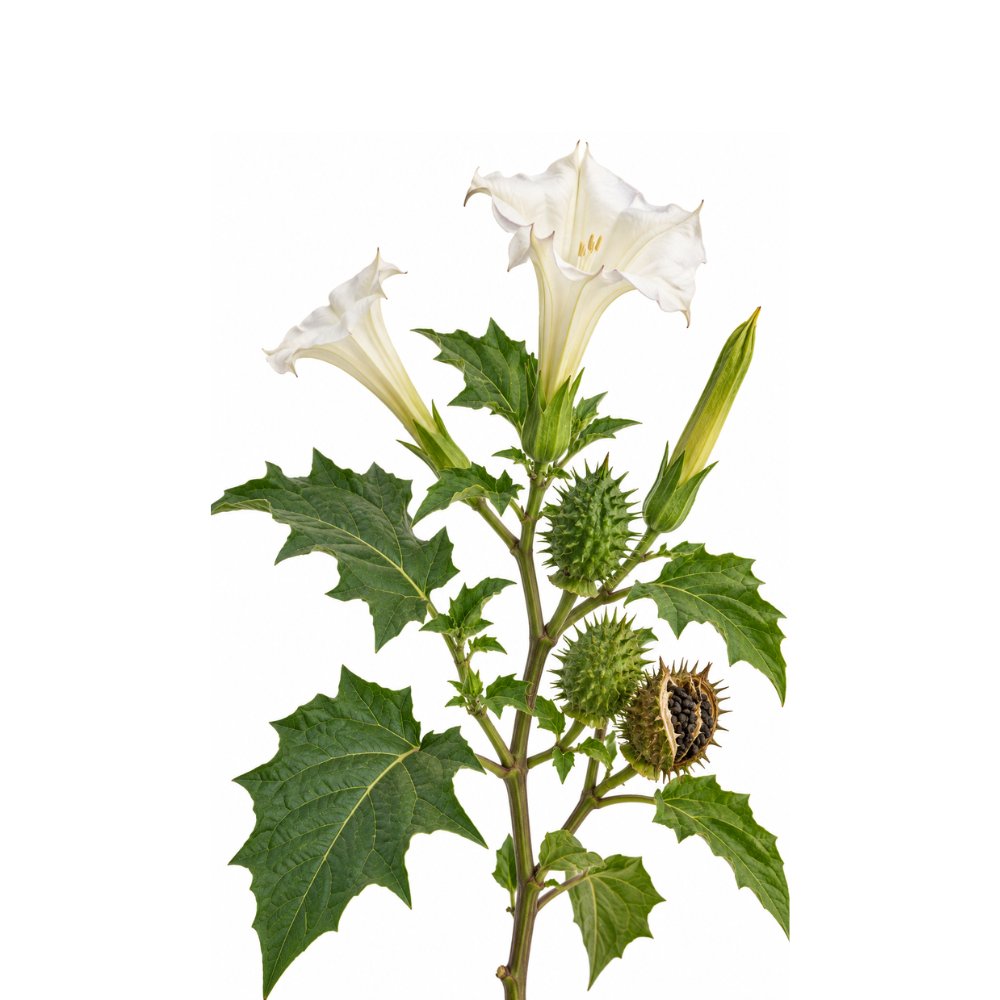
The seed capsule is the decisive character. Datura stramonium carries an upright, egg-shaped, spiny capsule that splits into four to scatter flat dark seeds — the “thorn apple”. Its flowers point upward and open toward evening on a soft-stemmed annual.
| Plant confused with it | How it actually differs |
|---|---|
| Angel’s trumpet (Brugmansia) | Woody shrub or small tree; flowers hang down; fruit smooth, not spiny. Also potently toxic, so this confusion changes the name, not the danger |
| Edible potherbs and salad greens | The classic mass poisoning. Young datura foliage gathered and cooked as greens — the 1676 Jamestown incident, which gave “jimsonweed” its name, poisoned a company of soldiers who ate it in a salad |
| Grain, flour and birdseed | Datura seeds contaminate harvested crops and commercial seed, and have caused community-scale poisonings with no foraging involved |
| Tomatillo / ground cherry husks | Both are nightshades with a papery or spiny covering; the datura capsule is dry, hard and four-parted |
Leaves and smell. The leaves are coarse, jaggedly toothed and rank-smelling when crushed. The unpleasant, foetid odour is a genuine deterrent and a useful field cue. Stems are soft and branching, never woody.
⚠ There is no safe amount to experiment with. Total tropane alkaloid content runs around 0.2–0.5% of dry weight but varies several-fold with plant part, age, season and provenance, and seeds are the most concentrated part. The quantity that intoxicates one person can kill the next from the same patch of ground.
Botany
Datura belongs to the nightshade family, Solanaceae. It is a fast-growing annual herb up to 1.5 m tall, with branching stems that are sometimes purple 3,
Its leaves are broadly ovate, up to 22 cm long, with coarse, irregular teeth along the edges 3Reference 3Bye, R. A. Datura stramonium Linnaeus and genus Datura — species description, habitat, distribution and history — flora. In Flora of North America Editorial Committee (eds.), Flora of North America North of Mexico, Vol. 14 (Solanaceae; family treatment by J. R. Sullivan). http://www.efloras.org/florataxon.aspx?flora_id=1&taxon_id=200020520 (genus: http://www.efloras.org/florataxon.aspx?flora_id=1&taxon_id=109368; family: http://www.efloras.org/florataxon.aspx?flora_id=1&taxon_id=10828)View study →.
The flowers are solitary and stand upright 3,
The fruit is an upright capsule 3–4.5 cm long, covered in prickles up to 15 mm long, which splits into four equal valves 3,
Brugmansia, the angel’s trumpets, were once included in Datura. They are told apart by their woody habit, hanging flowers and long, spineless fruits 3Reference 3Bye, R. A. Datura stramonium Linnaeus and genus Datura — species description, habitat, distribution and history — flora. In Flora of North America Editorial Committee (eds.), Flora of North America North of Mexico, Vol. 14 (Solanaceae; family treatment by J. R. Sullivan). http://www.efloras.org/florataxon.aspx?flora_id=1&taxon_id=200020520 (genus: http://www.efloras.org/florataxon.aspx?flora_id=1&taxon_id=109368; family: http://www.efloras.org/florataxon.aspx?flora_id=1&taxon_id=10828)View study →.
Distribution
Datura is probably native to central and southern Mexico, and it spread with Mesoamerican agriculture 3Reference 3Bye, R. A. Datura stramonium Linnaeus and genus Datura — species description, habitat, distribution and history — flora. In Flora of North America Editorial Committee (eds.), Flora of North America North of Mexico, Vol. 14 (Solanaceae; family treatment by J. R. Sullivan). http://www.efloras.org/florataxon.aspx?flora_id=1&taxon_id=200020520 (genus: http://www.efloras.org/florataxon.aspx?flora_id=1&taxon_id=109368; family: http://www.efloras.org/florataxon.aspx?flora_id=1&taxon_id=10828)View study →. It is now a weed found nearly worldwide 3,
Datura grows in gardens, cultivated fields, irrigation ditches, pastures, roadsides and waste places, from sea level to about 1,800 m 3Reference 3Bye, R. A. Datura stramonium Linnaeus and genus Datura — species description, habitat, distribution and history — flora. In Flora of North America Editorial Committee (eds.), Flora of North America North of Mexico, Vol. 14 (Solanaceae; family treatment by J. R. Sullivan). http://www.efloras.org/florataxon.aspx?flora_id=1&taxon_id=200020520 (genus: http://www.efloras.org/florataxon.aspx?flora_id=1&taxon_id=109368; family: http://www.efloras.org/florataxon.aspx?flora_id=1&taxon_id=10828)View study →. The trade in crop seed contaminated with datura seed has been one of the main ways it spread during the last century 3Reference 3Bye, R. A. Datura stramonium Linnaeus and genus Datura — species description, habitat, distribution and history — flora. In Flora of North America Editorial Committee (eds.), Flora of North America North of Mexico, Vol. 14 (Solanaceae; family treatment by J. R. Sullivan). http://www.efloras.org/florataxon.aspx?flora_id=1&taxon_id=200020520 (genus: http://www.efloras.org/florataxon.aspx?flora_id=1&taxon_id=109368; family: http://www.efloras.org/florataxon.aspx?flora_id=1&taxon_id=10828)View study →.
Growing Conditions
Cultivation snapshot for Datura ☠️
- Grows very easily from seed in full sun on almost any warm, well-drained disturbed soil; sown after frost, it flowers the same summer.
- A warm-season annual in cooler zones (about USDA 5–7), persisting as a short-lived tender perennial only where frost-free (zones 8–10).
- Self-seeds aggressively and escapes readily — the spiny capsules scatter abundant seed that stays viable for years, so it is listed as a noxious weed in many places; check local law before planting.
- Handling caution: every part, especially seeds and flowers, is extremely poisonous (tropane alkaloids) — wear gloves when weeding or deadheading and keep it away from children, pets and livestock.
Grow it yourself
Farm Wiki is our cultivation-focused sister site, also run by Justin Cooke.
Phytochemistry
The plant’s effects and toxicity come from tropane alkaloids that block the action of acetylcholine. More than 30 have been reported in Datura 3Reference 3Bye, R. A. Datura stramonium Linnaeus and genus Datura — species description, habitat, distribution and history — flora. In Flora of North America Editorial Committee (eds.), Flora of North America North of Mexico, Vol. 14 (Solanaceae; family treatment by J. R. Sullivan). http://www.efloras.org/florataxon.aspx?flora_id=1&taxon_id=200020520 (genus: http://www.efloras.org/florataxon.aspx?flora_id=1&taxon_id=109368; family: http://www.efloras.org/florataxon.aspx?flora_id=1&taxon_id=10828)View study →. A comparison of three varieties of D. stramonium identified 25 tropane alkaloids in the roots, leaves and seeds 1Reference 1Alkaloid patterns in some varieties of Datura stramoniumView study →.
The predominant compound is hyoscyamine, accompanied by scopolamine (hyoscine) and atropine. Atropine is the racemic form of hyoscyamine, and much of it arises during drying and extraction.
Hyoscyamine and scopolamine occur throughout the plant: leaf, stem, root, flower and seed. Total tropane alkaloid content is typically around 0.2–0.5% of dry weight but is highly variable, with hyoscyamine consistently the major component and scopolamine much lower 1Reference 1Alkaloid patterns in some varieties of Datura stramoniumView study →.
Growing conditions shape the mix. Varieties grown side by side in Bulgaria had very similar alkaloid patterns, while plants of the same variety grown in Egypt differed markedly 1Reference 1Alkaloid patterns in some varieties of Datura stramoniumView study →.
Constituent Summary
Figures are % of dry weight, and they vary widely with plant part, age, season and provenance.
Tropane Alkaloid3 compounds3 with data
† The defining tropane-alkaloid markers of the deadly-nightshade group.
Toxicology
Class of poison. Tropane alkaloids, which are competitive muscarinic acetylcholine receptor antagonists.
Mechanism. Hyoscyamine, atropine and scopolamine competitively block muscarinic receptors, shutting down parasympathetic signalling throughout the body. Scopolamine crosses the blood–brain barrier most readily, which is why the central delirium can dominate over the peripheral signs.
The result is the classic antimuscarinic toxidrome, traditionally summarised as hot as a hare, blind as a bat, dry as a bone, red as a beet, mad as a hatter. That means hyperthermia, dilated unreactive pupils with loss of near vision, absent sweating, flushed skin and delirium, alongside tachycardia, urinary retention and absent bowel sounds.
Course. Onset comes within 30–60 minutes of ingestion, and the poisoning is very prolonged. Central effects commonly run 24–48 hours, and dilated pupils and cognitive impairment can persist for days after the person appears recovered. Hallucinations are indistinguishable from reality at the time, frequently distressing, and typically followed by amnesia for the episode.
Potency. Highly variable and unpredictable. Total tropane alkaloids run roughly 0.2–0.5% of dry weight with hyoscyamine dominant, but shift several-fold with plant part, age, season and provenance, and seed carries the highest concentration. Case reports of severe poisoning in children from small numbers of seeds recur throughout the literature. The figures that circulate for a lethal seed count are rough indications from reviews, not established human doses.
Antidote — yes. Physostigmine is a reversible cholinesterase inhibitor that crosses into the brain. It reverses central antimuscarinic delirium and is used under cardiac monitoring. Care is otherwise supportive: benzodiazepines for agitation, active cooling for hyperthermia, and monitoring for arrhythmia and rhabdomyolysis.
Fatalities. Deaths are well documented and recurrent: in children through accidental ingestion, in adults through recreational use, and at community scale through contaminated food. Deaths arise from hyperthermia, arrhythmia, and injury or drowning sustained during the delirium rather than from the alkaloids alone.
Traditional & Historical Use
Ritual & Shamanic Use
Datura and its relatives appear in ritual practice across a wide spread of cultures, including Mesoamerica, the American Southwest, India and parts of Africa. They were used as deliriant intoxicants in initiation, divination and ordeal. Some Datura species have been part of Native American rites of passage since pre-Columbian times 3Reference 3Bye, R. A. Datura stramonium Linnaeus and genus Datura — species description, habitat, distribution and history — flora. In Flora of North America Editorial Committee (eds.), Flora of North America North of Mexico, Vol. 14 (Solanaceae; family treatment by J. R. Sullivan). http://www.efloras.org/florataxon.aspx?flora_id=1&taxon_id=200020520 (genus: http://www.efloras.org/florataxon.aspx?flora_id=1&taxon_id=109368; family: http://www.efloras.org/florataxon.aspx?flora_id=1&taxon_id=10828)View study →.
In these traditions, preparation, dose and setting were controlled by specialists. The plant was reserved for specific occasions rather than used freely, and the knowledge involved was closely held.
Medicinal Use
Its medicinal use relied on tiny quantities.
The dried leaf was smoked for asthma, where it acts as an anticholinergic bronchodilator. Datura and the related Atropa underlie the asthma cigarettes sold through Western pharmacy into the twentieth century. The same mechanism survives today in ipratropium and tiotropium, synthetic anticholinergics that open the airways without the delirium.
It was also used topically and in minute doses for pain, and as an antispasmodic.
Criminal Use
Datura has a documented history as a stupefacient used in crime, for robbery and assault, exploiting the profound confusion, suggestibility and amnesia the tropanes produce. Scopolamine’s reputation as a “truth drug” and the Colombian burundanga preparations both belong to this thread.
Modern Recreational Use
Modern recreational use accounts for a steady stream of hospitalisations and deaths. The experience is consistently described as frightening rather than rewarding: a true delirium in which hallucinations are indistinguishable from reality, followed by days of impairment.
Safety & Pregnancy
Datura is poisonous and potentially lethal. There is no safe recreational dose, and the gap between an active dose and a fatal overdose is small and impossible to judge. Suspected poisoning is a medical emergency.
- Poisonous & potentially lethal. The margin between an active dose and a fatal overdose is small and impossible to judge.
- Unpredictable potency. Alkaloid levels vary enormously between plants, parts and seasons.
- Anticholinergic emergency. Racing heart, dangerous hyperthermia, urinary retention, severe agitation, delirium, seizures, coma and death.
- No safe dose. Do not ingest; suspected poisoning requires immediate emergency care.
Full Safety & Interactions Detail
Dose. Alkaloid levels vary enormously between plants, parts and seasons. The difference between a “dose” and a fatal overdose is small and impossible to judge, and there is no safe recreational dose.
Symptoms. Effects include a racing heart, dangerously high body temperature, inability to urinate, blurred vision, severe agitation, terrifying delirium, seizures, coma and death.
Emergency care. Anticholinergic poisoning is a medical emergency. Suspected poisoning needs immediate emergency care.
Avoid entirely. Datura is acutely poisonous and must not be ingested by anyone, in pregnancy, while breastfeeding, or at any other time.
References
- Berkov, S., Zayed, R., & Doncheva, T. (2006). Alkaloid patterns in some varieties of Datura stramonium. Fitoterapia, 77(3), 179–182. (Tropane alkaloid content and ratios in D. stramonium; hyoscyamine the predominant alkaloid, scopolamine much lower.) https://pubmed.ncbi.nlm.nih.gov/16492393/
- Soni, P., Siddiqui, A. A., Dwivedi, J., & Soni, V. (2012). Pharmacological properties of Datura stramonium L. as a potential medicinal tree: an overview. Asian Pacific Journal of Tropical Biomedicine, 2(12), 1002–1008. (Reviews tropane alkaloid content of Datura, with hyoscyamine and scopolamine accounting for the bulk of total alkaloids, typically a fraction of a percent of dry weight.) https://pubmed.ncbi.nlm.nih.gov/23593583/
- Bye, R. A. Datura stramonium Linnaeus and genus Datura — species description, habitat, distribution and history — flora. In Flora of North America Editorial Committee (eds.), Flora of North America North of Mexico, Vol. 14 (Solanaceae; family treatment by J. R. Sullivan). http://www.efloras.org/florataxon.aspx?flora_id=1&taxon_id=200020520 (genus: http://www.efloras.org/florataxon.aspx?flora_id=1&taxon_id=109368; family: http://www.efloras.org/florataxon.aspx?flora_id=1&taxon_id=10828)
- Zhang, Z. Y., Lu, A. M., & D’Arcy, W. G. Datura stramonium Linnaeus — species description and distribution — flora. In Wu, Z. Y., & Raven, P. H. (eds.), Flora of China, Vol. 17 (Solanaceae). http://www.efloras.org/florataxon.aspx?flora_id=2&taxon_id=200020520