
Materia Medica
Mandrake ☠️
Mandragora officinarum
Mandrake (Mandragora officinarum) is a stemless Mediterranean nightshade with a thick, often forked root, famous in folklore and once used as a surgical anaesthetic. Its tropane alkaloids, chiefly hyoscyamine, make it a potentially deadly deliriant.
What Is Mandrake?
Mandrake is a poisonous Mediterranean nightshade with one of the richest medicinal histories in Europe and no modern use.
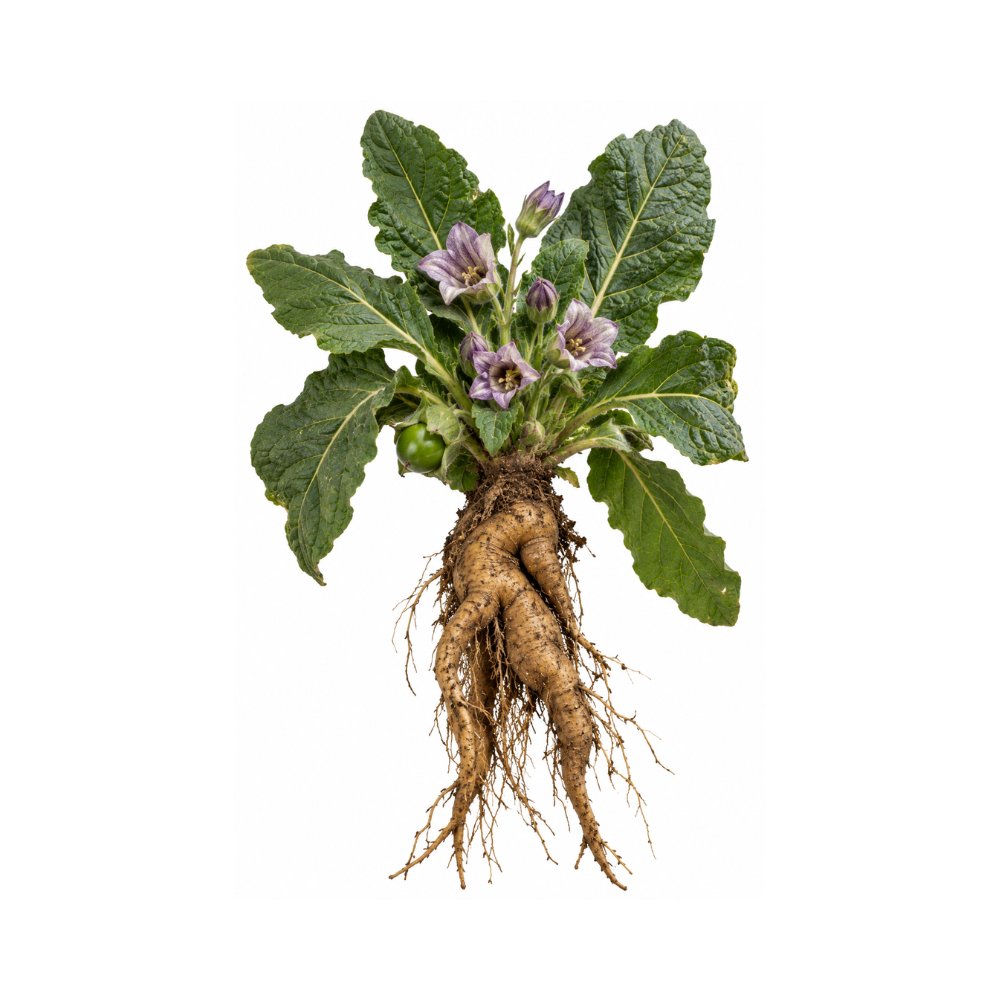
Mandragora officinarum is a stemless perennial nightshade: a flat rosette of large wavy leaves over a thick, often forked taproot whose vaguely human shape produced centuries of folklore. It is related to deadly nightshade, henbane and datura, and it shares their tropane alkaloids.
Mandrake was one of the classical world’s working surgical anaesthetics, and that effect is real pharmacology. The sedative dose and the deliriant dose sit very close together, and the alkaloid content of a given root cannot be known without assay. That is why the plant left medicine.
Every part is poisonous. Its interest today is historical, botanical and folkloric.
Identification & Lookalikes
The growth form is the decisive character. Mandrake has no stem. Its leaves emerge directly from the crown in a flat rosette pressed close to the ground, with flowers and later the yellow-orange berries sitting low in the centre of that rosette — not raised on a stalk.
| Plant confused with it | How it actually differs |
|---|---|
| Borage (Borago officinalis) | The documented real-world confusion, and it has produced repeated poisoning clusters around the Mediterranean. Borage leaves are bristly-hairy and cucumber-scented; mandrake’s are smoother, wavy-margined and rank |
| Wild spinach, beet and chard greens | Gathered as a leafy vegetable in the same season and habitat; the mandrake rosette is flatter and its leaves broader and more crinkled |
| Mayapple (Podophyllum peltatum) | Called “American mandrake” and entirely unrelated — a North American woodland plant with umbrella-like leaves. A naming confusion, but one that crosses references and recipes |
Root, smell and berries. The root is the plant’s signature: thick, fleshy, pale and frequently forked into two “legs”. Crushed foliage is unpleasant rather than aromatic. The ripe berries are yellow to orange, soft and sweet-smelling, which is why children eat them.
⚠ The forked root is folklore, not identification. The shape of the root tells you nothing about its alkaloid content. Mandragora autumnalis is treated by many floras as the same species and is used interchangeably in the older literature.
Botany
Mandrake belongs to the nightshade family (Solanaceae), alongside henbane, belladonna and datura.
Mandrake is a perennial herb with almost no stem 3Reference 3A revision of the genus Mandragora (Solanaceae) — species description, habitat and distribution (broad sense) — flora. Its leaves grow in a basal rosette and reach up to 45 cm long; they are elliptical or widest toward the tip, with crinkled, wavy edges 3Reference 3A revision of the genus Mandragora (Solanaceae) — species description, habitat and distribution (broad sense) — flora.
The flowers sit at the centre of the rosette. They are bell-shaped, 12–65 mm long, and greenish white to pale blue or violet 3Reference 3A revision of the genus Mandragora (Solanaceae) — species description, habitat and distribution (broad sense) — flora.
The fruit is a round to egg-shaped berry 5–40 mm across, which ripens glossy yellow to orange 3Reference 3A revision of the genus Mandragora (Solanaceae) — species description, habitat and distribution (broad sense) — flora.
Below ground it grows a long, thick taproot that is often branched 3Reference 3A revision of the genus Mandragora (Solanaceae) — species description, habitat and distribution (broad sense) — flora. The root often forks into two “legs,” and this vaguely human shape fed centuries of folklore about screaming roots pulled from the earth.
Like its relatives it is laden with tropane alkaloids, and every part is poisonous. The root is the part traditionally used.
Distribution
Botanists disagree on how widely to draw the species. In the broad sense, which includes the autumn-flowering plants, mandrake grows around the Mediterranean from Portugal and Morocco to Türkiye and the Levant 3Reference 3A revision of the genus Mandragora (Solanaceae) — species description, habitat and distribution (broad sense) — flora. It grows in light woodland and disturbed open ground, including olive groves, fallow fields, waysides and ruins, from sea level to 1,200 m 3Reference 3A revision of the genus Mandragora (Solanaceae) — species description, habitat and distribution (broad sense) — flora.
In the narrow sense, Mandragora officinarum is limited to Italy, the northwestern Balkans and Lebanon–Syria 4Reference 4Mandragora officinarum LView study →. The rest of the Mediterranean range belongs to the autumn-flowering Mandragora autumnalis 4Reference 4Mandragora officinarum LView study →.
In that narrow sense it is listed as Endangered in Europe 5Reference 5Mandragora officinarum (Europe assessment) — Endangered; regionally extinct in the EU 27, surviving in Croatia and Bosnia and Herzegovina. It has disappeared from Italy, and so from the European Union, and survives in Europe only in small populations in Croatia and Bosnia and Herzegovina 5Reference 5Mandragora officinarum (Europe assessment) — Endangered; regionally extinct in the EU 27, surviving in Croatia and Bosnia and Herzegovina.
Sourcing: the wild European plant is too rare to collect. Any mandrake root sold should come from cultivated plants, and it is worth asking the seller which.
Growing Conditions
Cultivation snapshot for Mandrake ☠️
- Grow as a Mediterranean-climate perennial: full sun to part shade with a warm, dry summer rest matching its natural dormancy.
- Give it deep, gritty, sharply drained soil so the long taproot can descend without sitting wet — waterlogging rots it.
- Usually raised from seed, but germination is slow and erratic, often needing cold stratification and patience over months.
- Site it permanently — the deep fleshy taproot resents transplanting — and handle with gloves, as every part is toxic; keep it from children, pets and livestock.
Grow it yourself
Farm Wiki is our cultivation-focused sister site, also run by Justin Cooke.
Phytochemistry
The root contains tropane alkaloids, the same anticholinergic compounds found in the other deadly nightshades. The major component is hyoscyamine, accompanied by scopolamine (hyoscine) and atropine. The genus also yields the minor alkaloid mandragorine and the coumarin scopoletin. More than 80 substances have been identified across the genus 1Reference 1Substances isolated from Mandragora speciesView study →.
Across Mandragora root, hyoscyamine is consistently the dominant alkaloid, with scopolamine and atropine present at much lower levels. One analysis reports an approximate hyoscyamine : scopolamine : atropine ratio of 18 : 2.5 : 1 1Reference 1Substances isolated from Mandragora speciesView study →.
The species differ. M. officinarum lacks scopolamine altogether and carries up to ten times more hyoscyamine than M. autumnalis 2Reference 2Alkaloid chemodiversity in Mandragora spp. is associated with loss-of-functionality of MoH6H, a hyoscyamine 6β-hydroxylase geneView study →. The loss traces to a mutation in the gene for the enzyme that turns hyoscyamine into scopolamine 2Reference 2Alkaloid chemodiversity in Mandragora spp. is associated with loss-of-functionality of MoH6H, a hyoscyamine 6β-hydroxylase geneView study →.
Constituent Summary
Reliable dry-weight figures for mandrake root are scarce, so the table gives relative proportions.
Tropane Alkaloid4 compounds3 with data
Coumarin1 compoundno data
† The defining tropane-alkaloid markers of the deadly-nightshade group.
Toxicology
Class of poison. Tropane alkaloids, which are competitive muscarinic acetylcholine receptor antagonists.
Mechanism. Atropine, scopolamine and hyoscyamine competitively block muscarinic receptors, shutting down parasympathetic signalling. The peripheral picture is the antimuscarinic toxidrome: hyperthermia, dilated unreactive pupils, dry skin and mouth, flushing, tachycardia, urinary retention and absent bowel sounds.
In the brain, the alkaloids produce sedation that shades into delirium as the dose rises. The anaesthetic effect the classical world used and the delirium that poisons people are the same drug action at different doses.
Course. Onset comes within one to four hours of ingestion, and the poisoning is prolonged. Central effects commonly persist 24 hours or more, and pupillary changes last longer. Recorded presentations run from drowsiness, blurred vision and dry mouth through to agitated delirium, hallucination and, at the severe end, coma and respiratory depression.
Potency. Unpredictable. Alkaloid content concentrates in the root and varies with age, season and provenance. The berries, the part children eat, carry enough to cause serious poisoning. No reliable dose figure exists for plant material.
Antidote — yes. Physostigmine, a reversible cholinesterase inhibitor, reverses central antimuscarinic delirium and is given under cardiac monitoring. Care is otherwise supportive: benzodiazepines for agitation, cooling, and airway support in severe cases.
Fatalities. Deaths are rare in the modern record but documented. The case literature is dominated by accidental foraging poisoning: clusters of people hospitalised after eating mandrake rosettes gathered in mistake for borage or wild greens. Most recover with supportive care.
Traditional & Historical Use
European Folk Medicine
Medicine and folklore. The drug is the root. Mandrake was one of the classical world’s principal surgical anaesthetics and soporifics, given before operations to induce sleep and blunt pain.
It was also used as a pain reliever. It was an ingredient in the “flying ointments” of early modern European witchcraft, where the deliriant alkaloids produced the sensation of flight the preparations were named for. It features heavily in magic, fertility lore and ritual across the same period.
In the best-known folklore, the forked root screams when pulled from the ground and kills whoever hears it.
Safety & Pregnancy
Mandrake is poisonous and acts as a deliriant rather than a classical psychedelic. Its tropane alkaloids can cause dangerous overheating, a racing heartbeat and delirium and, in significant doses, coma and death. There is no reliable safe dose.
- Poisonous deliriant. Tropane alkaloids cause racing heartbeat, dangerous overheating, delirium and, in significant doses, coma and death.
- No safe dose. The margin between an “active” and a lethal dose is narrow and unpredictable — not for ingestion.
- Keep from children & pets. Every part is toxic, including the sweet-smelling berries.
Full Safety & Interactions Detail
Symptoms. Mandrake’s tropane alkaloids cause dry mouth and skin, flushing, blurred vision, urinary retention, a racing heartbeat, dangerous overheating, confusion and frightening hallucinations. In significant doses they cause delirium, coma and death.
Dose. The margin between an “active” and a lethal dose is narrow and unpredictable. There is no reliable safe dose for recreational use.
Children and pets. Keep the plant away from children and pets.
Avoid entirely. Mandrake’s tropane alkaloids are potent and potentially fatal, and the plant has not been studied in pregnancy or lactation. It must be avoided entirely in both.
References
- Hanuš, L. O., Řezanka, T., Spížek, J., & Dembitsky, V. M. (2005). Substances isolated from Mandragora species. Phytochemistry, 66(20), 2408–2417. (Reviews Mandragora alkaloids; hyoscyamine the major tropane alkaloid, with scopolamine and atropine in an approximate 18 : 2.5 : 1 ratio, plus mandragorine and scopoletin.) https://pubmed.ncbi.nlm.nih.gov/16137728/
- Schlesinger, D., Davidovich Rikanati, R., Volis, S., Faigenboim, A., Vendramin, V., Cattonaro, F., Hooper, M., Oren, E., Taylor, M., Sitrit, Y., Inbar, M., & Lewinsohn, E. (2019). Alkaloid chemodiversity in Mandragora spp. is associated with loss-of-functionality of MoH6H, a hyoscyamine 6β-hydroxylase gene. Plant Science, 283, 301–310. (M. officinarum and M. turcomanica lack anisodamine and scopolamine and carry up to tenfold higher hyoscyamine than M. autumnalis.) https://pubmed.ncbi.nlm.nih.gov/31128700/
- Ungricht, S., Knapp, S., & Press, J. R. (1998). A revision of the genus Mandragora (Solanaceae) — species description, habitat and distribution (broad sense) — flora. Bulletin of the Natural History Museum, Botany Series, 28(1), 17–40.
- World Checklist of Vascular Plants (WCVP), Royal Botanic Gardens, Kew. Mandragora officinarum L. and Mandragora autumnalis Bertol. — accepted names and native distribution (narrow sense), via GBIF. https://www.gbif.org/species/207844474
- Bilz, M., & Šoljan, D. (2011). Mandragora officinarum (Europe assessment) — Endangered; regionally extinct in the EU 27, surviving in Croatia and Bosnia and Herzegovina. The IUCN Red List of Threatened Species.



