
Materia Medica
Maconha Brava
Zornia latifolia
Maconha brava is a low, creeping tropical legume of South America whose dried leaves are smoked in Brazil as a cannabis substitute. Its leaves are rich in flavonoids, and its cannabis-like effect has been traced to the rare flavone syzalterin.
What Is Maconha Brava?
Maconha brava (“wild cannabis”) is Zornia latifolia, a low, creeping legume of the South American savannas whose dried leaves are smoked as a cannabis substitute in Brazil 8Reference 8Zornia latifolia — fact sheet: morphology, common names, distribution, uses and ecology — species database. https://tropicalforages.info/text/entities/zornia_latifolia.htmView study →. It is not related to cannabis; the name records how it is used.
The plant grows in open grassland across much of tropical South America and has been studied as a forage legume for poor, acid soils 8Reference 8Zornia latifolia — fact sheet: morphology, common names, distribution, uses and ecology — species database. https://tropicalforages.info/text/entities/zornia_latifolia.htmView study →.
Its leaves are rich in flavonoids 2Reference 2Zornia latifolia: a smart drug being adulterated by Stylosanthes guianensis — analytical study, DNA barcodingView study →. A 2022 study traced a cannabis-like effect on lab-grown rat neurons to a rare flavone, syzalterin 1Reference 1In vitroCannabis-like activity of Zornia latifolia Sm. detected in vitro on rat cortical neurons: major role of the flavone syzalterin — in vitroView study →.
Products sold online as maconha brava have turned out to be a different legume, Stylosanthes guianensis 2Reference 2Zornia latifolia: a smart drug being adulterated by Stylosanthes guianensis — analytical study, DNA barcodingView study →.
How Is Maconha Brava Used?
- Dried aerial parts, smoked — the main use, as a substitute for cannabis 8Reference 8Zornia latifolia — fact sheet: morphology, common names, distribution, uses and ecology — species database. https://tropicalforages.info/text/entities/zornia_latifolia.htmView study →.
- Whole-plant juice — drunk in the Guianas for inflamed intestines 9Reference 9Fern, K. (n.d.). Zornia latifolia — habit, range, cultivation and medicinal uses — species database. Useful Tropical Plants. https://tropical.theferns.info/viewtropical.php?id=Zornia+latifoliaView study →.
No peer-reviewed analysis has confirmed the tryptamines (N,N-DMT, 5-MeO-DMT, bufotenin) or the β-carboline harmine often attributed to the plant; the one authenticated chemical study found no classical alkaloids 3Reference 3ReviewZornia latifolia as an emerging orphan medicinal plant: molecular pharmacology, bioactive scaffolds and prospects for drug discovery — reviewView study →.
Traditional Uses
Brazilian Folk Use
The dried aerial parts are smoked. The plant takes its Portuguese name, maconha brava, from its use as a substitute for cannabis among Indigenous people in Brazil 8Reference 8Zornia latifolia — fact sheet: morphology, common names, distribution, uses and ecology — species database. https://tropicalforages.info/text/entities/zornia_latifolia.htmView study →.
Traditional medicine also records it as antispasmodic and anxiolytic 2Reference 2Zornia latifolia: a smart drug being adulterated by Stylosanthes guianensis — analytical study, DNA barcodingView study →, and as a sedative and anti-inflammatory 3Reference 3ReviewZornia latifolia as an emerging orphan medicinal plant: molecular pharmacology, bioactive scaffolds and prospects for drug discovery — reviewView study →.
Guianas Folk Medicine
In the Guianas a juice made from the whole plant is drunk to calm inflamed intestines 9Reference 9Fern, K. (n.d.). Zornia latifolia — habit, range, cultivation and medicinal uses — species database. Useful Tropical Plants. https://tropical.theferns.info/viewtropical.php?id=Zornia+latifoliaView study →.
Indications
- Relaxation, as a cannabis substitute [dried aerial parts, smoked; Brazilian folk use]
- Anxiety [aerial parts; folk use]
- Spasms and cramping [aerial parts; folk use]
- Inflamed intestines [whole-plant juice; Guianas folk use]
Botany
Maconha brava is a perennial, tap-rooted herb in the legume family (Fabaceae). Its stems grow 20–50 cm long, lying flat or rising at the tips, and branch heavily into mats 8Reference 8Zornia latifolia — fact sheet: morphology, common names, distribution, uses and ecology — species database. https://tropicalforages.info/text/entities/zornia_latifolia.htmView study →.
Each leaf has just two leaflets, 1–4 cm long. The leaflets are broad at the base of the stem and grow narrower along the branches, sometimes shrinking to a single leaf 8Reference 8Zornia latifolia — fact sheet: morphology, common names, distribution, uses and ecology — species database. https://tropicalforages.info/text/entities/zornia_latifolia.htmView study →.
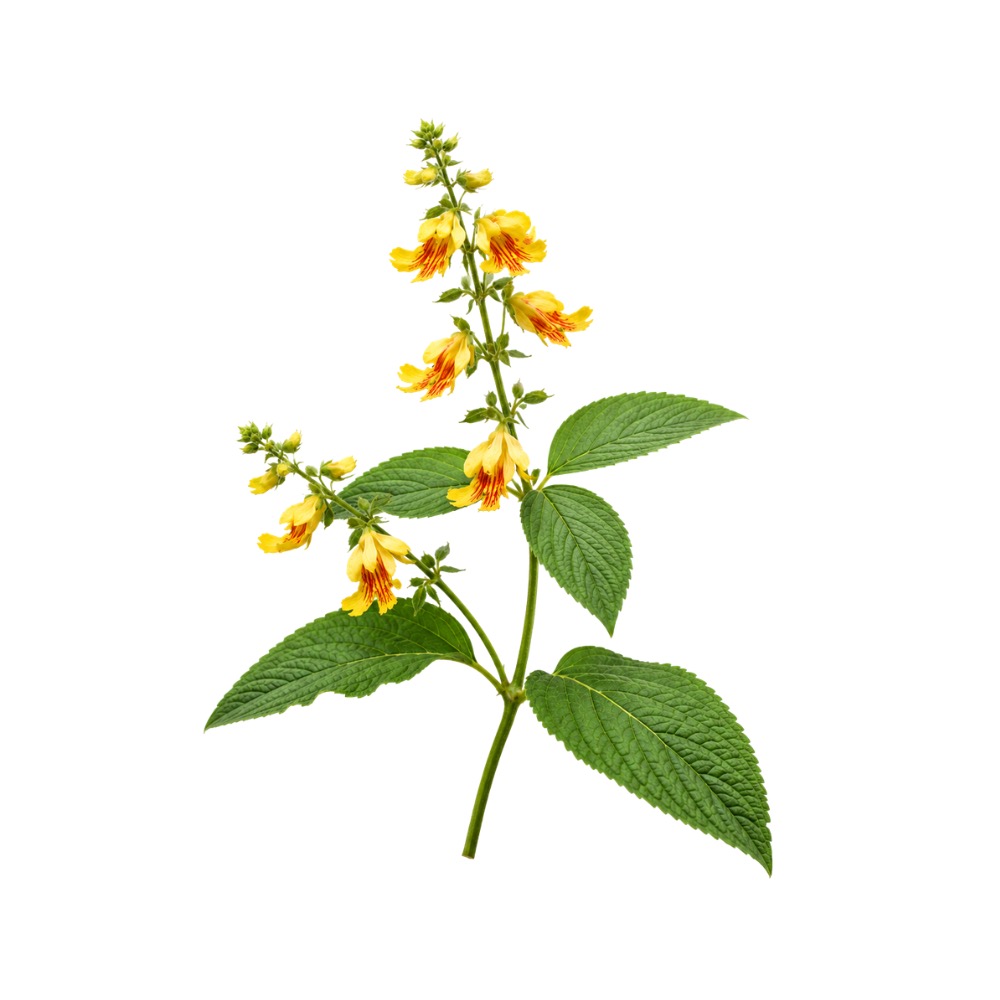
The yellow pea flowers, about 1 cm long with red streaks at the centre of the upper petal, are carried on spikes. Each flower sits between a pair of leafy bracts up to 1.5 cm long, dotted with glands, that nearly enclose it 8Reference 8Zornia latifolia — fact sheet: morphology, common names, distribution, uses and ecology — species database. https://tropicalforages.info/text/entities/zornia_latifolia.htmView study →.
The pods are divided into two to eight rounded joints, 2–3 mm across, bristly and hairy. Each joint holds a single seed and breaks away when ripe 8Reference 8Zornia latifolia — fact sheet: morphology, common names, distribution, uses and ecology — species database. https://tropicalforages.info/text/entities/zornia_latifolia.htmView study →.
Many Zornia species have two-leaflet leaves, and Z. latifolia has long been confused with Z. diphylla 8,
Distribution
Maconha brava is native to South America, from Argentina, Paraguay and Uruguay through Brazil, Bolivia, Peru, Ecuador and Colombia to Venezuela and the Guianas 8,
It grows in open fields, grassland and savanna, and is well adapted to the free-draining, acid, low-fertility soils of the South American savannas 8,
Growing Conditions
Cultivation snapshot for Maconha Brava
- A warm-climate creeping forage and ground-cover legume: it needs frost-free conditions (temperatures above about 13 °C) and dies back to the rootstock where winters turn cool.
- Site in full sun — it has little shade tolerance — on free-draining, acid, low-fertility soil, where it outperforms many legumes.
- Best where annual rainfall is roughly 1,000–2,000 mm; it shrugs off a 4–6 month dry season by shedding leaves.
- Grow from seed; the hard-coated seed benefits from scarification, and the plant fixes its own nitrogen and self-seeds freely.
Grow it yourself
Farm Wiki is our cultivation-focused sister site, also run by Justin Cooke.
Pharmacology & Research
Only a handful of peer-reviewed studies address Zornia latifolia directly, and none is a human trial 3Reference 3ReviewZornia latifolia as an emerging orphan medicinal plant: molecular pharmacology, bioactive scaffolds and prospects for drug discovery — reviewView study →.
The main study is a 2022 experiment on cultured rat cortical neurons. A fat-soluble leaf fraction suppressed neuronal firing in a way the authors compared to high-THC hashish, and the effect traced to the rare flavone syzalterin. The plant’s more abundant apigenin and genistein were inactive on their own 1Reference 1In vitroCannabis-like activity of Zornia latifolia Sm. detected in vitro on rat cortical neurons: major role of the flavone syzalterin — in vitroView study →.
The sedative, anxiolytic and antispasmodic uses have been linked to the plant’s flavonoids and to studies of other Zornia species, but have not been tested in Z. latifolia itself 2,
No clinical trial of Zornia latifolia has been registered or run.
- Best-supported: a cannabis-like suppression of neuronal firing shown in vitro, attributable to the minor flavone syzalterin rather than to any tryptamine 1Reference 1In vitroCannabis-like activity of Zornia latifolia Sm. detected in vitro on rat cortical neurons: major role of the flavone syzalterin — in vitroView study →.
-
Emerging, worth watching: anxiolytic/sedative and antispasmodic activity, inferred from the plant’s apigenin and genistein content and supported by studies in other Zornia species, but never tested in Z. latifolia itself 2,
4, .5, 6, 7Reference 2Zornia latifolia: a smart drug being adulterated by Stylosanthes guianensis — analytical study, DNA barcodingView study →Reference 4AnimalApigenin, a component of Matricaria recutita flowers, is a central benzodiazepine receptor-ligand with anxiolytic effects — animal modelView study →Reference 5AnimalAntidiarrheal effect of Zornia brasiliensis Vogel (Leguminosae) on mice involves adrenergic pathway activation — animal modelView study →Reference 6AnimalAntinociceptive effect of 7-methoxyflavone isolated from Zornia brasiliensis — animal modelView study →Reference 7In vitroSpasmolytic activity of some plants used by the Otomi Indians of Querétaro (México) for the treatment of gastrointestinal disorders (inclView study → - Mechanistically thin: anti-inflammatory activity, expected from the flavonoid profile but never measured in Z. latifolia 3Reference 3ReviewZornia latifolia as an emerging orphan medicinal plant: molecular pharmacology, bioactive scaffolds and prospects for drug discovery — reviewView study →.
-
The caveat: there is no human data of any kind, and commercial products have turned out to be a different plant 1,
2Reference 1In vitroCannabis-like activity of Zornia latifolia Sm. detected in vitro on rat cortical neurons: major role of the flavone syzalterin — in vitroView study →Reference 2Zornia latifolia: a smart drug being adulterated by Stylosanthes guianensis — analytical study, DNA barcodingView study → .
Everything rests on one cell study and on inference from other plants and single compounds. There is no animal behaviour study, no pharmacokinetic data and no evidence on the smoked leaf, and commercial material cannot be assumed to be Z. latifolia 1,
1. Cannabis-Like CNS Depression
The one direct pharmacology study exposed cultured networks of rat cortical neurons to fractions of a 2-propanol extract of the aerial parts and measured their activity with a multielectrode array 1Reference 1In vitroCannabis-like activity of Zornia latifolia Sm. detected in vitro on rat cortical neurons: major role of the flavone syzalterin — in vitroView study →.
The fat-soluble fraction (flavonoid aglycones) significantly reduced the neurons’ firing and bursting rates, while the water-soluble glycoside fraction did not. The effect was localised to a subfraction containing genistein and apigenin in about a 1:1 ratio, with the rare flavone syzalterin (6,8-dimethylapigenin) as a minor compound 1Reference 1In vitroCannabis-like activity of Zornia latifolia Sm. detected in vitro on rat cortical neurons: major role of the flavone syzalterin — in vitroView study →.
Apigenin and genistein standards had no effect. Syzalterin, or a 1:9 mixture of syzalterin and genistein, reproduced the inhibition, at a strength the authors compared to high-THC hashish 1Reference 1In vitroCannabis-like activity of Zornia latifolia Sm. detected in vitro on rat cortical neurons: major role of the flavone syzalterin — in vitroView study →.
Gap: firing suppression in rat neurons in a dish is not evidence of a cannabis-like experience in people. There is no pharmacokinetic data, no dose, and no evidence that syzalterin survives smoking or reaches the brain.
2. Anxiolytic & Sedative
The analysis that authenticated the plant’s chemistry proposed that its spasmolytic and anxiolytic properties, as reported in traditional medicine, come from its apigenin and genistein content 2Reference 2Zornia latifolia: a smart drug being adulterated by Stylosanthes guianensis — analytical study, DNA barcodingView study →.
Apigenin binds the benzodiazepine site of the brain’s GABA-A receptor. In mice it reduced anxiety without sedation or muscle relaxation at doses similar to those of benzodiazepines, and caused mild sedation at ten times that dose 4Reference 4AnimalApigenin, a component of Matricaria recutita flowers, is a central benzodiazepine receptor-ligand with anxiolytic effects — animal modelView study →.
A 2026 review lists sedative and anxiolytic uses among the species’ traditional indications 3Reference 3ReviewZornia latifolia as an emerging orphan medicinal plant: molecular pharmacology, bioactive scaffolds and prospects for drug discovery — reviewView study →.
Gap: no animal or human study has tested Z. latifolia extract for these effects, and it is unknown whether the plant delivers apigenin at an active dose.
3. Antispasmodic
Antispasmodic use is part of the plant’s folk-medicine profile, and the chemistry study attributed it to the flavonoids, chiefly apigenin and genistein 2Reference 2Zornia latifolia: a smart drug being adulterated by Stylosanthes guianensis — analytical study, DNA barcodingView study →.
Other Zornia species have been tested directly. An extract of Z. diphylla relaxed spontaneous contractions of isolated rat ileum in a concentration-dependent way 7Reference 7In vitroSpasmolytic activity of some plants used by the Otomi Indians of Querétaro (México) for the treatment of gastrointestinal disorders (inclView study →.
An ethanol extract of Z. brasiliensis reduced diarrhoea in mice by slowing intestinal movement through an adrenergic pathway 5Reference 5AnimalAntidiarrheal effect of Zornia brasiliensis Vogel (Leguminosae) on mice involves adrenergic pathway activation — animal modelView study →.
7-Methoxyflavone isolated from Z. brasiliensis had peripheral pain-relieving activity in mice 6Reference 6AnimalAntinociceptive effect of 7-methoxyflavone isolated from Zornia brasiliensis — animal modelView study →.
Gap: no isolated-tissue or animal study has been run on Z. latifolia.
4. Anti-Inflammatory
The 2026 review lists anti-inflammatory activity among the species’ traditional uses and names its flavonoid scaffolds as candidates for further study 3Reference 3ReviewZornia latifolia as an emerging orphan medicinal plant: molecular pharmacology, bioactive scaffolds and prospects for drug discovery — reviewView study →.
Luteolin, apigenin and genistein are among the most studied anti-inflammatory dietary flavonoids.
Gap: no anti-inflammatory assay of the herb exists.
Mechanisms
Syzalterin is a dimethylated form of apigenin, found in the plant as a minor compound. It has been studied for its suppression of neuronal firing in cultured rat cortical neurons, where the more abundant apigenin and genistein were inactive.
The other rows describe what the plant’s flavonoids do elsewhere, not in this plant.
| Mechanism | Drives | Key compounds |
|---|---|---|
| Neuronal firing/bursting suppression (↓ MFR, ↓ MBR on cortical MEA) | cannabis-like CNS depression | syzalterin, genistein |
| Central benzodiazepine (GABA-A) receptor binding | anxiolyticsedative | apigenin |
| Smooth-muscle relaxation (flavone spasmolysis) | antispasmodic | apigenin, genistein |
| NF-κB ↓ and eicosanoid modulation (flavonoid anti-inflammatory) | anti-inflammatory | luteolin, genistein |
Clinical Trials
No registered clinical trials were identified on ClinicalTrials.gov for Zornia latifolia or maconha brava.
| Completed | Planned | Terminated | Preclinical |
|---|---|---|---|
| 0 | 0 | 0 | ~6(1 in vitro on the species; rest constituent-level and other Zornia species) |
Last checked: August 2026.
Phytochemistry
Authenticated Zornia latifolia from Brazil contains large amounts of flavonoid di-glycosides derived from luteolin, apigenin and the isoflavone genistein 2Reference 2Zornia latifolia: a smart drug being adulterated by Stylosanthes guianensis — analytical study, DNA barcodingView study →.
In the fraction that carried the cannabis-like activity, genistein and apigenin occurred in about a 1:1 ratio, with the rare flavone syzalterin (6,8-dimethylapigenin) as a minor compound 1Reference 1In vitroCannabis-like activity of Zornia latifolia Sm. detected in vitro on rat cortical neurons: major role of the flavone syzalterin — in vitroView study →.
Classical alkaloids were not detected in the one authenticated neurochemical study 3Reference 3ReviewZornia latifolia as an emerging orphan medicinal plant: molecular pharmacology, bioactive scaffolds and prospects for drug discovery — reviewView study →. The tryptamines (N,N-DMT, 5-MeO-DMT, bufotenin) and the β-carboline harmine attributed to the plant in popular sources have not been confirmed in peer-reviewed work.
Stylosanthes guianensis, the legume found in commercial products, contains fewer flavonoids, mainly derived from quercetin 2Reference 2Zornia latifolia: a smart drug being adulterated by Stylosanthes guianensis — analytical study, DNA barcodingView study →.
Constituent Summary
No quantitative figures are published for the whole plant.
Isoflavone1 compound1 with data
Flavonoid3 compounds2 with data
Dosage
There is no established or research dose. The dried aerial parts are smoked in Brazilian folk use, in amounts that have not been recorded, and a whole-plant juice is drunk in the Guianas 8,
Safety & Pregnancy
Maconha brava is little studied. The main practical problem is that products sold under the name have turned out to be a different plant, so the identity and strength of any sample are uncertain 2Reference 2Zornia latifolia: a smart drug being adulterated by Stylosanthes guianensis — analytical study, DNA barcodingView study →.
- Uncertain identity. Commercial “maconha brava” samples tested in 2018 were a different legume, Stylosanthes guianensis 2Reference 2Zornia latifolia: a smart drug being adulterated by Stylosanthes guianensis — analytical study, DNA barcodingView study →.
- Tryptamine claims unconfirmed. No peer-reviewed analysis has found DMT, 5-MeO-DMT, bufotenin or harmine in the plant; the cannabis-like effect in the lab came from the flavone syzalterin 1,
3Reference 1In vitroCannabis-like activity of Zornia latifolia Sm. detected in vitro on rat cortical neurons: major role of the flavone syzalterin — in vitroView study →Reference 3ReviewZornia latifolia as an emerging orphan medicinal plant: molecular pharmacology, bioactive scaffolds and prospects for drug discovery — reviewView study → . - Sedatives and serotonergic drugs. Avoid combining it with serotonergic drugs, MAOIs or other central nervous system depressants. No interaction study exists.
- Legal status varies by country for a smoked psychoactive.
Full Safety Detail
Identity. A 2018 study using microscopy, DNA barcoding and chemical analysis found that commercial products sold as Zornia latifolia were Stylosanthes guianensis, a cheaper fodder legume 2Reference 2Zornia latifolia: a smart drug being adulterated by Stylosanthes guianensis — analytical study, DNA barcodingView study →.
Psychoactivity. The cannabis-like effect seen in cultured neurons came from the flavone syzalterin 1Reference 1In vitroCannabis-like activity of Zornia latifolia Sm. detected in vitro on rat cortical neurons: major role of the flavone syzalterin — in vitroView study →. The tryptamines and harmine attributed to the plant have not been found in peer-reviewed analyses 3Reference 3ReviewZornia latifolia as an emerging orphan medicinal plant: molecular pharmacology, bioactive scaffolds and prospects for drug discovery — reviewView study →.
Oestrogenic activity. Oestrogenic activity has been recorded in foliage affected by the fungal disease scab 8Reference 8Zornia latifolia — fact sheet: morphology, common names, distribution, uses and ecology — species database. https://tropicalforages.info/text/entities/zornia_latifolia.htmView study →.
Interactions. Because it may act on GABA receptors, avoid combining it with serotonergic drugs, MAOIs or other central nervous system depressants. No interaction study has been done.
Avoid. There is no data on use in pregnancy or while breastfeeding, and the plant is taken for a psychoactive effect.
References
- Alloisio, S., Clericuzio, M., Nobile, M., Salis, A., Damonte, G., Canali, C., Fortuna-Perez, A. P., Cornara, L., & Burlando, B. (2022). Cannabis-like activity of Zornia latifolia Sm. detected in vitro on rat cortical neurons: major role of the flavone syzalterin — in vitro. Drug and Chemical Toxicology. https://pubmed.ncbi.nlm.nih.gov/32628037/
- Cornara, L., Fortuna-Perez, A. P., Bruni, I., Salis, A., Damonte, G., Borghesi, B., & Clericuzio, M. (2018). Zornia latifolia: a smart drug being adulterated by Stylosanthes guianensis — analytical study, DNA barcoding. International Journal of Legal Medicine. https://pubmed.ncbi.nlm.nih.gov/29362872/
- Bonifacio, D., Furnari, S., & Condorelli, G. A. (2026). Zornia latifolia as an emerging orphan medicinal plant: molecular pharmacology, bioactive scaffolds and prospects for drug discovery — review. Fitoterapia. https://pubmed.ncbi.nlm.nih.gov/41796867/
- Viola, H., Wasowski, C., Levi de Stein, M., Wolfman, C., Silveira, R., Dajas, F., Medina, J. H., & Paladini, A. C. (1995). Apigenin, a component of Matricaria recutita flowers, is a central benzodiazepine receptor-ligand with anxiolytic effects — animal model. Planta Medica. https://pubmed.ncbi.nlm.nih.gov/7617761/
- Oliveira, F. R. M. B., Ferreira, S. R. D., Aires-Moreno, G. T., Silva, A. D. S., Nascimento, Y. M., Costa, V. C. O., Tavares, J. F., Silva, M. S., & Cavalcante, F. A. (2021). Antidiarrheal effect of Zornia brasiliensis Vogel (Leguminosae) on mice involves adrenergic pathway activation — animal model. Evidence-Based Complementary and Alternative Medicine. https://pubmed.ncbi.nlm.nih.gov/33727938/
- da Silva, A. D., Cavalcante-Silva, L. H., da Matta, C. B., Silva, D. de F., Araújo, M. V., Tavares, J. F., da Silva, M. S., & Alexandre-Moreira, M. S. (2013). Antinociceptive effect of 7-methoxyflavone isolated from Zornia brasiliensis — animal model. Natural Product Research. https://pubmed.ncbi.nlm.nih.gov/23425114/
- Rojas, A., Bah, M., Rojas, J. I., Serrano, V., & Pacheco, S. (1999). Spasmolytic activity of some plants used by the Otomi Indians of Querétaro (México) for the treatment of gastrointestinal disorders (incl. Zornia diphylla) — in vitro isolated-tissue study. Phytomedicine. https://pubmed.ncbi.nlm.nih.gov/11962546/
- Tropical Forages (2020). Zornia latifolia — fact sheet: morphology, common names, distribution, uses and ecology — species database. https://tropicalforages.info/text/entities/zornia_latifolia.htm
- Fern, K. (n.d.). Zornia latifolia — habit, range, cultivation and medicinal uses — species database. Useful Tropical Plants. https://tropical.theferns.info/viewtropical.php?id=Zornia+latifolia



