
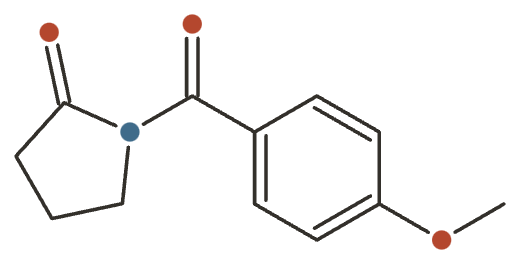

Aniracetam at a Glance
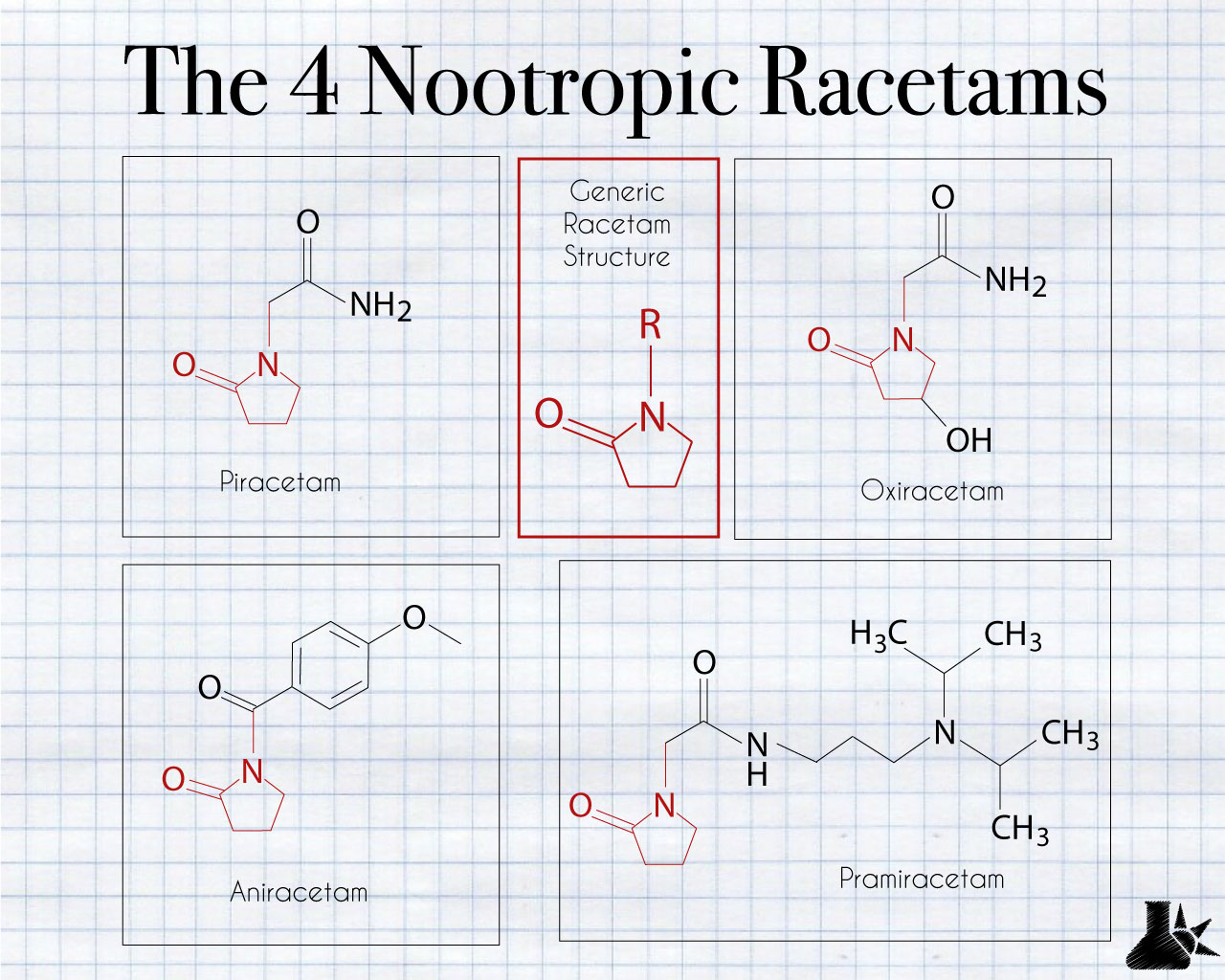
Aniracetam is a fat-soluble racetam, developed by Hoffmann-La Roche as Ro 13-5057 and sold in parts of Europe under names including Draganon and Ampamet. Like every racetam it is built on a 2-pyrrolidinone ring; what sets it apart is the 4-methoxybenzoyl group, which makes it fat-soluble where piracetam is water-soluble.
It is entirely synthetic — there is no dietary source. It has been available as a prescription medicine in parts of Europe and Japan, and is not approved as either a drug or a dietary supplement in the United States.
The point that should set expectations: aniracetam is not a nutrient, and there is no aniracetam deficiency to correct. Every claimed effect is an extra laid on top of an already-normal system — and nearly all of the human evidence comes from aged people or patients with dementia and cerebrovascular disease, where a system is already impaired. In those populations the older trial record is mixed but includes some genuinely positive placebo-controlled results. As a general smart drug for healthy users, the case rests on mechanism and anecdote rather than data.
What It’s Used For
- Dementia & age-related cognitive impairment — the best-studied use. Older placebo-controlled trials in Alzheimer-type and cerebrovascular dementia are genuinely mixed, so this is possible benefit in impaired brains, not proof.
- Emotional & behavioural symptoms in dementia — an open-label study found the emotional dimension improved fastest; interesting, but unblinded.
- Cerebral insufficiency & hypoxia-related deficits — small human EEG and psychometric studies show CNS activity and some protection against hypoxia-induced performance loss.
- Depression & mood — driven by an antidepressant-like signal in aged rats and a post-stroke-depression rationale; essentially preclinical.
- ADHD — only very recent mouse work; no human data at all.
Be sceptical of general memory and focus enhancement in healthy people — the one controlled test in healthy animals found nothing — and of the idea that it reliably treats depression, anxiety or Parkinson’s in people. Those claims rest on mechanism and rodents, not clinical trials.
How It Works
The unifying mechanism is at the AMPA receptor, which carries most of the brain’s fast excitatory glutamate signalling. Aniracetam is a positive allosteric modulator: it does not switch the receptor on by itself, but when glutamate is present it slows the receptor’s desensitisation and deactivation, so each signal lasts a little longer. That strengthens synaptic transmission and long-term potentiation, the cellular process underlying learning — which is why aniracetam and its relatives are sometimes called ampakines.
Layered on top is a cholinergic effect: aniracetam increases release of acetylcholine in the hippocampus and cortex. Because acetylcholine synthesis draws on dietary choline, this is the rationale for the near-universal advice to pair racetams with a choline source such as alpha-GPC or choline; running the cholinergic system harder without enough raw material is the usual explanation for the characteristic racetam headache. There are also more modest effects on dopamine and serotonin release.
A quirk that matters for interpreting the evidence: aniracetam itself barely survives absorption. It is almost entirely converted on first pass into metabolites — chiefly N-anisoyl-GABA, plus 2-pyrrolidinone and p-anisic acid — and several of these are themselves active at AMPA receptors. So the drug doing the work in the body is partly the parent and partly its breakdown products, and its very short parent half-life is less limiting than it first appears.
That framing also explains the variable results: a modulator that makes existing glutamate and acetylcholine signals last longer has the most room to help when those signals are weakened by age, ischaemia or neurodegeneration, and little to add to an already-healthy system.
Pharmacology & Research
Aniracetam is a synthetic pyrrolidinone AMPA-receptor positive allosteric modulator with secondary cholinergic actions. The evidence posture is a moderate older clinical literature in dementia and cerebral insufficiency that is mixed rather than uniformly positive, plus a much larger body of rodent and in-vitro mechanism work. The central distinction to keep in view is impairment-versus-enhancement: human benefit appears, when it appears at all, in aged or impaired populations, and the single controlled test in healthy subjects — an animal study — was null. Bioavailability of the parent compound is very low because of near-complete first-pass metabolism, so activity is attributed partly to its metabolites, and purity of the unregulated product is an uncontrolled variable in real-world use.
Support is an experimental score I’m building — a composite weighted by study type (human > animal > in vitro > review) and study volume. It’s a beta: a fast way to rank strength of evidence at a glance, not a validated metric. Each application links down to its write-up.
In the 276-patient open comparative study, the dimension that improved earliest under aniracetam was emotional state, significantly better by three months, while cognitive parameters were maintained rather than reversed 3Reference 3Clinical trialClinical efficacy of aniracetam, either as monotherapy or combined with cholinesterase inhibitors, in patients with cognitive impairment — comparative open studyView study →. This fits the drug’s secondary dopaminergic and serotonergic actions, and its long-standing use for the behavioural and psychological symptoms that accompany dementia and post-stroke states 13Reference 13ReviewPiracetam and piracetam-like drugs: from basic science to novel clinical applications to CNS disorders — reviewView study →.
Gap: the key evidence is open-label — no blinding, no placebo — so expectancy effects cannot be excluded, and the mood signal has never been tested in a controlled depression or agitation trial.
The antidepressant rationale comes from aged rats: aniracetam significantly reduced immobility in the forced-swim test, with a much larger effect in aged animals than in young ones, attributed to its metabolites 2-pyrrolidinone and N-anisoyl-GABA acting together, and to facilitation of dopaminergic transmission via nicotinic acetylcholine receptors 7Reference 7AnimalAntidepressant-like effects of aniracetam in aged rats and its mode of action — animal studyView study →.
This dovetails with broader interest in AMPA-receptor potentiators as candidate antidepressants 16Reference 16ReviewAMPA receptor potentiators: application for depression and Parkinson’s disease — reviewView study →, and with the drug’s historical use for post-stroke depression 8Reference 8ReviewAniracetam: its novel therapeutic potential in cerebral dysfunctional disorders based on recent pharmacological discoveries — reviewView study →.
Related animal work reports increased cortical dopamine and serotonin release through combined cholinergic and glutamatergic mechanisms 18Reference 18Aniracetam enhances cortical dopamine and serotonin release via cholinergic and glutamatergic mechanisms in SHRSP — animal study.
Gap: the antidepressant evidence is entirely preclinical and age-dependent — there is no randomised controlled trial of aniracetam for depression in humans, and the forced-swim test is a behavioural-despair screen rather than a measure of mood.
The newest signal is preclinical: in TARP γ-8 knockout mice, a genetic model of ADHD-like hyperactivity, impulsivity and memory deficits, aniracetam improved locomotor, impulsivity and recognition-memory measures 19Reference 19AnimalAniracetam ameliorates attention deficit hyperactivity disorder behavior in adolescent mice — animal study. eNeuro. https://pubmed.ncbi.nlm.nih.gov/40118526/View study →, and a follow-up reported it restored the excitation–inhibition neurotransmitter balance in the prefrontal cortex of these mice 20Reference 20AnimalAniracetam restores the excitation-inhibition balance of neurotransmitters in the prefrontal cortex of mice with ADHD — animal studyView study →.
Gap: mouse-only, from a single research group, and very recent. There is no human ADHD data and no basis yet for clinical use.
Mechanisms
| Target / pathway | Effect | Relevant to |
|---|---|---|
| AMPA (glutamate) receptor | Positive allosteric modulation — slows desensitisation and deactivation, enhancing transmission and LTP 9Reference 9In vitroThe mechanism of action of aniracetam at synaptic AMPA receptors: indirect and direct effects on desensitization — in vitro studyView study → | CognitionmemorymoodADHD models |
| AMPA receptor via the metabolite 2-pyrrolidinone | Long-lasting potentiation of AMPA currents through a CaMKII pathway 10Reference 10In vitroThe aniracetam metabolite 2-pyrrolidinone induces a long-term enhancement in AMPA receptor responses via a CaMKII pathway — in vitro studyView study → | Memory; explains the metabolite contribution |
| Acetylcholine release | Increased release in hippocampus and cortex 13Reference 13ReviewPiracetam and piracetam-like drugs: from basic science to novel clinical applications to CNS disorders — reviewView study → | Memory; the basis for choline pairing |
| Dopamine / serotonin release | Mild increase at cortical and mesolimbic terminals 7, | Moodemotional symptoms |
| Excitotoxic amino acids | Blunts the ischaemia-driven glutamate and aspartate surge 17Reference 17Effects of aniracetam on extracellular levels of transmitter amino acids in the hippocampus of conscious gerbils — intracranial microdialysis studyView study → | Cerebral insufficiencyneuroprotection |
Pharmacokinetics
Aniracetam is lipophilic and should be taken with food. It undergoes near-complete first-pass metabolism, so systemic exposure to the parent compound is very low — a bioequivalence study in healthy men found a peak plasma concentration of only about 8.7 ng/mL and a parent half-life of roughly 0.5 hours after a 400 mg dose 11Reference 11Pharmacokinetics and bioequivalence study of aniracetam after single-dose administration in healthy Chinese male volunteersView study →. It is converted mainly to N-anisoyl-GABA (~70%), with 2-pyrrolidinone and p-anisic acid making up the remainder; several of these metabolites are pharmacologically active, which is why the short parent half-life is not the whole story 11,
Clinical trials
Registered modern trial activity is minimal. Aniracetam is off-patent and has no pharmaceutical sponsor pursuing new indications, so the human record is dominated by studies from the 1980s to the 2000s; recent work is almost entirely preclinical. No large, contemporary, placebo-controlled efficacy trial is underway.
| Completed | Planned / recruiting | Terminated | Preclinical |
|---|---|---|---|
| ~8(small, mostly 1980s–2000s) | 0known | 0known | ~250+ |
Last checked: August 2026.
Dietary Sources
Aniracetam has no dietary source. It is a purely synthetic molecule, manufactured by acylating 2-pyrrolidinone with 4-methoxybenzoyl (anisoyl) chloride. It is not a nutrient, is not found in food, and the body does not make it — so unlike a vitamin or mineral there is no dietary alternative and no deficiency state it corrects. Because it is sold as an unapproved nootropic rather than a regulated drug or supplement, the practical quality issue is product purity and accurate labelling.
Dosage
These are doses studied in research and reported in self-directed use, not a personal recommendation.
- Studied range: clinical trials in dementia and cerebral insufficiency generally used
1,000–1,500 mg/day, frequently split into two doses; single-dose CNS-activity studies used
250–1,000 mg 1,
2, . Self-directed nootropic use commonly falls in the 750–1,500 mg/day range.6Reference 1RCTAniracetam (Ro 13-5057) in the treatment of senile dementia of Alzheimer type — placebo-controlled multicentre randomised trialView study →Reference 2RCTSenile dementia of the Alzheimer type treated with aniracetam — randomised controlled trialView study →Reference 6RCTQuantitative EEG and psychometric analyses in assessing CNS-activity of Ro 13-5057 — double-blind placebo-controlled crossover studyView study → - Splitting and timing: because the parent compound is cleared quickly, doses are typically split and taken with food containing fat, since aniracetam is fat-soluble and poorly absorbed on an empty stomach.
- Choline pairing: users routinely co-administer a choline source such as alpha-GPC to supply substrate for the increased acetylcholine turnover and to reduce the characteristic racetam headache. This is community practice rather than a trial finding — no study cited here tests the combination.
- No reference intake: aniracetam is not a nutrient, so there is no RDA or upper limit. Higher doses simply increase drug exposure.
Safety
Aniracetam was well tolerated in the small controlled trials that exist, but “well tolerated in a handful of old, short studies” is not the same as “well characterised.” Its long-term safety in healthy people taking it for cognitive enhancement is essentially unstudied, and the biggest real-world risk is that it is bought as an unregulated product of uncertain purity.
- Low biological toxicity in trials. Controlled studies reported excellent tolerability at 1–1.5 g/day over 3–6 months, and animal testing did not show a dependence liability 1,
21Reference 1RCTAniracetam (Ro 13-5057) in the treatment of senile dementia of Alzheimer type — placebo-controlled multicentre randomised trialView study →Reference 21Drug dependence test on a cerebral insufficiency improver, aniracetam — animal studyView study → . - No signal of abuse or withdrawal. A formal drug-dependence study in animals found no dependence potential 21Reference 21Drug dependence test on a cerebral insufficiency improver, aniracetam — animal studyView study →.
- Headache is the common complaint. Usually linked to increased acetylcholine demand; a choline source often reduces it.
- Interaction potential with CNS drugs. Its cholinergic and mild serotonergic and dopaminergic actions mean it should be combined cautiously with cholinergic agents and serotonergic medications.
- Not an approved drug or supplement in the US. It is sold as an unregulated nootropic; purity, dose accuracy and freedom from contamination cannot be assumed. It is a prescription cognition drug only in certain countries.
- Not for pregnancy, breastfeeding or children. There are no human safety data in these groups for a synthetic CNS-active drug.
Full Safety & Interactions Detail
Adverse effects reported in the clinical literature were generally mild; the most frequently mentioned is headache, attributed to the drug driving acetylcholine turnover — the basis for co-supplementing choline. One 3-month Alzheimer’s trial noted confusion leading to withdrawal in a few aniracetam-treated patients, though it also occurred on placebo 2Reference 2RCTSenile dementia of the Alzheimer type treated with aniracetam — randomised controlled trialView study →. In elderly patients with reduced renal function, metabolite clearance is markedly slower, so exposure accumulates even where acute tolerability looked fine 12Reference 12Clinical trialPharmacokinetic study of aniracetam in elderly patients with cerebrovascular disease — clinical studyView study →.
Interactions are pharmacodynamic rather than well-documented pharmacokinetic ones. Because aniracetam enhances cholinergic tone, combining it with cholinesterase inhibitors — donepezil, rivastigmine, galantamine — is additive; one open study deliberately combined the two, and dose stacking should be cautious 3Reference 3Clinical trialClinical efficacy of aniracetam, either as monotherapy or combined with cholinesterase inhibitors, in patients with cognitive impairment — comparative open studyView study →.
Its mild serotonergic and dopaminergic actions warrant caution alongside serotonergic drugs. There is no robust human CYP-interaction dataset. Anyone on prescription CNS medication should treat aniracetam as a drug and discuss it with a clinician, not as an inert supplement.
Scope disclosure. Interactions assessed? Yes — cholinergic agents and serotonergic or dopaminergic medications, on pharmacodynamic grounds; no comprehensive human CYP450 interaction data exist. Pregnancy/lactation assessed? Yes — no human data. Upper limit established? No — not a nutrient.
Avoid. There are no human pregnancy or lactation safety data for aniracetam, and it is a synthetic CNS-active drug with no nutritional role and no benefit that could offset unknown fetal or infant risk. It should not be used during pregnancy or breastfeeding.
References
- Senin U, Abate G, Fieschi C, et al. (1991). Aniracetam (Ro 13-5057) in the treatment of senile dementia of Alzheimer type — placebo-controlled multicentre randomised trial. European Neuropsychopharmacology. https://pubmed.ncbi.nlm.nih.gov/1822317/
- Sourander LB, Portin R, Mölsä P, et al. (1987). Senile dementia of the Alzheimer type treated with aniracetam — randomised controlled trial. Psychopharmacology. https://pubmed.ncbi.nlm.nih.gov/3103163/
- Koliaki CC, Messini C, Tsolaki M (2012). Clinical efficacy of aniracetam, either as monotherapy or combined with cholinesterase inhibitors, in patients with cognitive impairment — comparative open study. CNS Neuroscience & Therapeutics. https://pubmed.ncbi.nlm.nih.gov/22070796/
- Somnier FE, Ostergaard MS, Boysen G, et al. (1990). Aniracetam tested in chronic psychosyndrome after long-term exposure to organic solvents — randomised, double-blind, placebo-controlled crossover study. Psychopharmacology. https://pubmed.ncbi.nlm.nih.gov/2188276/
- Saletu B, Grünberger J (1984). The hypoxia model in human psychopharmacology: neurophysiological and psychometric studies with aniracetam i.v. — double-blind placebo-controlled study. Human Neurobiology. https://pubmed.ncbi.nlm.nih.gov/6434496/
- Saletu B, Grünberger J, Linzmayer L (1980). Quantitative EEG and psychometric analyses in assessing CNS-activity of Ro 13-5057 — double-blind placebo-controlled crossover study. Methods and Findings in Experimental and Clinical Pharmacology. https://pubmed.ncbi.nlm.nih.gov/6927816/
- Nakamura K, Tanaka Y (2001). Antidepressant-like effects of aniracetam in aged rats and its mode of action — animal study. Psychopharmacology. https://pubmed.ncbi.nlm.nih.gov/11702095/
- Nakamura K (2002). Aniracetam: its novel therapeutic potential in cerebral dysfunctional disorders based on recent pharmacological discoveries — review. CNS Drug Reviews. https://pubmed.ncbi.nlm.nih.gov/12070527/
- Lawrence JJ, Brenowitz S, Trussell LO (2003). The mechanism of action of aniracetam at synaptic AMPA receptors: indirect and direct effects on desensitization — in vitro study. Molecular Pharmacology. https://pubmed.ncbi.nlm.nih.gov/12869631/
- Nishizaki T, Matsumura T (2002). The aniracetam metabolite 2-pyrrolidinone induces a long-term enhancement in AMPA receptor responses via a CaMKII pathway — in vitro study. Brain Research Molecular Brain Research. https://pubmed.ncbi.nlm.nih.gov/11834304/
- Tian Y, Zhang JJ, Feng SD, et al. (2008). Pharmacokinetics and bioequivalence study of aniracetam after single-dose administration in healthy Chinese male volunteers. Arzneimittel-Forschung. https://pubmed.ncbi.nlm.nih.gov/19025058/
- Endo H, Tajima T, Yamada H, et al. (1997). Pharmacokinetic study of aniracetam in elderly patients with cerebrovascular disease — clinical study. Behavioural Brain Research. https://pubmed.ncbi.nlm.nih.gov/9062694/
- Malykh AG, Sadaie MR (2010). Piracetam and piracetam-like drugs: from basic science to novel clinical applications to CNS disorders — review. Drugs. https://pubmed.ncbi.nlm.nih.gov/20166767/
- Elston TW, Pandian A, Smith GD, et al. (2014). Aniracetam does not alter cognitive and affective behavior in adult C57BL/6J mice — animal study. PLoS ONE. https://pubmed.ncbi.nlm.nih.gov/25099639/
- Perng CH, Chang YC, Tzang RF (2018). The treatment of cognitive dysfunction in dementia — multiple treatments meta-analysis. Psychopharmacology. https://pubmed.ncbi.nlm.nih.gov/29502274/
- O’Neill MJ, Witkin JM (2007). AMPA receptor potentiators: application for depression and Parkinson’s disease — review. Current Drug Targets. https://pubmed.ncbi.nlm.nih.gov/17504104/
- Yu S, Cai J (2003). Effects of aniracetam on extracellular levels of transmitter amino acids in the hippocampus of conscious gerbils — intracranial microdialysis study. Neuroscience Letters. https://pubmed.ncbi.nlm.nih.gov/12633884/
- Shirane M, Nakamura K (2001). Aniracetam enhances cortical dopamine and serotonin release via cholinergic and glutamatergic mechanisms in SHRSP — animal study. Brain Research, 916:211–221.
- Sun XL, Cui J, et al. (2025). Aniracetam ameliorates attention deficit hyperactivity disorder behavior in adolescent mice — animal study. eNeuro. https://pubmed.ncbi.nlm.nih.gov/40118526/
- Cui J, Sun XL, et al. (2026). Aniracetam restores the excitation-inhibition balance of neurotransmitters in the prefrontal cortex of mice with ADHD — animal study. Scientific Reports. https://pubmed.ncbi.nlm.nih.gov/41644999/
- Kuwahara A, et al. (1987). Drug dependence test on a cerebral insufficiency improver, aniracetam — animal study. Folia Pharmacologica Japonica. https://pubmed.ncbi.nlm.nih.gov/3570103/
For half-lives, timing and stacking across the nootropics on this site, see the Nootropic Dosage Guide.



