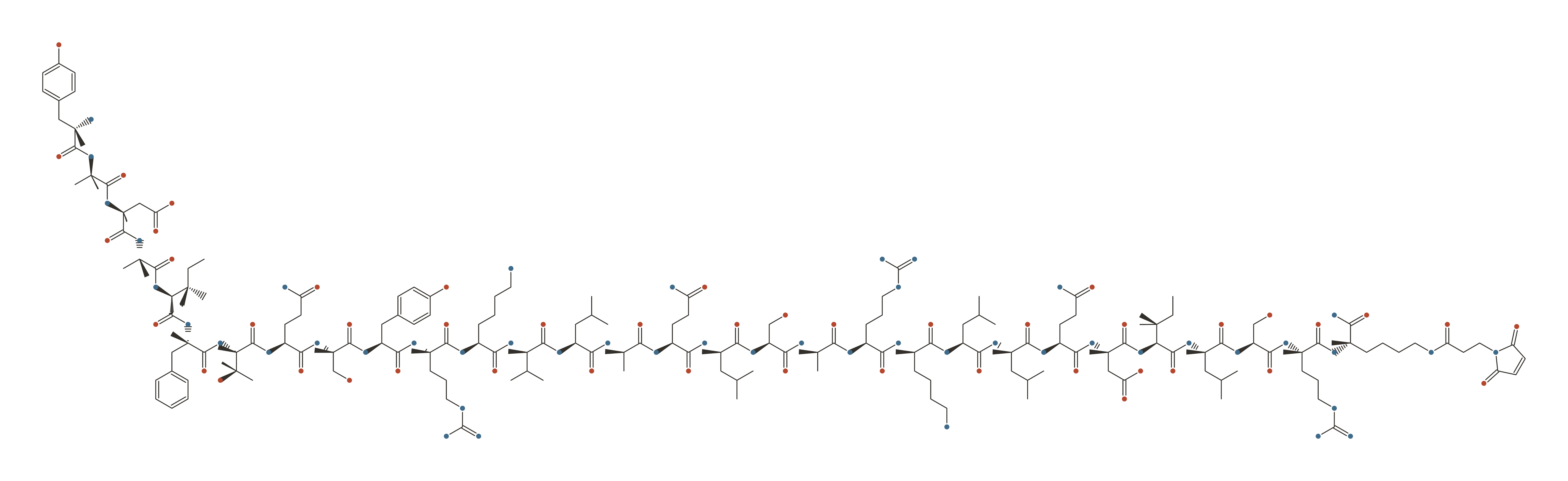
CJC-1295 DAC
A long-acting GHRH(1-29) analog that sustains growth hormone and IGF-1 for days after a single dose.

CJC-1295 DAC at a Glance
CJC-1295 DAC is a long-acting synthetic analogue of growth-hormone-releasing hormone — a peptide GH secretagogue, not a nutrient or an approved medicine. Its one well-established effect in humans is pharmacodynamic: a single subcutaneous dose raises growth hormone and IGF-1 for days, and keeps them elevated with weekly dosing.
The “DAC” is a Drug Affinity Complex that binds covalently to circulating albumin, stretching the half-life from minutes to roughly a week. That is what separates it from the short-acting no-DAC form — and the difference is not cosmetic. The DAC version holds GH and IGF-1 continuously elevated rather than restoring natural pulses, which is a mechanistic safety concern as much as a proposed benefit.
Original clinical development was discontinued, so it now circulates as a grey-market research chemical with community rather than validated dosing. It has never been approved anywhere, for anything.
History & Development
| First described | 2005, as the identification of CJC-1295 among hGRF(1-29)–albumin bioconjugates 9Reference 9In vitroHuman GH-releasing factor (hGRF)1-29-albumin bioconjugates activate the GRF receptor on the anterior pituitary in rats: identification of CJC-1295 as a long-lasting GRF analog — animal/in vitro studyView study → |
| Discovered / synthesised by | Jetté and colleagues, in the work that identified the compound 9Reference 9In vitroHuman GH-releasing factor (hGRF)1-29-albumin bioconjugates activate the GRF receptor on the anterior pituitary in rats: identification of CJC-1295 as a long-lasting GRF analog — animal/in vitro studyView study → |
| Institution | Not established in the sources consulted for this section |
| Origin | Tetrasubstituted GHRH(1-29) analogue bearing a maleimidopropionamide group that reacts covalently with albumin Cys34 |
| Key patent | Not established in the sources consulted for this section |
| Assignee | ConjuChem (the sponsor of the registered clinical trial) 8Reference 8A study to evaluate CJC-1295 in HIV patients with visceral obesity — terminatedView study → |
| Development status | Discontinued — the one registered clinical-outcome trial was terminated and never resumed 8Reference 8A study to evaluate CJC-1295 in HIV patients with visceral obesity — terminatedView study → |
Discovery
Native GHRH is degraded within minutes, chiefly by DPP-IV. The CJC-1295 backbone answers that with four substitutions to the GHRH(1-29) fragment, conferring resistance to enzymatic breakdown — the same modified backbone shared with the short-acting sibling.
What makes this molecule distinct is the addition of a maleimidopropionamide group, which reacts covalently with the free thiol on Cys34 of circulating albumin after subcutaneous injection 9Reference 9In vitroHuman GH-releasing factor (hGRF)1-29-albumin bioconjugates activate the GRF receptor on the anterior pituitary in rats: identification of CJC-1295 as a long-lasting GRF analog — animal/in vitro studyView study →. The peptide is thereafter carried on albumin, and inherits albumin’s long residence time. That is the Drug Affinity Complex, and it converts a minutes-long peptide into a days-long one.
Development & ownership
ConjuChem took the compound into early-phase clinical work around 2005–2006, producing the small
pharmacodynamic and safety studies that remain the only human data on it 1,
How it reached the market
Having left pharmaceutical channels without an approval, CJC-1295 DAC circulates through the research-peptide market: sold as “for research use only,” dosed by community protocol rather than by dose-finding, and now studied mainly by anti-doping laboratories developing detection assays rather than by therapeutic sponsors.
What It's Used For
CJC-1295 DAC is a long-acting synthetic analog of growth-hormone-releasing hormone (GHRH 1-29) — a peptide GH secretagogue, not a nutrient or approved medicine. Its one well-established effect in humans is pharmacodynamic: a single subcutaneous dose raises growth hormone (GH) and IGF-1 for days and keeps them elevated with weekly dosing. That surrogate-endpoint signal is real and replicated; what is not established is any downstream human clinical outcome — muscle gain, fat loss, recovery, or anti-aging — for which the evidence is preclinical, inferential, or absent. Because the “DAC” (Drug Affinity Complex) binds albumin and holds GH/IGF-1 continuously elevated rather than in natural pulses, the sustained supraphysiological exposure is a mechanistic safety concern as much as a proposed benefit. Original clinical development was discontinued, so it now circulates as a gray-market research chemical with community — not validated — dosing.
Support is an experimental score I’m building — a composite weighted by study type (human > animal > in vitro > review) and study volume. It’s a beta: a fast way to rank strength of evidence at a glance, not a validated metric. Each application links down to its write-up.
Note the unusual shape here: the top row is a surrogate biomarker that is genuinely well-proven, while every row below it — the reasons people actually buy the peptide — is thin. Read the caveats, not just the bars.
This is the one application with direct, high-quality human data. In two randomized, placebo-controlled, double-blind ascending-dose trials in healthy adults aged 21–61, a single subcutaneous injection of CJC-1295 raised mean plasma GH 2- to 10-fold for 6 days or more and IGF-1 1.5- to 3-fold for 9–11 days; with multiple weekly or biweekly doses IGF-1 stayed above baseline for up to 28 days, and doses of 30–60 µg/kg were the best tolerated 1Reference 1RCTProlonged stimulation of GH and IGF-I secretion by CJC-1295, a long-acting analog of GH-releasing hormone, in healthy adults — randomised, placebo-controlled trialView study →.
A separate human study showed that CJC-1295 raises trough (basal) GH about 7.5-fold and mean GH by about 46% while preserving natural GH pulse frequency and amplitude — it lifts the floor rather than adding pulses 2Reference 2Clinical trialPulsatile secretion of GH persists during continuous stimulation by CJC-1295, a long-acting GHRH analog — human studyView study →.
Human proteomic work confirmed measurable downstream GH/IGF-1 axis activation one week after a dose 4Reference 4Clinical trialActivation of the GH/IGF-1 axis by CJC-1295 results in serum protein profile changes in normal adult subjects — human studyView study →.
Gap: these are pharmacodynamic and safety endpoints in healthy volunteers — raising a hormone level is not the same as delivering a health or performance outcome, and none of these trials measured muscle, fat, strength, or recovery.
No human trial has tested CJC-1295 DAC for muscle or lean-mass gain. The rationale is entirely indirect: GH and IGF-1 are anabolic, and in GH-deficient mice (GHRH-knockout) once-daily CJC-1295 normalised body weight, length and lean mass 3Reference 3AnimalOnce-daily administration of CJC-1295, a long-acting GHRH analog, normalizes growth in the GHRH knockout mouse — animal studyView study →.
In a glucocorticoid-induced myopathy mouse model, CJC-1295 combined with ipamorelin improved maximum tetanic muscle tension — but that was an animal study of a combination, not CJC-1295 DAC alone in humans 5Reference 5ReviewInjectable peptide therapy: a primer for orthopaedic and sports medicine physicians — narrative reviewView study →.
Reviews aimed at sports-medicine clinicians conclude the physique and performance evidence is unvalidated in people 6,
Gap: benefit is demonstrated only in a deficiency model and only in animals; there is no evidence it adds muscle in healthy, GH-replete adults.
Marketed for fat loss on the basis that GH is lipolytic, but there is no direct human trial of CJC-1295 DAC for fat mass or body recomposition. The terminated commercial program targeted HIV-associated visceral fat — the same clinical space where the related GHRH analogue tesamorelin is approved — but that trial was stopped and never generated efficacy data for this compound 8Reference 8A study to evaluate CJC-1295 in HIV patients with visceral obesity — terminatedView study →.
Current reviews list recomposition among the unproven, self-administration-driven claims 7Reference 7ReviewThe emerging landscape of performance-enhancing peptides modulating the GH-IGF1 axis — narrative reviewView study →.
Gap: the entire fat-loss case is mechanistic extrapolation from GH physiology; no controlled human outcome data exist for this peptide.
Recovery and tissue-repair claims rest on GH and IGF-1’s role in collagen and tissue turnover, and on preclinical work — frequently using CJC-1295 + ipamorelin stacks in mice rather than the DAC peptide alone 5,
Gap: no human trials for injury recovery or connective-tissue healing; preclinical signals do not establish a clinical effect.
Mechanisms
| Target / pathway | Effect | Relevant to |
|---|---|---|
| GHRH receptor (pituitary somatotrophs) | Agonist → GH synthesis and release | All applications |
| Hepatic IGF-1 production (GH-driven) | Sustained IGF-1 elevation | Anabolic and metabolic claims |
| Albumin Cys34 (covalent maleimide binding — the “DAC”) | Extends plasma half-life to days | Pharmacokineticsduration |
| Dipeptidyl-peptidase-IV (DPP-IV) | Resistance conferred by tetrasubstitution | Metabolic stability |
| GH secretory pattern | Raises trough and basal GH; pulses preserved | The “GH bleed” against the natural pulse |
Pharmacokinetics
CJC-1295 is a tetrasubstituted GHRH(1-29) analogue carrying a maleimidopropionamide group that reacts covalently with the free thiol on Cys34 of circulating albumin after subcutaneous injection; the tetrasubstitution also confers resistance to DPP-IV degradation 9Reference 9In vitroHuman GH-releasing factor (hGRF)1-29-albumin bioconjugates activate the GRF receptor on the anterior pituitary in rats: identification of CJC-1295 as a long-lasting GRF analog — animal/in vitro studyView study →. The result is a plasma half-life of roughly 5.8–8.1 days 1Reference 1RCTProlonged stimulation of GH and IGF-I secretion by CJC-1295, a long-acting analog of GH-releasing hormone, in healthy adults — randomised, placebo-controlled trialView study →, against minutes for native GHRH. A single subcutaneous dose keeps GH elevated for about 6 days and IGF-1 for 9–11 days 1Reference 1RCTProlonged stimulation of GH and IGF-I secretion by CJC-1295, a long-acting analog of GH-releasing hormone, in healthy adults — randomised, placebo-controlled trialView study →.
The defining pharmacodynamic feature is that it produces a sustained, continuous elevation — a “GH bleed” — rather than restoring natural pulsatility: basal GH rises sharply while pulse frequency and amplitude are largely unchanged 2Reference 2Clinical trialPulsatile secretion of GH persists during continuous stimulation by CJC-1295, a long-acting GHRH analog — human studyView study →. This continuous supraphysiological exposure is exactly what distinguishes the DAC version from the short-acting no-DAC form, and it is central to the safety profile.
Clinical & regulatory status
Never approved anywhere, for any indication. Human data come from a small cluster of early-phase
pharmacodynamic and safety studies conducted by the original developer around 2005–2006 1,
| Completed | Planned | Terminated | Preclinical |
|---|---|---|---|
| ~2(early-phase PD/safety) | 0 | 1 | Several |
Last checked: August 2026.
Sourcing, Route & Legal Status
Regulatory status. Unapproved research chemical. CJC-1295 DAC holds no marketing authorisation from the FDA, EMA, TGA or any other regulator, for any indication, and there is no country where it is an approved prescription medicine. Its only registered clinical-outcome trial was terminated and never resumed 8Reference 8A study to evaluate CJC-1295 in HIV patients with visceral obesity — terminatedView study →. It is sold exclusively as “for research use only / not for human consumption,” which is the legally accurate frame for anyone acquiring it. It is WADA-prohibited (S2). It is not a US-scheduled controlled substance — but “not scheduled” is not “approved,” and marketing it for human use is unlawful in most Western jurisdictions.
How it’s supplied and administered. Vials of lyophilised powder, reconstituted by the user with bacteriostatic water and injected subcutaneously. The DAC form’s whole selling point is infrequent dosing — weekly or thereabouts — which follows directly from the multi-day half-life. There is no oral route, no intranasal route, and no transdermal route that delivers intact peptide.
Sourcing reality — a safety issue, not a footnote. These vials come from unregulated vendors with no manufacturing oversight and no regulatory accountability. Correct sequence, actual peptide content, absence of process impurities, and — most consequentially for an injected product — absence of bacterial endotoxin cannot be assumed 7Reference 7ReviewThe emerging landscape of performance-enhancing peptides modulating the GH-IGF1 axis — narrative reviewView study →. The DAC/no-DAC naming confusion compounds this: a vial labelled “CJC-1295” may contain either molecule, with half-lives differing by two orders of magnitude, and the buyer has no way to tell. Independent third-party certificates of analysis are the only partial mitigation, and a COA supplied by the seller is not independent verification. No vendor is recommended or linked here.
Safety
CJC-1295 DAC is a research peptide with no established human safety profile and no long-term data. The short human trials reported no serious adverse reactions at 30–60 µg/kg 1Reference 1RCTProlonged stimulation of GH and IGF-I secretion by CJC-1295, a long-acting analog of GH-releasing hormone, in healthy adults — randomised, placebo-controlled trialView study →, but those were small, brief pharmacodynamic studies — not safety trials.
- No long-term human safety data exist. The only human studies were small, short pharmacodynamic and safety trials in healthy volunteers, not powered as safety studies 1Reference 1RCTProlonged stimulation of GH and IGF-I secretion by CJC-1295, a long-acting analog of GH-releasing hormone, in healthy adults — randomised, placebo-controlled trialView study →.
- Sustained non-pulsatile GH/IGF-1 is the substantive concern. Unlike the short-acting no-DAC form, the DAC version holds both continuously elevated 2Reference 2Clinical trialPulsatile secretion of GH persists during continuous stimulation by CJC-1295, a long-acting GHRH analog — human studyView study → — the basis for insulin-resistance, fluid-retention and theoretical tissue-overgrowth and mitogenic concerns 7Reference 7ReviewThe emerging landscape of performance-enhancing peptides modulating the GH-IGF1 axis — narrative reviewView study →.
- Never assessed in pregnancy or breastfeeding. No human or animal reproductive data of any kind — see the box below.
- Development was discontinued. The one registered clinical-outcome trial was terminated 8Reference 8A study to evaluate CJC-1295 in HIV patients with visceral obesity — terminatedView study →; this is not a compound that failed to reach approval for want of interest.
- Dysglycemia is the predictable metabolic risk. GH opposes insulin, so caution applies with insulin and other antidiabetic agents.
- Product risks may exceed pharmacological ones. Non-sterile reconstitution, endotoxin, mislabelled peptide and self-mixed dosing errors are documented failure modes.
Full Safety & Interactions Detail
Overall posture. The short human trials reported no serious adverse reactions at 30–60 µg/kg 1Reference 1RCTProlonged stimulation of GH and IGF-I secretion by CJC-1295, a long-acting analog of GH-releasing hormone, in healthy adults — randomised, placebo-controlled trialView study →, but they were small, brief, conducted in healthy volunteers, and not designed or powered as safety trials. Everything below is class- and mechanism-level reasoning, labelled as such, rather than a characterised adverse-effect profile.
The core concern is the exposure pattern, not acute toxicity. Unlike the short-acting no-DAC form,
the DAC version holds GH and IGF-1 continuously elevated — a “GH bleed” — rather than restoring
natural pulses 2Reference 2Clinical trialPulsatile secretion of GH persists during continuous stimulation by CJC-1295, a long-acting GHRH analog — human studyView study →. Sustained supraphysiological GH and IGF-1 is biologically linked to insulin
resistance and dysglycaemia, fluid retention, carpal-tunnel-type symptoms, arthralgia and myalgia, and
theoretical tissue-overgrowth and mitogenic risk 7Reference 7ReviewThe emerging landscape of performance-enhancing peptides modulating the GH-IGF1 axis — narrative reviewView study →. Reviews also flag prolactin and cortisol
changes, appetite changes, and injection-site reactions among GH-axis peptides 6,
Interactions. No formal human drug-interaction studies exist for this compound. Plausible interactions — with insulin and other antidiabetic agents via glucose effects, or with corticosteroids, which blunt GH secretion — are inferred from GH physiology rather than tested. Stacking with a ghrelin-mimetic such as ipamorelin is common community practice and is an unstudied combination.
Injection- and product-specific risks may exceed the pharmacological ones. Non-sterile reconstitution technique, contaminated or endotoxin-bearing product, mislabelled or misidentified peptide, and dosing errors from self-mixed concentrations are concrete failure modes in the research-peptide market — and unlike the drug’s own effects, they do not require any pharmacology to hurt someone.
Scope disclosure. Human data? Only two small early-phase pharmacodynamic studies plus one proteomic study — no outcome trials. Interactions assessed? No — none formally studied; the cautions above are inferred from GH physiology. Pregnancy and lactation assessed? No — not studied, no data, and it should not be assumed safe. Long-term safety established? No. There is no Upper Limit because this is not a nutrient, and that absence implies nothing about safety at any dose. The lack of adverse-event data reflects the lack of study, not established safety.
Avoid — contraindicated by default. There are no human or animal reproductive-safety data for CJC-1295 DAC, and deliberately elevating GH and IGF-1 during pregnancy or lactation has no established safety margin. It should not be used.
Dosage
These are doses administered in supervised research, not a personal recommendation.
There is no RDA, AI or Tolerable Upper Intake Level for CJC-1295 DAC — it is not a nutrient.
- The only doses with human data come from early-phase research: single subcutaneous injections or weekly/biweekly dosing, with 30–60 µg/kg identified as the best-tolerated range, and doses up to 90 µg/kg studied 1Reference 1RCTProlonged stimulation of GH and IGF-I secretion by CJC-1295, a long-acting analog of GH-releasing hormone, in healthy adults — randomised, placebo-controlled trialView study →.
- Community protocols are not validated. Widely circulated figures — fixed doses of roughly 1–2 mg weekly, often stacked with ipamorelin — come from vendors and forums rather than dose-finding studies, and from unregulated supply chains where actual product identity, purity and dose are uncertain 7Reference 7ReviewThe emerging landscape of performance-enhancing peptides modulating the GH-IGF1 axis — narrative reviewView study →. They are reported here as data about the market, not as a dose.
- Splitting the dose changes nothing. Because of the multi-day half-life, the compound produces continuous rather than pulsatile GH exposure regardless of how it is divided — a pharmacologic feature, not a titratable convenience.
Related compounds
- CJC-1295 (no DAC / Mod GRF 1-29) — the short-acting sibling that produces a GH pulse rather than a sustained bleed. Confusing the two is the commonest error with this peptide.
- GH secretagogues frequently stacked with it: ipamorelin, GHRP-2, GHRP-6, hexarelin.
- Related GHRH analogues: sermorelin and tesamorelin — the latter FDA-approved for HIV-associated lipodystrophy, the indication CJC-1295’s terminated trial was targeting.
- Adjacent GH-axis peptides: AOD-9604.
References
- Teichman SL, Neale A, Lawrence B, Gagnon C, Castaigne JP, Frohman LA (2006). Prolonged stimulation of GH and IGF-I secretion by CJC-1295, a long-acting analog of GH-releasing hormone, in healthy adults — randomised, placebo-controlled trial. Journal of Clinical Endocrinology & Metabolism. https://pubmed.ncbi.nlm.nih.gov/16352683/
- Ionescu M, Frohman LA (2006). Pulsatile secretion of GH persists during continuous stimulation by CJC-1295, a long-acting GHRH analog — human study. Journal of Clinical Endocrinology & Metabolism. https://pubmed.ncbi.nlm.nih.gov/17018654/
- Alba M, Fintini D, Sagazio A, Lawrence B, Castaigne JP, Frohman LA, Salvatori R (2006). Once-daily administration of CJC-1295, a long-acting GHRH analog, normalizes growth in the GHRH knockout mouse — animal study. American Journal of Physiology: Endocrinology and Metabolism. https://pubmed.ncbi.nlm.nih.gov/16822960/
- Sackmann-Sala L, Ding J, Frohman LA, Kopchick JJ (2009). Activation of the GH/IGF-1 axis by CJC-1295 results in serum protein profile changes in normal adult subjects — human study. Growth Hormone & IGF Research. https://pubmed.ncbi.nlm.nih.gov/19386527/
- Mayfield CK, Bolia IK, Feingold CL, et al. (2026). Injectable peptide therapy: a primer for orthopaedic and sports medicine physicians — narrative review. American Journal of Sports Medicine. https://pubmed.ncbi.nlm.nih.gov/41476424/
- Mendias CL, Awan TM (2026). Safety and efficacy of approved and unapproved peptide therapies for musculoskeletal injuries and athletic performance — narrative review. Sports Medicine. https://pubmed.ncbi.nlm.nih.gov/41966639/
- Dominikowski A, Rękoś Z, Olejarz M, et al. (2026). The emerging landscape of performance-enhancing peptides modulating the GH-IGF1 axis — narrative review. Frontiers in Endocrinology. https://pubmed.ncbi.nlm.nih.gov/42395176/
- ConjuChem. A study to evaluate CJC-1295 in HIV patients with visceral obesity — terminated. ClinicalTrials.gov. https://clinicaltrials.gov/study/NCT00267527
- Jetté L, Léger R, Thibaudeau K, et al. (2005). Human GH-releasing factor (hGRF)1-29-albumin bioconjugates activate the GRF receptor on the anterior pituitary in rats: identification of CJC-1295 as a long-lasting GRF analog — animal/in vitro study. Endocrinology. https://pubmed.ncbi.nlm.nih.gov/15817669/