
Compound Monograph
Hastatoside
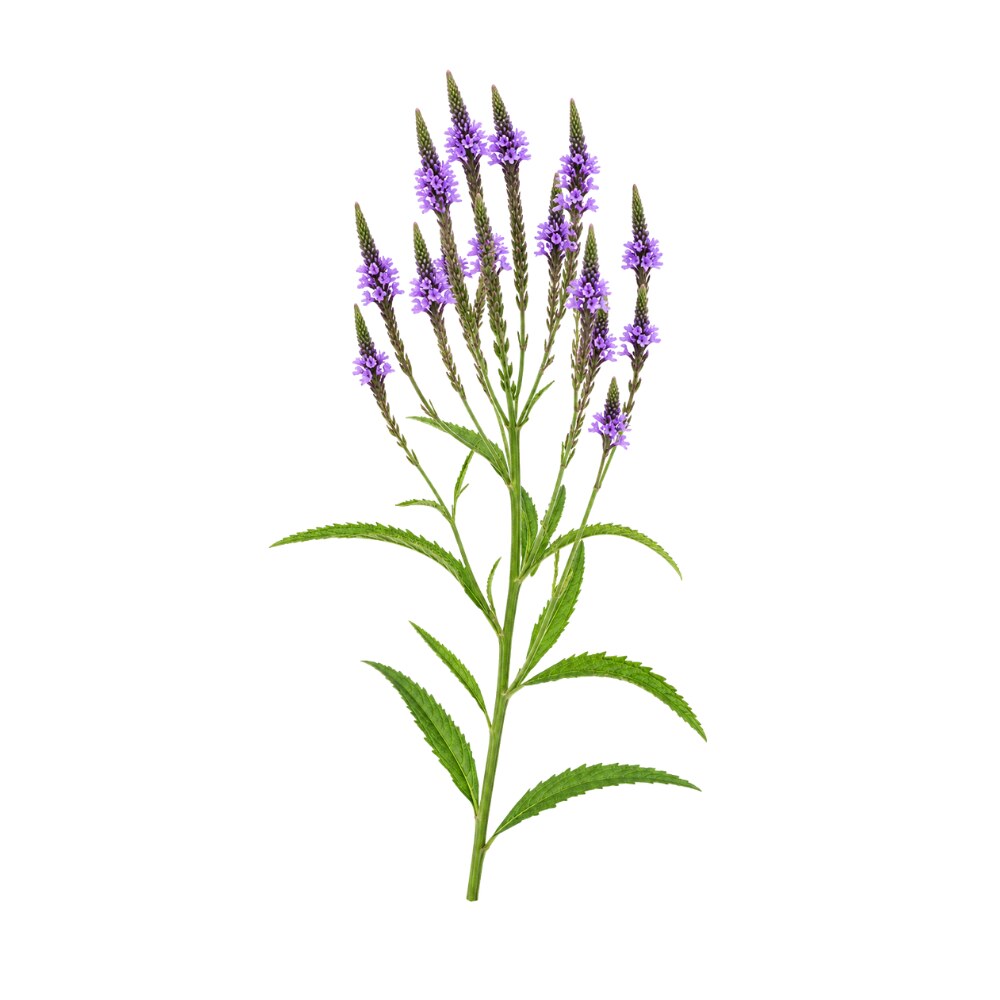
Hastatoside is an iridoid glycoside of vervain (Verbena officinalis and V. hastata) — with verbenalin, one of the two constituents shown in animals to account for the plant's traditional sleep-promoting use.

Sources · 3
Where Does It Come From?
Hastatoside is a naturally occurring iridoid glycoside, found in Common vervain, Blue vervain and 1 other source. It is well tolerated orally (low toxicity).
Concentration
Content by Source
Concentrations not reported. No percent-dry-weight or mg/g figures have been published for this compound in its source plants.
Hastatoside at a Glance
Hastatoside is an iridoid glycoside and, together with verbenalin, one of the two marker iridoids of vervain (Verbena). It was first isolated in 1979 from blue vervain (Verbena hastata) and common vervain (V. officinalis), the species that give it its name.
Its one genuinely distinctive finding is a sleep-promoting effect: an EEG study in rats identified hastatoside and verbenalin as the constituents that account for V. officinalis tea’s traditional use for insomnia 1Reference 1Hastatoside and verbenalin are sleep-promoting components in Verbena officinalisView study →. Beyond that and a single mouse liver-fibrosis study 2Reference 2Hastatoside attenuates carbon tetrachloride-induced liver fibrosis by targeting glycogen synthase kinase-3βView study →, the pharmacology of the isolated molecule is sparse — most of the evidence attributed to it is really for the vervain pair or the whole plant. This is a lean, honestly thin page.
The Vervain Sleep Pair
The reason hastatoside has a page at all is the Makino 2009 study, which set out to explain why Verbena officinalis herbal tea has long been used for insomnia and nervous complaints 1Reference 1Hastatoside and verbenalin are sleep-promoting components in Verbena officinalisView study →. By EEG analysis of rats after oral dosing, the authors compared three candidate constituents — hastatoside, verbenalin and the phenylethanoid verbascoside.
Hastatoside (0.64 mmol/kg) increased total non-REM sleep over a 9-hour night by 81%, and verbenalin (1.28 mmol/kg) by 42%, both with a lag of roughly 3–5 hours; verbascoside had no effect 1Reference 1Hastatoside and verbenalin are sleep-promoting components in Verbena officinalisView study →. On that basis the authors named hastatoside and verbenalin the major sleep-promoting components of the plant — hastatoside being the more potent of the pair. An earlier study had already shown that a whole aqueous extract of V. hastata potentiates pentobarbital-induced sleep in rats, shortening sleep latency and lengthening sleeping time dose-dependently 3Reference 3AnimalHypnotic effects of total aqueous extracts of Vervain hastata (Verbenaceae) in ratsView study →, so the isolate finding fits an established whole-plant signal.
The two molecules travel together — they are the vervain iridoid pair — and much of the literature reports them jointly rather than isolating hastatoside’s individual contribution.
What It's Used For
Outside the sleep work, the isolated-compound evidence is limited to preclinical models. Read the per-row basis: both signals below are animal or in-vitro, not human.
Support is an experimental score — weighted by study type (human > animal > in vitro) and volume. A beta, not a validated metric. Both applications rest on single preclinical studies, so scores are low by design.
The compound-defining application. In the isolated-molecule rat EEG study, oral hastatoside at 0.64 mmol/kg raised total non-REM sleep across the night by 81% — the largest effect of the three constituents tested — with verbenalin second and verbascoside inactive 1Reference 1Hastatoside and verbenalin are sleep-promoting components in Verbena officinalisView study →.
This is genuine isolate evidence, and it is backed by a whole-plant study in which an aqueous V. hastata extract potentiated pentobarbital hypnosis dose-dependently 3Reference 3AnimalHypnotic effects of total aqueous extracts of Vervain hastata (Verbenaceae) in ratsView study →, so isolate and plant agree.
Gap: the direct data are animal (rat) only — there is no human trial of hastatoside, or of standardised vervain, for sleep, and the delayed onset (3–5 h) and mechanism are uncharacterised. The “sleep-promoting” claim should be read as a well-supported traditional-use rationale, not a demonstrated clinical effect 1Reference 1Hastatoside and verbenalin are sleep-promoting components in Verbena officinalisView study →.
The only other isolate-specific pharmacology. In mice given carbon tetrachloride, hastatoside reduced markers of liver fibrosis (α-SMA, Col1α1) and suppressed hepatic stellate-cell activation; mechanistically it was shown to bind glycogen synthase kinase-3β (GSK-3β) and enhance its activity, thereby lowering β-catenin and blocking the pro-fibrotic Wnt/β-catenin programme 2Reference 2Hastatoside attenuates carbon tetrachloride-induced liver fibrosis by targeting glycogen synthase kinase-3βView study →.
This sits alongside verbenalin’s separately reported hepatoprotective activity, making hepatoprotection a plausible shared iridoid theme for vervain.
Gap: a single mouse study in one chemical-injury model; no dose-ranging in other species, no human data, and no confirmation that oral hastatoside reaches the liver at active concentrations (see Pharmacokinetics) 2Reference 2Hastatoside attenuates carbon tetrachloride-induced liver fibrosis by targeting glycogen synthase kinase-3βView study →.
Mechanisms
| Target / pathway | Effect | Relevant to |
|---|---|---|
| Central sleep regulation (mechanism uncharacterised) | oral dosing increases non-REM sleep after a 3–5 h lag | sleep promotion |
| GSK-3β / Wnt–β-catenin | binds and activates GSK-3β → lowers β-catenin → suppresses hepatic stellate-cell activation | hepatoprotection / anti-fibrotic |
| Iridoid glycoside class (bitter principle) | contributes to vervain’s characteristic bitterness and to the genus’s marker chemistry | plant chemistry / prevalence |
The two documented targets sit on unrelated axes — a central sedative effect whose molecular mediator is unknown, and a peripheral anti-fibrotic action through GSK-3β. Neither has been replicated, so both are best treated as single-study leads.
Pharmacokinetics
Essentially uncharacterised for the isolated molecule. As a polar iridoid glucoside, hastatoside would be expected to be poorly absorbed intact and subject to hydrolysis of its sugar by gut microbiota (the general fate of iridoid glycosides such as aucubin and catalpol), but no absorption, bioavailability, metabolite or half-life data specific to hastatoside have been published. That the sleep effect appears orally, after a 3–5 h delay 1Reference 1Hastatoside and verbenalin are sleep-promoting components in Verbena officinalisView study → is at least consistent with a metabolism-then-action step, but the active species is unidentified. This absence is a real limitation for interpreting the animal findings.
Clinical Trials
There are no human clinical trials of hastatoside, either as an isolate or as a standardised vervain preparation. The evidence base is entirely preclinical.
| Completed | Planned | Terminated | Preclinical |
|---|---|---|---|
| — | — | — | Sleep(rat EEG) 1Reference 1Hastatoside and verbenalin are sleep-promoting components in Verbena officinalisView study →; hepatoprotection (mouse CCl₄) 2Reference 2Hastatoside attenuates carbon tetrachloride-induced liver fibrosis by targeting glycogen synthase kinase-3βView study → |
Last checked: July 2026.
Prevalence in Nature
Hastatoside is a characteristic iridoid of the genus Verbena, reported from common vervain (Verbena officinalis) and blue vervain (V. hastata) — the two species from which it was first isolated 4Reference 4Hastatoside, a new iridoid from Verbena hastata L. and Verbena officinalis LView study → — and it is one of the two marker iridoids (with verbenalin) used to describe V. officinalis chemistry in reviews of the plant 5,
Concentrations are not well quantified. A whole-plant study of V. hastata identified hastatoside among the constituents but did not measure it, and published iridoid figures are for V. officinalis rather than V. hastata 5Reference 5Chemical constituents of the whole plant of Verbena hastata and their inhibitory activity against the production of AGEsView study →. No reliable percent-dry-weight range for hastatoside is available.
Discovery & Synthesis
Hastatoside was first isolated and named in 1979 by Horst Rimpler and Bernd Schäfer, who obtained it — a previously unknown iridoid — alongside verbenalin from Verbena hastata and V. officinalis, and determined its structure and absolute configuration by spectroscopic methods 4Reference 4Hastatoside, a new iridoid from Verbena hastata L. and Verbena officinalis LView study →. The name derives from V. hastata, one of the source species. No total synthesis is documented; like most iridoid glycosides it is obtained, when needed for research, by extraction and chromatographic isolation from vervain aerial parts rather than by synthesis. There is no commercial-scale production — hastatoside is a research-grade isolate, not an article of commerce.
Patents: not yet researched.
Toxicity & Safety
Hastatoside carries a low toxicity flag. It occurs in vervain, a herb with a long record of traditional use, and no specific toxicity, mutagenicity or organ-damage signal has been reported for the isolated compound. In the studies above it was administered orally to rodents without noted adverse effects 1,
- No toxicity signal reported. A minor iridoid of vervain, a traditionally well-tolerated herb; dosed orally to rodents without noted harm.
- Sedative in animals. The defining effect is increased sleep, so a theoretical additive effect with sedatives/CNS depressants can’t be excluded from the vervain data 3Reference 3AnimalHypnotic effects of total aqueous extracts of Vervain hastata (Verbenaceae) in ratsView study →.
- Safety not formally studied. No dedicated genotoxicity, repeat-dose or reproductive-toxicity data exist for the isolated molecule; the low rating reflects absence of red flags, not a clean bill of health.
Dosage
There is no established human dose for hastatoside. The figures below are the animal research doses, given only for context and not a recommendation:
| Application | Model | Dose |
|---|---|---|
| Sleep promotion | Rat, oral | 0.64 mmol/kg 1Reference 1Hastatoside and verbenalin are sleep-promoting components in Verbena officinalisView study → |
| Liver fibrosis | Mouse, oral | CCl₄ model (see study) 2Reference 2Hastatoside attenuates carbon tetrachloride-induced liver fibrosis by targeting glycogen synthase kinase-3βView study → |
Human exposure is indirect — through whole vervain preparations (tea, tincture), which are not standardised to hastatoside and in which its concentration is unmeasured. These are doses studied in research and are not a personal recommendation.
References
- Makino Y, Kondo S, Nishimura Y, Tsukamoto Y, Huang ZL, Urade Y (2009). Hastatoside and verbenalin are sleep-promoting components in Verbena officinalis. Sleep and Biological Rhythms. https://doi.org/10.1111/j.1479-8425.2009.00405.x
- Du C, Dong J, Wang Q, Xu C, Feng S, Feng R, Lv X, Li J, Zhang L, Huang C, Ma T (2023). Hastatoside attenuates carbon tetrachloride-induced liver fibrosis by targeting glycogen synthase kinase-3β. Phytomedicine. https://pubmed.ncbi.nlm.nih.gov/36610117/
- Akanmu MA, Honda K, Inoué S (2002). Hypnotic effects of total aqueous extracts of Vervain hastata (Verbenaceae) in rats. Psychiatry and Clinical Neurosciences. https://pubmed.ncbi.nlm.nih.gov/12047609/
- Rimpler H, Schäfer B (1979). Hastatoside, a new iridoid from Verbena hastata L. and Verbena officinalis L. Zeitschrift für Naturforschung C. https://doi.org/10.1515/znc-1979-5-601
- Yokosuka A, Honda M, Kondo H, Mimaki Y (2021). Chemical constituents of the whole plant of Verbena hastata and their inhibitory activity against the production of AGEs. Natural Product Communications. https://doi.org/10.1177/1934578X211009727
- Kubica P, Szopa A, Dominiak J, Luczkiewicz M, Ekiert H (2020). Verbena officinalis (Common Vervain) — a review on the investigations of this medicinally important plant species. Planta Medica. https://pubmed.ncbi.nlm.nih.gov/32937665/



