
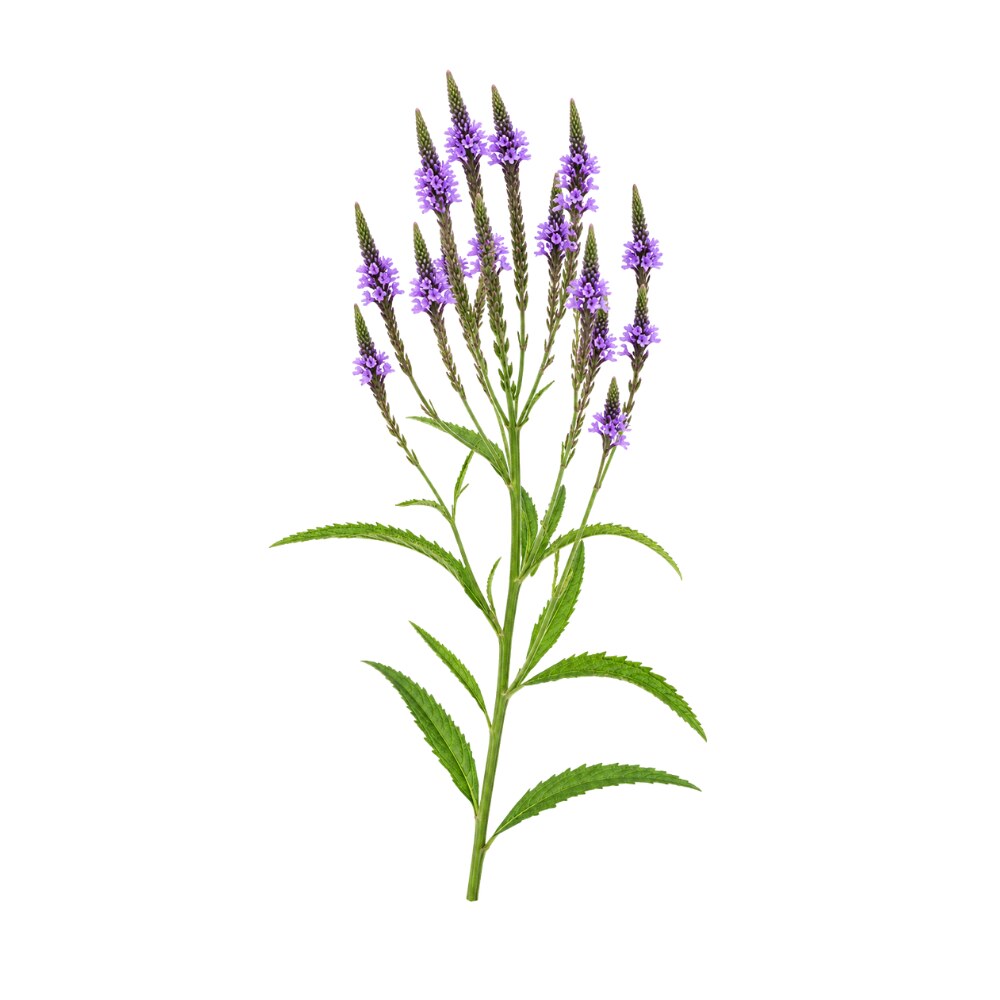
What Is Blue Vervain?
Blue vervain is a tall wildflower of North American wetlands, used in herbal medicine as a bitter, calming nervine. Its slender spikes of small violet-blue flowers bloom through mid to late summer 29Reference 29Verbena hastata (blue vervain) — description, distribution, ethnobotany — species databaseView study →.
Verbena hastata grows in wet meadows, marshes and along rivers across much of the United States and southern Canada 29Reference 29Verbena hastata (blue vervain) — description, distribution, ethnobotany — species databaseView study →. Many Native American nations used it, for fevers, stomach complaints and more, and it passed into Western herbal practice 28,
The plant contains the iridoid glycosides verbenalin and hastatoside, both of which promoted sleep in rats, along with the phenylethanoid glycoside verbascoside 1,
The name “vervain” also covers common vervain (Verbena officinalis), the European and Asian species, and is sometimes applied to lemon verbena (Aloysia citrodora), a plant of a different genus.
How Is Blue Vervain Used?
Blue vervain is used as the dried aerial parts, the leaf and flowering tops.
- Infusion — 2–4 g of dried herb, up to three times daily.
- Tincture (1:5) — 2–4 mL three times daily.
- Hot infusion — taken during a fever to bring on a sweat.
Traditional Uses
Western Herbal Medicine
Western herbalists use the dried leaf and flowering top as an infusion or tincture. They class blue vervain as a bitter nervine: relaxing and mildly sedative, and also bitter, so it is given for poor appetite and sluggish digestion. Taken hot, it is used as a diaphoretic in fevers.
It has been used for convalescence, depression, headaches, jaundice, cramps, coughs and fevers, and applied externally to wounds, ulcers and acne 29Reference 29Verbena hastata (blue vervain) — description, distribution, ethnobotany — species databaseView study →. It is chosen for tension and restlessness, and for nervous headache.
Native American Medicine
Blue vervain was used by many nations across its range 28Reference 28Native American Ethnobotany Database — Verbena hastata LView study →.
The Cherokee took it for colds, coughs, the early stages of fever and to bring on sweating, as a tonic, to strengthen the stomach, for afterpains and for “female obstructions”. A compound was taken for flux, old bowel complaints and dysentery, and the roots steeped in spirits were used for dropsy. The leaves, seeds and roots were also used as an emetic 28Reference 28Native American Ethnobotany Database — Verbena hastata LView study →.
Among the Iroquois, a compound decoction of the roots was taken for worms and stomach cramps, a root infusion was used as ear drops, and a decoction of the whole plant was taken for “summer complaint”. A wetted root was applied to the head to cool it, and a cold infusion of the leaves was used as a charm to make an unwelcome person leave 28,
The Dakota drank a leaf decoction for stomach ache, and the Menominee a root infusion to clear cloudy urine. The Delaware used a root compound for chills, the Mahuna the roots for stomach fevers, and the Chippewa a snuff of the dried flowers for nosebleed 28Reference 28Native American Ethnobotany Database — Verbena hastata LView study →.
The Omaha steeped the leaves as a tea-like drink, and the Concow ground the seeds into pinole 28Reference 28Native American Ethnobotany Database — Verbena hastata LView study →.
Indications
- Nervous tension, stress and anxiety [aerial parts; Western herbal] Caution: Calming effects have been shown only in animals, using the European species or purified iridoids 4,
5 . - Sleeplessness [aerial parts; Western herbal]
- Tension headache [aerial parts; Western herbal]
- Poor appetite and sluggish digestion [aerial parts; Western herbal]
- Fevers, colds and coughs [aerial parts; Western herbal, Cherokee]
- Stomach ache and stomach cramps [leaf, root; Dakota, Iroquois]
- Diarrhoea and dysentery [root compound; Cherokee]
- Afterpains [Cherokee]
- Cloudy urine [root; Menominee]
- Nosebleed [dried flower snuff; Chippewa]
- Wounds, ulcers and acne [external]
Botany
Blue vervain is an upright, clump-forming perennial in the vervain family, Verbenaceae 29Reference 29Verbena hastata (blue vervain) — description, distribution, ethnobotany — species databaseView study →. It grows 0.6–1.5 m tall and spreads slowly by rhizomes and by self-seeding 29Reference 29Verbena hastata (blue vervain) — description, distribution, ethnobotany — species databaseView study →.
The stems are square, green or reddish, and covered in fine white hairs that lie flat 29Reference 29Verbena hastata (blue vervain) — description, distribution, ethnobotany — species databaseView study →. The leaves grow in opposite pairs. They are lance-shaped with toothed edges and prominent veins, and grow up to about 15 cm long 29Reference 29Verbena hastata (blue vervain) — description, distribution, ethnobotany — species databaseView study →.
The flowers are borne on a candelabra-shaped cluster of pencil-thin spikes about 15 cm long 29Reference 29Verbena hastata (blue vervain) — description, distribution, ethnobotany — species databaseView study →. Each flower is about 6 mm across, with a blue-violet corolla of five spreading lobes 29Reference 29Verbena hastata (blue vervain) — description, distribution, ethnobotany — species databaseView study →. The flowers open from the bottom of each spike upward, only a few at a time, so a plant stays in bloom through mid and late summer 29Reference 29Verbena hastata (blue vervain) — description, distribution, ethnobotany — species databaseView study →.
After flowering, the persistent calyx encloses four oblong, reddish-brown nutlets 29Reference 29Verbena hastata (blue vervain) — description, distribution, ethnobotany — species databaseView study →. Songbirds such as cardinals, sparrows and juncos eat the seeds 29Reference 29Verbena hastata (blue vervain) — description, distribution, ethnobotany — species databaseView study →.
Distribution
Blue vervain is native to North America. It grows across most of the United States and in southern Canada, from Ontario and Quebec to New Brunswick and Nova Scotia 29Reference 29Verbena hastata (blue vervain) — description, distribution, ethnobotany — species databaseView study →.
It grows in moist meadows, thickets, pastures, riversides, marshes, ditches and river-bottom prairies, and it readily takes to disturbed ground 29,
Growing Conditions
Cultivation snapshot for Blue Vervain
- Prefers medium to wet, fertile soil and tolerates poor drainage and standing moisture — a natural choice for rain gardens and pond margins.
- Wants full sun for sturdy, upright growth and its best flowering.
- Cold-hardy across roughly USDA zones 3–8.
- Easily grown from seed (cold-moist stratification improves germination); individual plants may be short-lived but self-sow to keep a colony going.
Grow it yourself
Farm Wiki is our cultivation-focused sister site, also run by Justin Cooke.
Pharmacology & Research
Two modern studies have been done on blue vervain itself: an isolation of the whole plant’s constituents, which also tested their effect on advanced glycation end-products 1Reference 1In vitroChemical Constituents of the Whole Plant of Verbena hastata and Their Inhibitory Activity Against the Production of AGEs — in vitroView study →, and an analysis of its essential oil 3Reference 3The Volatile Phytochemistry of Seven Native American Aromatic Medicinal PlantsView study →. No human trial has tested blue vervain.
The rest of the research concerns the compounds it shares with common vervain (Verbena officinalis) — the iridoids verbenalin and hastatoside and the phenylethanoid glycoside verbascoside — or common vervain itself, whose herb carries European and Chinese pharmacopoeial monographs 27Reference 27ReviewVerbena officinalis (Common Vervain) — A Review on the Investigations of This Medicinally Important Plant Species — reviewView study →.
The iridoid cornin, studied for stroke and heart protection, is the same molecule as verbenalin (PubChem CID 73467). Studies of cornin are therefore studies of verbenalin, though they were done with material from common vervain.
-
Best-supported: anti-inflammatory 7,
8, and antioxidant/anti-glycation 1,9, 10Reference 7AnimalAnti-inflammatory and analgesic activity of the topical preparation of Verbena officinalis L. — ratView study →Reference 8AnimalAnti-inflammatory activity of leaf extract of Verbena officinalis L. — mouse/ratView study →Reference 9AnimalEffects of differential extraction of Verbena officinalis on rat models of inflammation, cicatrization and gastric damage — ratView study →Reference 10AnimalVerbenalin alleviates acute lung injury induced by sepsis and IgG immune complex through GPR18 receptor — in vivoView study → 11, activity, and a sleep-promoting action of the two marker iridoids 4,12Reference 1In vitroChemical Constituents of the Whole Plant of Verbena hastata and Their Inhibitory Activity Against the Production of AGEs — in vitroView study →Reference 11In vitroChemical Composition and Antioxidant Properties of Common and Lemon Verbena — in vitroView study →Reference 12In vitroAntioxidant and antifungal activity of Verbena officinalis L. leaves — in vitroView study → 5Reference 4AnimalHastatoside and verbenalin are sleep-promoting components in Verbena officinalis — animal modelView study →Reference 5AnimalAnticonvulsant, Anxiolytic, and Sedative Activities of Verbena officinalis — mouseView study → — all preclinical. -
Emerging, worth watching: liver protection by verbenalin and hastatoside 14,
15Reference 14AnimalVerbenalin attenuates hepatic damage and mitochondrial dysfunction in alcohol-associated steatohepatitis by regulating MDMX/PPARα-mediated ferroptosis — mouseView study →Reference 15AnimalHastatoside attenuates carbon tetrachloride-induced liver fibrosis by targeting glycogen synthase kinase-3β — mouseView study → , and neuroprotection by verbenalin, including the work published under the name cornin 16,17, .18, 19Reference 16AnimalVerbenalin Reduces Amyloid-Beta Peptide Generation in Cellular and Animal Models of Alzheimer’s Disease — animal modelView study →Reference 17In vitroProtective effects of verbenalin and (+)-eudesmin against 6-hydroxydopamine-induced oxidative/nitrosative stress in SH-SY5Y cells — in vitroView study →Reference 18AnimalCornin increases angiogenesis and improves functional recovery after stroke via the Ang1/Tie2 axis and the Wnt/β-catenin pathway — ratView study →Reference 19AnimalCornin protects against cerebral ischemia/reperfusion injury by preventing autophagy via the PI3K/Akt/mTOR pathway — ratView study → - Mechanistically thin: heart-protective, antimicrobial and anticancer findings rest on isolated compounds, essential oil or cell-line work on V. officinalis.
- The caveat: no human data and no efficacy study of V. hastata.
Most of the evidence comes from another species or from purified compounds. The behavioural, anti-inflammatory and anticancer work used common vervain, and the liver, brain and heart studies used isolated verbenalin or hastatoside, several of them by injection.
1. Anti-Inflammatory
Almost all of this work is on common vervain. A 50% methanolic extract applied to the skin at 1–3% reduced carrageenan-induced swelling in rats, and at 3% the effect matched piroxicam gel 7Reference 7AnimalAnti-inflammatory and analgesic activity of the topical preparation of Verbena officinalis L. — ratView study →. Applied to the skin, a leaf extract strongly reduced TPA-induced ear swelling, with a smaller effect on paw swelling 8Reference 8AnimalAnti-inflammatory activity of leaf extract of Verbena officinalis L. — mouse/ratView study →. Methanolic, flavonoid-enriched and CO₂ extracts were anti-inflammatory and protected the stomach in rats 9Reference 9AnimalEffects of differential extraction of Verbena officinalis on rat models of inflammation, cicatrization and gastric damage — ratView study →.
Verbenalin reduced lung inflammation in mice by acting through the GPR18 receptor 10Reference 10AnimalVerbenalin alleviates acute lung injury induced by sepsis and IgG immune complex through GPR18 receptor — in vivoView study →. Blue vervain’s flavonoids luteolin and apigenin and its verbascoside have also been studied for effects on NF-κB and COX-2.
Gap: no study of blue vervain, and much of the effect was shown on the skin rather than by mouth.
2. Antioxidant
This is the only indication with a direct V. hastata measurement. The whole-plant extract and its isolated constituents, including verbenalin, hastatoside, verbascoside and the triterpene acids, inhibited the formation of advanced glycation end-products (AGEs) in vitro 1Reference 1In vitroChemical Constituents of the Whole Plant of Verbena hastata and Their Inhibitory Activity Against the Production of AGEs — in vitroView study →.
In common vervain, water and hydromethanolic extracts, including infusions and decoctions, scored strongly on DPPH, ABTS, FRAP and CUPRAC assays 11Reference 11In vitroChemical Composition and Antioxidant Properties of Common and Lemon Verbena — in vitroView study →, and caffeoyl derivatives from the leaves were the main radical scavengers 12Reference 12In vitroAntioxidant and antifungal activity of Verbena officinalis L. leaves — in vitroView study →. GC-MS-profiled fractions also showed polyphenol-linked antioxidant capacity 13Reference 13In vitroMetabolic Profiling by GC-MS, In Vitro Biological Potential, and In Silico Molecular Docking Studies of Verbena officinalis — in vitroView study →.
The activity tracks rosmarinic acid, caffeic acid and verbascoside, all present in blue vervain.
Gap: all of it is in vitro, and the anti-AGE result is a single cell-free screen.
3. Sedative / Nervine
In rats, both hastatoside and verbenalin from common vervain promoted sleep, increasing non-REM sleep 4Reference 4AnimalHastatoside and verbenalin are sleep-promoting components in Verbena officinalis — animal modelView study →. Both iridoids occur in blue vervain 1Reference 1In vitroChemical Constituents of the Whole Plant of Verbena hastata and Their Inhibitory Activity Against the Production of AGEs — in vitroView study →, and hastatoside was first described from V. hastata and V. officinalis 2Reference 2Hastatoside, a New Iridoid from Verbena hastata L. and Verbena officinalis LView study →.
A crude extract of common vervain at 50–300 mg/kg was anxiolytic and sedative in mice: it increased time in the open arms of the elevated plus maze and in the light compartment of the light–dark box, and lengthened thiopental-induced sleep 5Reference 5AnimalAnticonvulsant, Anxiolytic, and Sedative Activities of Verbena officinalis — mouseView study →. At 100–500 mg/kg it also delayed and shortened chemically induced seizures 5Reference 5AnimalAnticonvulsant, Anxiolytic, and Sedative Activities of Verbena officinalis — mouseView study →. A 2025 study of standardised common vervain extracts reported effects on the nervous system in behavioural tests 6Reference 6AnimalVerbena officinalis LView study →.
Gap: no study in people. The behavioural results are from animals, mostly with common vervain, and the sleep study used purified iridoids.
4. Hepatoprotective
Two blue-vervain marker iridoids protect the liver in mouse injury models. Verbenalin, given by mouth, reduced alcohol-associated steatohepatitis by regulating MDMX/PPARα-mediated ferroptosis and mitochondrial dysfunction 14Reference 14AnimalVerbenalin attenuates hepatic damage and mitochondrial dysfunction in alcohol-associated steatohepatitis by regulating MDMX/PPARα-mediated ferroptosis — mouseView study →. Hastatoside reduced carbon-tetrachloride-induced liver fibrosis by targeting glycogen synthase kinase-3β 15Reference 15AnimalHastatoside attenuates carbon tetrachloride-induced liver fibrosis by targeting glycogen synthase kinase-3β — mouseView study →.
Both compounds were used in purified form, from common vervain.
5. Neuroprotective
Verbenalin reduced amyloid-beta production in cell and animal models of Alzheimer’s disease 16Reference 16AnimalVerbenalin Reduces Amyloid-Beta Peptide Generation in Cellular and Animal Models of Alzheimer’s Disease — animal modelView study →, and protected SH-SY5Y nerve cells against 6-hydroxydopamine-induced oxidative and nitrosative stress in vitro 17Reference 17In vitroProtective effects of verbenalin and (+)-eudesmin against 6-hydroxydopamine-induced oxidative/nitrosative stress in SH-SY5Y cells — in vitroView study →.
Under the name cornin, the same molecule, given intravenously at 25 mg/kg daily for 14 days after a stroke in rats, increased new blood-vessel growth and improved recovery through the Ang1/Tie2 and Wnt/β-catenin pathways 18Reference 18AnimalCornin increases angiogenesis and improves functional recovery after stroke via the Ang1/Tie2 axis and the Wnt/β-catenin pathway — ratView study →. It also limited brain injury after ischaemia and reperfusion by restraining autophagy through PI3K/Akt/mTOR 19Reference 19AnimalCornin protects against cerebral ischemia/reperfusion injury by preventing autophagy via the PI3K/Akt/mTOR pathway — ratView study →.
A whole ethanol extract of common vervain reduced stroke damage in rats through the IL-17A pathway 20Reference 20AnimalEthanol extract of Verbena officinalis alleviates MCAO-induced ischaemic stroke by inhibiting IL17A pathway-regulated neuroinflammation — in vivoView study →, and computer modelling identified its iridoids and flavonoids as possible anti-Alzheimer’s compounds 21Reference 21Integrating transcriptome and chemical analyses to reveal the anti-Alzheimer’s disease components in Verbena officinalis — in silicoView study →.
Gap: most of this work gave the isolated iridoid by injection, and no study has tested it by mouth.
6. Cardioprotective
Cornin, the same molecule as verbenalin, protected rat hearts against ischaemia and reperfusion injury when given intravenously at 30 mg/kg, and preserved phospho-CREB and phospho-Akt signalling in oxygen-starved heart cells 22Reference 22AnimalCardioprotection against experimental myocardial ischemic injury using cornin — ratView study →.
The same molecule reduced the progression of preeclampsia through NO signalling and NF-κB inactivation in cell, mouse and zebrafish models 23Reference 23AnimalCornin, a compound from Verbena officinalis L, ameliorates preeclampsia progression through activating NO signaling and deactivating NFκB — in vivoView study →.
Gap: one rat study, by injection, of an isolated compound.
7. Antimicrobial
Common vervain essential oil was antibacterial and antifungal in vitro, most notably against Bacillus cereus and Pseudomonas aeruginosa 24Reference 24In vitroChemistry, antioxidant, antibacterial and antifungal activities of volatile oils and their components — in vitroView study →. A 50% methanolic leaf extract and its caffeoyl derivatives were antifungal 12Reference 12In vitroAntioxidant and antifungal activity of Verbena officinalis L. leaves — in vitroView study →.
Blue vervain’s own essential oil has a different composition, rich in 1-octen-3-ol and palmitic acid 3Reference 3The Volatile Phytochemistry of Seven Native American Aromatic Medicinal PlantsView study →.
Gap: the active preparations were the essential oil and solvent fractions of common vervain, while blue vervain is taken as a water or alcohol extract.
8. Anticancer
Semi-purified fractions of common vervain were active against LOX-IMVI melanoma cells in vitro, with IC₅₀ values as low as about 2.85 µg/mL 25Reference 25In vitroIn Vitro Antimelanoma Properties of Verbena officinalis Fractions — in vitroView study →. A common vervain extract inhibited H22 solid tumours in mice while affecting immune measures 26Reference 26AnimalStudy on in-vivo anti-tumor activity of Verbena officinalis extract — animal modelView study →.
Gap: no active compound was identified, and there are no data on blue vervain.
Mechanisms
Blue vervain’s best-studied compound is the iridoid verbenalin, also known as cornin. It has been studied for anti-inflammatory activity at the GPR18 receptor, for liver protection through PPARα and ferroptosis, and for effects on blood-vessel growth and cell-survival signalling in stroke and heart models 10,
The second iridoid, hastatoside, has been studied for sleep promotion and liver fibrosis 4,
| Mechanism | Drives | Key compounds |
|---|---|---|
| GPR18 agonism, NF-κB ↓, COX-2 ↓ | anti-inflammatory | verbenalin, verbascoside, luteolin, apigenin |
| Radical scavenging, anti-glycation (AGE ↓) | antioxidant | rosmarinic acid, caffeic acid, verbascoside |
| Non-REM sleep promotion | sedative / nervine | hastatoside, verbenalin |
| PPARα/ferroptosis regulation, GSK-3β targeting | hepatoprotective | verbenalin, hastatoside |
| Ang1/Tie2, Wnt/β-catenin, PI3K/Akt/mTOR modulation | neuroprotectivecardioprotective | verbenalin (= cornin) |
Clinical Trials
No registered trial has tested blue vervain on its own. The only ClinicalTrials.gov entry that includes it is a completed trial of a multi-herb “alcohol alternative” tincture in 80 people, in which blue vervain is one of many ingredients (NCT06505694). Other “vervain” trials concern lemon verbena (Aloysia).
| Completed | Planned | Terminated | Preclinical |
|---|---|---|---|
| 0(monotherapy) | 0 | 0 | ~25 |
Last checked: July 2026.
Phytochemistry
Blue vervain contains the iridoid glycosides verbenalin and hastatoside, the marker compounds of the Verbena genus, along with the phenylethanoid glycoside verbascoside 1Reference 1In vitroChemical Constituents of the Whole Plant of Verbena hastata and Their Inhibitory Activity Against the Production of AGEs — in vitroView study →. A study of the whole plant also isolated the related glycosides leucosceptoside A and martynoside and the triterpene acids oleanolic acid and ursolic acid 1Reference 1In vitroChemical Constituents of the Whole Plant of Verbena hastata and Their Inhibitory Activity Against the Production of AGEs — in vitroView study →.
The flavonoids apigenin and luteolin and the phenolic acids caffeic acid and rosmarinic acid are also reported from the plant.
Hastatoside is named after this species; it was first described from V. hastata and V. officinalis 2Reference 2Hastatoside, a New Iridoid from Verbena hastata L. and Verbena officinalis LView study →.
The essential oil of the aerial parts is rich in 1-octen-3-ol (up to 29%) and palmitic acid (up to 22%) 3Reference 3The Volatile Phytochemistry of Seven Native American Aromatic Medicinal PlantsView study →.
Constituent Summary
Reported from Verbena hastata; † marks the iridoid glycosides used as Verbena markers.
Phenylpropanoid3 compoundsno data
Dosage
Blue vervain is taken as an infusion or tincture of the dried aerial parts. The research doses below are for animals, isolated compounds or common vervain.
| Indication | Preparation | Dose | Est. dried-herb equivalent | Source |
|---|---|---|---|---|
| Sedative / anxiolytic | V. officinalis crude extract (mouse) | 50–300 mg/kg | — | 5Reference 5AnimalAnticonvulsant, Anxiolytic, and Sedative Activities of Verbena officinalis — mouseView study → |
| Anticonvulsant | V. officinalis crude extract (mouse) | 100–500 mg/kg | — | 5Reference 5AnimalAnticonvulsant, Anxiolytic, and Sedative Activities of Verbena officinalis — mouseView study → |
| Anti-inflammatory (topical) | V. officinalis methanolic extract, topical gel | 1–3% w/w | — | 7Reference 7AnimalAnti-inflammatory and analgesic activity of the topical preparation of Verbena officinalis L. — ratView study → |
| Neuroprotective | Cornin (= verbenalin), rat, intravenous | 25 mg/kg daily for 14 days | — | 18Reference 18AnimalCornin increases angiogenesis and improves functional recovery after stroke via the Ang1/Tie2 axis and the Wnt/β-catenin pathway — ratView study → |
| Cardioprotective | Cornin (= verbenalin), rat, intravenous | 30 mg/kg | — | 22Reference 22AnimalCardioprotection against experimental myocardial ischemic injury using cornin — ratView study → |
Traditional Dosage
| System | Preparation | Dose |
|---|---|---|
| Western herbal | Dried herb (aerial parts), infusion | 2–4 g, up to three times daily |
| Western herbal | Tincture 1:5 in 40% ethanol | 2–4 mL, three times daily |
| Western herbal | Liquid extract 1:1 in 25% ethanol | 2–4 mL, three times daily |
Safety & Pregnancy
Blue vervain has no reports of serious toxicity. Its cautions are its bitterness at large doses, its possible sedative effect, and its traditional avoidance in pregnancy.
- Avoid in pregnancy. used traditionally for “female obstructions”; the related common vervain harmed fetal development in rats
- Large doses upset the stomach. they can cause nausea, vomiting and diarrhoea
- Sedatives. its mild sedative action may add to that of sedative medicines
- Blood-pressure and hormone medicines. it may interfere with both
- Confirm identity. “vervain” also names common vervain and lemon verbena (Aloysia citrodora)
Full Safety & Interactions Detail
Toxicity. There are no reports of serious toxicity. Its marker iridoid verbenalin was not mutagenic in a bacterial reverse-mutation (Ames) test; repeated-dose, reproductive and carcinogenicity testing has not been done 27Reference 27ReviewVerbena officinalis (Common Vervain) — A Review on the Investigations of This Medicinally Important Plant Species — reviewView study →.
Large doses. Blue vervain is intensely bitter, and large doses cause vomiting and diarrhoea 29Reference 29Verbena hastata (blue vervain) — description, distribution, ethnobotany — species databaseView study →.
Medicines. It may interfere with blood-pressure medication and hormone therapy 29Reference 29Verbena hastata (blue vervain) — description, distribution, ethnobotany — species databaseView study →. Its mild sedative action could add to that of sedatives, hypnotics or other central nervous system depressants; this has not been studied.
Identity. “Vervain” is shared by several plants, including lemon verbena (Aloysia citrodora), a different genus that is the source of most “vervain” trials and products. Check that the product is Verbena hastata.
Avoid. The Cherokee used blue vervain for “female obstructions”, a use recorded as abortifacient 28Reference 28Native American Ethnobotany Database — Verbena hastata LView study →.
In the related common vervain, an extract given to pregnant rats at 2,000–3,000 mg/kg reduced fetal weight and caused incomplete bone formation in the fetuses 31Reference 31AnimalPrenatal developmental toxicity evaluation of Verbena officinalis during gestation period in female Sprague-Dawley rats — ratView study →. Blue vervain itself has not been tested.
Use while breastfeeding has not been assessed, so it is best avoided.
References
- Yokosuka, A., et al. (2021). Chemical Constituents of the Whole Plant of Verbena hastata and Their Inhibitory Activity Against the Production of AGEs — in vitro. Natural Product Communications. https://doi.org/10.1177/1934578X211009727
- Rimpler, H., & Schäfer, B. (1979). Hastatoside, a New Iridoid from Verbena hastata L. and Verbena officinalis L. Zeitschrift für Naturforschung C. https://doi.org/10.1515/znc-1979-5-601
- Lawson, S. K., et al. (2021). The Volatile Phytochemistry of Seven Native American Aromatic Medicinal Plants. Plants (Basel). https://pubmed.ncbi.nlm.nih.gov/34070663/
- Makino, Y., et al. (2009). Hastatoside and verbenalin are sleep-promoting components in Verbena officinalis — animal model. Sleep and Biological Rhythms. https://doi.org/10.1111/j.1479-8425.2009.00405.x
- Khan, A. W., et al. (2016). Anticonvulsant, Anxiolytic, and Sedative Activities of Verbena officinalis — mouse. Frontiers in Pharmacology. https://pubmed.ncbi.nlm.nih.gov/28066246/
- Koshovyi, O., et al. (2025). Verbena officinalis L. Herb Extract, Its Amino Acid Preparations and 3D-Printed Dosage Forms: Phytochemical, Technological and Pharmacological Research — animal model. Plants (Basel). https://pubmed.ncbi.nlm.nih.gov/40941816/
- Calvo, M. I. (2006). Anti-inflammatory and analgesic activity of the topical preparation of Verbena officinalis L. — rat. Journal of Ethnopharmacology. https://pubmed.ncbi.nlm.nih.gov/16723201/
- Calvo, M. I., et al. (1998). Anti-inflammatory activity of leaf extract of Verbena officinalis L. — mouse/rat. Phytomedicine. https://pubmed.ncbi.nlm.nih.gov/23196030/
- Speroni, E., et al. (2007). Effects of differential extraction of Verbena officinalis on rat models of inflammation, cicatrization and gastric damage — rat. Planta Medica. https://pubmed.ncbi.nlm.nih.gov/17354166/
- Yang, L., et al. (2023). Verbenalin alleviates acute lung injury induced by sepsis and IgG immune complex through GPR18 receptor — in vivo. Cellular Signalling. https://pubmed.ncbi.nlm.nih.gov/37315751/
- Polumackanycz, M., et al. (2022). Chemical Composition and Antioxidant Properties of Common and Lemon Verbena — in vitro. Antioxidants (Basel). https://pubmed.ncbi.nlm.nih.gov/36421433/
- Casanova, E., et al. (2008). Antioxidant and antifungal activity of Verbena officinalis L. leaves — in vitro. Plant Foods for Human Nutrition. https://pubmed.ncbi.nlm.nih.gov/18498054/
- Nisar, R., et al. (2022). Metabolic Profiling by GC-MS, In Vitro Biological Potential, and In Silico Molecular Docking Studies of Verbena officinalis — in vitro. Molecules. https://pubmed.ncbi.nlm.nih.gov/36235221/
- Dong, J., et al. (2023). Verbenalin attenuates hepatic damage and mitochondrial dysfunction in alcohol-associated steatohepatitis by regulating MDMX/PPARα-mediated ferroptosis — mouse. Journal of Ethnopharmacology. https://pubmed.ncbi.nlm.nih.gov/36739928/
- Du, C., et al. (2023). Hastatoside attenuates carbon tetrachloride-induced liver fibrosis by targeting glycogen synthase kinase-3β — mouse. Phytomedicine. https://pubmed.ncbi.nlm.nih.gov/36610117/
- Lim, J., et al. (2022). Verbenalin Reduces Amyloid-Beta Peptide Generation in Cellular and Animal Models of Alzheimer’s Disease — animal model. Molecules. https://pubmed.ncbi.nlm.nih.gov/36557811/
- Demiryürek, A. N., et al. (2023). Protective effects of verbenalin and (+)-eudesmin against 6-hydroxydopamine-induced oxidative/nitrosative stress in SH-SY5Y cells — in vitro. Molecular Biology Reports. https://pubmed.ncbi.nlm.nih.gov/36331750/
- Xu, Y., et al. (2016). Cornin increases angiogenesis and improves functional recovery after stroke via the Ang1/Tie2 axis and the Wnt/β-catenin pathway — rat. Archives of Pharmacal Research. https://pubmed.ncbi.nlm.nih.gov/26276673/
- Lan, T., et al. (2022). Cornin protects against cerebral ischemia/reperfusion injury by preventing autophagy via the PI3K/Akt/mTOR pathway — rat. BMC Pharmacology & Toxicology. https://pubmed.ncbi.nlm.nih.gov/36280856/
- Zhang, W., et al. (2024). Ethanol extract of Verbena officinalis alleviates MCAO-induced ischaemic stroke by inhibiting IL17A pathway-regulated neuroinflammation — in vivo. Phytomedicine. https://pubmed.ncbi.nlm.nih.gov/38056148/
- Peng, S., et al. (2022). Integrating transcriptome and chemical analyses to reveal the anti-Alzheimer’s disease components in Verbena officinalis — in silico. Frontiers in Plant Science. https://pubmed.ncbi.nlm.nih.gov/35991454/
- Xu, Y., et al. (2016). Cardioprotection against experimental myocardial ischemic injury using cornin — rat. Brazilian Journal of Medical and Biological Research. https://pubmed.ncbi.nlm.nih.gov/26871971/
- Xu, Q., et al. (2026). Cornin, a compound from Verbena officinalis L, ameliorates preeclampsia progression through activating NO signaling and deactivating NFκB — in vivo. Phytomedicine. https://pubmed.ncbi.nlm.nih.gov/41483576/
- De Martino, L., et al. (2009). Chemistry, antioxidant, antibacterial and antifungal activities of volatile oils and their components — in vitro. Natural Product Communications. https://pubmed.ncbi.nlm.nih.gov/20120118/
- Nisar, R., et al. (2022). In Vitro Antimelanoma Properties of Verbena officinalis Fractions — in vitro. Molecules. https://pubmed.ncbi.nlm.nih.gov/36234866/
- Kou, W. Z., et al. (2013). Study on in-vivo anti-tumor activity of Verbena officinalis extract — animal model. African Journal of Traditional, Complementary and Alternative Medicines. https://pubmed.ncbi.nlm.nih.gov/24146482/
- Kubica, P., et al. (2020). Verbena officinalis (Common Vervain) — A Review on the Investigations of This Medicinally Important Plant Species — review. Planta Medica. https://pubmed.ncbi.nlm.nih.gov/32937665/
- Botanical Research Institute of Texas. Native American Ethnobotany Database — Verbena hastata L. (uses recorded from Hamel & Chiltoskey 1975, Herrick 1977, Gilmore 1919, Densmore 1928, Smith 1923, Tantaquidgeon 1942, Romero 1954, Rousseau 1945, Chestnut 1902) — ethnobotany database. http://naeb.brit.org/uses/search/?string=verbena+hastata
- North Carolina Extension Gardener Plant Toolbox. Verbena hastata (blue vervain) — description, distribution, ethnobotany — species database. https://plants.ces.ncsu.edu/plants/verbena-hastata/
- Native Plant Trust. Go Botany: Verbena hastata L. — facts, habitat and conservation status — species database. https://gobotany.nativeplanttrust.org/species/verbena/hastata/
- Fateh, A. H., Mohamed, Z., Chik, Z., Alsalahi, A., Md Zin, S. R., & Alshawsh, M. A. (2019). Prenatal developmental toxicity evaluation of Verbena officinalis during gestation period in female Sprague-Dawley rats — rat. Chemico-Biological Interactions. https://pubmed.ncbi.nlm.nih.gov/30807743/



