
Coca
Erythroxylum coca
Plant Family
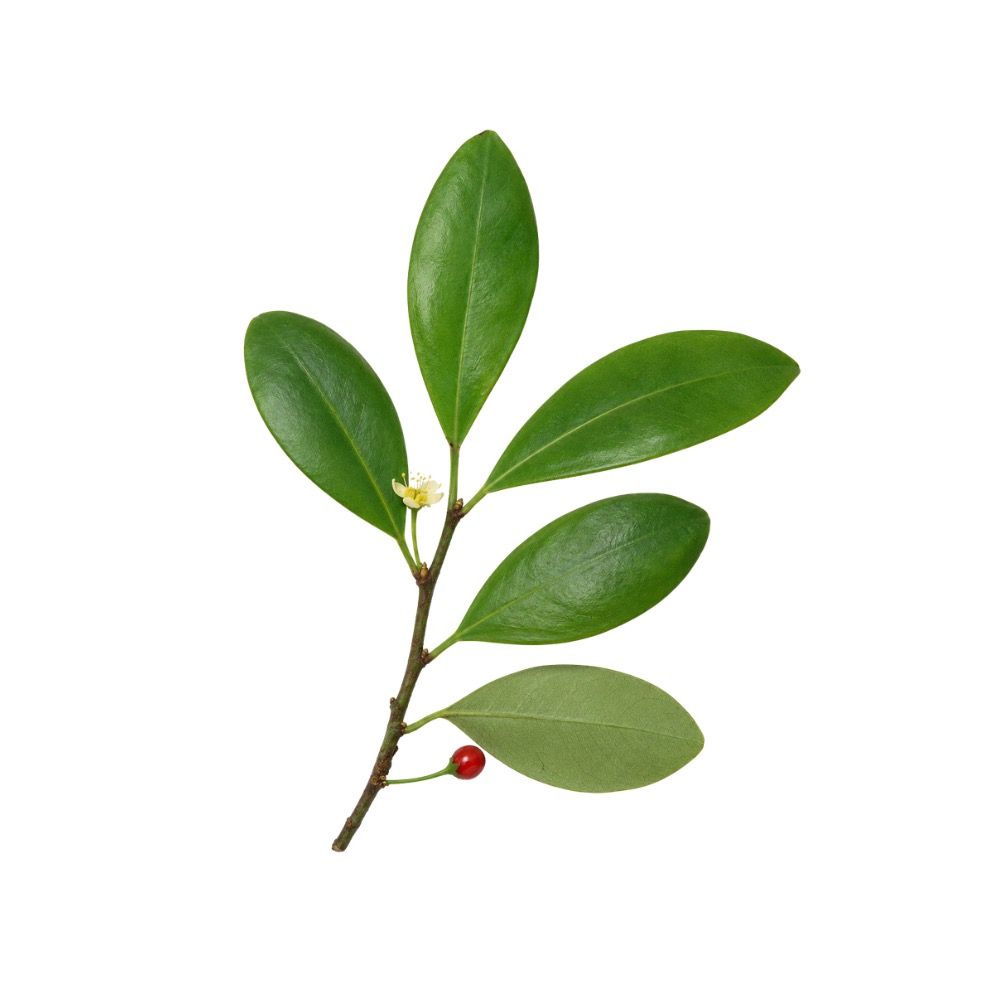
Pictured: Coca
Coca family
A small tropical family whose single medicinally significant genus, Erythroxylum, carries cocaine — the compound that founded local anaesthesia.
1 Herb // 13 Constituents // 3 Notable Members
Overview
A small family of about 4 genera and 240 species of tropical shrubs and small trees, with almost all the diversity — and all the pharmacological interest — in the genus Erythroxylum. The leaves are simple, alternate and characteristically marked with two pale lines running either side of the midrib, a folding scar from the leaf’s development in bud that is a reliable field character.
Shared Traits
In Practice
Coca (Erythroxylum coca) has been cultivated in the Andes for at least four thousand years, chewed as a quid with an alkaline ash or lime to free the alkaloid. In that traditional form it is a mild stimulant — used against fatigue, hunger, cold and the effects of altitude, with a pharmacological profile far closer to strong coffee than to the isolated drug. Coca leaf tea remains an everyday item in Peru and Bolivia and is culturally central rather than marginal.
The isolated alkaloid is a different matter. Cocaine was purified in 1860, and within two decades Karl Koller had demonstrated its ability to anaesthetise the eye — the first effective local anaesthetic, and the origin of an entire drug class. Every modern “-caine” agent (lidocaine, procaine, bupivacaine) descends structurally from it, redesigned to keep the sodium-channel blockade while discarding the reuptake inhibition that makes cocaine addictive. Cocaine itself is still used clinically in a narrow niche — topical anaesthesia of the nasal mucosa, where its vasoconstriction is an advantage.
Its mechanism is dual and worth separating: sodium-channel blockade produces the anaesthesia, while dopamine, noradrenaline and serotonin reuptake inhibition produces the euphoria, dependence and cardiovascular toxicity. The two effects are pharmacologically independent, which is precisely what allowed the useful half to be engineered out.
Safety and legality dominate any discussion of the isolated compound: cardiac arrhythmia, myocardial infarction, stroke and high addictive liability, and control under international convention. The leaf, in traditional context, has a markedly different risk profile — but is caught by the same restrictions in most of the world.
Materia Medica
The monograph in the database whose Erythroxylaceae membership is recorded on the herb itself — so this list keeps itself current as new herbs land.
Erythroxylum coca
Phytochemistry
Tropane alkaloids are the family marker — cocaine, cinnamoylcocaine, and the truxillines — a biosynthetic class it shares with the nightshades despite no close relationship. Also present: flavonoids, tannins, and the volatile methyl salicylate that gives the leaf its scent.
The compounds recorded for this family's single member, grouped by class.
Beyond the Database
Notable members without a monograph yet.
Keep Exploring