
St. John's Wort
Hypericum perforatum
Plant Family
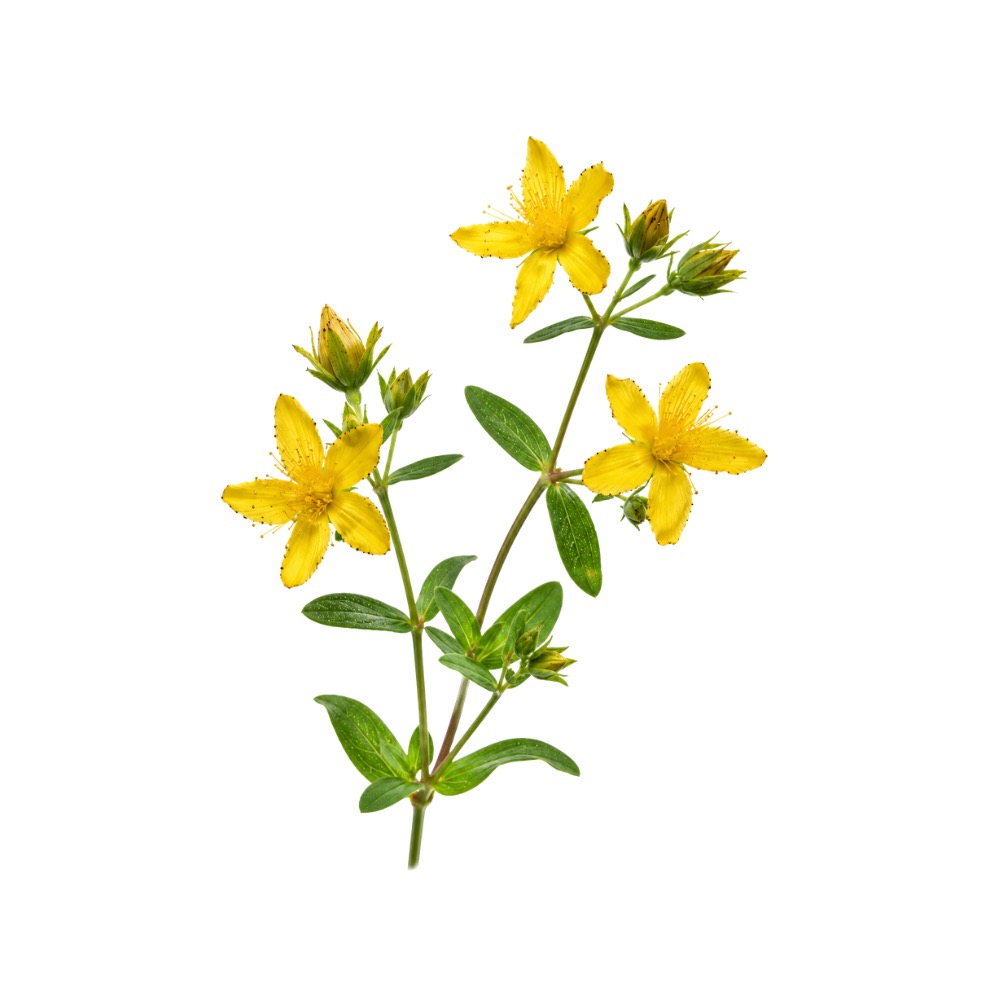
Pictured: St. John's Wort
St John’s wort family
Plants marked by translucent oil glands and dark pigment dots, whose signature compounds hyperforin and hypericin drive both real antidepressant activity and serious drug interactions.
1 Herb // 12 Constituents // 4 Notable Members
Overview
Around 9 genera and 700 species, most of them in the genus Hypericum, distributed through temperate and subtropical regions. The field character is excellent: hold a leaf to the light and it appears perforated by translucent dots — schizogenous oil glands, which give H. perforatum its species name — while the petal margins carry black dots of hypericin-containing pigment that stain the fingers red when crushed.
Shared Traits
In Practice
St John’s wort (Hypericum perforatum) is the best-evidenced herbal antidepressant in existence, and simultaneously the most dangerous common herb for drug interactions. Both facts trace to the same molecule.
Efficacy is not in serious doubt. Cochrane reviews and multiple meta-analyses find standardised extract superior to placebo in mild to moderate depression and comparable to standard antidepressants, with fewer side effects and better tolerability. Evidence in severe depression is weaker. The active principle is chiefly hyperforin, a prenylated phloroglucinol that inhibits reuptake of serotonin, noradrenaline, dopamine, GABA and glutamate — an unusually broad, non- selective profile arising from a mechanism (sodium-conductance-dependent) quite unlike an SSRI’s. Hypericin, the red pigment, contributes photosensitivity more than antidepressant activity.
The interaction problem is the reason this herb requires care. Hyperforin is a potent activator of the pregnane X receptor, which induces CYP3A4 and P-glycoprotein. The consequence is that St John’s wort accelerates the clearance of a very large fraction of prescription medicine — including oral contraceptives (documented contraceptive failure and pregnancy), ciclosporin (documented transplant rejection), warfarin, antiretrovirals, some chemotherapy agents, statins and anticonvulsants. Combined with SSRIs or triptans it can also precipitate serotonin syndrome. This is not a theoretical caution: it is among the best-documented herb–drug interaction profiles in pharmacology, with real clinical harm behind it.
Photosensitivity is the other characteristic effect, well established in grazing livestock and reported in fair-skinned people at higher doses.
Materia Medica
The monograph in the database whose Hypericaceae membership is recorded on the herb itself — so this list keeps itself current as new herbs land.
Hypericum perforatum
Phytochemistry
Prenylated phloroglucinols (hyperforin, adhyperforin) and naphthodianthrones (hypericin, pseudohypericin) are the family markers. Alongside them: flavonoids (hyperoside, rutin, quercitrin), biflavones (amentoflavone), tannins and xanthones.
The compounds recorded for this family's single member, grouped by class.
Beyond the Database
Notable members without a monograph yet.
Keep Exploring