Materia Medica
Meadow Saffron ☠️
Colchicum autumnale
Meadow saffron is a poisonous European meadow plant that flowers in autumn without its leaves. Every part contains colchicine, the alkaloid behind a licensed drug for gout, pericarditis and familial Mediterranean fever.
What Is Meadow Saffron?
Meadow saffron is a poisonous European meadow plant, and the source of colchicine, one of the oldest drugs still in use. It flowers in autumn with no leaves, which is where the name “naked ladies” comes from, and sends up its leaves and seed capsule the following spring 25Reference 25Species account: Colchicum autumnale — description, habitat, biogeography, ecology and threats — floraView study →.
It grows wild in damp grassland, meadows and woodland clearings across western and central Europe 25Reference 25Species account: Colchicum autumnale — description, habitat, biogeography, ecology and threats — floraView study →. It appears in the Ebers papyrus of ancient Egypt, and Byzantine physicians used it for gout 28Reference 28ReviewColchicine — a short history of an ancient drug — historical reviewView study →.
Every part of the plant contains colchicine 25Reference 25Species account: Colchicum autumnale — description, habitat, biogeography, ecology and threats — floraView study →. As a purified, measured medicine, colchicine has been tested in large randomised trials for gout, pericarditis, familial Mediterranean fever and heart disease 1,
Meadow saffron is not a crocus and is not the source of culinary saffron. It shares the name “autumn crocus” and the autumn flowering, but true crocuses have three stamens and meadow saffron has six 25Reference 25Species account: Colchicum autumnale — description, habitat, biogeography, ecology and threats — floraView study →.
Identification & Lookalikes
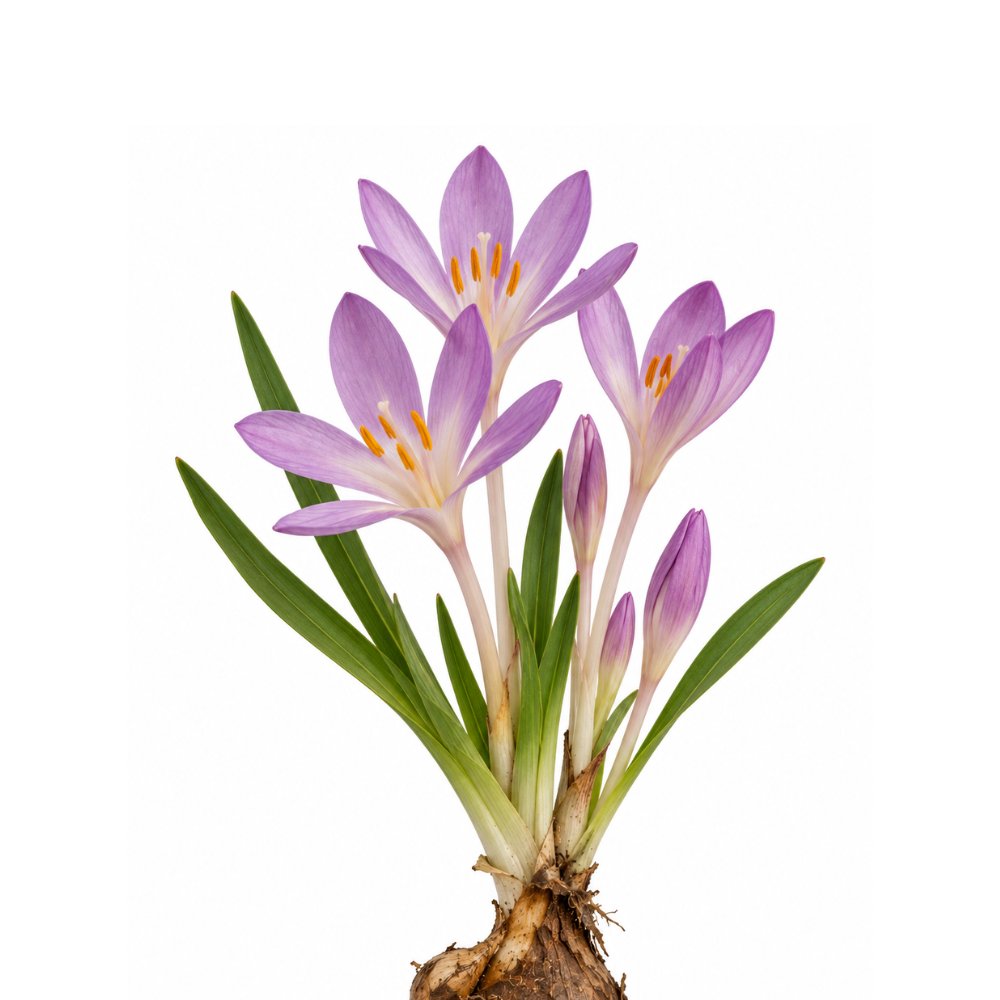
The leaves and the flowers never appear together. The flowers come up from bare ground in late summer and autumn. The broad, glossy leaves follow in spring, at the time of year when wild greens are gathered, and there is no flower beside them to identify the plant 25Reference 25Species account: Colchicum autumnale — description, habitat, biogeography, ecology and threats — floraView study →.
| Confused with | How it differs |
|---|---|
| Wild garlic / ramsons (Allium ursinum) | The confusion behind documented deaths. Wild garlic leaves smell strongly of garlic when crushed; meadow saffron leaves do not 22, |
| Onion or garlic bulbs | The corm could be taken for a bulb. A meadow saffron corm is solid, with dark brown, leathery sheaths, not built of layers like an onion 26Reference 26Colchicum autumnale L. — species description — floraView study → |
| Crocuses, including saffron crocus (Crocus spp.) | Some crocuses also flower leafless in autumn. True crocuses have three stamens; meadow saffron has six 25Reference 25Species account: Colchicum autumnale — description, habitat, biogeography, ecology and threats — floraView study → |
In a documented Croatian case, a 62-year-old man ate a salad of leaves he took for wild garlic. He developed multi-organ failure over the next two days and died five days after eating it 22Reference 22Case reportFatal colchicine poisoning by accidental ingestion of meadow saffron — case reportView study →.
Botany
Meadow saffron (Colchicum autumnale) is a perennial of the Colchicaceae that grows from an underground corm. The corm is 3–5 cm long, with dark brown, leathery sheaths, and is replaced every year 25,
In spring the plant produces a loose rosette of glossy, strap-shaped leaves, 15–35 cm long 25Reference 25Species account: Colchicum autumnale — description, habitat, biogeography, ecology and threats — floraView study →. The seed capsule rises among them from underground. It is 3–5 cm long and deeply three-lobed, and it sheds its seeds in June 25Reference 25Species account: Colchicum autumnale — description, habitat, biogeography, ecology and threats — floraView study →.
The leaves die back by early summer, and the plant rests underground through late July and early August 25Reference 25Species account: Colchicum autumnale — description, habitat, biogeography, ecology and threats — floraView study →. From late August or September it sends up one to seven flowers with no leaves around them 25Reference 25Species account: Colchicum autumnale — description, habitat, biogeography, ecology and threats — floraView study →.
The flowers are pinkish to pale mauve, occasionally white, and about 3 cm across. Each has six stamens with yellow anthers and three thin white stigmas. The flower narrows into a pale tube up to 20 cm long that joins the ovary below ground 25Reference 25Species account: Colchicum autumnale — description, habitat, biogeography, ecology and threats — floraView study →.
A plant can live for 15–20 years or more 25Reference 25Species account: Colchicum autumnale — description, habitat, biogeography, ecology and threats — floraView study →. It spreads slowly from buds on the corm and by seed, which ants carry, and a seedling takes four to six years to flower 25Reference 25Species account: Colchicum autumnale — description, habitat, biogeography, ecology and threats — floraView study →.
Distribution
Meadow saffron is native to western and central Europe. Its range runs east to Bulgaria, Romania and western Ukraine, and south to northern Greece and northern Spain 25Reference 25Species account: Colchicum autumnale — description, habitat, biogeography, ecology and threats — floraView study →.
It grows in damp but not waterlogged grassland, hay meadows, pastures, riverbanks, woodland glades and rides. It is mainly a lowland plant, but in the Swiss Alps it has been recorded above 2,200 m 25Reference 25Species account: Colchicum autumnale — description, habitat, biogeography, ecology and threats — floraView study →.
It is locally common in extensively managed meadows in Germany and Austria, and may be increasing in parts of Austria. Near the edges of its range it is declining 25Reference 25Species account: Colchicum autumnale — description, habitat, biogeography, ecology and threats — floraView study →.
In Britain it is native but local, commonest along the lower Severn and Wye in Herefordshire, Worcestershire and Gloucestershire. Its northern limit is in North Yorkshire, and its western limit is the Nore Valley in southern Ireland 25Reference 25Species account: Colchicum autumnale — description, habitat, biogeography, ecology and threats — floraView study →.
Many British grassland sites were lost before 1930 to drainage, ploughing and deliberate removal because the plant poisons livestock. It now survives most often in woodland clearings and rides 25Reference 25Species account: Colchicum autumnale — description, habitat, biogeography, ecology and threats — floraView study →.
Livestock poisoning is uncommon even where the plant is frequent in pasture, because animals generally avoid it, including in cut hay 25Reference 25Species account: Colchicum autumnale — description, habitat, biogeography, ecology and threats — floraView study →.
Beyond Europe it has been grown as a garden bulb and is recorded as naturalised in New Zealand 26Reference 26Colchicum autumnale L. — species description — floraView study →.
Phytochemistry
Colchicine is the plant’s principal alkaloid, and it is present in all parts of the plant 25Reference 25Species account: Colchicum autumnale — description, habitat, biogeography, ecology and threats — floraView study →. It is a tropolone alkaloid with a seven-membered tropolone ring. Demecolcine is a close relative.
Colchicine binds tubulin and stops microtubules from forming 27Reference 27Systematic reviewColchicine poisoning: the dark side of an ancient drug — systematic reviewView study →. This is the basis of both its medical use and its toxicity.
An analysis of leaves, stems and corms at four stages of growth found that colchicine content in the fresh plant changes as it grows, and that both colchicine and demecolcine fall as the material dries 24Reference 24Changes in colchicine and demecolcine content during the vegetation period of Colchicum autumnale L. — phytochemical analysisView study →.
Colchicine is also used in plant breeding to double chromosome numbers, because it stops cell division.
Constituent Summary
Content changes through the season and with drying.
Alkaloid2 compounds2 with data
Toxicology
Class of poison. Tropolone alkaloid; a poison of the mitotic spindle.
Mechanism. Colchicine binds tubulin and breaks up the microtubule network inside cells. Cell division stops, cells lose their ability to move, change shape and secrete, and heart-muscle conduction and contraction are disrupted. Together these lead to multi-organ failure 27Reference 27Systematic reviewColchicine poisoning: the dark side of an ancient drug — systematic reviewView study →.
Course. Colchicine poisoning runs in three overlapping phases 27Reference 27Systematic reviewColchicine poisoning: the dark side of an ancient drug — systematic reviewView study →:
- 10–24 hours after ingestion: a gastrointestinal phase that looks like gastroenteritis.
- From 24 hours to 7 days: multi-organ failure. Death comes from rapidly progressing organ failure and sepsis.
- Recovery: usually complete, within a few weeks, in those who survive. Survivors can lose their hair during recovery, typically from one to three weeks after the poisoning. It grows back 29,
30, .31Reference 29Systematic reviewAlopecia and associated toxic agents: a systematic reviewView study →Reference 30Case reportSuccessful management of accidental colchicine intoxication after ingestion of Colchicum autumnale: a case report — case reportView study →Reference 31Case reportGloriosa superba poisoning-induced anagen effluvium — case report of hair loss after colchicine poisoningView study →
Late presentation and existing kidney or liver disease worsen the outlook 27Reference 27Systematic reviewColchicine poisoning: the dark side of an ancient drug — systematic reviewView study →.
Toxic dose. The margin between a treatment dose and a toxic one is narrow. The lowest reported lethal oral doses of colchicine are 7–26 mg, and acute ingestions above 0.5 mg/kg carry a high fatality rate 27Reference 27Systematic reviewColchicine poisoning: the dark side of an ancient drug — systematic reviewView study →. The plant cannot be measured to anywhere near that precision, because its alkaloid content shifts through the season 24Reference 24Changes in colchicine and demecolcine content during the vegetation period of Colchicum autumnale L. — phytochemical analysisView study →.
Antidote. None is available. Fab antibody fragments against colchicine have been used experimentally but are not on the market. Treatment is supportive: early activated charcoal, fluids, and support of the bone marrow, including granulocyte colony-stimulating factor 27Reference 27Systematic reviewColchicine poisoning: the dark side of an ancient drug — systematic reviewView study →.
Fatal cases. Deaths are documented after people ate the leaves in mistake for wild garlic 22Reference 22Case reportFatal colchicine poisoning by accidental ingestion of meadow saffron — case reportView study →. Colchicine poisoning is uncommon, but its mortality is high when it is missed 27Reference 27Systematic reviewColchicine poisoning: the dark side of an ancient drug — systematic reviewView study →.
Traditional & Historical Use
Ancient and Classical Medicine
The name comes from Colchis, the ancient kingdom on the Black Sea where the plant grew in abundance, and which Greek myth tied to the sorceress Medea 28Reference 28ReviewColchicine — a short history of an ancient drug — historical reviewView study →.
The Ebers papyrus of ancient Egypt, from around 1550 BCE, lists the plant as a treatment for pain and swelling 28Reference 28ReviewColchicine — a short history of an ancient drug — historical reviewView study →.
Early Greek and Roman writers recorded it mainly as a poison. Dioscorides described its toxic effects in De materia medica, and Pliny the Elder listed it among the poisons 28Reference 28ReviewColchicine — a short history of an ancient drug — historical reviewView study →.
The Byzantine physician Alexander of Tralles (525–605 CE) used it systematically for acute gout. He also warned of its irritant action on the stomach and bowel 28Reference 28ReviewColchicine — a short history of an ancient drug — historical reviewView study →.
Nineteenth-Century Pharmacy
Tincture and wine of colchicum, made from the seed and corm, were official preparations in Western pharmacopoeias through the nineteenth century, prescribed for gout and rheumatism. They were also a recognised cause of poisoning in the same period.
In 1820 the French pharmacists Pierre-Joseph Pelletier and Joseph Bienaimé Caventou isolated the alkaloid 28Reference 28ReviewColchicine — a short history of an ancient drug — historical reviewView study →. Once the pure compound could be measured, it replaced the crude preparations.
Foxglove and cinchona followed the same path from plant to purified drug.
The Drug Derived From It
Every modern medical use belongs to isolated colchicine, a licensed prescription medicine. Its main uses are acute gout, pericarditis, familial Mediterranean fever and the prevention of further heart attacks and strokes in coronary disease 1,
The trials used pharmaceutical colchicine at doses measured in fractions of a milligram, with a formal dose-reduction scheme for patients on interacting drugs 19Reference 19Novel evidence-based colchicine dose-reduction algorithm to predict and prevent colchicine toxicity from drug interactions — pharmacokinetic analysisView study →. None tested a preparation of the plant.
The strongest human data are in pericarditis, where the ICAP, CORP and CORP-2 trials found numbers needed to treat of 3 to 5 4,
Its anti-inflammatory action is now understood to run through microtubule-dependent suppression of the NLRP3 inflammasome 14Reference 14In vitroGout-associated uric acid crystals activate the NALP3 inflammasome — in vitro and animal modelView study →. Work in mice suggests it also acts on liver cells, which release hormones that calm immune cells 15Reference 15AnimalColchicine acts selectively in the liver to induce hepatokines that inhibit myeloid cell activation — mouse in vivo mechanistic studyView study →.
1. Pericarditis
Pericarditis is colchicine’s best-supported use. In the ICAP trial (n=240, acute pericarditis), colchicine 0.5 mg twice daily for patients over 70 kg, or once daily for those 70 kg or under, for 3 months, was added to aspirin or ibuprofen. It cut incessant or recurrent pericarditis from 37.5% to 16.7%, a number needed to treat of 4 (P<0.001) 4Reference 4RCTA randomised trial of colchicine for acute pericarditis (ICAP) — randomised, double-blind, placebo-controlled RCTView study →.
The CORP trial (n=120, first recurrence) reduced 18-month recurrence from 55% to 24%, an absolute reduction of 31% 5Reference 5RCTColchicine for recurrent pericarditis (CORP) — randomised, double-blind, placebo-controlled trialView study →. CORP-2 (n=240, two or more prior recurrences) reduced recurrence from 42.5% to 21.6% 6Reference 6RCTEfficacy and safety of colchicine for multiple recurrences of pericarditis (CORP-2) — randomised, double-blind, placebo-controlled trialView study →.
A meta-analysis of the randomised trials confirmed fewer recurrences, with an acceptable rate of side effects 7Reference 7Meta-analysisThe role of colchicine in pericarditis — systematic review and meta-analysis of randomised trialsView study →.
All of these trials added colchicine to standard anti-inflammatory treatment, and none used a plant preparation.
2. Cardiovascular Secondary Prevention
Two large placebo-controlled trials tested low-dose colchicine in coronary disease.
COLCOT (n=4,745) enrolled patients within 30 days of a heart attack. Colchicine 0.5 mg daily lowered a composite of cardiovascular death, resuscitated cardiac arrest, heart attack, stroke or urgent hospitalisation for angina leading to revascularisation from 7.1% to 5.5% over a median 22.6 months (hazard ratio 0.77, 95% CI 0.61–0.96). The largest effects were on stroke and urgent hospitalisation for angina 8Reference 8RCTEfficacy and safety of low-dose colchicine after myocardial infarction (COLCOT) — randomised, double-blind, placebo-controlled RCTView study →.
LoDoCo2 (n=5,522, chronic coronary disease) reduced its primary composite from 9.6% to 6.8% (HR 0.69) over a median 28.6 months 9Reference 9RCTColchicine in patients with chronic coronary disease (LoDoCo2) — randomised, double-blind, placebo-controlled RCTView study →.
A 2025 Cochrane review and a 2025 European Heart Journal meta-analysis pooled these and other trials and found a consistent reduction in major cardiovascular events 10,
LoDoCo2 recorded more deaths from non-cardiovascular causes on colchicine than on placebo (HR 1.51, 95% CI 0.99–2.31) 9Reference 9RCTColchicine in patients with chronic coronary disease (LoDoCo2) — randomised, double-blind, placebo-controlled RCTView study →. A benefit on overall mortality has not been shown.
3. Acute Gout
Gout is the plant’s oldest documented use. The AGREE trial (n=184) compared low-dose colchicine (1.8 mg in total over 1 hour), high-dose colchicine (4.8 mg over 6 hours) and placebo in early gout flares. A 50% or greater fall in pain at 24 hours was reached by 37.8% on the low dose, 32.7% on the high dose and 15.5% on placebo 1Reference 1RCTHigh versus low dosing of oral colchicine for early acute gout flare (AGREE) — randomised, double-blind, placebo-controlled RCTView study →.
The low dose had a side-effect profile similar to placebo. On the high dose, 76.9% had diarrhoea and 17.3% vomited 1Reference 1RCTHigh versus low dosing of oral colchicine for early acute gout flare (AGREE) — randomised, double-blind, placebo-controlled RCTView study →.
The 2021 Cochrane review rated the evidence low-quality but consistent with a modest benefit from low-dose colchicine, and found that high-dose regimens add harm without adding benefit 2Reference 2Systematic reviewColchicine for acute gout — systematic reviewView study →.
Gap: the evidence is low-quality and the effect modest. The dose ceiling is the main finding: pushing past 1.8 mg added side effects and no benefit 1Reference 1RCTHigh versus low dosing of oral colchicine for early acute gout flare (AGREE) — randomised, double-blind, placebo-controlled RCTView study →.
4. Familial Mediterranean Fever
Colchicine is the standard preventive treatment for this inherited autoinflammatory disease. A controlled trial by Zemer and colleagues, published in 1974, showed that it prevents the recurrent attacks of fever and serositis 12Reference 12RCTA controlled trial of colchicine in preventing attacks of familial Mediterranean fever — randomised controlled trialView study →.
A Cochrane review of treatments for familial Mediterranean fever supports colchicine as first-line, and notes that the trial base is small and old 13Reference 13Systematic reviewInterventions for reducing inflammation in familial Mediterranean fever — systematic reviewView study →.
The pivotal trials are decades old and small by modern standards, and all of them used isolated colchicine.
5. Anti-Inflammatory
Colchicine binds tubulin and blocks microtubule assembly. This impairs neutrophil movement and suppresses the NLRP3 (NALP3) inflammasome, which urate crystals switch on 14Reference 14In vitroGout-associated uric acid crystals activate the NALP3 inflammasome — in vitro and animal modelView study →.
A 2021 mouse study found that at safe doses colchicine breaks up microtubules mainly in liver cells rather than in circulating immune cells. The liver cells then release anti-inflammatory hormones such as GDF15, which damp down immune-cell activation 15Reference 15AnimalColchicine acts selectively in the liver to induce hepatokines that inhibit myeloid cell activation — mouse in vivo mechanistic studyView study →.
Cell and animal work also shows effects against foam-cell formation in artery plaque, in line with the cardiovascular trials 16Reference 16In vitroColchicine exerts anti-atherosclerotic and plaque-stabilising effects targeting foam cell formation — in vitro and animal modelView study →.
The liver-cell mechanism has been shown in mice. In people, the evidence is the clinical outcomes of the disease trials rather than a direct measurement.
6. Hepatic Fibrosis
Colchicine was used for decades for alcoholic and other liver fibrosis and cirrhosis. A Cochrane review of 15 randomised trials (1,714 patients) found no effect on overall mortality (RR 1.00), liver-related mortality, complications, liver blood tests or liver histology. Adverse events were four times more common on colchicine (RR 4.35) 17Reference 17Systematic reviewColchicine for alcoholic and non-alcoholic liver fibrosis and cirrhosis — systematic reviewView study →.
The authors concluded that colchicine should not be used for liver fibrosis or cirrhosis outside clinical trials 17Reference 17Systematic reviewColchicine for alcoholic and non-alcoholic liver fibrosis and cirrhosis — systematic reviewView study →.
Mechanisms
Colchicine binds tubulin and blocks microtubule assembly 27Reference 27Systematic reviewColchicine poisoning: the dark side of an ancient drug — systematic reviewView study →. In white blood cells this stops them moving into inflamed tissue and suppresses the NLRP3 inflammasome, which is why it works in gout, pericarditis and familial Mediterranean fever 14Reference 14In vitroGout-associated uric acid crystals activate the NALP3 inflammasome — in vitro and animal modelView study →.
The same action damages every dividing cell. The gut lining and bone marrow are affected first as the dose rises, which is why diarrhoea limits the gout dose and why overdose leads to organ failure 1,
| Mechanism | Drives | Key compounds |
|---|---|---|
| Tubulin binding → microtubule depolymerisation | anti-inflammatoryantigouttoxicity | colchicine, demecolcine |
| NLRP3 (NALP3) inflammasome ↓, IL-1β ↓ | goutpericarditisFMFcardiovascular | colchicine |
| Neutrophil chemotaxis / adhesion ↓ | acute goutserositis | colchicine |
| Hepatocyte-selective Nrf2 → GDF15 hepatokine axis | systemic anti-inflammatory at safe doses | colchicine |
| Foam-cell formation ↓, plaque stabilisation | cardiovascular secondary prevention | colchicine |
Clinical Trials
Isolated colchicine has a large trial record in cardiovascular disease, pericarditis, gout and familial Mediterranean fever. No trial has tested a preparation of Colchicum autumnale, and the hepatic-fibrosis trials found no benefit 17Reference 17Systematic reviewColchicine for alcoholic and non-alcoholic liver fibrosis and cirrhosis — systematic reviewView study →.
| Completed | Planned | Terminated | Preclinical |
|---|---|---|---|
| 10+ | several(cardiovascular) | hepatic fibrosis (no benefit) | many |
Last checked: August 2026.
Pharmaceutical Doses — Not Herbal Ones
These are the doses of prescription colchicine used in the trials. There is no herbal dose.
| Indication | Preparation | Dose | Est. dried-herb equivalent | Source |
|---|---|---|---|---|
| Acute gout flare | Isolated colchicine (prescription) | 1.8 mg total over 1 hour; 4.8 mg added side effects, not benefit | Not derivable | 1Reference 1RCTHigh versus low dosing of oral colchicine for early acute gout flare (AGREE) — randomised, double-blind, placebo-controlled RCTView study → |
| Pericarditis (added to standard treatment) | Isolated colchicine | 0.5 mg twice daily (>70 kg) or once daily (≤70 kg), 3 months | Not derivable | 4Reference 4RCTA randomised trial of colchicine for acute pericarditis (ICAP) — randomised, double-blind, placebo-controlled RCTView study → |
| Cardiovascular secondary prevention | Isolated colchicine | 0.5 mg once daily | Not derivable | 8, |
| Familial Mediterranean fever | Isolated colchicine | Long-term prevention, specialist-managed | Not derivable | 12, |
The plant’s alkaloid content changes through the season and with drying, so no plant equivalent can be given 24Reference 24Changes in colchicine and demecolcine content during the vegetation period of Colchicum autumnale L. — phytochemical analysisView study →.
Safety & Pregnancy
Every part of meadow saffron is poisonous, and colchicine poisoning has no available antidote 25,
- All parts are poisonous, and fatal poisonings are documented 22,
25Reference 22Case reportFatal colchicine poisoning by accidental ingestion of meadow saffron — case reportView study →Reference 25Species account: Colchicum autumnale — description, habitat, biogeography, ecology and threats — floraView study → . - No available antidote. Treatment is supportive only 27Reference 27Systematic reviewColchicine poisoning: the dark side of an ancient drug — systematic reviewView study →.
- Three-phase course. Gastrointestinal illness in the first day, then multi-organ failure up to day 7, then recovery or death. The first phase can look like ordinary gastroenteritis 27Reference 27Systematic reviewColchicine poisoning: the dark side of an ancient drug — systematic reviewView study →.
- Mistaken for wild garlic. The spring leaves have been eaten as wild garlic (ramsons), with fatal results 22Reference 22Case reportFatal colchicine poisoning by accidental ingestion of meadow saffron — case reportView study →. Wild garlic smells of garlic when crushed; meadow saffron does not 25Reference 25Species account: Colchicum autumnale — description, habitat, biogeography, ecology and threats — floraView study →.
- Drug interactions. CYP3A4 and P-glycoprotein inhibitors raise colchicine levels, and the drug has a formal dose-reduction scheme for use alongside them 19,
27Reference 19Novel evidence-based colchicine dose-reduction algorithm to predict and prevent colchicine toxicity from drug interactions — pharmacokinetic analysisView study →Reference 27Systematic reviewColchicine poisoning: the dark side of an ancient drug — systematic reviewView study → . Grapefruit juice increased colchicine absorption in cell and rat models 18Reference 18Grapefruit juice and its constituents augment colchicine intestinal absorption: potential hazardous interaction — pharmacokinetic studyView study →. - Content varies through the season 24Reference 24Changes in colchicine and demecolcine content during the vegetation period of Colchicum autumnale L. — phytochemical analysisView study →, so no crude preparation can be measured.
Full Safety Detail
How poisoning looks. It begins with nausea, vomiting, abdominal pain and diarrhoea that can be mistaken for food poisoning. Over the following days it progresses to multi-organ failure with bone-marrow suppression. There is no available antidote, and treatment is supportive 27Reference 27Systematic reviewColchicine poisoning: the dark side of an ancient drug — systematic reviewView study →. Late presentation worsens the outlook 27Reference 27Systematic reviewColchicine poisoning: the dark side of an ancient drug — systematic reviewView study →. Survivors can lose their hair during recovery, typically from one to three weeks after the poisoning 29,
How people are exposed to the plant. Mostly by misidentification. The spring leaves are gathered as wild garlic, and a fatal case from exactly this error is documented 22Reference 22Case reportFatal colchicine poisoning by accidental ingestion of meadow saffron — case reportView study →. Wild garlic smells strongly of garlic when crushed, and meadow saffron does not 25Reference 25Species account: Colchicum autumnale — description, habitat, biogeography, ecology and threats — floraView study →.
Poisoning with the medicine. Colchicine tablets also poison children. A UK National Poisons Information Service series recorded 57 cases in people under 18 over ten years, 2011–2021. Twelve progressed to systemic toxicity and four died; all of the deaths were mixed overdoses 23Reference 23Case reportPaediatric colchicine poisoning in the UK: a 10-year retrospective case series — National Poisons Information ServiceView study →.
Drug interactions. Colchicine is broken down by CYP3A4 and pumped out of cells by P-glycoprotein. Drugs that block either one raise its levels. Pharmacokinetic studies led to recommended colchicine dose cuts of 33–66% for acute gout and 50–75% for prevention when it is combined with these drugs, except azithromycin, which needed no change 19Reference 19Novel evidence-based colchicine dose-reduction algorithm to predict and prevent colchicine toxicity from drug interactions — pharmacokinetic analysisView study →.
Grapefruit juice. In cell and rat models, grapefruit juice blocked the pump that removes colchicine from the gut wall and increased its absorption. The authors advised awareness of the interaction because of colchicine’s narrow margin 18Reference 18Grapefruit juice and its constituents augment colchicine intestinal absorption: potential hazardous interaction — pharmacokinetic studyView study →.
Side effects at treatment doses. Diarrhoea is the main dose-limiting problem. In the AGREE trial it affected 76.9% of patients on the high dose, against 23.0% on the low dose 1,
Pregnancy. The plant is contraindicated. The drug is a separate matter, because women with familial Mediterranean fever take colchicine long term. A 2025 systematic review of colchicine in fertility, pregnancy and breastfeeding was carried out to inform the EULAR/PReS recommendations for the disease 21Reference 21Meta-analysisSafety of colchicine on fertility, pregnancy, and lactation: a systematic review and meta-analysis informing the EULAR/PReS recommendations for familial Mediterranean feverView study →.
Avoid the plant entirely. Meadow saffron is lethally poisonous, has no available antidote and cannot be dosed.
The isolated drug is a separate question. Women with familial Mediterranean fever take colchicine long term, and its safety in fertility, pregnancy and breastfeeding has been formally reviewed to inform the EULAR/PReS recommendations 21Reference 21Meta-analysisSafety of colchicine on fertility, pregnancy, and lactation: a systematic review and meta-analysis informing the EULAR/PReS recommendations for familial Mediterranean feverView study →. That is a specialist prescribing decision about a measured medicine, not about the plant.
References
- Terkeltaub RA, et al. (2010). High versus low dosing of oral colchicine for early acute gout flare (AGREE) — randomised, double-blind, placebo-controlled RCT. Arthritis Rheum. https://pubmed.ncbi.nlm.nih.gov/20131255/
- McKenzie BJ, Wechalekar MD, Johnston RV, et al. (2021). Colchicine for acute gout — systematic review. Cochrane Database Syst Rev. https://pubmed.ncbi.nlm.nih.gov/34438469/
- Niel E, Scherrmann JM (2006). Colchicine today — review. Joint Bone Spine. https://pubmed.ncbi.nlm.nih.gov/17067838/
- Imazio M, et al. (2013). A randomised trial of colchicine for acute pericarditis (ICAP) — randomised, double-blind, placebo-controlled RCT. N Engl J Med. https://pubmed.ncbi.nlm.nih.gov/23992557/
- Imazio M, et al. (2011). Colchicine for recurrent pericarditis (CORP) — randomised, double-blind, placebo-controlled trial. Ann Intern Med. https://pubmed.ncbi.nlm.nih.gov/21873705/
- Imazio M, et al. (2014). Efficacy and safety of colchicine for multiple recurrences of pericarditis (CORP-2) — randomised, double-blind, placebo-controlled trial. Lancet. https://pubmed.ncbi.nlm.nih.gov/24694983/
- Raval J, Nagaraja V, Eslick GD, et al. (2015). The role of colchicine in pericarditis — systematic review and meta-analysis of randomised trials. Heart Lung Circ. https://pubmed.ncbi.nlm.nih.gov/25766664/
- Tardif JC, et al. (2019). Efficacy and safety of low-dose colchicine after myocardial infarction (COLCOT) — randomised, double-blind, placebo-controlled RCT. N Engl J Med. https://pubmed.ncbi.nlm.nih.gov/31733140/
- Nidorf SM, et al. (2020). Colchicine in patients with chronic coronary disease (LoDoCo2) — randomised, double-blind, placebo-controlled RCT. N Engl J Med. https://pubmed.ncbi.nlm.nih.gov/32865380/
- Ebrahimi F, Ebrahimi R, Beer M, et al. (2025). Colchicine for the secondary prevention of cardiovascular events — systematic review. Cochrane Database Syst Rev. https://pubmed.ncbi.nlm.nih.gov/41224205/
- Samuel M, Berry C, Dubé MP, et al. (2025). Long-term trials of colchicine for secondary prevention of vascular events — meta-analysis. Eur Heart J. https://pubmed.ncbi.nlm.nih.gov/40314333/
- Zemer D, Revach M, Pras M, et al. (1974). A controlled trial of colchicine in preventing attacks of familial Mediterranean fever — randomised controlled trial. N Engl J Med. https://pubmed.ncbi.nlm.nih.gov/4606109/
- Wu B, Xu T, Li Y, et al. (2015). Interventions for reducing inflammation in familial Mediterranean fever — systematic review. Cochrane Database Syst Rev. https://pubmed.ncbi.nlm.nih.gov/25791871/
- Martinon F, et al. (2006). Gout-associated uric acid crystals activate the NALP3 inflammasome — in vitro and animal model. Nature. https://pubmed.ncbi.nlm.nih.gov/16407889/
- Weng JH, et al. (2021). Colchicine acts selectively in the liver to induce hepatokines that inhibit myeloid cell activation — mouse in vivo mechanistic study. Nat Metab. https://pubmed.ncbi.nlm.nih.gov/33846641/
- Schwarz N, Fernando S, Chen YC, et al. (2023). Colchicine exerts anti-atherosclerotic and plaque-stabilising effects targeting foam cell formation — in vitro and animal model. FASEB J. https://pubmed.ncbi.nlm.nih.gov/36856983/
- Rambaldi A, Gluud C (2005). Colchicine for alcoholic and non-alcoholic liver fibrosis and cirrhosis — systematic review. Cochrane Database Syst Rev. https://pubmed.ncbi.nlm.nih.gov/15846629/
- Dahan A, Amidon GL (2009). Grapefruit juice and its constituents augment colchicine intestinal absorption: potential hazardous interaction — pharmacokinetic study. Pharm Res. https://pubmed.ncbi.nlm.nih.gov/19048359/
- Terkeltaub RA, et al. (2011). Novel evidence-based colchicine dose-reduction algorithm to predict and prevent colchicine toxicity from drug interactions — pharmacokinetic analysis. Arthritis Rheum. https://pubmed.ncbi.nlm.nih.gov/21480191/
- Stewart S, et al. (2020). Adverse events during oral colchicine use — systematic review and meta-analysis of randomised trials. Arthritis Res Ther. https://pubmed.ncbi.nlm.nih.gov/32054504/
- Otón T, Sağ E, Carmona L, et al. (2025). Safety of colchicine on fertility, pregnancy, and lactation: a systematic review and meta-analysis informing the EULAR/PReS recommendations for familial Mediterranean fever. Ann Rheum Dis. https://pubmed.ncbi.nlm.nih.gov/40023732/
- Sundov Z, Nincevic Z, Definis-Gojanovic M, et al. (2005). Fatal colchicine poisoning by accidental ingestion of meadow saffron — case report. Forensic Sci Int. https://pubmed.ncbi.nlm.nih.gov/15749368/
- Kazi B, Gray L, Thanacoody HKR, et al. (2026). Paediatric colchicine poisoning in the UK: a 10-year retrospective case series — National Poisons Information Service. Arch Dis Child. https://pubmed.ncbi.nlm.nih.gov/41663238/
- Vičar J, et al. (1993). Changes in colchicine and demecolcine content during the vegetation period of Colchicum autumnale L. — phytochemical analysis. Acta Univ Palacki Olomuc. https://pubmed.ncbi.nlm.nih.gov/7887202/
- Smith, S. (2017). Species account: Colchicum autumnale — description, habitat, biogeography, ecology and threats — flora. Botanical Society of Britain and Ireland. https://bsbi.org/learn/resources/species-accounts/colchicum-autumnale
- Healy, A. J., & Edgar, E. (1980). Colchicum autumnale L. — species description — flora. In Flora of New Zealand, Vol. III: Adventive Cyperaceous, Petalous and Spathaceous Monocotyledons. Government Printer, Wellington. https://www.nzflora.info/factsheet/Taxon/Colchicum-autumnale.html
- Finkelstein Y, Aks SE, Hutson JR, et al. (2010). Colchicine poisoning: the dark side of an ancient drug — systematic review. Clin Toxicol (Phila). https://pubmed.ncbi.nlm.nih.gov/20586571/
- Nerlekar N, Beale A, & Harper RW (2014). Colchicine — a short history of an ancient drug — historical review. Med J Aust, 201(11), 687-688. https://www.mja.com.au/journal/2014/201/11/colchicine-short-history-ancient-drug
- Yu V, Juhász M, Chiang A, Atanaskova Mesinkovska N (2018). Alopecia and associated toxic agents: a systematic review. Skin Appendage Disord, 4(4), 245–260. https://pubmed.ncbi.nlm.nih.gov/30410891/
- Kovács-Ábrahám Z, Aczél T, Lakner B, Ónodi M, Csontos C, Németh M (2026). Successful management of accidental colchicine intoxication after ingestion of Colchicum autumnale: a case report — case report. Toxics, 14(4), 309. https://pubmed.ncbi.nlm.nih.gov/42043136/
- Sakkaravarthi V, Somasundaram A, Aithal S (2025). Gloriosa superba poisoning-induced anagen effluvium — case report of hair loss after colchicine poisoning. Int J Trichology, 17(2), 130–132. https://pubmed.ncbi.nlm.nih.gov/41306838/