
Compound Monograph
Allobetonicoside
Allobetonicoside is an allose-containing iridoid glycoside first isolated from wood betony (Betonica officinalis) — a chemotaxonomic marker for the genus Betonica with essentially no pharmacology of its own yet studied.

Sources · 6
Where Does It Come From?
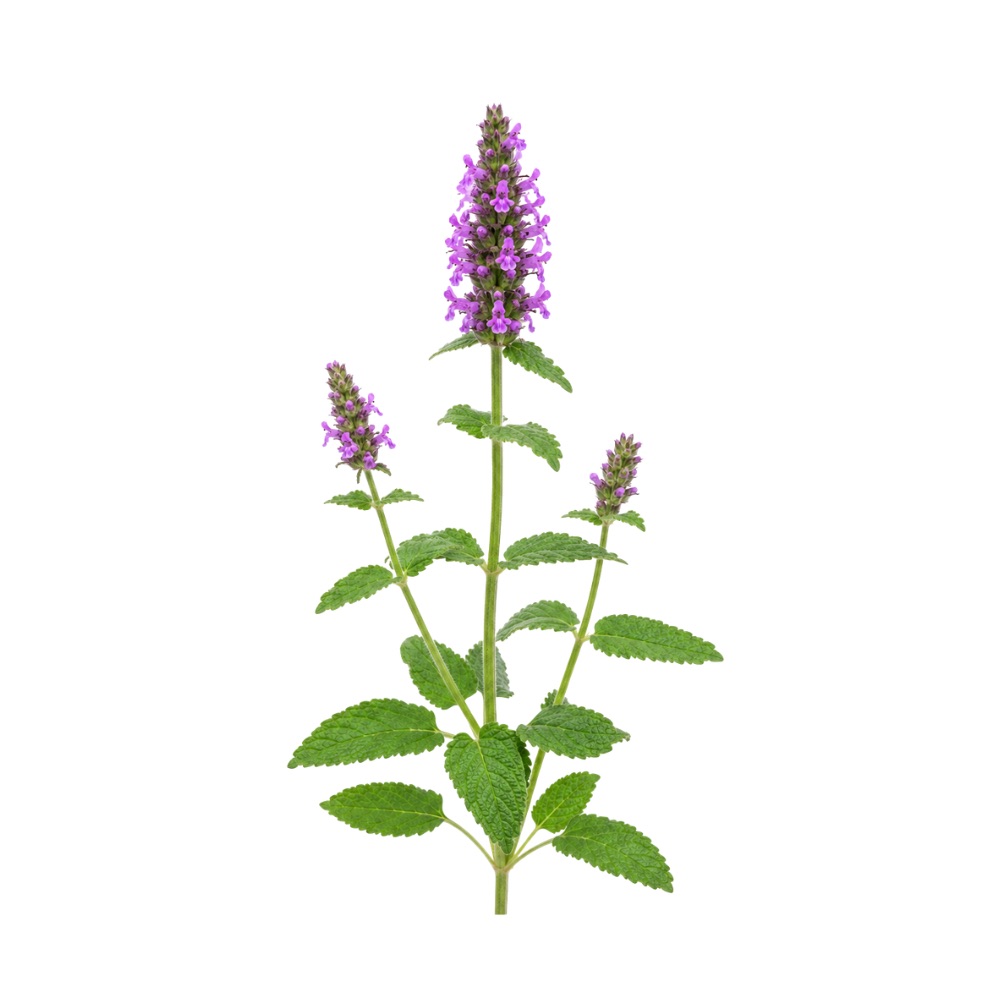
Allobetonicoside is a naturally occurring iridoid glycoside, found in Wood betony, Stachys macrantha, Stachys glutinosa and 3 other sources. It is well tolerated orally (low toxicity).
Concentration
Content by Source
Concentrations not reported. No percent-dry-weight or mg/g figures have been published for this compound in its source plants.
Allobetonicoside at a Glance
Allobetonicoside is an iridoid glycoside first isolated in 1989 from the aerial parts of wood betony (Betonica officinalis, syn. Stachys officinalis) 1Reference 1Allobetonicoside and 6-O-acetylmioporoside: two new iridoid glycosides from Betonica officinalis LView study →. Structurally it is an allose-containing iridoid diglycoside — the “allo-” in its name marks the rare allose sugar that distinguishes it from the more common glucose-bearing betony iridoids — and it was described alongside a second new iridoid, 6-O-acetylmioporoside, in the same report 1Reference 1Allobetonicoside and 6-O-acetylmioporoside: two new iridoid glycosides from Betonica officinalis LView study →.
Its main significance is chemotaxonomic rather than pharmacological: allobetonicoside occurs almost exclusively in the genus Betonica and a small set of related Lamioideae, so it is used as a marker compound for identifying and distinguishing these plants 2Reference 2Chemophenetically relevant iridoids and phenolics from Betonica and Stachys (Lamioideae, Lamiaceae)View study →. It sits in the same iridoid family as betony’s better-studied aucubin, harpagide and 8-O-acetylharpagide, and the related harpagoside and catalpol.
This is an obscure molecule. The published literature is essentially limited to isolation and phytochemical/chemotaxonomic work. It has, as of this writing, no dedicated pharmacology, no pharmacokinetics and no clinical data of its own — a genuinely lean evidence picture, described honestly below rather than padded.
A Betony Marker Iridoid
The clearest thing that can be said about allobetonicoside is where it is found, not what it does. Recent chemotaxonomic (chemophenetic) analysis of the closely related genera Betonica and Stachys singles it out — together with two flavonoid glucuronides — as a compound that helps define the genus Betonica and separate it chemically from its neighbours 2Reference 2Chemophenetically relevant iridoids and phenolics from Betonica and Stachys (Lamioideae, Lamiaceae)View study →.
That marker status flows directly from its structure. Iridoid glycosides are a workhorse class for plant chemotaxonomy because their patterns are relatively conserved within lineages, and allobetonicoside’s uncommon allose sugar makes it a distinctive fingerprint 1,
None of this is a health claim. A compound being a good botanical marker says nothing about what — if anything — it does in the body.
What It's Used For
There is no isolated-compound pharmacology for allobetonicoside. No study has taken the purified molecule and measured a pharmacological effect, a mechanism, a target or a dose response. Because there are no researched applications, the usual ranked evidence-by-application table is deliberately omitted here — there is nothing to rank.
What exists instead is class-level context. Iridoid glycosides are regarded as among the main bioactive constituents behind the anti-inflammatory and antioxidant activity of Betonica and Stachys preparations 2,
But when Háznagy-Radnai and colleagues actually tested individual Hungarian Stachys iridoids for anti-inflammatory activity in vivo, the compounds evaluated were ajugoside, aucubin, acetylharpagide, harpagide and harpagoside — with aucubin and harpagoside showing the strongest dose-dependent effects. Allobetonicoside was not one of the tested compounds 3Reference 3Antiinflammatory activities of Hungarian Stachys species and their iridoidsView study →.
Extending those findings to it would be an unsupported leap.
Mechanisms
No mechanism of action has been established for allobetonicoside. No molecular targets, receptors, enzymes or signalling pathways have been reported for the isolated molecule.
Pharmacokinetics
No pharmacokinetic data exist. Absorption, oral bioavailability, distribution, metabolism and half-life are all uncharacterised. As a polar diglycoside it would be expected to be poorly absorbed intact and subject to gut-microbial deglycosylation — the general pattern for iridoid glycosides — but this has not been measured for allobetonicoside specifically, and should be treated as unknown rather than assumed.
Clinical Trials
None. There are no human trials of allobetonicoside, and none are known to be planned.
| Completed | Planned | Terminated | Preclinical |
|---|---|---|---|
| — | — | — | — |
Last checked: July 2026.
Isolate vs. Plant Studies
For most constituents this section weighs isolated-molecule evidence against whole-plant evidence. For allobetonicoside there is effectively neither at the level of the compound itself. It has been isolated and structurally characterised 1Reference 1Allobetonicoside and 6-O-acetylmioporoside: two new iridoid glycosides from Betonica officinalis LView study →, and detected as a marker across Betonica and Stachys material 2Reference 2Chemophenetically relevant iridoids and phenolics from Betonica and Stachys (Lamioideae, Lamiaceae)View study →, but it has never been isolated and then assayed for activity. The bioactivity literature it is adjacent to belongs to other betony iridoids and to whole-herb extracts — not to this molecule 3Reference 3Antiinflammatory activities of Hungarian Stachys species and their iridoidsView study →. Any statement about what allobetonicoside “does” would therefore be extrapolation, not evidence.
Prevalence in Nature
Allobetonicoside is a Lamiaceae (subfamily Lamioideae) iridoid with a narrow distribution. It was first obtained from the aerial parts of wood betony (Betonica officinalis), co-occurring there with the known iridoids acetylharpagide and reptoside 1Reference 1Allobetonicoside and 6-O-acetylmioporoside: two new iridoid glycosides from Betonica officinalis LView study →. It has since been reported from several related species — Stachys macrantha, Stachys glutinosa, the Balkan endemic Stachys scardica 4Reference 4Exploring the phytochemical composition and biological potential of Balkan endemic species Stachys scardica GrisebView study →, Stachys alopecuros subsp. divulsa 5Reference 5Reassessment of the polar fraction of Stachys alopecuros (L.) Benth. subsp. divulsa (Ten.) Grande (Lamiaceae) from the Monti Sibillini National Park: a potential source of bioactive compoundsView study →, and Melittis melissophyllum 6Reference 6Reassessment of Melittis melissophyllum L. subsp. melissophyllum iridoidic fractionView study → — a distribution tight enough to underpin its use as a genus-level marker for Betonica 2Reference 2Chemophenetically relevant iridoids and phenolics from Betonica and Stachys (Lamioideae, Lamiaceae)View study →.
Quantitatively, its abundance is not documented. No published figures give its concentration as a percent of dry weight or a µg/g content in any plant part, so it is best described simply as a minor iridoid constituent of the tissues where it occurs. Because there are no measured source figures, no Content-by-Source comparison is offered here — the holes are real and are logged in this compound’s gaps tracker rather than filled with guesses.
Discovery & Synthesis
Allobetonicoside was first isolated and named in 1989 by Marianne Jeker, Otto Sticher, İhsan Çalış and Peter Rüedi (ETH Zürich / Hacettepe University), who obtained it from the aerial parts of Betonica officinalis L. and characterised it as a new allose-containing iridoid diglycoside, reporting it together with the new iridoid 6-O-acetylmioporoside 1Reference 1Allobetonicoside and 6-O-acetylmioporoside: two new iridoid glycosides from Betonica officinalis LView study →. Its name reflects both its botanical origin (Betonica → “betonicoside”) and the allose sugar (“allo-”) that sets it apart from the glucose-bearing betony iridoids.
No total synthesis of allobetonicoside is documented; like most obscure plant iridoids it exists only as a natural isolate, obtained by extraction and chromatographic purification from betony/Stachys aerial parts rather than by manufacture. There is no commercial production.
Patents: not yet researched.
Toxicity & Safety
Allobetonicoside carries a low toxicity flag — but that reflects the absence of any signal, not a body of safety data. No toxicological studies (acute, repeat-dose, genotoxicity, reproductive) have been performed on the isolated compound, and no adverse effects, drug interactions or contraindications have been reported for it. Its low flag rests on its status as a minor iridoid of a gently-regarded, well-tolerated culinary/medicinal herb (wood betony), the general low-toxicity profile of dietary iridoid glycosides, and the lack of any red flag in the isolation and chemotaxonomic literature.
- No toxicity signal. A minor iridoid of wood betony, a herb with a long record of gentle, well-tolerated use; no adverse findings reported for the isolated compound.
- Safety is un-studied, not proven. There are no dedicated toxicology, interaction or reproductive-safety data for isolated allobetonicoside — “low” here means no evidence of harm, not evidence of no harm.
- Judge intake at the herb level. Any real-world exposure is as one trace constituent of whole betony; safety decisions (including pregnancy/lactation) belong to the wood betony monograph, where intake is actually decided, not to this molecule page.
References
- Jeker M, Sticher O, Çalış İ, Rüedi P (1989). Allobetonicoside and 6-O-acetylmioporoside: two new iridoid glycosides from Betonica officinalis L. Helvetica Chimica Acta. https://doi.org/10.1002/hlca.19890720814
- Herre I, Stegemann T, Zidorn C (2025). Chemophenetically relevant iridoids and phenolics from Betonica and Stachys (Lamioideae, Lamiaceae). Biochemical Systematics and Ecology. https://doi.org/10.1016/j.bse.2025.105113
- Háznagy-Radnai E, Balogh Á, Czigle S, Máthé I, Hohmann J, Blazsó G (2012). Antiinflammatory activities of Hungarian Stachys species and their iridoids. Phytotherapy Research. https://pubmed.ncbi.nlm.nih.gov/21887806/
- Mantovska DI, Zhiponova MK, Petrova D, et al. (2023). Exploring the phytochemical composition and biological potential of Balkan endemic species Stachys scardica Griseb. Plants (Basel). https://pubmed.ncbi.nlm.nih.gov/38202340/
- Venditti A, Frezza C, Lorenzetti LM, et al. (2017). Reassessment of the polar fraction of Stachys alopecuros (L.) Benth. subsp. divulsa (Ten.) Grande (Lamiaceae) from the Monti Sibillini National Park: a potential source of bioactive compounds. Journal of Intercultural Ethnopharmacology. https://pubmed.ncbi.nlm.nih.gov/28512595/
- Venditti A, Frezza C, Guarcini L, et al. (2016). Reassessment of Melittis melissophyllum L. subsp. melissophyllum iridoidic fraction. Natural Product Research. https://pubmed.ncbi.nlm.nih.gov/26131916/



