
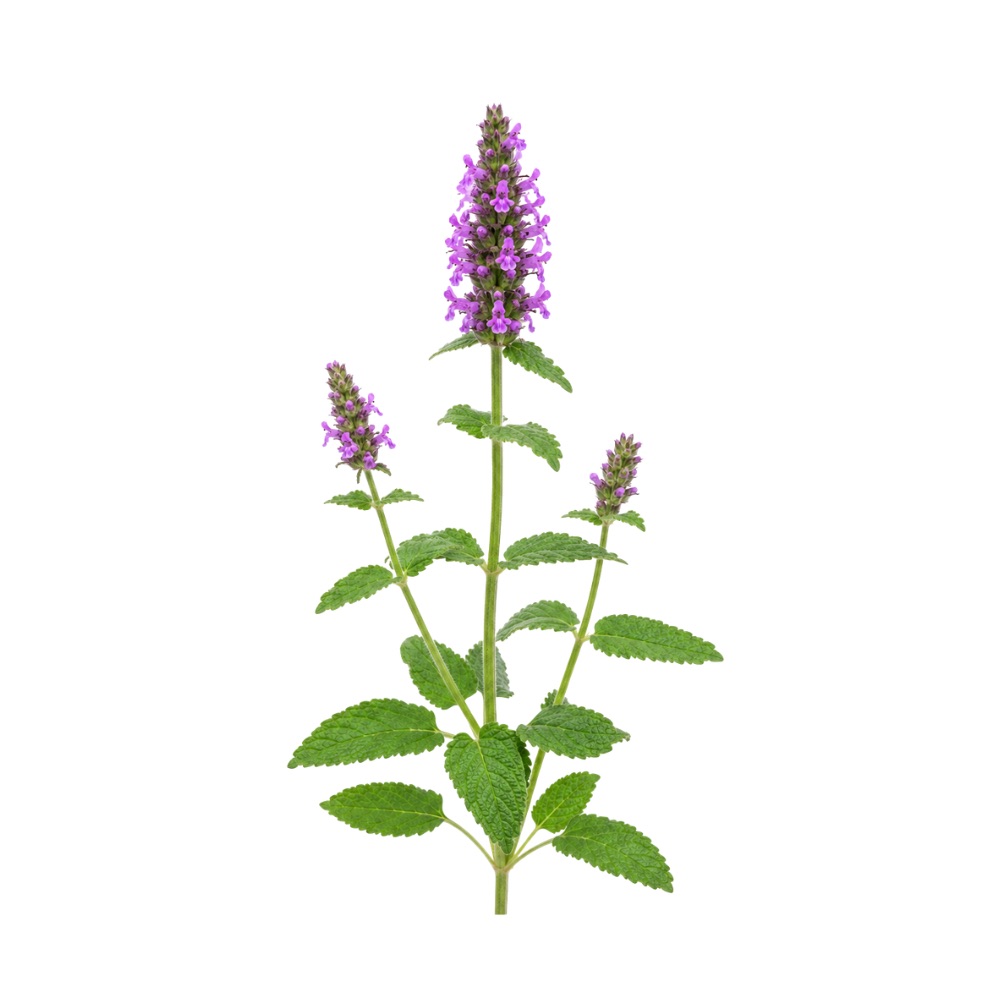
What Is Wood Betony?
Wood betony is a low perennial of the mint family, used in European herbal medicine as a gentle nervine for anxiety and headaches. Its leaves and flowering tops are dried for tea and tincture 13,
Stachys officinalis (also sold as Betonica officinalis) is native to Europe, north-western Africa, the Caucasus and Siberia, where it grows in meadows, pastures, hedge banks and open woodland 14Reference 14Stachys officinalis (betony, bishop’s wort)View study →. It forms clumps of heart-shaped basal leaves and sends up spikes of purple-red flowers through summer 14Reference 14Stachys officinalis (betony, bishop’s wort)View study →.
The herb is rich in phenylethanoid glycosides, including verbascoside and a group named after it, the betonyosides 10Reference 10Phenylethanoid glycosides from Stachys officinalisView study →. Laboratory studies have looked mainly at its antioxidant activity, with one rat study of its anti-inflammatory effect 1,
In North America the name “wood betony” is also given to Pedicularis canadensis, a lousewort in a different family 15Reference 15Pedicularis canadensis (Canadian lousewort, wood betony)View study →.
How Is Wood Betony Used?
Wood betony is used as the dried leaf and flowering top.
- Tea — the leaves and flowering tops infused as a tea 14Reference 14Stachys officinalis (betony, bishop’s wort)View study →, taken for nervous tension, headache and digestion.
- Tincture or liquid extract — taken for the same purposes.
- Gargle — for mouth and throat irritation 13Reference 13ReviewDrugs and Lactation Database (LactMed). (2006, updated). Betony — review. National Library of Medicine. https://pubmed.ncbi.nlm.nih.gov/30000919/View study →.
- Smoking blends — added to herbal smoking mixtures.
Traditional Uses
European Herbal Medicine
Betony was one of the most esteemed herbs of medieval European medicine, and it was already in medicinal use in ancient Egypt 14Reference 14Stachys officinalis (betony, bishop’s wort)View study →. The medicine is the aerial part, the leaf and flowering top, gathered as the plant comes into flower.
It has been used as a nerve tonic for anxiety and headaches, as an astringent for diarrhoea, and as a gargle for mouth and throat irritation 13Reference 13ReviewDrugs and Lactation Database (LactMed). (2006, updated). Betony — review. National Library of Medicine. https://pubmed.ncbi.nlm.nih.gov/30000919/View study →. Modern Western herbalists class it as a calming nervine, valued especially for tension headache, and as a mild bitter for digestion.
It is also used as a supposed galactogogue, to increase breast milk 13Reference 13ReviewDrugs and Lactation Database (LactMed). (2006, updated). Betony — review. National Library of Medicine. https://pubmed.ncbi.nlm.nih.gov/30000919/View study →. It is taken as an infusion of the dried herb, as a tincture, or in herbal smoking blends, and is often combined with other herbs.
Indications
- Anxiety and nervous tension [aerial parts; European herbal medicine]
- Tension headache [aerial parts; European herbal medicine]
- Indigestion [aerial parts; Western herbal medicine]
- Diarrhoea [aerial parts; European herbal medicine]
- Mouth and throat irritation [aerial parts, as a gargle; European herbal medicine]
Botany
Wood betony is a clump-forming herbaceous perennial of the mint family, Lamiaceae 14Reference 14Stachys officinalis (betony, bishop’s wort)View study →. Its accepted name is Stachys officinalis, and many herbal texts and nurseries list it as Betonica officinalis 14Reference 14Stachys officinalis (betony, bishop’s wort)View study →.
Most of its leaves grow from the base on long stalks. They are large, oblong to heart-shaped, with toothed edges 14Reference 14Stachys officinalis (betony, bishop’s wort)View study →. Smaller stalkless leaves grow in pairs at wide intervals on the slender, square stems 14Reference 14Stachys officinalis (betony, bishop’s wort)View study →. Both kinds of leaf are rough, fringed with short hairs, and carry glands that give off an aromatic, bitter oil 14Reference 14Stachys officinalis (betony, bishop’s wort)View study →.
The flowers are purple-red, tubular and two-lipped, with the middle lobe of the lower lip the largest 14Reference 14Stachys officinalis (betony, bishop’s wort)View study →. They grow in whorls separated by bare stem and pairs of leaves, forming an interrupted spike 14Reference 14Stachys officinalis (betony, bishop’s wort)View study →. Each flower has two short and two long stamens 14Reference 14Stachys officinalis (betony, bishop’s wort)View study →. The plant flowers from summer into autumn and reaches 45–60 cm 14Reference 14Stachys officinalis (betony, bishop’s wort)View study →.
The fruit is a dry schizocarp that splits into single-seeded nutlets when ripe 14Reference 14Stachys officinalis (betony, bishop’s wort)View study →.
Distribution
Wood betony is native to Europe, north-western Africa, the Caucasus and Siberia 14Reference 14Stachys officinalis (betony, bishop’s wort)View study →. It grows in meadows, pastures, hedge banks and open woodland 14Reference 14Stachys officinalis (betony, bishop’s wort)View study →.
Growing Conditions
Cultivation snapshot for Wood Betony
- Grows in full sun to part shade 14Reference 14Stachys officinalis (betony, bishop’s wort)View study →.
- Prefers moist, well-drained, neutral to acidic soil, and is drought-resistant once established 14Reference 14Stachys officinalis (betony, bishop’s wort)View study →.
- Hardy in USDA zones 4–8 14Reference 14Stachys officinalis (betony, bishop’s wort)View study →.
- Grows from seed sown in late summer, autumn or early spring, and self-seeds readily 14Reference 14Stachys officinalis (betony, bishop’s wort)View study →.
- Slugs and snails may damage it 14Reference 14Stachys officinalis (betony, bishop’s wort)View study →.
Grow it yourself
Farm Wiki is our cultivation-focused sister site, also run by Justin Cooke.
Pharmacology & Research
About a dozen laboratory studies have been published on wood betony. Most are test-tube studies of its antioxidant and antimicrobial activity, and one tested its anti-inflammatory effect in rats 1,
The antioxidant results are the most consistent: betony extracts ranked among the stronger of several Lamiaceae tested 1,
No human clinical trial of the herb has been run or registered.
-
Best-supported: consistent free-radical scavenging and reducing activity in vitro, with betony often among the strongest of the Lamiaceae tested 1,
2Reference 1In vitroAntioxidant and free radical scavenging activities of some medicinal plants from the Lamiaceae — in vitroView study →Reference 2In vitroPhytochemical analysis and biological activity of three Stachys species — in vitroView study → ; a reproducible whole-herb phenolic/antioxidant profile 3,4Reference 3In vitroStachys species: comparative evaluation of phenolic profile and antimicrobial and antioxidant potential — in vitroView study →Reference 4In vitroChemical and antioxidant profile of hydroalcoholic extracts of Stachys officinalis, S. palustris and S. sylvatica from Romania — in vitroView study → . -
Emerging, worth watching: an in vivo anti-inflammatory effect in rats attributed to iridoids 6Reference 6AnimalAntiinflammatory activities of Hungarian Stachys species and their iridoids — animal model (rat), in vivoView study →; modest antimicrobial activity in vitro 2,
7, .9Reference 2In vitroPhytochemical analysis and biological activity of three Stachys species — in vitroView study →Reference 7In vitroChemical composition and antimicrobial activity of the essential oil of Stachys officinalis — in vitroView study →Reference 9In vitroScreening of medicinal and aromatic plant extracts for synergism with fluconazole against Candida — in vitroView study → - Mechanistically thin: the traditional nervine, anti-headache and digestive uses have not been studied pharmacologically.
Every finding is preclinical. Most studies compared several Stachys species at once, and most used alcohol extracts or the essential oil rather than the tea. There is no standardised dose or marker-calibrated extract.
1. Antioxidant
This is the most replicated activity. In a comparison of six wild European Lamiaceae, a methanol extract of S. officinalis gave the strongest reducing power in the phosphomolybdenum assay and, with Marrubium vulgare, the highest inhibition of lipid peroxidation (78%) 1Reference 1In vitroAntioxidant and free radical scavenging activities of some medicinal plants from the Lamiaceae — in vitroView study →. It ranked fourth of six for DPPH radical scavenging 1Reference 1In vitroAntioxidant and free radical scavenging activities of some medicinal plants from the Lamiaceae — in vitroView study →.
In a comparison of three Romanian Stachys species, betony had the highest total polyphenol content (232 mg gallic-acid equivalents/g) and the highest antioxidant capacity (602 mM Trolox/g) 2Reference 2In vitroPhytochemical analysis and biological activity of three Stachys species — in vitroView study →.
In a comparison of six Romanian Stachys species, chlorogenic acid was the main polyphenol in every sample 3Reference 3In vitroStachys species: comparative evaluation of phenolic profile and antimicrobial and antioxidant potential — in vitroView study →. Another Romanian study found betony highest of three species in tannins and in anthocyanins, which occurred only in the flowers, and confirmed antioxidant activity in all three 4Reference 4In vitroChemical and antioxidant profile of hydroalcoholic extracts of Stachys officinalis, S. palustris and S. sylvatica from Romania — in vitroView study →.
The antioxidant activity is linked to the phenylethanoid glycosides, such as verbascoside and the betonyosides, and to flavonoids such as luteolin and apigenin.
Gap: No cell, animal or human study shows this antioxidant capacity has a measurable effect in the body. The assays used alcohol or methanol extracts, not the tea.
2. Anti-Inflammatory
A study of ten Hungarian Stachys species used the carrageenan rat paw-oedema model. Water extracts of the aerial parts were given by injection into the abdomen and by mouth 6Reference 6AnimalAntiinflammatory activities of Hungarian Stachys species and their iridoids — animal model (rat), in vivoView study →. The extracts of S. officinalis, S. alpina, S. germanica and S. recta were highly active by injection. At 5 mg/kg they matched or exceeded the reference drug diclofenac 6Reference 6AnimalAntiinflammatory activities of Hungarian Stachys species and their iridoids — animal model (rat), in vivoView study →.
The main iridoids in the extracts (ajugoside, aucubin, acetylharpagide, harpagide and harpagoside) were tested in the same model. Only aucubin and harpagoside showed strong, dose-dependent activity 6Reference 6AnimalAntiinflammatory activities of Hungarian Stachys species and their iridoids — animal model (rat), in vivoView study →. The authors conclude that iridoids are most probably responsible, with other constituents or synergy also involved 6Reference 6AnimalAntiinflammatory activities of Hungarian Stachys species and their iridoids — animal model (rat), in vivoView study →.
Gap: A single laboratory and one model, not independently replicated. An acute rodent assay does not show clinical anti-inflammatory benefit at any human dose.
3. Antimicrobial
The essential oil of the aerial parts, mostly germacrene D and β-caryophyllene, was most active against the mould Aspergillus niger (MIC 2.5 mg/mL) and the yeast Candida albicans (MIC 5.0 mg/mL) 7Reference 7In vitroChemical composition and antimicrobial activity of the essential oil of Stachys officinalis — in vitroView study →.
In comparisons of several Stachys species, extracts were active mainly against Gram-positive bacteria 2Reference 2In vitroPhytochemical analysis and biological activity of three Stachys species — in vitroView study →, and against Candida and both Gram-positive and Gram-negative bacteria, with betony not the most active 3Reference 3In vitroStachys species: comparative evaluation of phenolic profile and antimicrobial and antioxidant potential — in vitroView study →.
In a screen of 166 Ukrainian plant extracts, a water-alcohol extract of betony had direct antifungal activity against azole-resistant Candida albicans and C. tropicalis from denture stomatitis 9Reference 9In vitroScreening of medicinal and aromatic plant extracts for synergism with fluconazole against Candida — in vitroView study →.
Gap: The clearest potency data are for the essential oil, which is not how the herb is used. There is no animal infection study.
Mechanisms
Betony’s iridoid glycosides, especially aucubin, have shown anti-inflammatory activity in rats, and are thought to carry the extract’s effect 6Reference 6AnimalAntiinflammatory activities of Hungarian Stachys species and their iridoids — animal model (rat), in vivoView study →. Its phenylethanoid glycosides and flavonoids act as antioxidants in laboratory tests 1,
The essential oil is mostly sesquiterpenes, which carry its modest antifungal activity 7Reference 7In vitroChemical composition and antimicrobial activity of the essential oil of Stachys officinalis — in vitroView study →.
| Mechanism | Drives | Key compounds |
|---|---|---|
| Free-radical scavenging, metal reduction, lipid-peroxidation inhibition | antioxidant | verbascoside, luteolin, chlorogenic acid |
| Iridoid-mediated antiphlogistic activity | anti-inflammatory | aucubin, harpagoside |
| Terpene-rich essential-oil membrane disruption | antimicrobial | germacrene D, β-caryophyllene |
Clinical Trials
The evidence base is entirely preclinical.
| Completed | Planned | Terminated | Preclinical |
|---|---|---|---|
| 0 | 0 | 0 | ~13 |
Last checked: July 2026.
Phytochemistry
The aerial parts contain phenylethanoid glycosides. Six were first isolated from this species and named betonyosides A–F 10Reference 10Phenylethanoid glycosides from Stachys officinalisView study →. The same study found verbascoside (acteoside), forsythoside B and leucosceptoside B 10Reference 10Phenylethanoid glycosides from Stachys officinalisView study →.
The main iridoid glycosides in water extracts of Hungarian Stachys species, including betony, are aucubin, harpagide, 8-O-acetylharpagide, ajugoside and harpagoside 6Reference 6AnimalAntiinflammatory activities of Hungarian Stachys species and their iridoids — animal model (rat), in vivoView study →. Chlorogenic acid is the main polyphenol 3Reference 3In vitroStachys species: comparative evaluation of phenolic profile and antimicrobial and antioxidant potential — in vitroView study →. Betony is also rich in tannins, and its flowers contain anthocyanins 4Reference 4In vitroChemical and antioxidant profile of hydroalcoholic extracts of Stachys officinalis, S. palustris and S. sylvatica from Romania — in vitroView study →.
The essential oil of the aerial parts from the Balkans is mostly sesquiterpenes, led by germacrene D (19.9%), β-caryophyllene (14.1%) and α-humulene (7.5%) 7Reference 7In vitroChemical composition and antimicrobial activity of the essential oil of Stachys officinalis — in vitroView study →. An Italian study analysed the volatile fraction of the leaves and flowers separately. The leaves gave mainly (E)-caryophyllene (20.1%), (E)-nerolidol (14.3%) and caryophyllene oxide (6.1%), and the flowers mainly caryophyllene oxide (16.5%), (E)-nerolidol (15.4%) and humulene epoxide II (9.2%) 11Reference 11Secretory structures and essential oil composition in Stachys officinalis subsp. officinalis from ItalyView study →.
The herb also contains the flavonoids apigenin and luteolin, the triterpene acids oleanolic acid and ursolic acid, and the amine stachydrine.
Constituent Summary
No quantitative content has been published for these compounds in wood betony. † marks the glycosides first described from this species.
Phenylpropanoid4 compoundsno data
Iridoid4 compoundsno data
Amine4 compoundsno data
Alkaloid1 compoundno data
Flavonoid3 compoundsno data
Phenolic Acid1 compound1 with data
Dosage
Traditional doses follow the British Herbal Pharmacopoeia 16Reference 16British Herbal Pharmacopoeia 1983 — Stachys betonica, preparations and doses — pharmacopoeia, as reproduced in the Inner Path materia medica entry for Stachys officinalis. https://www.innerpath.com.au/matmed/herbs/Stachys_officinalis.htmView study →. The research figures below are animal doses and test-tube concentrations.
| Indication | Preparation | Dose | Source |
|---|---|---|---|
| Anti-inflammatory | Water extract (rat, by injection) | 5 mg/kg | 6Reference 6AnimalAntiinflammatory activities of Hungarian Stachys species and their iridoids — animal model (rat), in vivoView study → |
| Antimicrobial | Essential oil (in vitro) | MIC 2.5–5.0 mg/mL | 7Reference 7In vitroChemical composition and antimicrobial activity of the essential oil of Stachys officinalis — in vitroView study → |
Traditional Dosage
| System | Preparation | Dose |
|---|---|---|
| British Herbal Pharmacopoeia | Dried herb (aerial parts), or by infusion | 2–4 g, 3× daily 16Reference 16British Herbal Pharmacopoeia 1983 — Stachys betonica, preparations and doses — pharmacopoeia, as reproduced in the Inner Path materia medica entry for Stachys officinalis. https://www.innerpath.com.au/matmed/herbs/Stachys_officinalis.htmView study → |
| British Herbal Pharmacopoeia | Liquid extract 1:1, 25% ethanol | 2–4 mL, 3× daily 16Reference 16British Herbal Pharmacopoeia 1983 — Stachys betonica, preparations and doses — pharmacopoeia, as reproduced in the Inner Path materia medica entry for Stachys officinalis. https://www.innerpath.com.au/matmed/herbs/Stachys_officinalis.htmView study → |
| British Herbal Pharmacopoeia | Tincture 1:5, 45% ethanol | 2–6 mL, 3× daily 16Reference 16British Herbal Pharmacopoeia 1983 — Stachys betonica, preparations and doses — pharmacopoeia, as reproduced in the Inner Path materia medica entry for Stachys officinalis. https://www.innerpath.com.au/matmed/herbs/Stachys_officinalis.htmView study → |
Safety & Pregnancy
Wood betony is a gentle, generally well-tolerated herb at ordinary doses. It has a traditional reputation for bringing on menstruation, so it is best avoided in pregnancy.
- Avoid in pregnancy. It has a traditional reputation as a mild emmenagogue (bringing on menstruation).
- Well tolerated. Gentle and generally uneventful at ordinary doses.
- Large doses. Very large amounts may cause digestive upset.
- Smoking. Inhaling smoke carries respiratory risk whatever the plant.
Full Safety Detail
Tolerance. Wood betony is gentle and generally well tolerated at ordinary tea and tincture doses. Very large amounts may cause digestive upset.
Smoking. Like any smoked herb, it exposes the lungs to combustion products.
Tannins. Its tannins could in theory reduce the absorption of some drugs and minerals taken at the same time. This has not been studied.
Genetic safety tests. In laboratory tests, a Betonica officinalis extract was not mutagenic in the Ames test and did not cause chromosome aberrations in human lymphocytes 12Reference 12In vitroGenotoxic properties of Betonica officinalis and other extracts — in vitroView study →. It caused DNA damage in the comet assay and a slight rise in sister-chromatid exchange 12Reference 12In vitroGenotoxic properties of Betonica officinalis and other extracts — in vitroView study →.
Interactions. No drug-interaction study of the whole herb has been published.
Avoid in pregnancy. Wood betony has a traditional reputation as a mild emmenagogue, so it is conventionally avoided in pregnancy. It has not been tested for reproductive toxicity.
Avoid while breastfeeding. Betony is said to increase breast milk, but no valid clinical trial supports this 13Reference 13ReviewDrugs and Lactation Database (LactMed). (2006, updated). Betony — review. National Library of Medicine. https://pubmed.ncbi.nlm.nih.gov/30000919/View study →. There are no data on whether its constituents pass into breast milk, and because of the general lack of safety data it should be avoided while breastfeeding 13Reference 13ReviewDrugs and Lactation Database (LactMed). (2006, updated). Betony — review. National Library of Medicine. https://pubmed.ncbi.nlm.nih.gov/30000919/View study →.
References
- Matkowski, A., & Piotrowska, M. (2006). Antioxidant and free radical scavenging activities of some medicinal plants from the Lamiaceae — in vitro. Fitoterapia. https://pubmed.ncbi.nlm.nih.gov/16713687/
- Stegăruș, D. I., et al. (2021). Phytochemical analysis and biological activity of three Stachys species — in vitro. Plants (Basel). https://pubmed.ncbi.nlm.nih.gov/34961181/
- Benedec, D., et al. (2023). Stachys species: comparative evaluation of phenolic profile and antimicrobial and antioxidant potential — in vitro. Antibiotics (Basel). https://pubmed.ncbi.nlm.nih.gov/37998846/
- Apostolescu, G. F., et al. (2023). Chemical and antioxidant profile of hydroalcoholic extracts of Stachys officinalis, S. palustris and S. sylvatica from Romania — in vitro. Acta Chim Slov. https://pubmed.ncbi.nlm.nih.gov/40836517/
- Moshari-Nasirkandi, A., et al. (2023). Screening of 20 species from Lamiaceae family based on phytochemical analysis, antioxidant activity and HPLC profiling — in vitro. Sci Rep. https://pubmed.ncbi.nlm.nih.gov/37813985/
- Háznagy-Radnai, E., et al. (2012). Antiinflammatory activities of Hungarian Stachys species and their iridoids — animal model (rat), in vivo. Phytother Res. https://pubmed.ncbi.nlm.nih.gov/21887806/
- Lazarević, J. S., et al. (2013). Chemical composition and antimicrobial activity of the essential oil of Stachys officinalis — in vitro. Chem Biodivers. https://pubmed.ncbi.nlm.nih.gov/23847079/
- Hickl, J., et al. (2024). Antimicrobial power of plant extracts against oral pathogens and Streptococcus mutans biofilms — in vitro. Front Oral Health. https://pubmed.ncbi.nlm.nih.gov/39726767/
- Ohiienko, T., et al. (2023). Screening of medicinal and aromatic plant extracts for synergism with fluconazole against Candida — in vitro. Wiad Lek. https://pubmed.ncbi.nlm.nih.gov/37622505/
- Miyase, T., et al. (1996). Phenylethanoid glycosides from Stachys officinalis. Phytochemistry. https://pubmed.ncbi.nlm.nih.gov/8862039/
- Giuliani, C., et al. (2017). Secretory structures and essential oil composition in Stachys officinalis subsp. officinalis from Italy. Nat Prod Res. https://pubmed.ncbi.nlm.nih.gov/27931115/
- Slapšytė, G., et al. (2019). Genotoxic properties of Betonica officinalis and other extracts — in vitro. Food Chem Toxicol. https://pubmed.ncbi.nlm.nih.gov/31520668/
- Drugs and Lactation Database (LactMed). (2006, updated). Betony — review. National Library of Medicine. https://pubmed.ncbi.nlm.nih.gov/30000919/
- NC State Extension Gardener Plant Toolbox. Stachys officinalis (betony, bishop’s wort). North Carolina State University. https://plants.ces.ncsu.edu/plants/stachys-officinalis/
- NC State Extension Gardener Plant Toolbox. Pedicularis canadensis (Canadian lousewort, wood betony). North Carolina State University. https://plants.ces.ncsu.edu/plants/pedicularis-canadensis/
- British Herbal Medicine Association. (1983). British Herbal Pharmacopoeia 1983 — Stachys betonica, preparations and doses — pharmacopoeia, as reproduced in the Inner Path materia medica entry for Stachys officinalis. https://www.innerpath.com.au/matmed/herbs/Stachys_officinalis.htm



