
Materia Medica
Chacruna
Psychotria viridis
Chacruna is an Amazonian shrub of the coffee family whose leaves are the usual source of DMT in ayahuasca. Boiled with the ayahuasca vine, it gives the brew its visionary effect.
What Is Chacruna?
Chacruna is a shrub of the coffee family whose leaves are the most common source of DMT in ayahuasca, the visionary brew of the western Amazon. The leaves are boiled with the ayahuasca vine, Banisteriopsis caapi, to make the brew 14,
Psychotria viridis grows in the understorey of tropical forests from Central America and the Caribbean to the Amazon basin 21,
The leaves contain N,N-DMT, a psychedelic tryptamine. Swallowed on its own, DMT is broken down by the enzyme monoamine oxidase (MAO) before it can act. The vine’s harmala alkaloids block that enzyme, so the DMT reaches the brain 18Reference 18In vitroMonoamine oxidase inhibitors in South American hallucinogenic plants: tryptamine and beta-carboline constituents of ayahuasca — analytical and in vitroView study →. A placebo-controlled trial of the brew found a rapid antidepressant effect in treatment-resistant depression 2Reference 2RCTRapid antidepressant effects of the psychedelic ayahuasca in treatment-resistant depression: a randomised placebo-controlled trialView study →.
Psychotria is a very large genus, and dried leaves sold as chacruna are hard to identify with certainty. Commercial samples have turned out to vary widely 20Reference 20Identification challenges in examination of commercial plant material of Psychotria viridis — analyticalView study →.
How Is Chacruna Used?
Within the brew. The leaves are boiled with the pounded ayahuasca vine to make ayahuasca 14,
Other uses. Dried leaves are also smoked by recreational users 20Reference 20Identification challenges in examination of commercial plant material of Psychotria viridis — analyticalView study →.
Traditional Uses
Amazonian Ceremonial Medicine
Across many Amazonian Indigenous and mestizo traditions, the leaves are combined with the Banisteriopsis caapi vine to make ayahuasca, the visionary brew of the western Amazon. Chacruna is a component of the brew rather than a remedy in its own right.
The brew is prepared by long boiling of leaf and vine together. It is taken in structured ceremony, for healing, divination and insight, under the direction of an experienced practitioner.
In some traditions the leaves are added to “strengthen” and “lengthen” the effects of the drink 22Reference 22Fern, K. (n.d.). Psychotria viridis Ruiz & Pav. — habit, range, habitat and uses, drawing on Standley & Steyermark, Flora of Guatemala, and Williams, Woods of Northeastern Peru — species database. Useful Tropical Plants Database. https://tropical.theferns.info/viewtropical.php?id=Psychotria+viridisView study →.
Brazilian Ayahuasca Religions
Ayahuasca is also a sacrament in Brazilian syncretic churches, above all the Santo Daime and the União do Vegetal. There it is taken in congregational ceremonies on a fixed calendar rather than in the shamanic model.
Indications
- Depression [leaf in the ayahuasca brew]
- Anxiety [brew]
- Addiction and substance dependence [brew; ceremonial and retreat use]
- Healing, divination and insight [brew; Amazonian ceremonial use]
Botany
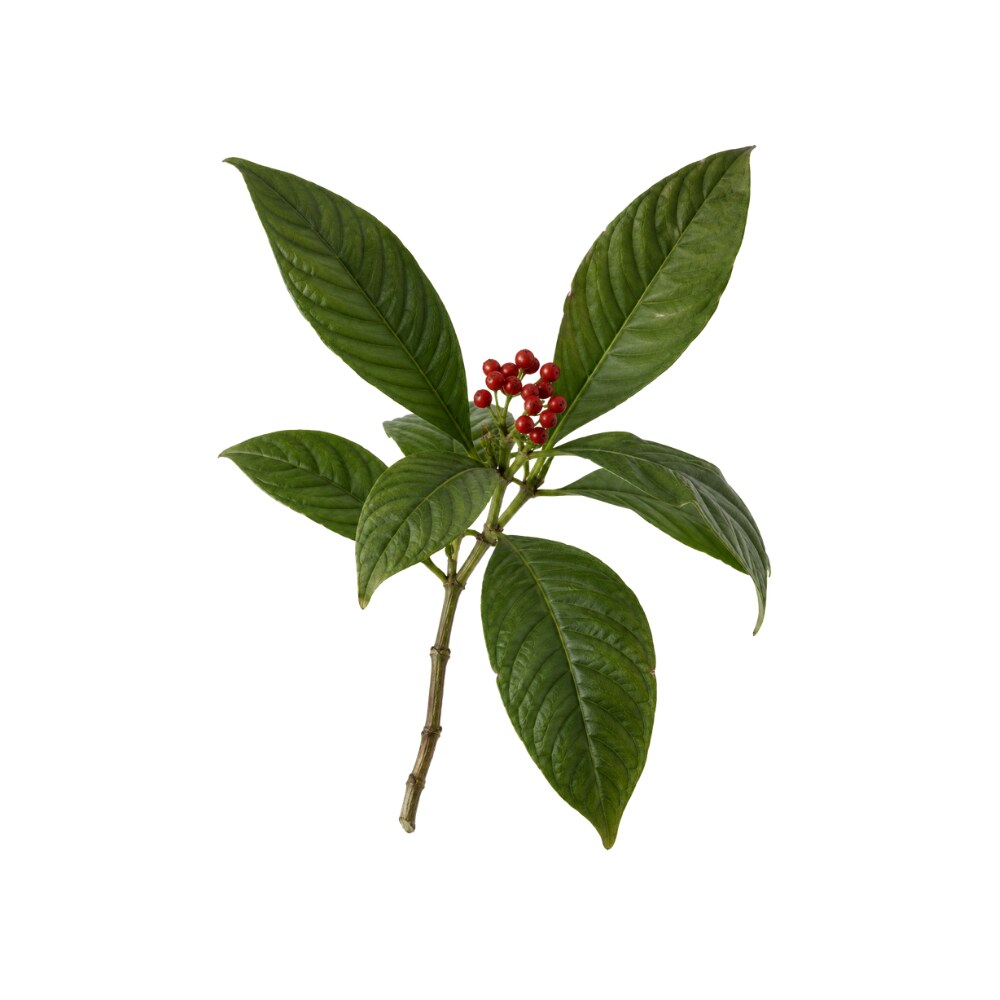
Chacruna is a slender evergreen shrub or small tree of the coffee family, Rubiaceae. It grows 1.5–5.4 m tall, and its straight, slender trunk is often unbranched for more than half its height 22Reference 22Fern, K. (n.d.). Psychotria viridis Ruiz & Pav. — habit, range, habitat and uses, drawing on Standley & Steyermark, Flora of Guatemala, and Williams, Woods of Northeastern Peru — species database. Useful Tropical Plants Database. https://tropical.theferns.info/viewtropical.php?id=Psychotria+viridisView study →.
Its leaves grow in opposite pairs. They are elliptic, up to 15 cm long and 6 cm wide, and shiny green and hairless above, with hairs on the main veins beneath 21Reference 21Lorence, D. (n.d.). Psychotria viridis — botanical description and native range — species database. National Tropical Botanical Garden Tropical Plants Database. https://ntbg.org/database/plants/detail/psychotria-viridisView study →.
Each leaf has 5–10 pairs of side veins. Where these meet the midrib, the underside carries tiny pockets called domatia, which appear to house mites that keep the leaf clean 21Reference 21Lorence, D. (n.d.). Psychotria viridis — botanical description and native range — species database. National Tropical Botanical Garden Tropical Plants Database. https://ntbg.org/database/plants/detail/psychotria-viridisView study →.
The flowers are small, white and stalkless, 1–2 mm long, in branched clusters at the stem tips. The fruits form in dense clusters and ripen purple-red; each is 4–6 mm long 21Reference 21Lorence, D. (n.d.). Psychotria viridis — botanical description and native range — species database. National Tropical Botanical Garden Tropical Plants Database. https://ntbg.org/database/plants/detail/psychotria-viridisView study →.
The leaf is the part used.
Distribution
Chacruna grows in Central America from Mexico to Panama, in the Caribbean in Cuba, the Dominican Republic and Haiti, and in South America in Colombia, Venezuela, Ecuador, Peru, Bolivia and Brazil 22Reference 22Fern, K. (n.d.). Psychotria viridis Ruiz & Pav. — habit, range, habitat and uses, drawing on Standley & Steyermark, Flora of Guatemala, and Williams, Woods of Northeastern Peru — species database. Useful Tropical Plants Database. https://tropical.theferns.info/viewtropical.php?id=Psychotria+viridisView study →.
It grows in moist or wet thickets and as an understorey plant in dense or moderately dense rainforest, often on limestone soils 22Reference 22Fern, K. (n.d.). Psychotria viridis Ruiz & Pav. — habit, range, habitat and uses, drawing on Standley & Steyermark, Flora of Guatemala, and Williams, Woods of Northeastern Peru — species database. Useful Tropical Plants Database. https://tropical.theferns.info/viewtropical.php?id=Psychotria+viridisView study →.
Growing Conditions
Cultivation snapshot for Chacruna
- A true tropical understory plant: grow only in frost-free climates (roughly USDA zone 10+), or as a protected greenhouse/container specimen elsewhere.
- Give it dappled or partial shade rather than full sun, echoing the forest floor, with warm temperatures and high humidity year-round.
- Wants rich, well-drained, consistently moist loam.
- Propagates very readily from cuttings — even a single leaf lightly covered with soil can root; seed is slow and unreliable, taking months to germinate.
Grow it yourself
Farm Wiki is our cultivation-focused sister site, also run by Justin Cooke.
Phytochemistry
The main alkaloid of chacruna leaf is N,N-DMT. DMT makes up 0.1–0.66% of the dried leaf, depending on the plant and the time of day it was picked 16Reference 16ReviewToxicological aspects and determination of the main components of ayahuasca: a critical reviewView study →.
Smaller amounts of N-methyltryptamine and the β-carboline 2-methyl-1,2,3,4-tetrahydro-beta-carboline (MTHC) accompany it 17Reference 17ReviewAyahuasca: uses, phytochemical and biological activities — reviewView study →. The MAO-inhibiting β-carbolines of ayahuasca come from the vine 18Reference 18In vitroMonoamine oxidase inhibitors in South American hallucinogenic plants: tryptamine and beta-carboline constituents of ayahuasca — analytical and in vitroView study →.
DMT content varies widely between plants. In a survey of 36 samples from 22 sites across Brazil, some had little or no detectable DMT 19Reference 19Phytochemical analyses of Banisteriopsis caapi and Psychotria viridis — analyticalView study →.
The leaves also contain triterpenes (ursolic and oleanolic acids), plant sterols including β-sitosterol and stigmasterol, squalene and long-chain fatty acids 1Reference 1Psychotria viridis: chemical constituents from leaves and biological propertiesView study →.
Constituent Summary
Figures are percentages of dried leaf.
Indole Alkaloid3 compounds3 with data
† The marker constituent that makes chacruna a DMT-bearing ayahuasca admixture.
Pharmacology & Research
Most human research relevant to chacruna is on the ayahuasca brew, made from Psychotria viridis leaf boiled with Banisteriopsis caapi vine.
The leaf supplies N,N-DMT, a 5-HT2A receptor agonist 14Reference 14Ayahuasca: pharmacology, neuroscience and therapeutic potentialView study →. Swallowed on its own, DMT is broken down by MAO in the gut. The vine’s β-carbolines inhibit MAO, which makes the DMT orally active 18Reference 18In vitroMonoamine oxidase inhibitors in South American hallucinogenic plants: tryptamine and beta-carboline constituents of ayahuasca — analytical and in vitroView study →.
The strongest human finding is an antidepressant effect: one small double-blind, placebo-controlled trial in treatment-resistant depression, with supporting open-label and biomarker studies 2,
The anti-inflammatory, neuroprotective and neurogenic findings for DMT come from cell studies and from animals given DMT by injection 9,
-
Best-supported: rapid antidepressant effect of the ayahuasca brew in treatment-resistant depression, from a single small RCT plus open-label and biomarker studies 2,
3, .5, 6Reference 2RCTRapid antidepressant effects of the psychedelic ayahuasca in treatment-resistant depression: a randomised placebo-controlled trialView study →Reference 3Clinical trialAntidepressant effects of a single dose of ayahuasca in patients with recurrent depression: a preliminary reportView study →Reference 5RCTModulation of serum brain-derived neurotrophic factor by a single dose of ayahuasca: observation from a randomized controlled trialView study →Reference 6Changes in inflammatory biomarkers are related to the antidepressant effects of ayahuascaView study → -
Emerging, worth watching: N,N-DMT drives adult neurogenesis and activates the sigma-1 receptor to blunt inflammation and protect neurons under ischaemia — all preclinical 9,
10, .11Reference 9In vitroN,N-dimethyltryptamine compound found in the hallucinogenic tea ayahuasca regulates adult neurogenesis in vitro and in vivoView study →Reference 10Psychedelic N,N-dimethyltryptamine and 5-methoxy-N,N-dimethyltryptamine modulate innate and adaptive inflammatory responses through the sigma-1 receptor of human monocyte-derived dendritic cellsView study →Reference 11AnimalN,N-dimethyltryptamine reduces infarct size and improves functional recovery following transient focal brain ischemia in ratsView study → -
Mechanistically thin: anxiolytic and anti-addictive claims rest on secondary trial outcomes, reviews of the same small studies, and one observational cohort 7,
13Reference 7Systematic reviewAntidepressive, anxiolytic and antiaddictive effects of ayahuasca, psilocybin and lysergic acid diethylamide: a systematic review of clinical trialsView study →Reference 13ObservationalAyahuasca-assisted therapy for addiction: results from a preliminary observational study in CanadaView study → . - The caveat: the human data are on the brew, not the leaf, and the preclinical DMT work used injected DMT.
The human evidence is for the whole brew, not chacruna alone. The vine’s β-carbolines make the DMT orally active and have pharmacology of their own, so no result can be credited to the leaf by itself.
1. Antidepressant
In a parallel-arm, double-blind, placebo-controlled trial in 29 patients with treatment-resistant depression, a single dose of the brew lowered MADRS depression scores more than placebo at days 1, 2 and 7. The between-group effect size reached Cohen’s d = 1.49 by day 7, and the response rate at day 7 was 64% against 27% 2Reference 2RCTRapid antidepressant effects of the psychedelic ayahuasca in treatment-resistant depression: a randomised placebo-controlled trialView study →.
This built on an open-label inpatient study in six patients with recurrent depression, whose depression scores fell by up to 82% at 1, 7 and 21 days 3Reference 3Clinical trialAntidepressant effects of a single dose of ayahuasca in patients with recurrent depression: a preliminary reportView study →. A follow-up in 17 patients found scores falling from 80 minutes after dosing to day 21, with increased blood flow in brain regions involved in mood 4Reference 4Clinical trialAntidepressant effects of a single dose of ayahuasca in patients with recurrent depression: a SPECT studyView study →.
Two studies from the randomised trial found serum brain-derived neurotrophic factor (BDNF) higher and C-reactive protein lower after the brew than after placebo 5,
The active molecule chacruna contributes is N,N-DMT, a 5-HT2A agonist 4Reference 4Clinical trialAntidepressant effects of a single dose of ayahuasca in patients with recurrent depression: a SPECT studyView study →.
Gap: one small single-dose RCT of the whole brew. A psychedelic is hard to blind, so expectancy is difficult to control.
2. Anti-Inflammatory
N,N-DMT and its relative 5-MeO-DMT reduced the pro-inflammatory cytokines IL-1β, IL-6, TNF-α and IL-8 and raised the anti-inflammatory IL-10 in human monocyte-derived dendritic cells, by activating the sigma-1 receptor 10Reference 10Psychedelic N,N-dimethyltryptamine and 5-methoxy-N,N-dimethyltryptamine modulate innate and adaptive inflammatory responses through the sigma-1 receptor of human monocyte-derived dendritic cellsView study →.
In the randomised depression trial, C-reactive protein fell after the brew in both patients and healthy controls but not after placebo. In patients, larger falls went with lower depression scores at 48 hours. Interleukin-6 did not change 6Reference 6Changes in inflammatory biomarkers are related to the antidepressant effects of ayahuascaView study →.
Gap: no study has measured an inflammatory disease outcome. The human signal is a biomarker change inside a depression trial, and the mechanism is isolated DMT on cultured cells.
3. Anxiolytic
The open-label depression study reported fast-acting anti-anxiety as well as antidepressant effects 3Reference 3Clinical trialAntidepressant effects of a single dose of ayahuasca in patients with recurrent depression: a preliminary reportView study →. Systematic reviews of psychedelic trials report reduced anxiety, but mainly from psilocybin and LSD in people with cancer. For ayahuasca, the reported benefit is for depression 7,
A review of ayahuasca’s pharmacology describes increases in mindfulness facets related to acceptance after ayahuasca intake 14Reference 14Ayahuasca: pharmacology, neuroscience and therapeutic potentialView study →.
In the randomised depression trial, transient anxiety during the session was reported by 50% of the ayahuasca group and 73% of the placebo group 2Reference 2RCTRapid antidepressant effects of the psychedelic ayahuasca in treatment-resistant depression: a randomised placebo-controlled trialView study →.
Gap: no trial has taken anxiety as a primary outcome.
4. Neuroplasticity
Isolated N,N-DMT activated the main adult neurogenic niche of the hippocampus in mice, promoting new neurons, and the treated mice performed better in memory tests. The effect was blocked by a sigma-1 receptor antagonist 9Reference 9In vitroN,N-dimethyltryptamine compound found in the hallucinogenic tea ayahuasca regulates adult neurogenesis in vitro and in vivoView study →.
In a randomised controlled trial, serum BDNF was higher 48 hours after the brew than after placebo, in both patients and controls. In patients given the brew, higher BDNF went with lower depression scores 5Reference 5RCTModulation of serum brain-derived neurotrophic factor by a single dose of ayahuasca: observation from a randomized controlled trialView study →.
Gap: the neurogenesis data are preclinical and used injected DMT; the human evidence is one serum marker at one time point.
5. Anti-Addictive
An observational study followed 12 participants through ayahuasca-assisted retreats for addiction and stress in a First Nations community in British Columbia, combining four days of group counselling with two ayahuasca ceremonies. At six months, scores for hopefulness, empowerment, mindfulness and quality of life had improved. Self-reported alcohol, tobacco and cocaine use declined, and the fall in problematic cocaine use was significant. Cannabis and opiate use did not decline 13Reference 13ObservationalAyahuasca-assisted therapy for addiction: results from a preliminary observational study in CanadaView study →.
A review of systematic reviews credits the controlled results for alcohol and tobacco dependence to psilocybin and LSD rather than ayahuasca 8Reference 8Systematic reviewEfficacy, tolerability and safety of serotonergic psychedelics for the management of mood, anxiety and substance-use disorders: a systematic review of systematic reviewsView study →.
Gap: the strongest ayahuasca study is 12 people in a group-therapy retreat, uncontrolled, so the brew’s contribution cannot be separated from the therapy and the setting.
6. Neuroprotective
N,N-DMT binds the sigma-1 receptor. In rats, injected DMT given around a temporary blockage of the middle cerebral artery reduced the size of the brain lesion and improved functional recovery, an effect blocked by a sigma-1 antagonist 11Reference 11AnimalN,N-dimethyltryptamine reduces infarct size and improves functional recovery following transient focal brain ischemia in ratsView study →.
In a model of global forebrain ischaemia, intravenous DMT damped spreading depolarisations and reduced cell death, again through sigma-1 12Reference 12AnimalN,N-dimethyltryptamine attenuates spreading depolarization and restrains neurodegeneration by sigma-1 receptor activation in the ischemic rat brainView study →.
Gap: animal and cell work only, using DMT by injection at controlled doses in acute-injury models.
Mechanisms
N,N-DMT is an agonist at the 5-HT2A receptor, which produces the acute psychedelic effect 14Reference 14Ayahuasca: pharmacology, neuroscience and therapeutic potentialView study →. It also activates the sigma-1 receptor, which has been studied for anti-inflammatory, neurogenic and neuroprotective effects 9,
Every oral effect depends on MAO inhibition, which in ayahuasca comes from the vine’s harmala β-carbolines 18Reference 18In vitroMonoamine oxidase inhibitors in South American hallucinogenic plants: tryptamine and beta-carboline constituents of ayahuasca — analytical and in vitroView study →.
| Mechanism | Drives | Key compounds |
|---|---|---|
| 5-HT2A receptor agonism | acute psychedelic effectsantidepressant | N,N-DMT |
| Sigma-1 receptor activation | anti-inflammatoryneuroprotectiveneurogenesis | N,N-DMT |
| Serum BDNF ↑, CRP ↓ | antidepressant | whole brew |
| MAO-A inhibition (makes DMT orally active) | all oral effects | harmala β-carbolines (harmine etc.) from the ayahuasca vine |
Clinical Trials
Registered human trials are few and centre on depression: of roughly fourteen ayahuasca studies on ClinicalTrials.gov, about five are completed, several are recruiting, and a small number were terminated or withdrawn. All test the brew, not chacruna alone.
| Completed | Planned | Terminated | Preclinical |
|---|---|---|---|
| ~5 | ~7 | 2 | dozens |
Last checked: August 2026.
Dosage
Chacruna is not dosed on its own. It is brewed with Banisteriopsis caapi, and trials dose the brew by its DMT content.
| Indication | Preparation | Dose | Est. dried-herb equivalent | Source |
|---|---|---|---|---|
| Antidepressant (treatment-resistant) | Single dose of ayahuasca brew, 1 mL/kg, adjusted to 0.36 mg/kg DMT | One supervised dose | — | 2Reference 2RCTRapid antidepressant effects of the psychedelic ayahuasca in treatment-resistant depression: a randomised placebo-controlled trialView study → |
| Antidepressant (recurrent depression) | Single dose of ayahuasca brew, 2.2 mL/kg, inpatient | One supervised dose | — | 4Reference 4Clinical trialAntidepressant effects of a single dose of ayahuasca in patients with recurrent depression: a SPECT studyView study → |
Traditional Dosage
| System | Preparation | Dose |
|---|---|---|
| Amazonian / mestizo (ceremonial) | Leaves decocted with Banisteriopsis caapi vine as ayahuasca | Prepared and given by experienced practitioners in ceremony. Not given by weight; leaf DMT content varies (0.1–0.66% of dried leaf) 16Reference 16ReviewToxicological aspects and determination of the main components of ayahuasca: a critical reviewView study →. |
Safety & Pregnancy
Chacruna is psychoactive by mouth only when combined with an MAO inhibitor. Most of its risk comes from that combination: food and drug interactions, and intense psychological effects.
- Serotonin toxicity risk. With the MAO inhibitor in ayahuasca, combining with SSRIs or other serotonergic drugs can cause dangerous serotonin toxicity.
- MAOI dietary & blood-pressure risk. MAO inhibition makes tyramine-rich foods and many medications hazardous, with a risk of dangerous blood-pressure spikes.
- Cardiac & psychiatric contraindications. Inappropriate for some heart conditions or psychiatric vulnerabilities; can provoke intense psychological reactions and vomiting.
- Legal status. DMT and ayahuasca are illegal in many countries, with some religious exemptions.
- Requires a supported context. Should only be approached in a knowledgeable, prepared and supported setting.
Full Safety Detail
MAO inhibition. Swallowed DMT is inactivated in the gut, so chacruna is psychoactive only when combined with an MAO inhibitor, in practice the β-carbolines of the ayahuasca vine 18Reference 18In vitroMonoamine oxidase inhibitors in South American hallucinogenic plants: tryptamine and beta-carboline constituents of ayahuasca — analytical and in vitroView study →. MAO inhibition makes tyramine-rich foods and many medications dangerous and can cause hypertensive reactions. Combining ayahuasca with SSRIs or other serotonergic drugs risks serotonin toxicity.
Vomiting and acute effects. In the Global Ayahuasca Survey of 10,836 people, 69.9% reported acute physical effects, mainly vomiting, and 2.3% needed medical attention afterwards 15Reference 15Adverse effects of ayahuasca: results from the Global Ayahuasca SurveyView study →. In the randomised depression trial, 57% vomited after the brew 2Reference 2RCTRapid antidepressant effects of the psychedelic ayahuasca in treatment-resistant depression: a randomised placebo-controlled trialView study →.
Psychological effects. In the same survey, 55.9% reported adverse mental-health effects in the weeks or months after drinking, and about 88% of them saw these as part of a positive process. Physical effects were more common in people with a physical health condition and in unsupervised settings; mental-health effects were more common in people with anxiety disorders 15Reference 15Adverse effects of ayahuasca: results from the Global Ayahuasca SurveyView study →.
Legal status. DMT and ayahuasca are controlled substances in most countries, with limited religious exemptions. Chacruna itself is a controlled plant in Poland and France 20Reference 20Identification challenges in examination of commercial plant material of Psychotria viridis — analyticalView study →.
Enzymes. The enzyme that matters is monoamine oxidase, and it is inhibited by the vine, not by chacruna. No CYP450 interaction is known for the leaf.
Avoid. In pregnant rats given ayahuasca daily, doses four and eight times the human ritual dose killed many of the mothers, and non-lethal doses increased embryo deaths and foetal abnormalities 23Reference 23AnimalMaternal and developmental toxicity of the hallucinogenic plant-based beverage ayahuasca in rats — rat in vivoView study →. The brew also depends on an MAO inhibitor.
There is no data on use while breastfeeding, so it is best avoided.
References
- Soares, D. B. S., Duarte, L. P., Cavalcanti, A. D., et al. (2017). Psychotria viridis: chemical constituents from leaves and biological properties. Anais da Academia Brasileira de Ciências. https://pubmed.ncbi.nlm.nih.gov/28640347/
- Palhano-Fontes, F., Barreto, D., Onias, H., et al. (2019). Rapid antidepressant effects of the psychedelic ayahuasca in treatment-resistant depression: a randomised placebo-controlled trial. Psychological Medicine. https://pubmed.ncbi.nlm.nih.gov/29903051/
- Osório, F. L., Sanches, R. F., Macedo, L. R., et al. (2015). Antidepressant effects of a single dose of ayahuasca in patients with recurrent depression: a preliminary report. Brazilian Journal of Psychiatry. https://pubmed.ncbi.nlm.nih.gov/25806551/
- Sanches, R. F., de Lima Osório, F., Dos Santos, R. G., et al. (2016). Antidepressant effects of a single dose of ayahuasca in patients with recurrent depression: a SPECT study. Journal of Clinical Psychopharmacology. https://pubmed.ncbi.nlm.nih.gov/26650973/
- de Almeida, R. N., Galvão, A. C. M., da Silva, F. S., et al. (2019). Modulation of serum brain-derived neurotrophic factor by a single dose of ayahuasca: observation from a randomized controlled trial. Frontiers in Psychology. https://pubmed.ncbi.nlm.nih.gov/31231276/
- Galvão-Coelho, N. L., de Menezes Galvão, A. C., de Almeida, R. N., et al. (2020). Changes in inflammatory biomarkers are related to the antidepressant effects of ayahuasca. Journal of Psychopharmacology. https://pubmed.ncbi.nlm.nih.gov/32648790/
- Dos Santos, R. G., Osório, F. L., Crippa, J. A., et al. (2016). Antidepressive, anxiolytic and antiaddictive effects of ayahuasca, psilocybin and lysergic acid diethylamide: a systematic review of clinical trials. Therapeutic Advances in Psychopharmacology. https://pubmed.ncbi.nlm.nih.gov/27354908/
- Dos Santos, R. G., Bouso, J. C., Alcázar-Córcoles, M. Á., et al. (2018). Efficacy, tolerability and safety of serotonergic psychedelics for the management of mood, anxiety and substance-use disorders: a systematic review of systematic reviews. Expert Review of Clinical Pharmacology. https://pubmed.ncbi.nlm.nih.gov/30102078/
- Morales-Garcia, J. A., Calleja-Conde, J., Lopez-Moreno, J. A., et al. (2020). N,N-dimethyltryptamine compound found in the hallucinogenic tea ayahuasca regulates adult neurogenesis in vitro and in vivo. Translational Psychiatry. https://pubmed.ncbi.nlm.nih.gov/32989216/
- Szabo, A., Kovacs, A., Frecska, E., & Rajnavolgyi, E. (2014). Psychedelic N,N-dimethyltryptamine and 5-methoxy-N,N-dimethyltryptamine modulate innate and adaptive inflammatory responses through the sigma-1 receptor of human monocyte-derived dendritic cells. PLOS ONE. https://pubmed.ncbi.nlm.nih.gov/25171370/
- Nardai, S., László, M., Szabó, A., et al. (2020). N,N-dimethyltryptamine reduces infarct size and improves functional recovery following transient focal brain ischemia in rats. Experimental Neurology. https://pubmed.ncbi.nlm.nih.gov/32067950/
- Szabó, Í., Varga, V. É., Dvorácskó, S., et al. (2021). N,N-dimethyltryptamine attenuates spreading depolarization and restrains neurodegeneration by sigma-1 receptor activation in the ischemic rat brain. Neuropharmacology. https://pubmed.ncbi.nlm.nih.gov/34023338/
- Thomas, G., Lucas, P., Capler, N. R., et al. (2013). Ayahuasca-assisted therapy for addiction: results from a preliminary observational study in Canada. Current Drug Abuse Reviews. https://pubmed.ncbi.nlm.nih.gov/23627784/
- Domínguez-Clavé, E., Soler, J., Elices, M., et al. (2016). Ayahuasca: pharmacology, neuroscience and therapeutic potential. Brain Research Bulletin. https://pubmed.ncbi.nlm.nih.gov/26976063/
- Bouso, J. C., Andión, Ó., Sarris, J. J., et al. (2022). Adverse effects of ayahuasca: results from the Global Ayahuasca Survey. PLOS Global Public Health. https://pubmed.ncbi.nlm.nih.gov/36962494/
- Simão, A. Y., Gonçalves, J., Duarte, A. P., Barroso, M., Cristóvão, A. C., & Gallardo, E. (2019). Toxicological aspects and determination of the main components of ayahuasca: a critical review. Medicines (Basel), 6(4). https://pubmed.ncbi.nlm.nih.gov/31635364/
- Estrella-Parra, E. A., Almanza-Pérez, J. C., & Alarcón-Aguilar, F. J. (2019). Ayahuasca: uses, phytochemical and biological activities — review. Natural Products and Bioprospecting, 9(4), 251-265. https://pubmed.ncbi.nlm.nih.gov/31134518/
- McKenna, D. J., Towers, G. H., & Abbott, F. (1984). Monoamine oxidase inhibitors in South American hallucinogenic plants: tryptamine and beta-carboline constituents of ayahuasca — analytical and in vitro. Journal of Ethnopharmacology, 10(2), 195-223. https://pubmed.ncbi.nlm.nih.gov/6587171/
- Callaway, J. C., Brito, G. S., & Neves, E. S. (2005). Phytochemical analyses of Banisteriopsis caapi and Psychotria viridis — analytical. Journal of Psychoactive Drugs, 37(2), 145-150. https://pubmed.ncbi.nlm.nih.gov/16149327/
- Kowalczuk, A. P., Łozak, A., Bachliński, R., Duszyński, A., Sakowska, J., & Zjawiony, J. K. (2015). Identification challenges in examination of commercial plant material of Psychotria viridis — analytical. Acta Poloniae Pharmaceutica, 72(4), 747-755. https://pubmed.ncbi.nlm.nih.gov/26647632/
- Lorence, D. (n.d.). Psychotria viridis — botanical description and native range — species database. National Tropical Botanical Garden Tropical Plants Database. https://ntbg.org/database/plants/detail/psychotria-viridis
- Fern, K. (n.d.). Psychotria viridis Ruiz & Pav. — habit, range, habitat and uses, drawing on Standley & Steyermark, Flora of Guatemala, and Williams, Woods of Northeastern Peru — species database. Useful Tropical Plants Database. https://tropical.theferns.info/viewtropical.php?id=Psychotria+viridis
- da Motta, L. G., de Morais, J. A., Tavares, A. C. A. M., Vianna, L. M. S., Mortari, M. R., Amorim, R. F. B., et al. (2018). Maternal and developmental toxicity of the hallucinogenic plant-based beverage ayahuasca in rats — rat in vivo. Reproductive Toxicology, 77, 143-153. https://pubmed.ncbi.nlm.nih.gov/29522798/



