
Condition
Diabetic Nephropathy
Diabetic nephropathy is progressive kidney damage caused by long-standing diabetes and a leading cause of chronic kidney disease.

Overview
Aetiology
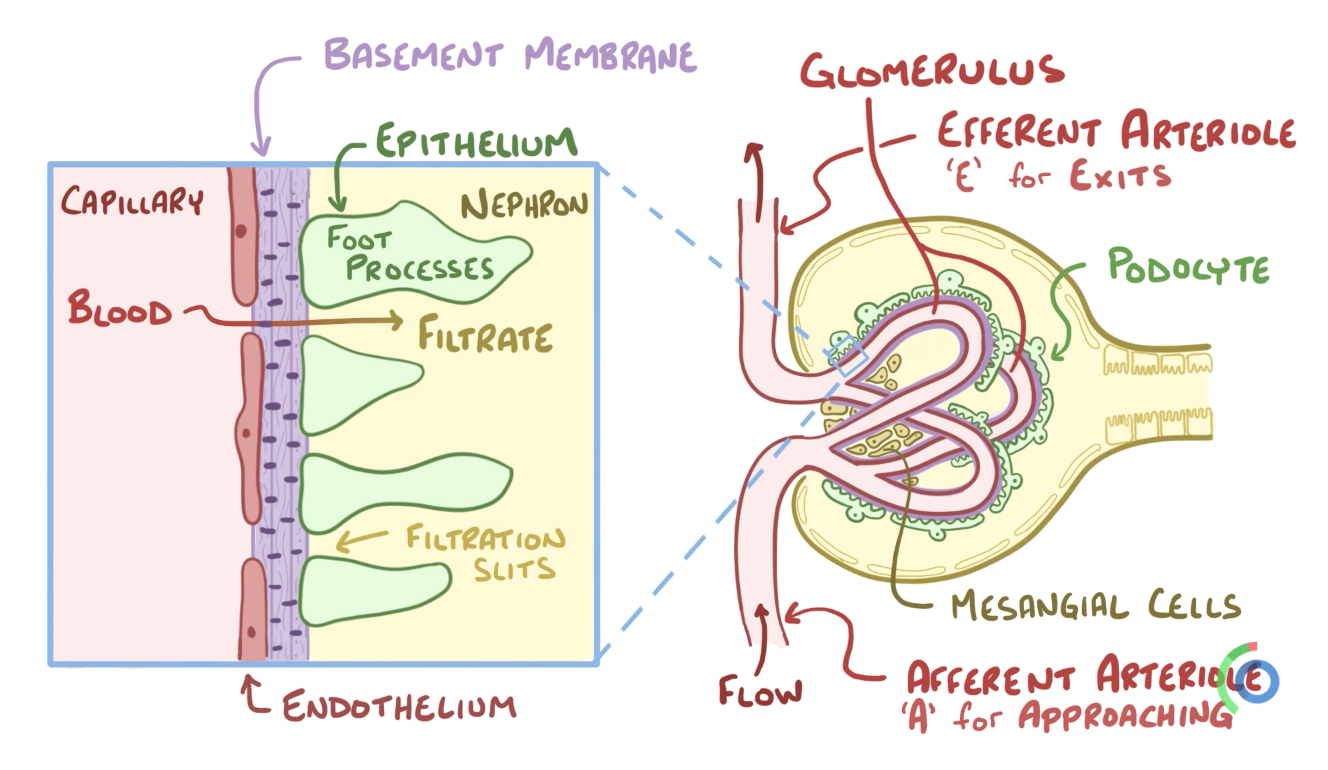
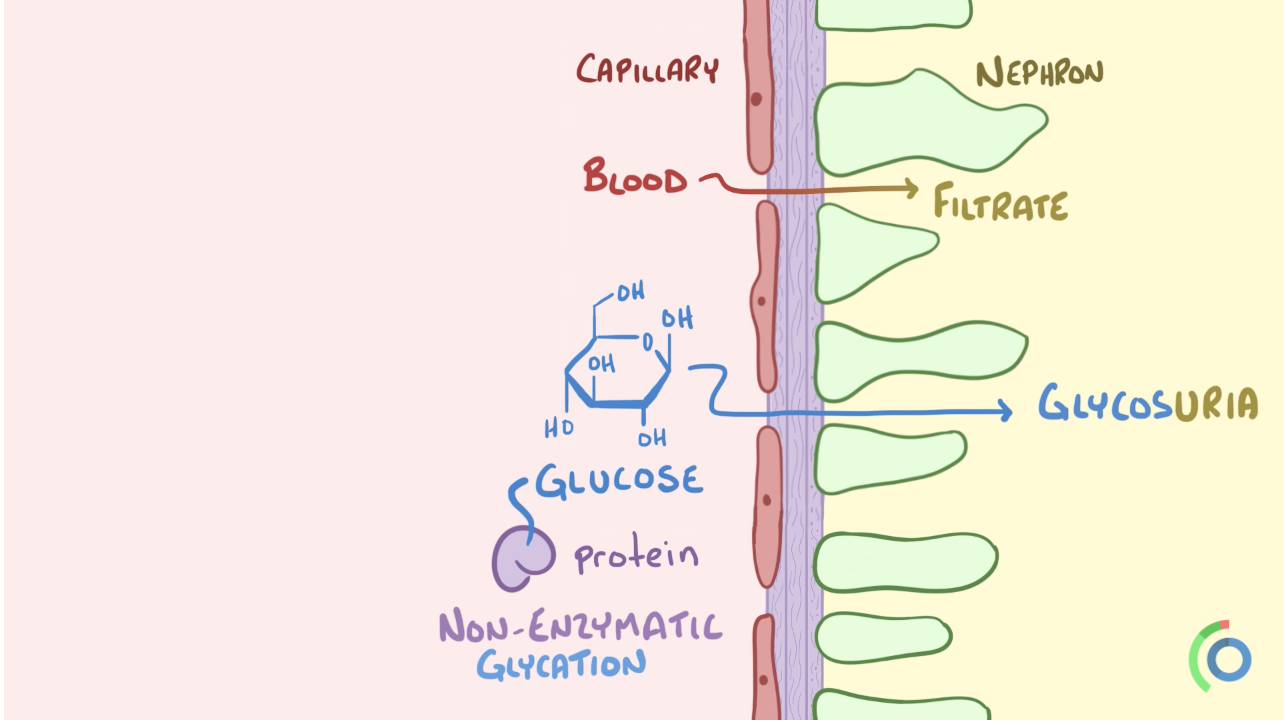
Diabetic nephropathy is slow and insidious in onset and normally progresses to chronic kidney disease. Chronically elevated glucose drives glycation of the glomerular basement membrane and obstruction to blood flow. The resulting increased pressure causes arterial dilation and a rise in the glomerular filtration rate, producing an initial stage of hyperfiltration that progresses over time into more advanced stages of damage.
Presentation
Symptoms
Early diabetic nephropathy is usually asymptomatic. As kidney function declines, signs may include foamy urine from protein loss, swelling of the legs and around the eyes, raised blood pressure, fatigue, nausea, and reduced urine output in advanced disease.
Assessment
Diagnostic Considerations
- Reduced GFR
- Elevated cratinine and urea
- Electrolyte abnormalities
- Protein in the urine
- RBC/WBC testing
- pH
- Glucose
- Ketones
- Nitrites
Assessment
Differential Diagnosis
Other causes of chronic kidney disease and proteinuria should be considered, including hypertensive nephrosclerosis, glomerulonephritis, and urinary tract infection.
The Compounds
Research Compounds (15)
Individual molecules studied for diabetic nephropathy. These are research findings, not supplements to take — each page states how far the evidence goes.
Arjunolic Acid
Triterpenoid (pentacyclic, oleanane-type acid)
Arjunolic acid is the flagship oleanane triterpenoid acid of arjuna (Terminalia arjuna) bark — the Ayurvedic cardiac tonic — with a large, coherent preclinical record as an antioxidant, mitochondrial-protective, cardio-, hepato- and nephroprotective molecule. Almost all of it is rodent and cell work on the isolate; there are no human trials of isolated arjunolic acid, and as a large lipophilic acid it is poorly absorbed by mouth.
Astragaloside IV
Cycloartane triterpenoid saponin
Astragaloside IV is the signature cycloartane triterpenoid saponin of astragalus (Astragalus membranaceus / huang qi), the compound most credited with the root's cardio- and kidney-protective reputation. It has an enormous preclinical footprint — cardioprotection, anti-fibrosis, diabetic nephropathy and neuroprotection — but almost none of it translates cleanly, because the isolated molecule is barely absorbed by mouth (~2–3% oral bioavailability) and has never been tested as an isolated compound in a human trial.
Aucubin
Iridoid glycoside
Aucubin is an iridoid glycoside — the namesake constituent of Aucuba japonica and a widespread marker of plantain, mullein, Eucommia, Rehmannia and chaste-tree. Its coherent but entirely preclinical profile is led by a hepatoprotective / anti-fibrotic signal (Nrf2/Smad7); there are no isolate human trials, in chaste-tree it is a quality-control marker rather than the tested agent, and oral bioavailability is low with an unstable, reactive aglycone.
Boldine
Aporphine alkaloid
Boldine is the principal aporphine alkaloid of boldo (Peumus boldus) and a potent radical-scavenging antioxidant, best known now as a blocker of connexin hemichannels — a mechanism that plausibly unifies its hepatoprotective, neuroprotective and muscle-sparing effects in rodents. Human evidence is for the boldo herb, not the isolate, and boldo's severe toxicity is chiefly its essential oil (ascaridole), not boldine.
Epiberberine
Isoquinoline alkaloid (protoberberine group)
A minor quaternary protoberberine alkaloid of goldthread (Coptis) — one of the five signature Coptis alkaloids used as HPLC quality-control markers for Huanglian. Its own research is entirely preclinical (anti-Helicobacter pylori, anti-diabetic, acetylcholinesterase inhibition), and, unlike its isomer berberine, it is reasonably well absorbed by mouth.
Esculin
Coumarin glycoside
Esculin (aesculin) is a coumarin glucoside — esculetin 6-O-glucoside — of horse-chestnut bark and ash (Fraxinus) bark. Its preclinical research centers on anti-inflammatory (NF-κB/PPARγ), antioxidant (Nrf2) and antidiabetic-nephroprotective activity, with no human trials of the isolate. It is the toxic coumarin removed when horse-chestnut seed is standardized to aescin — and is neither aescin nor a warfarin-type anticoagulant.
Hyperoside
Flavonol glycoside
Hyperoside is quercetin-3-O-galactoside — a flavonol glycoside and the pharmacopoeial flavonoid marker of St John's Wort, motherwort, hawthorn and calendula, and a major leaf flavonoid of Houttuynia and juniper. It has a broad isolated-compound preclinical literature (liver, brain, heart, kidney), but like its aglycone quercetin it is poorly absorbed and hydrolyzed by gut bacteria to quercetin, and every result to date is from cell and animal models.
Morroniside
Secoiridoid glucoside (iridoid glycoside)
Morroniside is a principal secoiridoid glucoside of cornelian cherry (Cornus officinalis / shan zhu yu) and, with loganin, one of the two iridoid markers used to standardize the herb. Its pharmacology is a broad but entirely preclinical anti-diabetic-nephropathy, neuroprotective and bone-protective profile — there are no isolate human trials, the human evidence belongs to the whole fruit and its formulas, and oral bioavailability is very low (~4.3% in rats).
Notoginsenoside R1
Dammarane triterpenoid saponin (protopanaxatriol group)
Notoginsenoside R1 (NGR1) is the signature saponin of notoginseng (Panax notoginseng / San Qi) — a protopanaxatriol-type dammarane found in essentially no other Panax species, which makes it the herb's authentication marker. It is the standardised component of the widely used Chinese cardiovascular injectables Xuesaitong and Xueshuantong, with a large but almost entirely preclinical anti-ischemic, endothelial-protective and neuroprotective literature; the human evidence is for the Panax notoginseng saponin (PNS) mixture, not isolated NGR1 taken by mouth.
P-Coumaric Acid
Hydroxycinnamic acid
p-Coumaric acid is one of the most widespread of all dietary hydroxycinnamic (phenolic) acids, present in nearly every plant here and also made endogenously from tyrosine. Unusually for a phenolic acid it is absorbed rapidly and relatively well, but it is then swiftly conjugated to glucuronides and sulfates — so its best-supported use is topical (a potent human tyrosinase inhibitor for skin), while its antioxidant, antiplatelet and antidiabetic signals are almost all preclinical.
Rhein
Anthraquinone (aglycone)
Rhein is an anthraquinone aglycone of rhubarb, yellow dock and senna and — uniquely among the anthraquinones — the active metabolite of the licensed osteoarthritis drug diacerein. That prodrug link gives rhein human clinical data (OA meta-analyses, one diabetic-CKD RCT) that most anthraquinones lack, though the benefit is small and disputed.
Salvianolic Acid B
Polyphenol (caffeic-acid oligomer / depside tetramer; phenolic acid)
The dominant water-soluble constituent of danshen and the marker compound five pharmacopoeias standardise the root on (not less than 3% dried root). A caffeic-acid tetramer with genuine molecule-level evidence — a 6-month biopsy-controlled liver-fibrosis trial, P2Y12 and phosphodiesterase antiplatelet activity, direct thrombin inhibition — undercut by an oral bioavailability of 1–2%.
Sarsasapogenin
Steroidal sapogenin (25S-5β-spirostan-3β-ol; spirostanol aglycone)
Sarsasapogenin is the spirostanol sapogenin of sarsaparilla — the aglycone left after gut bacteria strip the sugars off sarsasaponin, the shatavarins and the timosaponins. Despite a steroid skeleton and a long marketing history as a natural hormone source, it is not converted to any human hormone; its real pharmacology is cholinergic, anti-inflammatory and neuroprotective, and it is almost entirely rodent-stage.
Scutellarin
Flavonoid (flavone O-glucuronide)
Scutellarin (scutellarein-7-O-glucuronide) is a flavone glucuronide from skullcap and Erigeron breviscapus — the standardised active of breviscapine, an injectable Chinese medicine used for ischaemic stroke and cardiovascular disease. Its human record is a genuine clinical footprint of low-to-moderate evidence quality; its recurring weakness is poor oral bioavailability.
Tectorigenin
Isoflavone
Tectorigenin is an O-methylated isoflavone of Iris tectorum and Belamcanda chinensis (She-gan) rhizome — the aglycone of tectoridin — studied preclinically for NF-κB anti-inflammatory action and a distinctive metabolic (PPARα / NAFLD, antidiabetic) signal, with modest but characterized estrogen-receptor activity. No human trials of the isolate.