
Condition
Typhoid Fever
Typhoid fever — the human-restricted bacterium Salmonella Typhi, how it invades the gut and bloodstream, the drug-resistant strains spreading out of South Asia, how it is treated, and the herbs traditionally used against enteric fevers.


Bacterial infection has always plagued human history, and it likely always will. Organisms like tuberculosis, cholera, plague, and typhoid took countless lives across the centuries before antibiotics, and typhoid fever — a bloodstream infection with the bacterium Salmonella Typhi — was one of the most feared of them all.
For about seventy years, antibiotics tamed it. But S. Typhi has been quietly learning to resist those drugs, and a strain that emerged in Pakistan is resistant to nearly all of them. Researchers worry it offers a preview of a post-antibiotic era — where a common, treatable infection becomes deadly again.
What Is Typhoid Fever?
Typhoid fever comes from infection with a Salmonella bacterium. There are more than 2,500 kinds of Salmonella, and almost all human illness comes from a single species, Salmonella enterica. That species splits into two very different clinical worlds:
Non-Typhoidal Salmonella
This is the Salmonella most people have heard of — the food-poisoning kind, spread through undercooked eggs, poultry, and meat, and shared between animals and people. It stays in the gastrointestinal tract and causes a self-limiting bout of diarrhoea, cramps, and fever. Unpleasant, but rarely life-threatening in a healthy person.
Typhoidal Salmonella
This is a different and far more serious disease. The typhoidal serovars — chiefly Salmonella Typhi, with the related S. Paratyphi A, B, and C causing a usually milder “paratyphoid” — don’t stop at the gut wall. They breach it, enter the bloodstream, and seed organs throughout the body. Typhoid fever is the name for this systemic, invasive infection. It is what makes the difference between a few days of stomach upset and a weeks-long illness that can kill.
Crucially, S. Typhi infects only humans — it has no animal reservoir 4Reference 4ReviewHost restriction, pathogenesis and chronic carriage of typhoidal Salmonella — reviewView study →. That single fact shapes everything about the disease: it spreads person to person through contaminated water and food, it thrives where sanitation fails, and — at least in principle — it is a disease we could eliminate.
How Typhoid Makes Us Sick
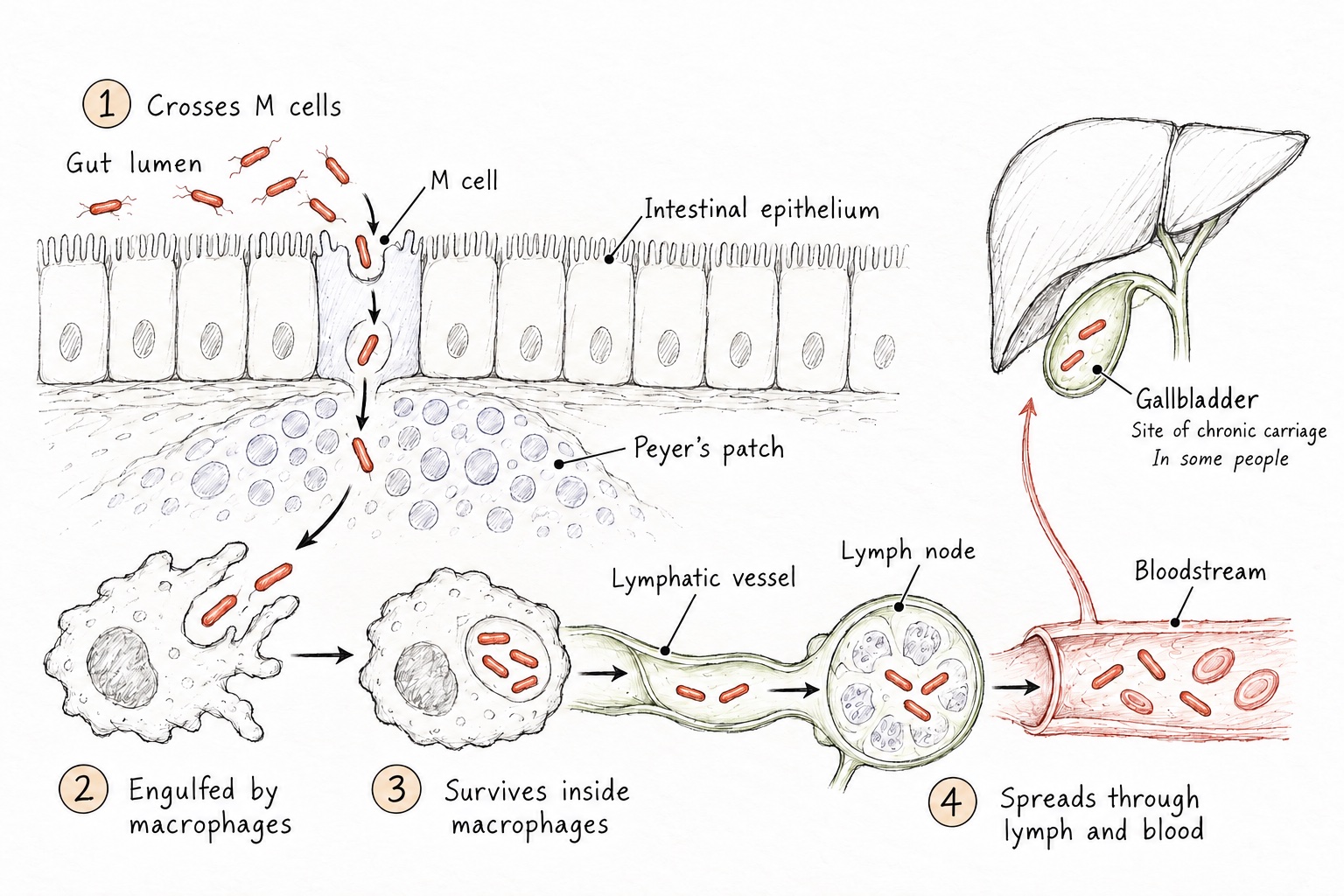
S. Typhi is a rod-shaped, Gram-negative bacterium with long flagella it uses to swim toward the gut lining. Once swallowed in contaminated water or food, it survives the stomach and reaches the small intestine, where the real invasion begins 4Reference 4ReviewHost restriction, pathogenesis and chronic carriage of typhoidal Salmonella — reviewView study →5Reference 5Salmonella Typhi (Typhoid Fever).
- Invasion. The bacteria cross the gut lining, targeting the M cells and enterocytes over the Peyer’s patches — clusters of immune tissue in the wall of the distal small intestine. To force its way into cells that don’t normally engulf anything, S. Typhi fires a molecular syringe — the type III secretion system built by a gene cluster called SPI-1 — injecting “effector proteins” that hijack the cell’s own actin skeleton, making the surface ruffle up and swallow the bacterium 5Reference 5Salmonella Typhi (Typhoid Fever)6Reference 6Typhoid feverView study →.
- Survival inside cells. Once inside, S. Typhi is not digested. It wraps itself in a protective bubble — the Salmonella-containing vacuole (SCV) — and deploys a second secretion system (SPI-2) to remodel that bubble into a safe room where it survives and multiplies, even inside the macrophages meant to destroy it 16Reference 16Functions of the Salmonella pathogenicity island 2 (SPI-2) type III secretion system effectors. Living inside our own cells is what makes typhoid so hard to treat — an antibiotic has to penetrate the cell and reach the vacuole to work.
- Bacteremia. Carried inside those immune cells, the bacteria ride to the lymph nodes, liver, spleen, and bone marrow, multiply, and spill back into the blood — the bacteremia that drives the sustained fever 6Reference 6Typhoid feverView study →.
- Gallbladder carriage. S. Typhi has a particular affinity for the gallbladder, especially where gallstones are present — it forms an antibiotic-resistant biofilm on the stones. This is how some people become long-term carriers, shedding the bacteria for months or years after they feel well — the mechanism behind the infamous “Typhoid Mary” 4Reference 4ReviewHost restriction, pathogenesis and chronic carriage of typhoidal Salmonella — reviewView study →17Reference 17Gallstones play a significant role in Salmonella spp. gallbladder colonization and carriageView study →.
Its Molecular Toolkit — And the Vaccine’s Weak Point
Two features set S. Typhi apart from ordinary food-poisoning Salmonella and explain why it goes systemic rather than just causing diarrhoea.
The first is a sugar cloak, the Vi capsular polysaccharide. Vi hides the bacterium from our first-line defences: it blocks the complement system from tagging the cell for destruction, and it masks the inflammatory surface molecule LPS (endotoxin) from immune sensors, quieting the alarm so the infection can spread stealthily 18Reference 18The Vi-capsular polysaccharide prevents Toll-like receptor 4 recognition of SalmonellaView study →. When that LPS is eventually sensed, it drives the high fevers and, in severe cases, the sepsis of typhoid. The elegant twist: Vi is exactly the antigen the modern typhoid conjugate vaccine (TCV) trains the immune system to recognise — turning the bacterium’s own cloak against it.
The second is a weapon no ordinary Salmonella carries: typhoid toxin, assembled from three subunits (PltA, PltB, and CdtB). Its CdtB component is a nuclease that cuts host-cell DNA and stalls the cell cycle; it is thought to contribute to the systemic symptoms and to establishing long-term carriage 19Reference 19Structure and function of the Salmonella Typhi chimaeric A2B5 typhoid toxinView study →.
The Clinical Course
Untreated, typhoid follows a fairly distinctive week-by-week march. The hallmark is a “step-wise” fever — the temperature climbs a little higher each day over the first few days until it plateaus around 39–40 °C and stays there.
- Week 1: A gradually rising, sustained fever, headache, malaise, and body aches. Constipation is often more typical early on than diarrhoea. A telling sign is relative bradycardia — a pulse slower than you’d expect for such a high fever (the Faget sign).
- Week 2: High, sustained fever; rose spots — small, salmon-pink, blanching spots on the chest and abdomen — appear in a minority of patients; the liver and spleen enlarge; patients are exhausted and may become delirious (the “typhoid state”).
- Week 3: The most dangerous stage. As the bacteria damage the lymphoid tissue (Peyer’s patches) in the gut wall, the risk of intestinal haemorrhage and intestinal perforation — a hole in the bowel leading to peritonitis and sepsis — rises sharply. These are the main causes of death in typhoid 5Reference 5Salmonella Typhi (Typhoid Fever).
- Week 4: In those who survive, the fever slowly breaks and recovery begins.
Worsening abdominal pain, a distended abdomen, signs of bleeding, or sudden deterioration in the third week are medical emergencies — perforation can develop with little warning and needs immediate hospital care.
How Typhoid Spreads
Because S. Typhi lives only in humans and is shed in faeces, it spreads wherever human waste contaminates drinking water or food. In places with overcrowding and poor sewage systems, sewage overflows into the rivers and wells that supply drinking water and irrigate crops — a near-perfect breeding ground. Flies moving from faeces to food, and food handled by an infected person who hasn’t washed their hands, complete the chain.
It can also spread from people showing no symptoms at all. The first documented case of this was a cook in early-1900s New York, Mary Mallon — “Typhoid Mary” — an asymptomatic chronic carrier whose gallbladder harboured the bacteria. She is thought to have infected more than 50 people through the food she prepared, several of whom died. Chronic carriers like her are the reservoir that keeps typhoid circulating between outbreaks 4Reference 4ReviewHost restriction, pathogenesis and chronic carriage of typhoidal Salmonella — reviewView study →6Reference 6Typhoid feverView study →.
How Dangerous Is Typhoid Fever?
Typhoid remains a major global killer, concentrated in regions with unsafe water and limited sanitation — South Asia above all, along with parts of sub-Saharan Africa and Southeast Asia. The WHO estimates roughly 9 million cases and 110,000 deaths every year; the peer-reviewed Global Burden of Disease study put it at about 10.9 million cases and 116,800 deaths for 2017 1Reference 1Typhoid — Fact sheet2Reference 2The global burden of typhoid and paratyphoid fevers: a systematic analysis for the Global Burden of Disease Study 2017.
That ~1% fatality figure is with effective antibiotics available. Before antibiotics, case fatality ran around 10–20%, and an untreated fever could last for weeks or months 5Reference 5Salmonella Typhi (Typhoid Fever). This is exactly why the rise of drug-resistant typhoid is so alarming: it threatens to push the outcome back toward those pre-antibiotic numbers.
Drug Resistance & the XDR Outbreak
Antibiotic resistance in S. Typhi is not new — it has been climbing since the 1970s, forcing doctors to switch drugs again and again as each one failed. First chloramphenicol, ampicillin, and co-trimoxazole were lost to “multidrug-resistant” (MDR) strains; then the fluoroquinolones (like ciprofloxacin) were eroded across South Asia.
The sharpest warning came from Pakistan. Beginning around 2016 in Hyderabad, in Sindh province, an extensively drug-resistant (XDR) strain emerged and spread nationally. Genetically, it is the widespread H58 lineage that acquired a plasmid carrying blaCTX-M-15 (knocking out third-generation cephalosporins like ceftriaxone) plus a qnrS gene (fluoroquinolone resistance) on top of its existing MDR background 3Reference 3Emergence of an extensively drug-resistant Salmonella enterica serovar Typhi clone harboring a promiscuous plasmid encoding resistance to fluoroquinolones and third-generation cephalosporins. mBio, 9(1), e00105-18. That leaves this strain resistant to five classes of antibiotic — chloramphenicol, ampicillin, co-trimoxazole, fluoroquinolones, and third-generation cephalosporins — with only azithromycin (oral) and the carbapenems (intravenous) still reliably working.
If a strain adds resistance to azithromycin, there would be almost nothing left to give by mouth — and troublingly, azithromycin-resistant XDR isolates have already been reported at low frequency 3Reference 3Emergence of an extensively drug-resistant Salmonella enterica serovar Typhi clone harboring a promiscuous plasmid encoding resistance to fluoroquinolones and third-generation cephalosporins. mBio, 9(1), e00105-18. This outbreak has not stayed put: travel-associated XDR cases have been detected in the UK, the US, and elsewhere. If this resistance continues to spread, typhoid could once again carry the fatality rates of the pre-antibiotic era.
Treatment
Conventional Treatment
Prevention Comes First
The single most effective measure against typhoid is clean water and good sanitation — it is fundamentally a disease of contaminated water. For travellers to endemic areas and for populations at risk, two tools help:
- Safe food and water practices — drink treated or boiled water, avoid raw produce washed in unsafe water, and wash hands well.
- Vaccination. The newer typhoid conjugate vaccine (TCV) — Typbar-TCV was the first, WHO-prequalified in 2018 — offers longer, stronger protection than the older vaccines and works in young children. Pakistan became the first country to add TCV to its routine childhood immunisation in 2019, directly in response to the XDR outbreak 7Reference 7Typhoid conjugate vaccine (Typbar-TCV) prequalification, 2018; and Pakistan’s introduction of TCV into routine immunisation, 2019.
Antibiotics
For an active infection, prompt antibiotics are essential, and the right choice now depends heavily on local resistance patterns:
- Azithromycin — oral; the mainstay for uncomplicated and XDR typhoid.
- Ceftriaxone — intravenous; used for severe illness, though it fails against the XDR strain.
- Fluoroquinolones (e.g. ciprofloxacin) — once first-line, now widely compromised by resistance across South Asia.
- Carbapenems (e.g. meropenem) — intravenous; reserved for severe XDR cases.
Because the bacteria hide inside our cells, the antibiotic has to penetrate those cells to work — which is part of why treatment takes days and why starting early matters. Adequate nutrition and hydration are important supportive care; mortality is highest in those who are malnourished.
Materia Medica
Herbal & Nutritional Support
Typhoid is a serious, potentially fatal bloodstream infection that requires prompt medical diagnosis and antibiotics. No plant is a substitute for antibiotics, and none should be used in place of proper medical care. If anything, the emergence of drug-resistant XDR typhoid makes getting the right treatment more important, not less — the window is narrowing, and complications like intestinal perforation can be deadly. Anyone with suspected typhoid needs a doctor.
Plants have a long history of traditional use against fevers and enteric infections across the regions where typhoid is endemic, and a number of them show activity against S. Typhi in the laboratory.
Not one of these herbs has been tested as a treatment for human typhoid in a controlled clinical trial. Every result is either a test-tube study against clinical S. Typhi isolates, an animal model, or documented traditional use. These results point to plants worth investigating — as adjuncts, or as sources of future drugs against superbugs like XDR typhoid — not to plants that “cure” typhoid.
For several herbs the lab activity belongs to an isolated molecule, not the whole herb — and in two notorious cases the isolated marker compound (andrographis’s andrographolide, neem’s azadirachtin) shows no direct antibacterial activity at all, so the herb’s reputation outruns its chemistry.
- Proven
- Promising
- Shaky
- Unsupported
On-Target Signals
Tulsi and bael have evidence specifically against S. Typhi, in PubMed-indexed studies using clinical isolates.
Tulsi, or holy basil (Ocimum tenuiflorum): an ethanolic leaf extract was tested against 23 clinical S. Typhi isolates — including strains fully resistant to chloramphenicol and trimethoprim — and not only inhibited them, but at sub-inhibitory doses potentiated those antibiotics, restoring some of their activity against the resistant bacteria 8Reference 8In vitroEnhancing chloramphenicol and trimethoprim in vitro activity by Ocimum sanctum Linn. (Lamiaceae) leaf extract against Salmonella enterica serovar Typhi. Antibiotic potentiation of this kind is a possible adjunct role in a resistance crisis.
The result belongs to the whole leaf extract (tulsi’s aromatic oil is rich in eugenol), and it remains a bench finding, untested in people.
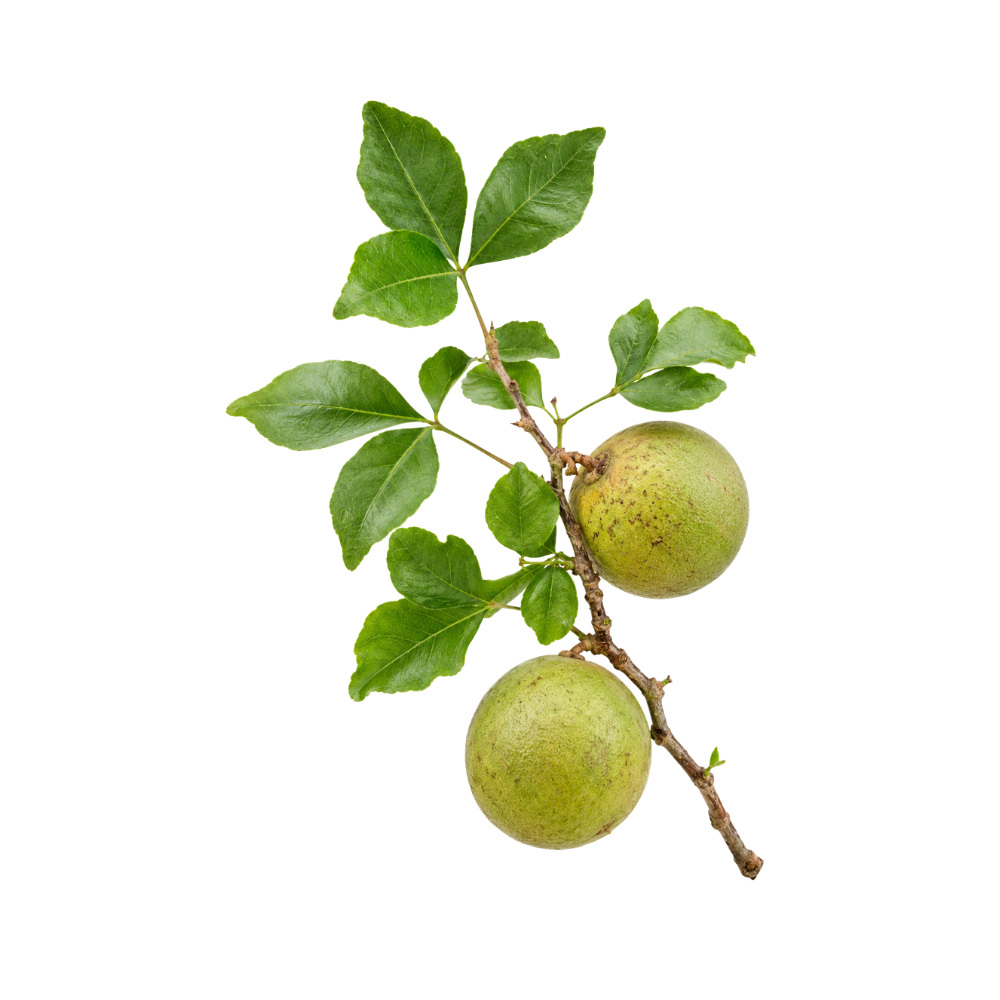
Bael (Aegle marmelos), a revered Ayurvedic remedy for digestive and enteric complaints, was named among the most active plants in a screen of 54 Ayurvedic extracts against multidrug-resistant S. Typhi 9Reference 9Antimicrobial evaluation of some medicinal plants for their anti-enteric potential against multi-drug resistant Salmonella typhi. It has deep traditional use for diarrhoea and dysentery to match, and a mechanistic study found its unripe-fruit decoction works less by killing bacteria outright than by blocking their adherence and neutralising enteric toxins.
Antibacterial In The Lab
A larger group inhibits S. Typhi in the test tube without any on-target human data. Garlic (Allium sativum) has the best-understood mechanism: its sulfur compound allicin halts bacterial RNA synthesis, and it is bacteriostatic against Salmonella 10Reference 10In vitroIn vitro mechanism of inhibition of bacterial cell growth by allicin; in one rat study, garlic extract reduced gut S. Typhi counts and shortened the infection, though it did not prevent it.
Allicin is unstable, poorly absorbed, and concentrates in the gut — plausible for a luminal effect, but unlikely to reach the intracellular, bloodstream niche where typhoid actually lives.
Haritaki (Terminalia chebula) — the pre-eminent Ayurvedic fruit and an anti-enteric staple — is broadly antibacterial through its tannins, inhibiting Shigella and Salmonella in vitro and, notably, potentiating conventional antibiotics against them 12Reference 12Phytochemical analysis and antimicrobial activity of Terminalia bellirica and Terminalia chebula fruit extracts against gastrointestinal pathogens.
Berberine, the yellow alkaloid shared by barberry, goldenseal, and Coptis, acts on the infection inside the cell: rather than just killing bacteria in a dish, it curbs Salmonella surviving inside host cells — both by shutting down the injection system the bacterium uses to invade and by boosting the host cell’s own self-cleaning (autophagy) — a target suited to an intracellular pathogen, with supportive mouse data (in non-typhoidal Salmonella) 13Reference 13Berberine restricts intracellular Salmonella by enhancing autophagy and inhibiting the type III secretion systemView study →.
Guava (Psidium guajava), though a classic pan-tropical anti-enteric leaf with genuine human trials for acute diarrhoea, does not have convincing direct activity against S. Typhi — careful testing found Salmonella among the organisms resistant to its leaf extracts 11Reference 11Antimicrobial activities of leaf extracts of guava (Psidium guajava L.) on two Gram-negative and Gram-positive bacteria. Its use is as traditional anti-enteric support, not as a Salmonella killer.
Cryptolepis sanguinolenta, West Africa’s go-to antimicrobial root, has indoloquinoline alkaloids with broad antibacterial activity in vitro, including against enteric organisms 15Reference 15In vitroIn vitro biological activities of alkaloids from Cryptolepis sanguinolenta, though its verified strength is greater against Gram-positive bacteria, and its fame really rests on antimalarial activity, not typhoid.
Traditional Anti-Enteric Plants
Some plants carry a strong traditional anti-typhoid reputation that outpaces the laboratory data. Neem (Azadirachta indica) is used across India for fevers and infection, and crude leaf extracts do show some anti-Salmonella activity — but it is inconsistent (S. Typhi is among the organisms less susceptible to neem), no single active molecule is established. Concentrated neem oil and seed are toxic, and in children have caused a Reye-like encephalopathy, a hazard in the young, febrile patients typhoid often strikes.
Senna alata is explicitly named as a traditional typhoid remedy in West-African ethnobotany 14Reference 14Ethnobotanical description and biological activities of Senna alata, with modest antibacterial data to match.
Andrographis (Andrographis paniculata) — “King of Bitters” — is a classic fever herb, but its direct antibacterial signal against S. Typhi is weak, and its signature compound andrographolide is inactive against Salmonella; its strengths are immunomodulatory, not bactericidal.
Molecular Leads — Where the Drug Hunt Is Going
The rise of XDR typhoid has reframed what plant research into the disease is even for. The scientifically live question is no longer whether a crude leaf brew dents Salmonella in a dish — many do, weakly — but whether isolated plant molecules offer either a new mechanism or a way to rescue the antibiotics we already have.
Two ideas carry that weight. The first is host-directed and anti-virulence molecules that attack the intracellular lifestyle conventional antibiotics largely ignore: berberine both shuts down the SPI-1 injection system S. Typhi uses to invade and boosts the host cell’s self-cleaning (autophagy) to clear bacteria hiding inside it, with supportive mouse data 13Reference 13Berberine restricts intracellular Salmonella by enhancing autophagy and inhibiting the type III secretion systemView study →. The highest-potency verified hits, meanwhile, are single molecules — plumbagin (from Plumbago) inhibited eight multidrug-resistant clinical isolates including S. Typhi at sub-microgram concentrations 20Reference 20Antibacterial and antibiofilm potential of plumbagin against multidrug-resistant clinical isolates including Salmonella Typhi, and clove’s eugenol killed S. Typhi rapidly by disrupting its membrane 21Reference 21Evaluation of antifungal and antibacterial activity of eugenol against Salmonella Typhi and other pathogens — though these, like the aromatic phenolics generally, suit the gut lumen or a drug-design starting point better than a systemic bloodstream infection.
The second idea is potentiation — restoring a failing drug. Pomegranate’s punicalagin re-sensitised MDR S. Typhi to several antibiotic classes in vitro 22Reference 22Punicalagin, a pomegranate polyphenol, sensitizes the activity of antibiotics against three MDR pathogens of the Enterobacteriaceae; an efflux-pump inhibitor from milk thistle seed restored ciprofloxacin’s activity against a resistant S. Typhi pump 23Reference 23Efflux-pump inhibition restores ciprofloxacin activity against a multidrug-resistant Salmonella Typhi efflux pump; and tulsi leaf extract sharpened chloramphenicol and trimethoprim against resistant isolates 8Reference 8In vitroEnhancing chloramphenicol and trimethoprim in vitro activity by Ocimum sanctum Linn. (Lamiaceae) leaf extract against Salmonella enterica serovar Typhi. All of this is in vitro, none is a human typhoid cure, and potency is often modest. These are drug leads and adjuvant concepts — but in the XDR era, that is exactly where the field’s attention has moved.
Supportive & Convalescent Care
Beyond any direct antimicrobial hope, general supportive measures matter enormously in typhoid. Because mortality is highest in the malnourished, maintaining hydration and adequate nutrition is real, evidence-aligned care. The many additional plants in cultures across Asia and Africa with anti-enteric or antibacterial reputations are leads for researchers hunting new drugs against resistant Salmonella, not a treatment plan for someone who is sick. Treatment always means antibiotics and a doctor.
Typhoid is a medical emergency, not a home-remedy condition. Suspected typhoid — a sustained high fever after travel to an endemic area, especially with abdominal symptoms — needs prompt medical diagnosis (blood culture) and antibiotics. No herb is a substitute.
- Never delay or replace antibiotics with herbs. Drug-resistant typhoid makes fast, correct medical treatment more critical, not less.
- Third-week warning signs — worsening or spreading abdominal pain, a swollen hard belly, blood in the stool, or sudden collapse — mean go to hospital immediately (possible perforation).
- Neem oil/seed and concentrated extracts are toxic, especially to children and in pregnancy — avoid in the young or pregnant.
- Andrographis is contraindicated in pregnancy.
- Garlic in large medicinal doses has an antiplatelet effect — a consideration in a severely ill patient at risk of intestinal bleeding.
The Herbs
Materia Medica (1)
Herbs traditionally or clinically used for typhoid fever.
References
- World Health Organization. Typhoid — Fact sheet. Retrieved from who.int/news-room/fact-sheets/detail/typhoid.
- GBD 2017 Typhoid and Paratyphoid Collaborators. (2019). The global burden of typhoid and paratyphoid fevers: a systematic analysis for the Global Burden of Disease Study 2017. The Lancet Infectious Diseases, 19(4), 369–381. PMID 30792131
- Klemm, E. J., Shakoor, S., Page, A. J., et al. (2018). Emergence of an extensively drug-resistant Salmonella enterica serovar Typhi clone harboring a promiscuous plasmid encoding resistance to fluoroquinolones and third-generation cephalosporins. mBio, 9(1), e00105-18. PMID 29463654
- Barton, A. J., Hill, J., Blohmke, C. J., & Pollard, A. J. (2021). Host restriction, pathogenesis and chronic carriage of typhoidal Salmonella — review. FEMS Microbiology Reviews, 45(6), fuab014. doi:10.1093/femsre/fuab014
- Ashurst, J. V., Truong, J., & Woodbury, B. (2024). Salmonella Typhi (Typhoid Fever). In StatPearls. Treasure Island (FL): StatPearls Publishing. NBK557513
- Parry, C. M., Hien, T. T., Dougan, G., White, N. J., & Farrar, J. J. (2002). Typhoid fever. New England Journal of Medicine, 347(22), 1770–1782. doi:10.1056/NEJMra020201
- World Health Organization. Typhoid conjugate vaccine (Typbar-TCV) prequalification, 2018; and Pakistan’s introduction of TCV into routine immunisation, 2019. See the WHO typhoid fact sheet [1] and Gavi coverage.
- Mandal, S., Mandal, M. D., & Pal, N. K. (2012). Enhancing chloramphenicol and trimethoprim in vitro activity by Ocimum sanctum Linn. (Lamiaceae) leaf extract against Salmonella enterica serovar Typhi. Asian Pacific Journal of Tropical Medicine, 5(3), 220–224. PMID 22305788
- Rani, P., & Khullar, N. (2004). Antimicrobial evaluation of some medicinal plants for their anti-enteric potential against multi-drug resistant Salmonella typhi. Phytotherapy Research, 18(8), 670–673. PMID 15476301
- Feldberg, R. S., Chang, S. C., Kotik, A. N., et al. (1988). In vitro mechanism of inhibition of bacterial cell growth by allicin. Antimicrobial Agents and Chemotherapy, 32(12), 1763–1768. PMID 2469386
- Biswas, B., Rogers, K., McLaughlin, F., Daniels, D., & Yadav, A. (2013). Antimicrobial activities of leaf extracts of guava (Psidium guajava L.) on two Gram-negative and Gram-positive bacteria. International Journal of Microbiology, 2013, 746165. PMID 24223039
- Tiwana, G., Cock, I. E., Cheesman, M. J., et al. (2024). Phytochemical analysis and antimicrobial activity of Terminalia bellirica and Terminalia chebula fruit extracts against gastrointestinal pathogens. PMID 39770866
- Huang, Lu, Wu, et al. (2025). Berberine restricts intracellular Salmonella by enhancing autophagy and inhibiting the type III secretion system. Biomolecules, 15(11), 1589. doi:10.3390/biom15111589
- Oladeji, O. S., Adelowo, F. E., Oluyori, A. P., & Bankole, D. T. (2020). Ethnobotanical description and biological activities of Senna alata. Evidence-Based Complementary and Alternative Medicine, 2020, 2580259. PMID 32148534
- Cimanga, K., De Bruyne, T., Pieters, L., et al. (1996). In vitro biological activities of alkaloids from Cryptolepis sanguinolenta. Planta Medica, 64(3), 209–214. PMID 8720383
- Figueira, R., & Holden, D. W. (2012). Functions of the Salmonella pathogenicity island 2 (SPI-2) type III secretion system effectors. Microbiology, 158(5), 1147–1161. PMID 22422755
- Crawford, R. W., Rosales-Reyes, R., Ramírez-Aguilar, M. de la L., et al. (2010). Gallstones play a significant role in Salmonella spp. gallbladder colonization and carriage. PNAS, 107(9), 4353–4358. doi:10.1073/pnas.1000862107
- Wilson, R. P., Raffatellu, M., Chessa, D., et al. (2008). The Vi-capsular polysaccharide prevents Toll-like receptor 4 recognition of Salmonella. Cellular Microbiology, 10(4), 876–890. doi:10.1111/j.1462-5822.2007.01090.x
- Song, J., Gao, X., & Galán, J. E. (2013). Structure and function of the Salmonella Typhi chimaeric A2B5 typhoid toxin. Nature, 499(7458), 350–354. doi:10.1038/nature12377
- Alfhili, M. A., Ahmad, I., Alraey, Y., et al. (2022). Antibacterial and antibiofilm potential of plumbagin against multidrug-resistant clinical isolates including Salmonella Typhi. Saudi Medical Journal. PMID 36379534
- Devi, K. P., Nisha, S. A., Sakthivel, R., et al. (2011). Evaluation of antifungal and antibacterial activity of eugenol against Salmonella Typhi and other pathogens. Journal of Ethnopharmacology. PMID 20435121
- Kiran, S., Tariq, A., Iqbal, S., et al. (2024). Punicalagin, a pomegranate polyphenol, sensitizes the activity of antibiotics against three MDR pathogens of the Enterobacteriaceae. BMC Complementary Medicine and Therapies, 24(1), 93. PMID 38365729
- Tariq, A., Sana, M., Shaheen, A., et al. (2019). Efflux-pump inhibition restores ciprofloxacin activity against a multidrug-resistant Salmonella Typhi efflux pump. Letters in Applied Microbiology. PMID 31267555