
Condition
Zika
Zika virus — a mild mosquito-borne flavivirus that turned out to cross the placenta and damage developing brains, the 2015–16 epidemic that made it famous, why there is still no vaccine or antiviral, and what actually prevents it.


For most of the twentieth century Zika was a footnote. It was found in a caged monkey in Uganda’s Zika Forest in 1947, turned up occasionally in African and Asian serology surveys, and produced a handful of mild, self-limiting illnesses — a few days of fever, rash and sore joints. In seventy years it caused no recorded deaths and no outbreaks worth the name.
Then it reached the Americas. Between 2015 and 2016 an epidemic swept through Brazil and outward across the continent, and paediatricians in the north-east began reporting something that had never been linked to the virus before: babies born with abnormally small heads and severe brain damage. Zika turned out to be one of the very few viruses that crosses the human placenta and attacks the developing nervous system directly.
Zika is a trivial illness in the person infected, and a potentially devastating one in a fetus.
What Is Zika?
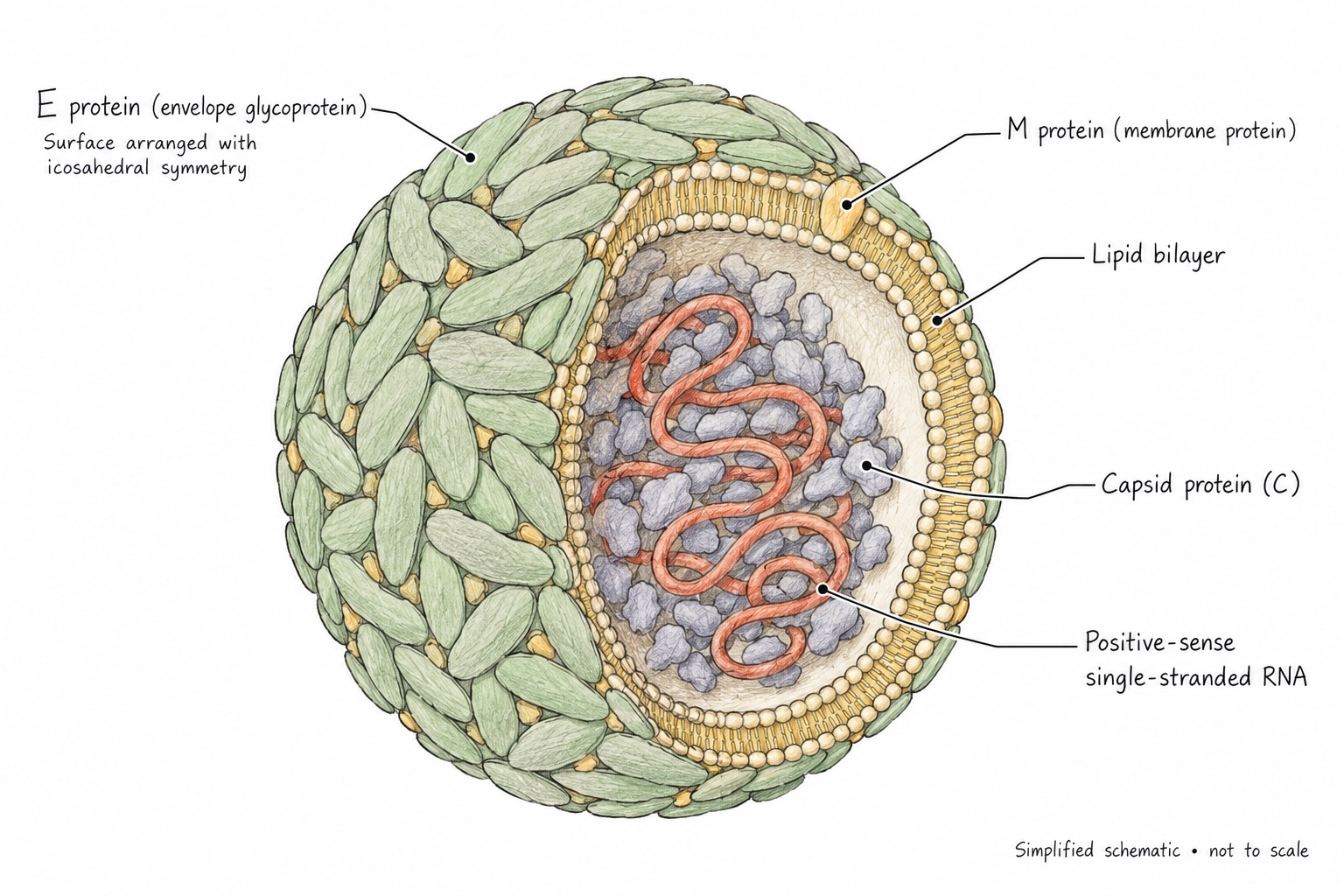
Zika is a flavivirus — a small, enveloped, positive-sense single-stranded RNA virus in the family Flaviviridae. Its close relatives are a roll-call of the mosquito-borne diseases: dengue, yellow fever, West Nile, and Japanese encephalitis. That family resemblance is the reason Zika is so hard to diagnose — the antibodies our immune system raises against one flavivirus cross-react with the others, and dengue circulates in almost every place Zika does.
The virus was isolated in 1947 from a sentinel rhesus macaque placed in the Zika Forest of Uganda by researchers monitoring for yellow fever. It was recovered from Aedes africanus mosquitoes the following year, and the first confirmed human infections were described in the early 1950s. For the next half-century it stayed in that quiet band across equatorial Africa and Asia, causing scattered mild illness and attracting almost no research funding.
Zika exists as two genetic lineages — an African lineage and an Asian one. The Asian lineage is the one that travelled: it caused the first real outbreak on Yap Island in Micronesia in 2007, a much larger one in French Polynesia in 2013–14, and from there reached Brazil and spread across the Americas.
How Zika Spreads
Zika is primarily an arbovirus — arthropod-borne — carried by mosquitoes of the genus Aedes, chiefly Aedes aegypti and to a lesser extent Aedes albopictus (the Asian tiger mosquito). These are the same mosquitoes that carry dengue, chikungunya and yellow fever, which is why those diseases tend to arrive together.
Aedes bites during the day, with peaks in the early morning and late afternoon. The bed nets and dusk-to-dawn precautions that work against the Anopheles mosquitoes of malaria are close to useless against Aedes. Daytime repellent and covering clothing are what matter.
But Zika is unusual among arboviruses in having several routes that have nothing to do with mosquitoes at all:
- Sexual transmission. Zika persists in semen far longer than in blood — it has been detected months after symptoms resolved — and is transmitted from men to partners, from women to partners, and between same-sex partners. No other major arbovirus does this to any comparable degree, and it is the reason travel advice includes barrier contraception rather than only insect repellent.
- Mother to fetus. The virus crosses the placenta and infects fetal tissue directly. This is the route that turned Zika from a nuisance into an emergency.
- Blood transfusion. Documented, and the reason blood services in affected regions introduced screening and deferral.
- Around birth and possibly breast milk. Viral RNA has been found in breast milk; the WHO’s position is that the established benefits of breastfeeding outweigh the theoretical risk, and no case of disease from breastfeeding has been confirmed.
How Zika Makes Us Sick
In the person infected, Zika is mostly a non-event. Roughly four out of five infections produce no symptoms at all. Where illness does occur it is mild and self-limiting, typically lasting two to seven days:
- A low-grade fever — often under 38.5 °C, which distinguishes it from the abrupt high fever of dengue
- A maculopapular rash, often itchy, usually starting on the face and spreading down the body
- Non-purulent conjunctivitis — red eyes without discharge, one of the more distinctive signs
- Arthralgia and myalgia, particularly in the small joints of the hands and feet
- Headache, and general malaise
The serious harm falls on two groups: the developing fetus, and a small number of adults.
Congenital Zika Syndrome
Zika is neurotropic — it has a particular affinity for neural progenitor cells, the stem cells that build the fetal brain. Infecting them early in gestation kills them and disrupts the cascade of cell division and migration that constructs the cortex. The result is a recognisable pattern of damage now called congenital Zika syndrome:
- Microcephaly — a severely undersized head and brain, often with a collapsed skull and overlapping sutures
- Intracranial calcifications, especially at the junction of grey and white matter
- Ventriculomegaly and cortical malformations
- Ocular abnormalities — macular scarring and optic-nerve damage, causing visual impairment
- Congenital contractures (arthrogryposis) and marked hypertonia, reflecting damage to the motor pathways
Risk is highest with first-trimester infection, when the brain is being built, and falls through the second and third trimesters. Critically, the mother’s own illness is no guide at all — a completely asymptomatic infection can still produce a severely affected baby.
The Brazilian epidemic of 2015–16 made the link visible because the case numbers were large enough to see: paediatricians in the north-east reported a sharp, unexplained rise in microcephaly notifications, and the epidemiological, virological and animal evidence assembled over the following months established causation. In February 2016 the WHO declared the cluster of microcephaly and neurological disorders a Public Health Emergency of International Concern — the same mechanism used for the 2014 Ebola epidemic. The declaration was lifted in November 2016, with the emphasis shifting from emergency response to long-term management of affected children.
Guillain-Barré Syndrome
The second serious outcome is in adults. Guillain-Barré syndrome (GBS) is an autoimmune attack on peripheral nerve myelin, producing ascending weakness and paralysis that can require ventilatory support. It is a known post-infectious complication of several pathogens, and the French Polynesian outbreak of 2013–14 produced the first strong signal that Zika is one of them — a case-control study there found a striking association, and the pattern was reproduced across Latin America during the Americas epidemic.
GBS remains a rare outcome in absolute terms, but in a large outbreak a rare complication still fills intensive-care beds.
Assessment
Diagnosis
Diagnosing Zika is difficult.
In the acute phase, RT-PCR detects viral RNA in serum and urine. Serum is only useful for the first few days; urine stays positive longer — commonly out to around two weeks — which makes it the more forgiving sample.
After that window, diagnosis falls back on antibodies, and this is where flavivirus family resemblance bites. IgM assays for Zika cross-react heavily with dengue, and in most Zika-endemic regions a large fraction of the population has been exposed to dengue already. A positive Zika IgM in a dengue-endemic setting means very little on its own. Confirmation requires a plaque-reduction neutralisation test (PRNT), which measures how well the patient’s serum neutralises live virus and can discriminate between flaviviruses — but it is slow, needs a specialised laboratory, and even it can be ambiguous in someone with prior flavivirus exposure.
Clinically, the differential that matters most is dengue and chikungunya, which share the vector, the geography and much of the presentation. Distinguishing them is not academic: dengue can cause haemorrhage, which changes what you may safely give for the pain.
Treatment
Conventional Treatment
There is no specific antiviral for Zika and no licensed vaccine. Treatment is entirely supportive:
- Rest and fluids
- Paracetamol (acetaminophen) for fever and pain
- Avoid aspirin and other NSAIDs until dengue has been excluded — in dengue they raise the risk of bleeding, and early Zika and early dengue look alike
Vaccine development advanced quickly during the emergency — DNA, mRNA, inactivated and viral-vector candidates all reached early clinical trials — and then stalled. As the epidemic burned through the susceptible population and case numbers collapsed, there were no longer enough infections anywhere to run an efficacy trial. Several programmes were shelved for want of an epidemic to test them in. Should a large outbreak recur, that work would resume from a reasonably advanced starting point.
What Actually Prevents Zika
With no drug and no vaccine, prevention carries the entire load, and it is unusually clear-cut:
- Bite avoidance during the day — EPA/WHO-registered repellents (DEET, picaridin, IR3535, or oil of lemon eucalyptus / PMD, the one plant-derived repellent with genuine regulatory standing), long sleeves, treated clothing, screens and air-conditioning.
- Source reduction — Aedes aegypti breeds in small containers of standing water around houses: tyres, buckets, plant saucers, roof gutters, water-storage vessels. Emptying them is the single most effective community measure.
- Sexual precautions after travel. Because the virus persists in semen, health authorities recommend barrier contraception or abstinence for a defined period after returning from an affected area — longer for men than for women, and longer still if a partner is pregnant or planning pregnancy.
- Pregnancy travel advice. Pregnant women are advised against non-essential travel to areas with active transmission. This remains the single most effective protection against congenital Zika syndrome.
Materia Medica
Herbal & Nutritional Support
Zika is an acute, self-limiting viral illness in the person infected — there is very little for a herb to improve, because most people are not ill and those who are recover in under a week without intervention. The outcomes that matter — congenital brain damage and Guillain-Barré syndrome — are not things any botanical has ever been shown to prevent or treat, and no plausible mechanism has been proposed for either.
The documented role of botanicals in this disease is vector control, not treatment. Plant-derived repellents are the one area where the evidence is strong, and oil of lemon eucalyptus (Corymbia citriodora) and its refined active PMD hold formal registration as skin-applied repellents alongside the synthetics. Vector control across all the mosquito-borne diseases is covered under human parasites.
No herb substitutes for bite avoidance in pregnancy.
The Compounds
Research Compounds (1)
Individual molecules studied for zika. These are research findings, not supplements to take — each page states how far the evidence goes.
Geraniin
Ellagitannin (hydrolysable tannin, dehydrohexahydroxydiphenoyl type)
Geraniin is the marker ellagitannin of Geranium and Phyllanthus — a large, water-soluble hydrolysable tannin best known for how unstable it is. It breaks down to corilagin, then to ellagic and gallic acid, so much of what the literature calls geraniin activity may belong to its fragments.