
Materia Medica
Bundleflower
Desmanthus illinoensis
Bundleflower is a native prairie legume of the central and southern United States, valued as a nutritious forage and wildlife plant. Its root bark contains DMT and related tryptamines, and is used as a DMT source for ayahuasca-like brews.
What Is Bundleflower?
Illinois bundleflower is a native prairie legume, valued as a nutritious forage plant and one of the most important native legumes of the prairies 16Reference 16Plant guide: Illinois bundleflower, Desmanthus illinoensisView study →. Livestock, deer and pronghorn eat it readily, and birds and rodents eat its seeds 16Reference 16Plant guide: Illinois bundleflower, Desmanthus illinoensisView study →.
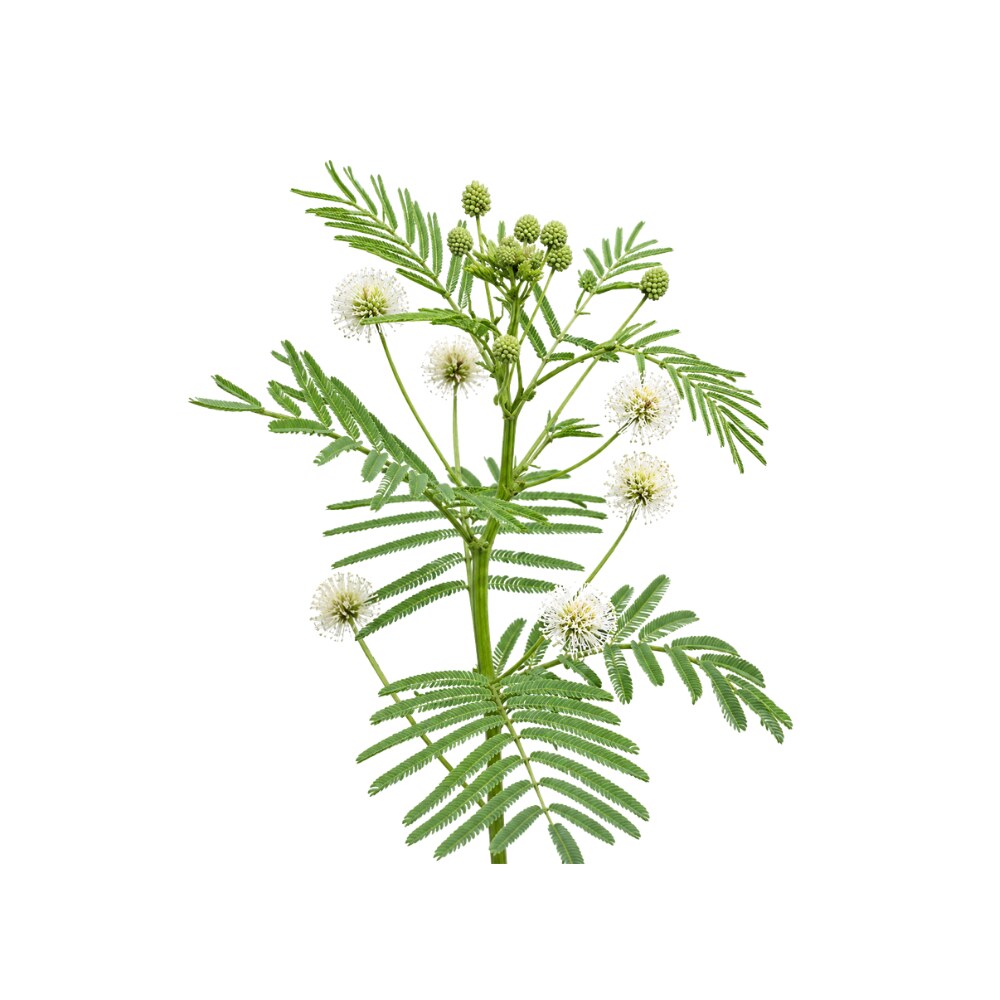
Desmanthus illinoensis is a perennial of the central and southern United States, 0.6–1.3 m tall, with feathery leaves, round white flower heads and clusters of flat, curved pods 16Reference 16Plant guide: Illinois bundleflower, Desmanthus illinoensisView study →. Native American peoples used it as a minor medicine and its seed pods as children’s rattles 16Reference 16Plant guide: Illinois bundleflower, Desmanthus illinoensisView study →.
Its root bark contains the hallucinogen N,N-DMT and related tryptamines 1Reference 1Indolealkylamines of Desmanthus illinoensis and their growth inhibition activityView study →. That has made the root bark a North American source of DMT for brews modelled on ayahuasca. Research on the plant itself covers its chemistry, not its effects in people.
How Is Bundleflower Used?
- Forage and range planting — sown in range seedings and revegetation projects, and for wildlife food and cover 16Reference 16Plant guide: Illinois bundleflower, Desmanthus illinoensisView study →.
- Grain crop research — studied at the Land Institute in Kansas as a possible human grain crop 16Reference 16Plant guide: Illinois bundleflower, Desmanthus illinoensisView study →.
- Leaf wash — the Pawnee boiled the leaves to make a wash for itching 16Reference 16Plant guide: Illinois bundleflower, Desmanthus illinoensisView study →.
- Root bark — used today as a DMT source, combined with a separate plant containing a monoamine-oxidase inhibitor.
Traditional Uses
Native American Use
Illinois bundleflower was a minor medicinal plant for Native Americans 16Reference 16Plant guide: Illinois bundleflower, Desmanthus illinoensisView study →. The Pawnee boiled the leaves to make a wash that relieved itching 16Reference 16Plant guide: Illinois bundleflower, Desmanthus illinoensisView study →.
The Omaha and Ponca called it rattle plant. Children used the dry pods, with the seeds rattling inside, as rattles while imitating the adults’ dances 16Reference 16Plant guide: Illinois bundleflower, Desmanthus illinoensisView study →.
Agricultural Use
Bundleflower is a nitrogen-fixing prairie legume with nutritious, protein-rich forage 16Reference 16Plant guide: Illinois bundleflower, Desmanthus illinoensisView study →. It is recommended for range seedings, wildlife food and cover, and is often used in range revegetation 16Reference 16Plant guide: Illinois bundleflower, Desmanthus illinoensisView study →.
It declines under heavy grazing, so ranchers use it as an indicator of range condition 16Reference 16Plant guide: Illinois bundleflower, Desmanthus illinoensisView study →.
Modern Entheogenic Use
In recent decades the root bark has been grown or collected in North America as a DMT source for brews modelled on ayahuasca. The bark is combined with a separate plant containing a monoamine-oxidase (MAO) inhibitor, which allows the DMT to act when swallowed 5Reference 5Pharmacokinetics of Hoasca alkaloids in healthy humansView study →.
Indications
- Itching [boiled leaf wash; Pawnee use]
Botany
Illinois bundleflower is a warm-season, herbaceous perennial legume in the pea family, Fabaceae 16Reference 16Plant guide: Illinois bundleflower, Desmanthus illinoensisView study →. Several stems grow each year from a woody base (caudex) on a perennial root system 16Reference 16Plant guide: Illinois bundleflower, Desmanthus illinoensisView study →. The stems are hairless, angled, grooved and upright, and the plant stands 0.6–1.3 m tall 16Reference 16Plant guide: Illinois bundleflower, Desmanthus illinoensisView study →.
The leaves are twice-divided into many small leaflets, arranged alternately on the stem 16Reference 16Plant guide: Illinois bundleflower, Desmanthus illinoensisView study →. Like those of the sensitive plant, the leaflets fold up when touched or in response to sunlight 16Reference 16Plant guide: Illinois bundleflower, Desmanthus illinoensisView study →.
The flowers are small, white and five-parted, packed into round heads on stalks that grow from the leaf axils 16Reference 16Plant guide: Illinois bundleflower, Desmanthus illinoensisView study →. Each head ripens into a cluster of flat, curved, slightly twisted dark brown pods, each holding two to several seeds 16Reference 16Plant guide: Illinois bundleflower, Desmanthus illinoensisView study →. The seeds are brown, 3–5 mm long, and ripen in August 16Reference 16Plant guide: Illinois bundleflower, Desmanthus illinoensisView study →.
Distribution
Illinois bundleflower is the most widespread Desmanthus in the United States 16Reference 16Plant guide: Illinois bundleflower, Desmanthus illinoensisView study →. It grows from South Dakota and Minnesota south through Colorado, New Mexico and Texas, and east to Ohio, Kentucky, Tennessee, the Carolinas and Florida 16Reference 16Plant guide: Illinois bundleflower, Desmanthus illinoensisView study →.
It grows on rocky, open wooded slopes, prairies, ravines, stream banks, roadsides and waste ground 16Reference 16Plant guide: Illinois bundleflower, Desmanthus illinoensisView study →. In the east it is most often found in prairie remnants, glades, sloughs and woodland edges; in the west, in moist alkaline bottoms, rocky open woods, grasslands and along streams 16Reference 16Plant guide: Illinois bundleflower, Desmanthus illinoensisView study →.
Growing Conditions
Cultivation snapshot for Bundleflower
- Easily grown from seed, which is sold commercially. Scarifying the seed improves germination 16Reference 16Plant guide: Illinois bundleflower, Desmanthus illinoensisView study →.
- Thrives in medium-textured soils and tolerates most soils except coarse sands and heavy clays. Soil acidity does not seem to matter 16Reference 16Plant guide: Illinois bundleflower, Desmanthus illinoensisView study →.
- Grows best with more than 50 cm of rain a year, though it has good drought tolerance where competition is light 16Reference 16Plant guide: Illinois bundleflower, Desmanthus illinoensisView study →.
- Grows less vigorously in shade, and tolerates burning while dormant fairly well 16Reference 16Plant guide: Illinois bundleflower, Desmanthus illinoensisView study →.
- Grows alongside native warm-season prairie grasses such as big bluestem, Indian grass, switchgrass and little bluestem 16Reference 16Plant guide: Illinois bundleflower, Desmanthus illinoensisView study →.
Grow it yourself
Farm Wiki is our cultivation-focused sister site, also run by Justin Cooke.
Pharmacology & Research
Research on bundleflower covers two subjects: the chemistry of its root bark, whose main alkaloid is N,N-dimethyltryptamine (DMT) 1Reference 1Indolealkylamines of Desmanthus illinoensis and their growth inhibition activityView study →, and the pharmacology of DMT and of ayahuasca-type brews made from DMT and an MAO inhibitor 3,
No clinical trial, animal study or efficacy study has tested any preparation of bundleflower.
The human DMT data come from purified DMT given intravenously 3,
- Best-supported: the root bark contains DMT and related tryptamines (N-methyltryptamine, minor hydroxylated tryptamines, plus the indole gramine), with content varying from undetectable to ~0.34% between plants 1Reference 1Indolealkylamines of Desmanthus illinoensis and their growth inhibition activityView study →.
- Emerging, worth watching: the therapeutic-depression signal for DMT/ayahuasca-type preparations — a treatment-resistant-depression RCT of ayahuasca 6Reference 6RCTRapid antidepressant effects of the psychedelic ayahuasca in treatment-resistant depression: a randomised placebo-controlled trialView study → and an observational study of an ayahuasca analogue 7Reference 7ObservationalTherapeutic effect of an ayahuasca analogue in clinically depressed patients: a longitudinal observational studyView study → — but neither used this plant.
- Mechanistically thin: any effect of bundleflower itself. All human data is for the isolated molecule or a brew; the plant has no efficacy study of its own.
Bundleflower is a source of DMT rather than a remedy. The bark does nothing on its own by mouth, the MAO-inhibitor combinations that make it active carry real risks 8Reference 8Ayahuasca preparations and serotonin reuptake inhibitors: a potential combination for severe adverse interactionsView study →, and DMT is a controlled substance in most countries.
1. Psychoactivity
The root bark of bundleflower contains the hallucinogen N,N-dimethyltryptamine. A chemical survey found DMT as the main alkaloid alongside N-methyltryptamine and minor hydroxylated tryptamines, with root-bark DMT ranging from undetectable to about 0.34% of dry weight 1Reference 1Indolealkylamines of Desmanthus illinoensis and their growth inhibition activityView study →.
In people, intravenous N,N-DMT at 0.05–0.4 mg/kg produced peak blood levels and effects within 2 minutes, which had faded by 30 minutes 3Reference 3Dose-response study of N,N-dimethyltryptamine in humansView study →. Hallucinogenic effects appeared at 0.2 and 0.4 mg/kg 4Reference 4Dose-response study of N,N-dimethyltryptamine in humansView study →. DMT raised blood pressure, heart rate, pupil size, body temperature, cortisol and prolactin in a dose-dependent way 3Reference 3Dose-response study of N,N-dimethyltryptamine in humansView study →. A 2026 study of intravenous DMT doses of 5–20 mg found effects peaked within 2 minutes and were gone within 12–30 minutes 13Reference 13Dose-dependent pharmacokinetics and acute effects of intravenous bolus N,N-dimethyltryptamineView study →.
In ayahuasca, the harmala alkaloids harmine and harmaline block the enzyme MAO-A, which allows the DMT in the brew to act when swallowed 5Reference 5Pharmacokinetics of Hoasca alkaloids in healthy humansView study →.
Gap: No study has tested Desmanthus illinoensis in people or animals. The human data are for purified DMT injected into a vein, and the bark’s alkaloid content varies widely 1Reference 1Indolealkylamines of Desmanthus illinoensis and their growth inhibition activityView study →.
2. Antidepressant / Mood
Ayahuasca-type brews combine DMT with an MAO inhibitor. In a randomised, placebo-controlled trial in 29 people with treatment-resistant depression, a single dose of ayahuasca lowered depression scores more than placebo at 1, 2 and 7 days 6Reference 6RCTRapid antidepressant effects of the psychedelic ayahuasca in treatment-resistant depression: a randomised placebo-controlled trialView study →. At day 7, 64% responded to ayahuasca against 27% to placebo 6Reference 6RCTRapid antidepressant effects of the psychedelic ayahuasca in treatment-resistant depression: a randomised placebo-controlled trialView study →.
In an observational study of 20 clinically depressed people who attended a ceremony using an ayahuasca analogue, depression scores fell from before the ceremony to 1 day, 1 month and 1 year afterwards 7Reference 7ObservationalTherapeutic effect of an ayahuasca analogue in clinically depressed patients: a longitudinal observational studyView study →. There was no control group 7Reference 7ObservationalTherapeutic effect of an ayahuasca analogue in clinically depressed patients: a longitudinal observational studyView study →.
DMT acts mainly on the serotonin 5-HT2A receptor 11Reference 11ReviewThe hallucinogenic world of tryptamines: an updated reviewView study →, and the harmala alkaloids of the companion plant block MAO-A 5Reference 5Pharmacokinetics of Hoasca alkaloids in healthy humansView study →. Bundleflower does not make the harmala alkaloids.
Gap: No antidepressant trial has used bundleflower. The evidence is for ayahuasca and an analogue brew, not for home-grown bark with variable alkaloid content.
Mechanisms
N,N-DMT is an agonist at the serotonin 5-HT2A receptor, which is how tryptamine hallucinogens produce their effects 11Reference 11ReviewThe hallucinogenic world of tryptamines: an updated reviewView study →. Swallowed DMT is broken down before it reaches the brain unless MAO-A is blocked, which in ayahuasca-type brews is done by the harmala alkaloids of a second plant 5Reference 5Pharmacokinetics of Hoasca alkaloids in healthy humansView study →.
Combining an MAO inhibitor with serotonergic drugs can cause serotonin syndrome 8Reference 8Ayahuasca preparations and serotonin reuptake inhibitors: a potential combination for severe adverse interactionsView study →.
| Mechanism | Drives | Key compounds |
|---|---|---|
| 5-HT2A receptor agonism | psychoactivityacute mood effects | N,N-DMT, N-methyltryptamine |
| MAO-A inhibition (from the companion plant, not Desmanthus) | oral activity of DMT | harmine, harmaline (not bundleflower constituents) |
| Serotonin excess when DMT is combined with an MAO inhibitor | serotonin-toxicity risk | N,N-DMT |
Clinical Trials
No clinical trial of Desmanthus illinoensis is registered. The human trials that exist test purified DMT or ayahuasca.
| Completed | Planned | Terminated | Preclinical |
|---|---|---|---|
| 0 | 0 | 0 | ~2(phytochemistry) |
Last checked: August 2026.
Phytochemistry
The root bark contains indole alkaloids. The main one is N,N-DMT, with N-methyltryptamine, the minor hydroxylated tryptamines N-hydroxy-N-methyltryptamine and 2-hydroxy-N-methyltryptamine, and gramine 1Reference 1Indolealkylamines of Desmanthus illinoensis and their growth inhibition activityView study →. A methanol extract of the roots slowed the growth of tomato and radish seedlings 1Reference 1Indolealkylamines of Desmanthus illinoensis and their growth inhibition activityView study →.
Alkaloid content varies widely between plants: root-bark DMT has been reported from undetectable to about 0.34% of dry weight 1Reference 1Indolealkylamines of Desmanthus illinoensis and their growth inhibition activityView study →.
The leaves contain a set of flavonoids 2Reference 2Flavonoids of Desmanthus illinoensisView study → and tannins, at about 63 g per kg of leaf dry matter 16Reference 16Plant guide: Illinois bundleflower, Desmanthus illinoensisView study →. The foliage and seeds are eaten as forage 16Reference 16Plant guide: Illinois bundleflower, Desmanthus illinoensisView study →.
Constituent Summary
Root-bark figures are % of dry weight and vary widely between plants.
Indole Alkaloids4 compounds2 with data
Dosage
No dose of bundleflower has been studied. The figures below are for purified DMT and for ayahuasca, not for this plant.
| Indication | Preparation | Dose | Source |
|---|---|---|---|
| Psychoactivity | Purified N,N-DMT, intravenous (not this plant) | 0.05–0.4 mg/kg IV | 3, |
| Antidepressant / mood | Ayahuasca brew or analogue (not this plant) | Single ceremonial dose | 6, |
Safety & Pregnancy
The safety of bundleflower root bark is the safety of DMT and of the ayahuasca-type brews it is used to make.
- The MAO-inhibitor combination is the main danger. It can cause serotonin syndrome with SSRI antidepressants and other serotonergic drugs 8Reference 8Ayahuasca preparations and serotonin reuptake inhibitors: a potential combination for severe adverse interactionsView study →.
- Deaths are on record. Five deaths after DMT use have been reported, two during ayahuasca ceremonies and two involving several other drugs 9Reference 9Case reportFatalities following DMT use: two case reports and a review of the literatureView study →.
- The dose cannot be known. Root-bark DMT ranges from undetectable to about 0.34% of dry weight 1Reference 1Indolealkylamines of Desmanthus illinoensis and their growth inhibition activityView study →.
- Legally controlled. DMT is a controlled substance in most countries.
- Purified DMT is short-acting. In controlled intravenous studies it caused brief rises in blood pressure, heart rate and stress hormones that faded within about 30 minutes 3Reference 3Dose-response study of N,N-dimethyltryptamine in humansView study →.
Full Safety Detail
The MAO-inhibitor combination. Harmala alkaloids in ayahuasca are MAO inhibitors, and combined with SSRI antidepressants they may cause serotonin syndrome, which can be severe 8Reference 8Ayahuasca preparations and serotonin reuptake inhibitors: a potential combination for severe adverse interactionsView study →. MAO inhibitors can also interact with other serotonergic drugs and with tyramine-rich foods.
Purified DMT. In controlled studies, intravenous DMT was given safely to experienced hallucinogen users. It raised blood pressure, heart rate, pupil size, cortisol and prolactin for a short time 3,
Deaths. A 2025 review found three earlier reports of deaths after DMT use, two of them during ayahuasca ceremonies, all judged accidental 9Reference 9Case reportFatalities following DMT use: two case reports and a review of the literatureView study →. It added two UK deaths in which DMT was taken with several other drugs, including cocaine, amphetamine or antidepressants that raise serotonin; serotonin syndrome may have caused them 9Reference 9Case reportFatalities following DMT use: two case reports and a review of the literatureView study →.
Variable content. Root-bark alkaloid content varies widely, so any dose of the bark is unpredictable 1Reference 1Indolealkylamines of Desmanthus illinoensis and their growth inhibition activityView study →. Reviews of recreational tryptamine use cover the wider picture for this class 10,
Repeated use. Rats given ayahuasca daily for 28 days showed no clinical, blood or organ signs of toxicity, but had changes in brain serotonin, dopamine turnover and BDNF 14Reference 14AnimalToxicity of ayahuasca after 28 days daily exposure and effects on monoamines and BDNF in brain of Wistar ratsView study →.
Interactions. No drug-metabolism (CYP450) interaction has been shown for bundleflower. The known interaction comes from the MAO-A inhibition supplied by the companion plant.
Avoid. There are no pregnancy or breastfeeding data for bundleflower. In pregnant rats, ayahuasca at four and eight times the ritual dose killed 44–52% of the mothers, and at lower doses it increased embryo deaths and foetal abnormalities 15Reference 15AnimalMaternal and developmental toxicity of the hallucinogenic plant-based beverage ayahuasca in ratsView study →. That study used the brew, not this plant.
References
- Thompson, A. C., Nicollier, G. F., & Pope, D. H. (1987). Indolealkylamines of Desmanthus illinoensis and their growth inhibition activity. Journal of Agricultural and Food Chemistry, 35(3), 361–365. https://doi.org/10.1021/jf00075a020
- Nicollier, G. F., & Thompson, A. C. (1983). Flavonoids of Desmanthus illinoensis. Journal of Natural Products, 46(1), 112–117. https://doi.org/10.1021/np50025a011
- Strassman, R. J., & Qualls, C. R. (1994). Dose-response study of N,N-dimethyltryptamine in humans. I. Neuroendocrine, autonomic, and cardiovascular effects. Archives of General Psychiatry. https://pubmed.ncbi.nlm.nih.gov/8297216/
- Strassman, R. J., Qualls, C. R., Uhlenhuth, E. H., & Kellner, R. (1994). Dose-response study of N,N-dimethyltryptamine in humans. II. Subjective effects. Archives of General Psychiatry. https://pubmed.ncbi.nlm.nih.gov/8297217/
- Callaway, J. C., McKenna, D. J., Grob, C. S., et al. (1999). Pharmacokinetics of Hoasca alkaloids in healthy humans. Journal of Ethnopharmacology. https://pubmed.ncbi.nlm.nih.gov/10404423/
- Palhano-Fontes, F., Barreto, D., Onias, H., et al. (2019). Rapid antidepressant effects of the psychedelic ayahuasca in treatment-resistant depression: a randomised placebo-controlled trial. Psychological Medicine. https://pubmed.ncbi.nlm.nih.gov/29903051/
- van Oorsouw, K., Toennes, S. W., & Ramaekers, J. G. (2022). Therapeutic effect of an ayahuasca analogue in clinically depressed patients: a longitudinal observational study. Psychopharmacology. https://pubmed.ncbi.nlm.nih.gov/35072760/
- Callaway, J. C., & Grob, C. S. (1998). Ayahuasca preparations and serotonin reuptake inhibitors: a potential combination for severe adverse interactions. Journal of Psychoactive Drugs. https://pubmed.ncbi.nlm.nih.gov/9924842/
- Pullen, J., Moore, R., Wood, R., et al. (2025). Fatalities following DMT use: two case reports and a review of the literature. Journal of Analytical Toxicology. https://pubmed.ncbi.nlm.nih.gov/40632616/
- Tittarelli, R., Mannocchi, G., Pantano, F., & Romolo, F. S. (2015). Recreational use, analysis and toxicity of tryptamines. Current Neuropharmacology. https://pubmed.ncbi.nlm.nih.gov/26074742/
- Araújo, A. M., Carvalho, F., Bastos, M. L., et al. (2015). The hallucinogenic world of tryptamines: an updated review. Archives of Toxicology. https://pubmed.ncbi.nlm.nih.gov/25877327/
- McKenna, D., & Riba, J. (2018). New World tryptamine hallucinogens and the neuroscience of ayahuasca. Current Topics in Behavioral Neurosciences. https://pubmed.ncbi.nlm.nih.gov/28401525/
- Erne, L., Mueller, L., Straumann, I., et al. (2026). Dose-dependent pharmacokinetics and acute effects of intravenous bolus N,N-dimethyltryptamine. Translational Psychiatry. https://pubmed.ncbi.nlm.nih.gov/41896202/
- Colaço, C. S., Alves, S. S., Nolli, L. M., et al. (2020). Toxicity of ayahuasca after 28 days daily exposure and effects on monoamines and BDNF in brain of Wistar rats. Metabolic Brain Disease. https://pubmed.ncbi.nlm.nih.gov/32103409/
- da Motta, L. G., de Morais, J. A., Tavares, A. C. A. M., et al. (2018). Maternal and developmental toxicity of the hallucinogenic plant-based beverage ayahuasca in rats. Reproductive Toxicology. https://pubmed.ncbi.nlm.nih.gov/29522798/
- Wynia, R. (2008). Plant guide: Illinois bundleflower, Desmanthus illinoensis. USDA Natural Resources Conservation Service, Manhattan Plant Materials Center, Kansas. https://plants.usda.gov/DocumentLibrary/plantguide/pdf/pg_deil.pdf



