
Materia Medica
Tobacco
Nicotiana tabacum
Tobacco is a large-leaved plant of the nightshade family, grown worldwide for its nicotine-rich leaves, which are smoked, chewed and taken as snuff. Nicotine makes it strongly addictive, and tobacco use is a leading cause of cancer, heart disease and lung disease.
What Is Tobacco?
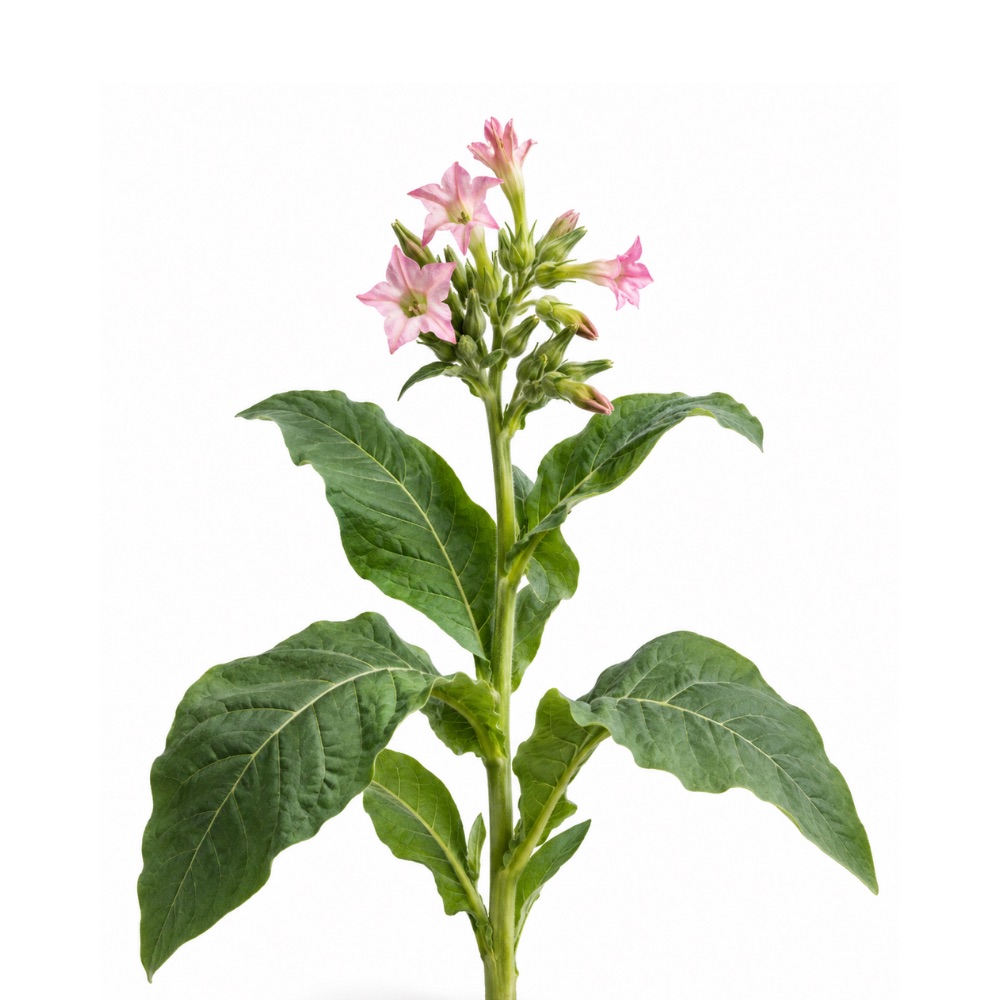
Tobacco is a tall, sticky-leaved plant of the nightshade family, grown for its leaves, which are rich in the alkaloid nicotine. Nicotiana tabacum is the tobacco of commerce, dried and cured for smoking, chewing and snuff 31Reference 31Knapp, S. (n.d.). Nicotiana tabacum Linnaeus — species description, habitat and distribution — flora. In Flora of North America Editorial Committee (eds.), Flora of North America North of Mexico, Vol. 14 (Solanaceae). http://www.efloras.org/florataxon.aspx?flora_id=1&taxon_id=200020550View study →.
It is native to South America and is now cultivated almost worldwide 31Reference 31Knapp, S. (n.d.). Nicotiana tabacum Linnaeus — species description, habitat and distribution — flora. In Flora of North America Editorial Committee (eds.), Flora of North America North of Mexico, Vol. 14 (Solanaceae). http://www.efloras.org/florataxon.aspx?flora_id=1&taxon_id=200020550View study →. In North America it replaced Nicotiana rustica as the main cultivated tobacco in the early 1600s 31Reference 31Knapp, S. (n.d.). Nicotiana tabacum Linnaeus — species description, habitat and distribution — flora. In Flora of North America Editorial Committee (eds.), Flora of North America North of Mexico, Vol. 14 (Solanaceae). http://www.efloras.org/florataxon.aspx?flora_id=1&taxon_id=200020550View study →.
Nicotine makes up about 90–95% of the leaf’s alkaloids 30Reference 30Variations of alkaloid accumulation and gene transcription in Nicotiana tabacum — plant chemistry (three varieties, five developmental stages)View study →. Nicotine alone, given by patch or gum, has been tested in trials for ulcerative colitis, mild cognitive impairment and Parkinson’s disease 5,
Nicotiana rustica, called mapacho or Aztec tobacco, is a separate species with more nicotine in its leaf. It is the tobacco of South American ceremony.
How Is Tobacco Used?
- Smoked — as cigarettes, cigars, pipe tobacco and in waterpipes.
- Smokeless — chewed, held in the mouth or taken as snuff, including regional products such as naswar 22Reference 22Meta-analysisNaswar (smokeless tobacco) use and the risk of oral cancer in Pakistan — systematic review with meta-analysisView study →.
- Insecticide — in China the plant is also used to kill insects 32Reference 32Nicotiana tabacum Linnaeus — species description, distribution and uses — floraView study →.
- Ceremonial — in Indigenous American traditions, though the strong ceremonial preparations mostly use mapacho.
Traditional Uses
Indigenous American Ceremonial Use
In Indigenous American traditions tobacco is a sacred plant. The leaf is used in prayer, in offering and in healing work.
The concentrated ceremonial preparations, such as strong infusions, rapé snuff and tobacco enemas, mostly use mapacho (N. rustica) rather than this species.
Chinese Folk Medicine
In China, where tobacco is widely cultivated, the plant has been used medicinally as an anaesthetic, to induce sweating and to induce vomiting 32Reference 32Nicotiana tabacum Linnaeus — species description, distribution and uses — floraView study →.
Commercial & Recreational Use
N. tabacum became the principal tobacco of commerce, and it was the mainstay of the economy of the Chesapeake Bay region in colonial times 31Reference 31Knapp, S. (n.d.). Nicotiana tabacum Linnaeus — species description, habitat and distribution — flora. In Flora of North America Editorial Committee (eds.), Flora of North America North of Mexico, Vol. 14 (Solanaceae). http://www.efloras.org/florataxon.aspx?flora_id=1&taxon_id=200020550View study →. Its spread as a crop created the everyday use that now defines it: smoked, chewed or snuffed many times a day as a stimulant.
Botany
Tobacco is a soft-wooded herb or shrub in the nightshade family (Solanaceae) 31Reference 31Knapp, S. (n.d.). Nicotiana tabacum Linnaeus — species description, habitat and distribution — flora. In Flora of North America Editorial Committee (eds.), Flora of North America North of Mexico, Vol. 14 (Solanaceae). http://www.efloras.org/florataxon.aspx?flora_id=1&taxon_id=200020550View study →, the family of tomato, potato, chilli and datura. It is grown as an annual or lives for a few years, and its single, usually unbranched stem reaches 1–3 m 31,
The whole plant is covered in sticky glandular hairs 31,
The flowers open by day in large branched clusters. Each is a slender tube 3–5 cm long, pale greenish cream to pink or red, opening to a five-pointed face 2–3 cm across in pale to reddish pink or occasionally white 31Reference 31Knapp, S. (n.d.). Nicotiana tabacum Linnaeus — species description, habitat and distribution — flora. In Flora of North America Editorial Committee (eds.), Flora of North America North of Mexico, Vol. 14 (Solanaceae). http://www.efloras.org/florataxon.aspx?flora_id=1&taxon_id=200020550View study →. The fruit is an oval capsule 1.2–2 cm long, holding tiny seeds about 0.5 mm across 31Reference 31Knapp, S. (n.d.). Nicotiana tabacum Linnaeus — species description, habitat and distribution — flora. In Flora of North America Editorial Committee (eds.), Flora of North America North of Mexico, Vol. 14 (Solanaceae). http://www.efloras.org/florataxon.aspx?flora_id=1&taxon_id=200020550View study →.
The fresh leaf is handled with care. Harvesters who handle wet leaves absorb dissolved nicotine through the skin, which causes green tobacco sickness 24Reference 24ObservationalGreen tobacco sickness in tobacco harvesters — Kentucky, 1992 — observational field reportView study →.
Distribution
Tobacco is native to South America and is cultivated almost worldwide 31Reference 31Knapp, S. (n.d.). Nicotiana tabacum Linnaeus — species description, habitat and distribution — flora. In Flora of North America Editorial Committee (eds.), Flora of North America North of Mexico, Vol. 14 (Solanaceae). http://www.efloras.org/florataxon.aspx?flora_id=1&taxon_id=200020550View study →. It is widely grown throughout China 32Reference 32Nicotiana tabacum Linnaeus — species description, distribution and uses — floraView study →.
In North America it occasionally escapes from cultivation, growing as a short-lived weed of disturbed ground and field edges where the climate is mild, from sea level to 1,000 m 31Reference 31Knapp, S. (n.d.). Nicotiana tabacum Linnaeus — species description, habitat and distribution — flora. In Flora of North America Editorial Committee (eds.), Flora of North America North of Mexico, Vol. 14 (Solanaceae). http://www.efloras.org/florataxon.aspx?flora_id=1&taxon_id=200020550View study →. Plants left standing at the edges of commercial fields can be mistaken for naturalised weeds 31Reference 31Knapp, S. (n.d.). Nicotiana tabacum Linnaeus — species description, habitat and distribution — flora. In Flora of North America Editorial Committee (eds.), Flora of North America North of Mexico, Vol. 14 (Solanaceae). http://www.efloras.org/florataxon.aspx?flora_id=1&taxon_id=200020550View study →.
Growing Conditions
Cultivation snapshot for Tobacco
- Warmth-loving and frost-tender — grown as a summer annual, needing a long, warm, frost-free season to ripen its leaves.
- Full sun.
- Rich, deep, well-drained soil suits it; the plant is a hungry feeder with a strong taproot.
- Started from the tiny, dust-fine seed sown on the surface and transplanted out once warm.
Grow it yourself
Farm Wiki is our cultivation-focused sister site, also run by Justin Cooke.
Phytochemistry
Tobacco leaf contains pyridine alkaloids. In a study of three commercial varieties at five stages of growth, total alkaloids ranged from about 0.6% to 4.2% of leaf dry weight. Nicotine made up about 94% of them, anatabine about 4% and nornicotine under 2%, with anabasine present only in traces 30Reference 30Variations of alkaloid accumulation and gene transcription in Nicotiana tabacum — plant chemistry (three varieties, five developmental stages)View study →.
Nornicotine is made in the leaf by enzymes that remove a methyl group from nicotine. The mix of its two mirror-image forms varies widely between plants, and this is explained by how selectively those enzymes act 1Reference 1Enantioselective demethylation of nicotine as a mechanism for variable nornicotine composition in tobacco leafView study →.
The minor alkaloids have effects of their own. In rodents, nornicotine, anabasine and anatabine each substituted for nicotine in a drug-discrimination test. Only nornicotine was self-administered like nicotine, and all three lowered nicotine self-administration when given beforehand 27Reference 27AnimalNicotine-like behavioral effects of the minor tobacco alkaloids nornicotine, anabasine, and anatabine — animal model (rodents)View study →. Anabasine and anatabine are absent from nicotine-replacement products, so they are used as urine markers of continued tobacco use during nicotine-replacement therapy 28Reference 28ObservationalAnabasine and anatabine as biomarkers for tobacco use during nicotine replacement therapy — observationalView study →.
Tobacco smoke also contains the β-carbolines harman and norharman, which are potent, reversible inhibitors of monoamine oxidase (MAO) 26Reference 26In vitroHuman monoamine oxidase is inhibited by tobacco smoke: β-carboline alkaloids act as potent and reversible inhibitors — in vitroView study →. Together they are estimated to account for less than 10% of the MAO-A inhibition produced by cigarette smoke 25Reference 25ReviewA review of monoamine oxidase (MAO) inhibitors in tobacco or tobacco smoke — reviewView study →.
Constituent Summary
Figures are from the leaves of three Chinese commercial varieties sampled across five stages of growth. Alkaloid content varies widely with variety, leaf position and stage 30Reference 30Variations of alkaloid accumulation and gene transcription in Nicotiana tabacum — plant chemistry (three varieties, five developmental stages)View study →.
Other Alkaloids4 compounds4 with data
Pharmacology & Research
Research on tobacco falls into two bodies of work. The larger is the epidemiology of harm: cigarettes, cured leaf and smokeless tobacco as causes of cancer, cardiovascular disease and lung disease 19,
About ten completed human trials have tested transdermal or nasal nicotine in ulcerative colitis, mild cognitive impairment and Parkinson’s disease. Their results are mixed, and none has led to an approved use 5,
-
Best-supported: nicotine is a nicotinic-receptor stimulant and reinforcer with well-mapped human pharmacology 2,
3, , and it improved attention and memory test scores in a 6-month trial in mild cognitive impairment 5Reference 5RCTNicotine treatment of mild cognitive impairment: a 6-month double-blind pilot clinical trial — randomised, placebo-controlled (Class I)View study →.4Reference 2ReviewNicotine chemistry, metabolism, kinetics and biomarkers — reviewView study →Reference 3ReviewNicotine addiction: more than just dopamine — reviewView study →Reference 4ReviewDual role of nicotine in addiction and cognition: a review of neuroimaging studies in humans — reviewView study → -
Emerging, worth watching: transdermal nicotine improved active ulcerative colitis in one randomised trial 8Reference 8RCTTransdermal nicotine for mildly to moderately active ulcerative colitis — randomised, double-blind, placebo-controlled trialView study →, and smoking is consistently linked with a lower risk of Parkinson’s disease 13,
14Reference 13Meta-analysisAssociation between cigarette smoking and Parkinson’s disease — meta-analysisView study →Reference 14Meta-analysisAssociation between Parkinson’s disease and cigarette smoking, rural living, well-water consumption, farming and pesticide use — systematic review and meta-analysisView study → . - Mechanistically thin / contradicted: nicotine did not slow early Parkinson’s disease in a year-long trial 15Reference 15RCTTransdermal nicotine treatment and progression of early Parkinson’s disease — randomised, double-blind, placebo-controlled trialView study →; in ulcerative colitis, one meta-analysis found no benefit for inducing remission 11Reference 11Meta-analysisEfficacy and tolerability of nicotine preparations in active ulcerative colitis — systematic review and meta-analysisView study → while a Cochrane review found benefit over placebo but none over standard treatment 12Reference 12Systematic reviewTransdermal nicotine for induction of remission in ulcerative colitis — Cochrane systematic reviewView study →.
-
The caveat: every scored effect comes from isolated nicotine, not the smoked or chewed plant. Tobacco has no therapeutic dose, and its ordinary uses cause serious, well-established harm 19,
20, .21, 22, 23Reference 19Meta-analysisLow cigarette consumption and risk of coronary heart disease and stroke: meta-analysis of 141 cohort studies — meta-analysis of cohort studiesView study →Reference 20Meta-analysisCigarette smoking reduction and health risks — systematic review and meta-analysisView study →Reference 21Meta-analysisSmokeless tobacco use and waterpipe smoking and the risk of lung cancer — systematic review and meta-analysisView study →Reference 22Meta-analysisNaswar (smokeless tobacco) use and the risk of oral cancer in Pakistan — systematic review with meta-analysisView study →Reference 23Meta-analysisMaternal smoking status during pregnancy and low birth weight in offspring: meta-analysis of 55 cohort studies — meta-analysis of cohort studiesView study →
None of these trials used tobacco. Every therapeutic result on this page comes from controlled doses of isolated nicotine, by patch, gum or nasal spray, and says nothing about smoking, chewing or snuffing the leaf.
1. Stimulant & Reinforcement
Tobacco’s main activity is the pharmacology of nicotine, and the human evidence for it is extensive. Nicotine is an agonist at nicotinic acetylcholine receptors. Its action in the brain’s reward pathway drives dopamine release, producing arousal, mild euphoria and strong reinforcement, and it makes nicotine one of the most dependence-forming substances in common use 2,
This pharmacology belongs to the molecule and applies equally to N. tabacum and N. rustica.
Dependence is part of the same reward pharmacology, not a separate effect. No medical use exists for tobacco as a stimulant.
2. Cognitive Enhancement
Nicotine’s effect on cognition is the most credible therapeutic signal linked to this plant’s chemistry. In a 6-month double-blind trial in 74 non-smokers with amnestic mild cognitive impairment, 15 mg/day of transdermal nicotine improved the primary attention measure and secondary measures of attention, memory and psychomotor speed 5Reference 5RCTNicotine treatment of mild cognitive impairment: a 6-month double-blind pilot clinical trial — randomised, placebo-controlled (Class I)View study →. It did not change the clinician-rated global impression, and the authors graded it as Class I evidence for improved test performance, not for a clinical benefit 5Reference 5RCTNicotine treatment of mild cognitive impairment: a 6-month double-blind pilot clinical trial — randomised, placebo-controlled (Class I)View study →.
Human brain-imaging studies link nicotine’s effects to cholinergic attention networks 4Reference 4ReviewDual role of nicotine in addiction and cognition: a review of neuroimaging studies in humans — reviewView study →.
In Alzheimer’s disease, a Cochrane review found no trials suitable for inclusion and could not support nicotine as a treatment 7Reference 7Systematic reviewNicotine for Alzheimer’s disease — Cochrane systematic reviewView study →.
Each of these results used controlled doses of isolated nicotine, not tobacco.
Gap: the evidence is one small, 6-month trial with test-score outcomes; the one clinical measure it used showed no effect, and there is no evidence the plant confers any of this.
3. Ulcerative Colitis
Ulcerative colitis is mainly a disease of non-smokers, and this led to several randomised trials of transdermal nicotine. In mildly to moderately active disease, 12 of 31 patients (39%) on nicotine (11 mg for a week, then up to 22 mg a day) improved at 4 weeks, against 3 of 33 (9%) on placebo 8Reference 8RCTTransdermal nicotine for mildly to moderately active ulcerative colitis — randomised, double-blind, placebo-controlled trialView study →.
Nicotine did not maintain remission better than placebo 9Reference 9RCTTransdermal nicotine as maintenance therapy for ulcerative colitis — randomised, double-blind trialView study →, and in active disease it was less effective than 15 mg of oral prednisolone and caused more side effects 10Reference 10RCTTransdermal nicotine compared with oral prednisolone therapy for active ulcerative colitis — randomised, double-blind trialView study →.
The reviews disagree. A 2004 Cochrane review pooled two placebo-controlled trials and found nicotine better than placebo for inducing remission (19 of 71 against 9 of 70), with no advantage over standard treatment and more withdrawals because of side effects 12Reference 12Systematic reviewTransdermal nicotine for induction of remission in ulcerative colitis — Cochrane systematic reviewView study →. A 2010 meta-analysis of three placebo-controlled trials found no significant benefit for remission (relative risk 1.40, 95% CI 0.63–3.12) and more adverse events 11Reference 11Meta-analysisEfficacy and tolerability of nicotine preparations in active ulcerative colitis — systematic review and meta-analysisView study →.
These trials all used a nicotine patch, not tobacco.
Gap: the benefit, where found, is modest and comes with more side effects, and nicotine is not part of standard ulcerative colitis care.
4. Parkinsonian Neuroprotection
Observational studies consistently find less Parkinson’s disease in smokers. A meta-analysis of 69 studies put the risk in ever-smokers at 0.59 of that in never-smokers (95% CI 0.56–0.62) 13Reference 13Meta-analysisAssociation between cigarette smoking and Parkinson’s disease — meta-analysisView study →. The association is consistent enough to serve as a “positive control” in studies of Parkinson’s risk factors 14Reference 14Meta-analysisAssociation between Parkinson’s disease and cigarette smoking, rural living, well-water consumption, farming and pesticide use — systematic review and meta-analysisView study →.
In cell and animal models, nicotine acting at α7 nicotinic receptors protects neurons against toxins, including rotenone, which is used to model Parkinson’s disease 17,
When the treatment was tested directly, it failed. In a double-blind, placebo-controlled trial of 163 people with early, untreated Parkinson’s disease, a year of transdermal nicotine did not slow progression 15Reference 15RCTTransdermal nicotine treatment and progression of early Parkinson’s disease — randomised, double-blind, placebo-controlled trialView study →. The nicotine group worsened slightly more than placebo on the UPDRS, a difference that fell short of significance on the primary endpoint 15Reference 15RCTTransdermal nicotine treatment and progression of early Parkinson’s disease — randomised, double-blind, placebo-controlled trialView study →. An earlier open-label study with blinded scoring found no motor benefit at doses up to 90 mg a day 16Reference 16RCTHigh-dose transdermal nicotine in Parkinson’s disease patients — randomised, open-label, blinded-endpoint phase 2 studyView study →.
A 2025 review concluded that neither smoking nor nicotine is recommended to prevent or treat Parkinson’s disease 17Reference 17ReviewProposed mechanisms of neuroprotection for nicotine in Parkinson’s disease — reviewView study →.
Gap: the epidemiology is strong but observational; the one adequately powered interventional trial was negative, so there is no basis for using nicotine — let alone tobacco — to prevent or treat Parkinson’s disease.
Mechanisms
Nicotine is an agonist at nicotinic acetylcholine receptors. Studies have traced its effects in different tissues to this one receptor family: dopamine release in the reward pathway, cholinergic attention signalling, an α7-receptor anti-inflammatory effect in the colon, and nerve protection in animal models.
A separate line of work concerns the β-carbolines harman and norharman in tobacco smoke, which reversibly inhibit monoamine oxidase 25,
| Mechanism | Drives | Key compounds |
|---|---|---|
| nAChR (α4β2) agonism → striatal dopamine release | stimulant/arousalreinforcementdependence | nicotine |
| nAChR-mediated cognitive/cholinergic signalling | attention & memory enhancement | nicotine |
| α7-nAChR cholinergic anti-inflammatory effect | ulcerative colitis (colonic mucosa) | nicotine |
| nAChR-mediated neuroprotection (α7) | Parkinsonian neuroprotection (preclinical only) | nicotine |
| Reversible MAO-A/B inhibition | may add to reward pharmacology | harman, norharman |
| Hepatic metabolism (CYP2A6, UGT, FMO) → cotinine | pharmacokinetics; dependence variability | nicotine, cotinine |
Clinical Trials
The registered therapeutic trials, other than smoking-cessation trials, all test the isolated molecule: small studies of transdermal or nasal nicotine in mild cognitive impairment and Parkinson’s disease, plus the older ulcerative-colitis trials. The main Parkinson’s trial was negative 15Reference 15RCTTransdermal nicotine treatment and progression of early Parkinson’s disease — randomised, double-blind, placebo-controlled trialView study →.
| Completed | Planned | Terminated | Preclinical |
|---|---|---|---|
| ~10(isolated nicotine) | ~1 | 0 | many(disease-burden epidemiology dominates) |
Last checked: August 2026.
Dosage
Tobacco has no therapeutic dose. Nicotine is a potent poison with a narrow margin between a psychoactive and a toxic amount, and smoking, snuff and oral tobacco are well-documented causes of cancer and cardiovascular disease 19,
Ceremonial preparations used in some Indigenous traditions, such as strong infusions, rapé and tobacco enemas, mostly use mapacho. They are far more concentrated than commercial tobacco and have caused fatal poisonings outside their traditional context.
Safety & Pregnancy
Tobacco is highly addictive and toxic. Nicotine is a potent poison, and long-term smoking is a leading cause of cancer and cardiovascular disease.
- Potent poison. Concentrated preparations or ingested leaf can cause severe, sometimes fatal poisoning.
- Highly addictive. Nicotine is strongly reinforcing and dependence-forming.
- Smoking causes disease. A leading cause of cancer, heart disease, stroke and chronic lung disease; there is no safe level.
- Ceremonial doses dangerous. Strong preparations risk acute nicotine toxicity — approach only, if at all, with experienced guidance.
- ★ Absorbed through skin — handling wet leaf is hazardous. Green tobacco sickness is an acute nicotine poisoning of harvesters, from skin absorption alone 24Reference 24ObservationalGreen tobacco sickness in tobacco harvesters — Kentucky, 1992 — observational field reportView study →.
- Risk remains even at very low daily consumption. One cigarette a day carries about half the excess heart-disease and stroke risk of twenty 19Reference 19Meta-analysisLow cigarette consumption and risk of coronary heart disease and stroke: meta-analysis of 141 cohort studies — meta-analysis of cohort studiesView study →.
- Harms pregnancy. Maternal smoking is strongly linked to low birth weight, and the risk rises with the number of cigarettes smoked 23Reference 23Meta-analysisMaternal smoking status during pregnancy and low birth weight in offspring: meta-analysis of 55 cohort studies — meta-analysis of cohort studiesView study →.
Full Safety Detail
Acute poisoning. Nicotine is a potent poison. Concentrated preparations or swallowed leaf can cause severe poisoning, with nausea, vomiting, sweating, a racing or irregular heartbeat, seizures and, in extreme cases, death.
Green tobacco sickness. Nicotine dissolved from wet tobacco leaves is absorbed through the skin. In harvesters this causes green tobacco sickness, with nausea, vomiting, weakness, dizziness and sometimes swings in blood pressure or heart rate 24Reference 24ObservationalGreen tobacco sickness in tobacco harvesters — Kentucky, 1992 — observational field reportView study →. Anyone growing or processing the plant should keep wet leaves off bare skin.
Long-term harm. Smoking, cured-leaf and smokeless use are among the best-established causes of cancer, coronary heart disease, stroke and chronic lung disease. The excess risk is present even at very low daily consumption: one cigarette a day carries about half the excess risk of coronary heart disease and stroke of twenty a day 19Reference 19Meta-analysisLow cigarette consumption and risk of coronary heart disease and stroke: meta-analysis of 141 cohort studies — meta-analysis of cohort studiesView study →. Cutting down lowers lung cancer risk, but the risk stays high, and quitting is the most effective step 20Reference 20Meta-analysisCigarette smoking reduction and health risks — systematic review and meta-analysisView study →.
Smokeless and waterpipe tobacco. Smokeless tobacco and waterpipe smoking both raise the risk of lung cancer 21Reference 21Meta-analysisSmokeless tobacco use and waterpipe smoking and the risk of lung cancer — systematic review and meta-analysisView study →. Naswar, a smokeless tobacco used in Pakistan, is strongly linked to oral cancer 22Reference 22Meta-analysisNaswar (smokeless tobacco) use and the risk of oral cancer in Pakistan — systematic review with meta-analysisView study →.
After a first cancer. Smoking is linked to a higher risk of a second primary cancer in cancer survivors 29Reference 29Meta-analysisCigarette smoking and risk of second primary cancer — systematic review and meta-analysisView study →.
Interactions. Nicotine is metabolised mainly by the liver enzyme CYP2A6, and its metabolism is affected by other medications, pregnancy and kidney disease 2Reference 2ReviewNicotine chemistry, metabolism, kinetics and biomarkers — reviewView study →.
Tobacco smoke, through its polycyclic aromatic hydrocarbons rather than nicotine, induces the liver enzyme CYP1A2 and speeds the clearance of drugs such as theophylline, caffeine, imipramine, haloperidol and propranolol 33Reference 33ReviewDrug interactions with tobacco smokingView study →. Smokeless tobacco does not appear to do this: in snuff and chewing-tobacco users who did not smoke, theophylline was cleared at the same rate as in non-smokers 34Reference 34Clinical pharmacokinetics of theophylline and levels of alpha 1-acid glycoprotein in smokeless tobacco usersView study →.
Avoid. Maternal smoking in pregnancy is strongly linked to low birth weight, with the risk rising with the number of cigarettes smoked and the length of smoking in pregnancy, in a meta-analysis of 55 studies 23Reference 23Meta-analysisMaternal smoking status during pregnancy and low birth weight in offspring: meta-analysis of 55 cohort studies — meta-analysis of cohort studiesView study →. Nicotine crosses the placenta and passes into breast milk.
No trial has looked at tobacco use while breastfeeding. Given nicotine’s toxicity and its transfer into milk, avoid it.
References
- Cai B, Siminszky B, Chappell J, et al. (2012). Enantioselective demethylation of nicotine as a mechanism for variable nornicotine composition in tobacco leaf. J Biol Chem. https://pubmed.ncbi.nlm.nih.gov/23100254/
- Benowitz NL, Hukkanen J, Jacob P. (2009). Nicotine chemistry, metabolism, kinetics and biomarkers — review. Handbook of Experimental Pharmacology. https://doi.org/10.1007/978-3-540-69248-5_2 https://pubmed.ncbi.nlm.nih.gov/19184645/
- Kim K, Picciotto MR (2023). Nicotine addiction: more than just dopamine — review. Current Opinion in Neurobiology. https://doi.org/10.1016/j.conb.2023.102797
- Jasinska AJ, Zorick T, Brody AL, Stein EA. (2013). Dual role of nicotine in addiction and cognition: a review of neuroimaging studies in humans — review. Neuropharmacology. https://doi.org/10.1016/j.neuropharm.2013.02.015
- Newhouse P, et al. (2012). Nicotine treatment of mild cognitive impairment: a 6-month double-blind pilot clinical trial — randomised, placebo-controlled (Class I). Neurology. https://doi.org/10.1212/WNL.0b013e31823efcbb
- Fond G, et al. (2015). Innovative mechanisms of action for pharmaceutical cognitive enhancement: a systematic review — systematic review of RCTs. Psychiatry Research. https://doi.org/10.1016/j.psychres.2015.07.006
- López-Arrieta JM, Rodríguez JL, Sanz F. (2000). Nicotine for Alzheimer’s disease — Cochrane systematic review. Cochrane Database of Systematic Reviews. https://doi.org/10.1002/14651858.CD001749
- Sandborn WJ, et al. (1997). Transdermal nicotine for mildly to moderately active ulcerative colitis — randomised, double-blind, placebo-controlled trial. Annals of Internal Medicine. https://doi.org/10.7326/0003-4819-126-5-199703010-00004
- Thomas GA, et al. (1995). Transdermal nicotine as maintenance therapy for ulcerative colitis — randomised, double-blind trial. New England Journal of Medicine. https://doi.org/10.1056/NEJM199504133321503
- Thomas GA, et al. (1996). Transdermal nicotine compared with oral prednisolone therapy for active ulcerative colitis — randomised, double-blind trial. European Journal of Gastroenterology & Hepatology. https://pubmed.ncbi.nlm.nih.gov/8864674/
- Nikfar S, et al. (2010). Efficacy and tolerability of nicotine preparations in active ulcerative colitis — systematic review and meta-analysis. Clinical Therapeutics. https://doi.org/10.1016/j.clinthera.2011.01.004
- McGrath J, McDonald JW, MacDonald JK. (2004). Transdermal nicotine for induction of remission in ulcerative colitis — Cochrane systematic review. Cochrane Database of Systematic Reviews. https://doi.org/10.1002/14651858.CD004722.pub2
- Li X, et al. (2015). Association between cigarette smoking and Parkinson’s disease — meta-analysis. Archives of Gerontology and Geriatrics. https://doi.org/10.1016/j.archger.2015.08.004
- Breckenridge CB, et al. (2016). Association between Parkinson’s disease and cigarette smoking, rural living, well-water consumption, farming and pesticide use — systematic review and meta-analysis. PLoS One. https://doi.org/10.1371/journal.pone.0151841
- Oertel WH, et al. (2023). Transdermal nicotine treatment and progression of early Parkinson’s disease — randomised, double-blind, placebo-controlled trial. NEJM Evidence. https://doi.org/10.1056/EVIDoa2200311
- Villafane G, et al. (2017). High-dose transdermal nicotine in Parkinson’s disease patients — randomised, open-label, blinded-endpoint phase 2 study. European Journal of Neurology. https://doi.org/10.1111/ene.13474
- Kumari S, et al. (2025). Proposed mechanisms of neuroprotection for nicotine in Parkinson’s disease — review. Journal of Parkinson’s Disease. https://doi.org/10.1177/1877718X251355112
- Shimohama S. (2009). Nicotinic receptor-mediated neuroprotection in neurodegenerative disease models — review (animal models). Biological & Pharmaceutical Bulletin. https://doi.org/10.1248/bpb.32.332
- Hackshaw A, et al. (2018). Low cigarette consumption and risk of coronary heart disease and stroke: meta-analysis of 141 cohort studies — meta-analysis of cohort studies. BMJ. https://doi.org/10.1136/bmj.j5855
- Chang CM, et al. (2021). Cigarette smoking reduction and health risks — systematic review and meta-analysis. Nicotine & Tobacco Research. https://doi.org/10.1093/ntr/ntaa156
- Rogers M, et al. (2022). Smokeless tobacco use and waterpipe smoking and the risk of lung cancer — systematic review and meta-analysis. Asian Pacific Journal of Cancer Prevention. https://doi.org/10.31557/APJCP.2022.23.5.1451
- Khan Z, et al. (2017). Naswar (smokeless tobacco) use and the risk of oral cancer in Pakistan — systematic review with meta-analysis. Nicotine & Tobacco Research. https://doi.org/10.1093/ntr/ntx281
- Di, Gan, Lu, et al. (2022). Maternal smoking status during pregnancy and low birth weight in offspring: meta-analysis of 55 cohort studies — meta-analysis of cohort studies. World Journal of Pediatrics. https://doi.org/10.1007/s12519-021-00501-5
- Centers for Disease Control and Prevention (CDC). (1993). Green tobacco sickness in tobacco harvesters — Kentucky, 1992 — observational field report. MMWR Morbidity and Mortality Weekly Report. https://pubmed.ncbi.nlm.nih.gov/8459790/
- Hong Y, et al. (2022). A review of monoamine oxidase (MAO) inhibitors in tobacco or tobacco smoke — review. NeuroToxicology. https://doi.org/10.1016/j.neuro.2022.09.008
- Herraiz T, Chaparro C. (2005). Human monoamine oxidase is inhibited by tobacco smoke: β-carboline alkaloids act as potent and reversible inhibitors — in vitro. Biochemical and Biophysical Research Communications. https://doi.org/10.1016/j.bbrc.2004.11.033
- Caine SB, et al. (2014). Nicotine-like behavioral effects of the minor tobacco alkaloids nornicotine, anabasine, and anatabine — animal model (rodents). Experimental and Clinical Psychopharmacology. https://doi.org/10.1037/a0035749
- Jacob P, et al. (2002). Anabasine and anatabine as biomarkers for tobacco use during nicotine replacement therapy — observational. Cancer Epidemiology, Biomarkers & Prevention. https://pubmed.ncbi.nlm.nih.gov/12496059/
- Phua ZJ, et al. (2022). Cigarette smoking and risk of second primary cancer — systematic review and meta-analysis. Cancer Epidemiology. https://doi.org/10.1016/j.canep.2022.102160
- Sun, B., Tian, Y. X., Zhang, F., Chen, Q., Zhang, Y., Luo, Y., Wang, X. R., Lin, F. C., Yang, J., & Tang, H. R. (2018). Variations of alkaloid accumulation and gene transcription in Nicotiana tabacum — plant chemistry (three varieties, five developmental stages). Biomolecules, 8(4), 114. https://pubmed.ncbi.nlm.nih.gov/30326637/
- Knapp, S. (n.d.). Nicotiana tabacum Linnaeus — species description, habitat and distribution — flora. In Flora of North America Editorial Committee (eds.), Flora of North America North of Mexico, Vol. 14 (Solanaceae). http://www.efloras.org/florataxon.aspx?flora_id=1&taxon_id=200020550
- Zhang, Z. Y., Lu, A., & D’Arcy, W. G. (1994). Nicotiana tabacum Linnaeus — species description, distribution and uses — flora. In Wu, Z. Y., & Raven, P. H. (eds.), Flora of China, Vol. 17 (Solanaceae). http://www.efloras.org/florataxon.aspx?flora_id=2&taxon_id=200020550
- Zevin S, Benowitz NL. (1999). Drug interactions with tobacco smoking. An update — review. Clinical Pharmacokinetics. https://pubmed.ncbi.nlm.nih.gov/10427467/
- Parish RC, Terrell JR, Brown WJ. (1989). Clinical pharmacokinetics of theophylline and levels of alpha 1-acid glycoprotein in smokeless tobacco users. Chest. https://pubmed.ncbi.nlm.nih.gov/2721260/



