
Condition
Ovarian cancer
Ovarian cancer is a malignant growth arising from the tissues of the ovary, often diagnosed late because early symptoms are vague.

Overview
Aetiology
Causes
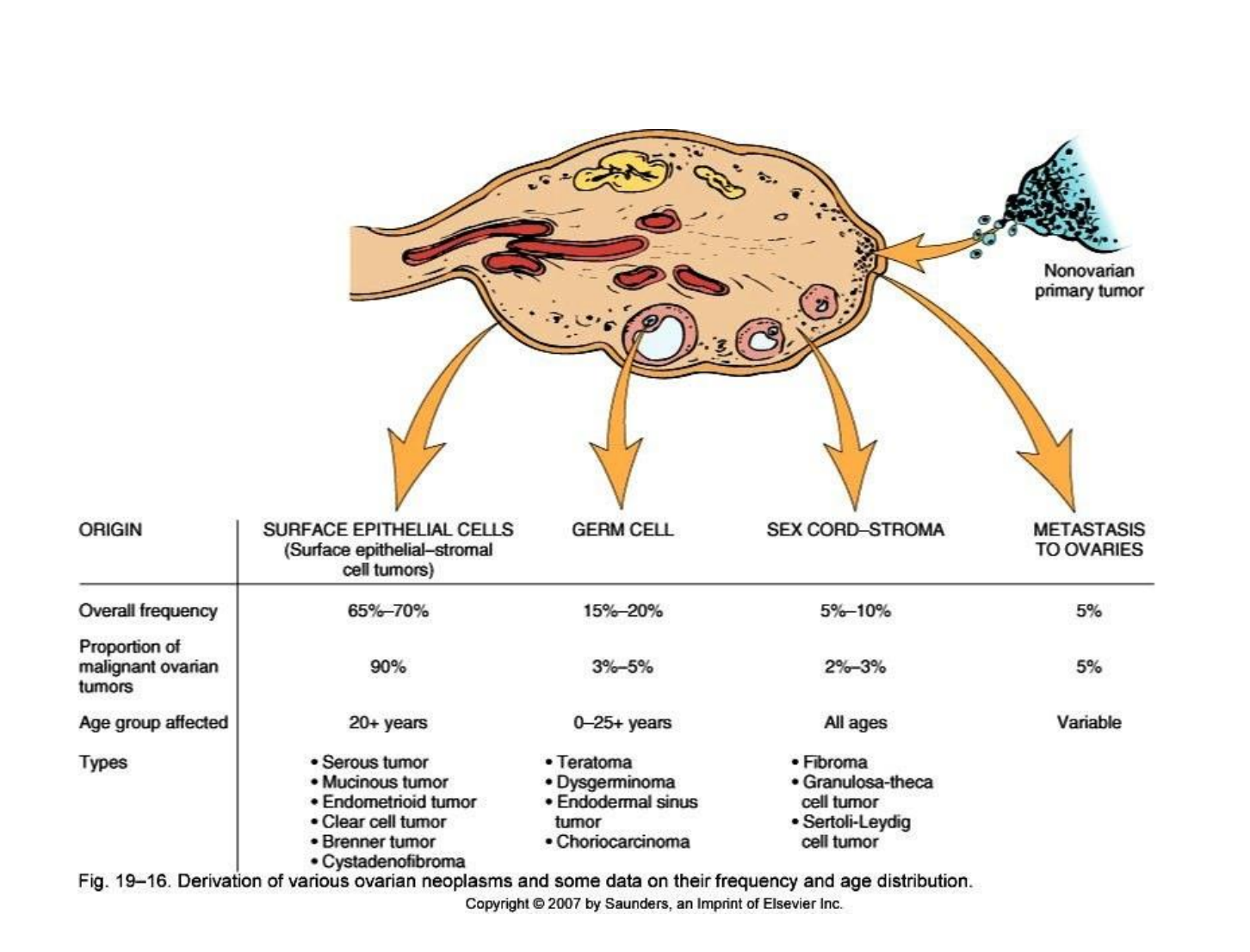
Ovarian cancer arises when cells of the ovary grow and divide uncontrollably to form a malignant tumor. The great majority are epithelial cancers originating from the surface lining of the ovary, while less common types arise from the germ cells or the hormone-producing stromal cells.
Pathophysiology
Accumulated genetic mutations allow abnormal ovarian cells to proliferate without normal control, forming a tumor that can invade surrounding pelvic tissue. Because the ovaries lie deep within the pelvis, tumors often grow and shed cells into the peritoneal cavity before producing noticeable symptoms, contributing to late diagnosis.
Risk Factors
- Family History of Ovarian cancer (BRCA genes)
- Personal/family history of breast cancer
- Diabetes/ Obesity
Presentation
Symptoms
Early ovarian cancer is frequently silent. As the disease progresses, symptoms tend to be vague and non-specific, including persistent abdominal or pelvic discomfort, bloating and abdominal swelling, early satiety or loss of appetite, and changes in bowel or urinary habits. Advanced disease may produce ascites and unintended weight loss.
Assessment
Diagnostic Considerations
Clinical Features:
- Very vague and occur very late
- Non-specific abdominal pain and swelling
- A very large cystic ovary can obstruct normal fluid flow in the gastrointestinal tract and result in ascites
- Even if benign, a large ovarian cyst can cause cachexia
Lab Results:
- Full blood examination (FBE)
- Cancer antigen 125 (CA-125), a tumor marker for ovarian cancer
- Ultrasound, CT, MRI
- Biopsy and surgical staging of ovarian carcinoma
Assessment
Differential Diagnosis
- Benign ovarian cyst
- Uterine fibroids
- Endometriosis
- Pelvic inflammatory disease
- Gastrointestinal or other pelvic malignancy
The Compounds
Research Compounds (15)
Individual molecules studied for ovarian cancer. These are research findings, not supplements to take — each page states how far the evidence goes.
[10]-Gingerol
Gingerol homolog (vanilloid phenol / β-hydroxy alkanone)
[10]-Gingerol is the longest-chain minor gingerol homolog of fresh ginger — less abundant and less studied than 6-gingerol, but with a notable isolate-level signal in triple-negative breast cancer and against oral bacteria, and often more potent than 6-gingerol in the same in-vitro assays.
Apigenin
Flavone (flavonoid)
A dietary flavone — the flavone sibling of luteolin (minus the B-ring 3'-OH) and the des-3 analogue of kaempferol. No trial of isolated apigenin exists: its "chamomile before bed" reputation rides on whole-chamomile-extract anxiety trials, with apigenin only the presumed active via GABA-A benzodiazepine-site binding — a mechanism that is real but genuinely mixed. Poorly bioavailable (nanomolar plasma).
Bisdemethoxycurcumin
Diarylheptanoid (curcuminoid)
Bisdemethoxycurcumin (BDMC) is the third, minor curcuminoid of turmeric — the fully demethoxylated relative of curcumin. It is the most chemically stable of the three, a weaker direct antioxidant but often the strongest at suppressing NF-κB-driven inflammation, with a distinctive preclinical signal for boosting immune clearance of amyloid-beta. The human evidence is thin and preclinical.
Corilagin
Ellagitannin (hydrolyzable tannin)
Corilagin is a water-soluble ellagitannin from Phyllanthus, Terminalia and Geranium. Well-studied preclinically as an anti-inflammatory (NLRP3/NF-κB/TNF) with antiviral (herpes) and anticancer signals — all in vitro or animal, with no human trials and poor oral bioavailability.
Geranial
Monoterpene aldehyde (acyclic; the E/trans isomer of citral)
Geranial (citral A, the E/trans isomer of citral) is the principal aldehyde of lemongrass oil and the more antimicrobial of the two citral isomers. Its evidence is overwhelmingly preclinical — isolate and whole-oil antimicrobial, antifungal and anticancer work — and its main real-world caution is skin sensitisation, not oral toxicity.
Harmine
β-carboline alkaloid
Harmine is the principal β-carboline alkaloid of the ayahuasca vine and Syrian rue — a reversible MAO-A inhibitor (the pharmacology behind ayahuasca) and a DYRK1A kinase inhibitor now studied for diabetes, Alzheimer's and cancer.
Hispidulin
Flavone (methoxyflavone)
Hispidulin is a methoxyflavone (6-methoxyapigenin) of sage, yerba santa and mugwort. Its distinctive feature is that it is a positive allosteric ligand at the benzodiazepine site of GABA-A receptors and crosses the blood-brain barrier — a real, cited basis for anticonvulsant/anxiolytic activity in rodents. Its anticancer, anti-inflammatory and bone data are broad but shallow preclinical work; no trial of the isolate exists.
Isoxanthohumol
Prenylflavonoid (flavanone)
Isoxanthohumol (IX) is the prenylflavanone of hops and beer — the cyclization isomer of xanthohumol and the main dietary precursor of the potent phytoestrogen 8-prenylnaringenin.
Kaempferol
Flavonol (flavonoid)
A common dietary flavonol — quercetin's close cousin, one hydroxyl lighter. No randomized trial of the isolated molecule exists for any indication; its human evidence is dietary-intake epidemiology (lower ovarian/gastric cancer and cardiovascular-mortality risk) plus a large preclinical mechanism literature. Poorly bioavailable.
Luteolin
Flavone (flavonoid)
A dietary flavone — quercetin minus one hydroxyl (the 3-OH), and the 3'-hydroxy sibling of apigenin. A compelling preclinical molecule with a near-empty human cabinet: no rigorous RCT of the isolate exists; the only RCT-grade human data are for PEA-luteolin combinations (PEA-driven), and its signature mast-cell-stabilizing property is entirely bench-level. Poorly bioavailable.
Osthole
Prenylated coumarin
Osthole is a prenylated O-methylated coumarin and the signature active of Cnidium monnieri seed (she chuang zi), also found in Angelica and other Apiaceae. Its marquee preclinical signals are bone formation and neuroprotection, but it is highly lipophilic with modest oral bioavailability, and every result to date comes from cell and animal models — there is no isolated-molecule human trial.
Schisandrol B
Lignan (dibenzocyclooctadiene)
Schisandrol B is a dibenzocyclooctadiene lignan of schisandra berries — the same molecule as gomisin A — best known for hepatoprotection (activating NRF2/ARE and the pregnane X receptor to defend the liver against paracetamol and cholestatic injury) and for a concrete CYP3A/P-glycoprotein drug-interaction profile. The evidence is preclinical.
Scoulerine
Isoquinoline alkaloid (tetrahydroprotoberberine group)
Scoulerine (discretamine) is a tetrahydroprotoberberine alkaloid of California poppy and Corydalis — and, as (S)-scoulerine, the central biosynthetic branch-point of the whole protoberberine/benzophenanthridine alkaloid family, the first product of the berberine bridge enzyme. Its own pharmacology is preclinical: a microtubule-disrupting antimitotic in cancer cells and a dopamine-linked, mildly sedative member of its chemical class.
Scutellarein
Flavone
Scutellarein (6-hydroxyapigenin) is a flavone from skullcap and Erigeron — the aglycone of the cerebrovascular drug-lead scutellarin. Its own profile (anti-inflammatory, neuroprotective, anticancer, antiviral) is broad but almost entirely preclinical, and its poor oral bioavailability is the recurring caveat.
Tephrosin
Rotenoid (isoflavonoid-derived; 12aβ-hydroxydeguelin)
Tephrosin is 12aβ-hydroxydeguelin — the hydroxylated congener that sits alongside rotenone and deguelin in cubé resin and in the fish-poison bean. The single hydroxyl blunts it as a respiratory poison and sharpens it as an NF-κB inhibitor, which is the only reason it reads differently from its parent.