
Materia Medica
Rose
Rosa spp.
Rose is a fragrant flowering shrub whose petals, rose water and essential oil are used to calm the mind and ease stress, and whose hips are a vitamin-C-rich fruit. Its scent comes from an oil rich in citronellol, geraniol and 2-phenylethanol.
What Is Rose?
Rose is a fragrant flowering shrub, valued for its petals, its hips, and the oil and water distilled from its flowers. The petals go into tea, rose water and sweet conserves, and the hips are eaten as a sour fruit rich in vitamin C.
Most medicinal rose comes from three species: the apothecary rose (Rosa gallica), the damask rose (R. × damascena) and the dog rose (R. canina). Wild roses grow across the cooler parts of the Northern Hemisphere 24Reference 24H., Ertter, B., & Bruneau, AView study →. Rose has a long history in Persian, Unani, Ayurvedic and European herbal medicine as a cooling, mildly astringent herb for the heart and the mood.
The scent comes from an essential oil rich in citronellol, geraniol and 2-phenylethanol 1Reference 1ReviewPharmacological effects of Rosa damascena — reviewView study →. Trials of the inhaled oil have looked at anxiety, sleep and pain, and trials of dog-rose hip powder have looked at osteoarthritis 2,
Rose oil and rose water are usually made from the damask rose, while the hips used in teas and supplements usually come from the dog rose 1,
How Is Rose Used?
Rose is taken as dried petals, rose water, essential oil and hips.
- Petal tea — 1–2 teaspoons of dried petals per cup.
- Rose water and petal conserve — rose water in drinks and sweets, and gulkand, petals cooked with sugar, taken by the spoonful.
- Essential oil — inhaled or diluted in massage oil. It is not taken by mouth.
- Rose hips — as tea, syrup, or a standardised hip powder.
- Smoking blends — dried petals add a soft floral aroma.
Traditional Uses
Persian & Unani Medicine
Rose is a cornerstone of Persian and Unani (Greco-Arabic) practice. Damask rose (gul) is distilled into rose water and cooked with sugar into gulqand, a rose-petal preserve taken as a gentle laxative and a cooling tonic for the heart and gut.
In this system rose is classed as cooling and mildly astringent. It is used to “strengthen the heart”, lift low spirits, calm agitation and settle the stomach. Rose water is also a long-standing eye-wash and skin remedy.
European Folk Medicine
European herbal tradition kept the apothecary rose (Rosa gallica) as a tonic and mild astringent. The dried petals were used for sore throats, bowel complaints and excess mucous discharge, and as an eye wash 26Reference 26H., Ertter, B., & Bruneau, AView study →. The fragrance was used for grief and nervous tension.
The autumn hips were gathered as a vitamin-C-rich food.
Ayurvedic Medicine
Ayurveda uses rose (gulab) as a cooling herb that settles pitta, for the heart and for the mood. The petals are taken as gulkand, a petal conserve, and rose water is added to drinks.
Indications
- Anxiety and stress [essential oil, inhaled] Caution: Pooled trials show an effect on short-term (state) anxiety but not on long-standing (trait) anxiety 2.
- Low mood [petal extract; essential oil; Persian medicine]
- Poor sleep [essential oil, inhaled]
- Acute pain, including labour pain [essential oil, inhaled or in massage] Caution: A separate meta-analysis found no significant effect on acute pain from rose taken by mouth or applied to the skin 5.
- Osteoarthritis pain [hip powder, R. canina]
- Heart tonic [petals; Persian & Unani medicine]
- Constipation [petal preserve; Persian & Unani medicine]
- Sore throat [petals; European folk use]
- Loose bowels [petals; European folk use]
- Eye irritation [rose water; Persian & Unani medicine]
Botany
Rose is a prickly shrub in the genus Rosa, the type genus of the rose family (Rosaceae). Floras count the genus at about 140 to 200 species, and thousands of cultivated forms have been bred from them 1,
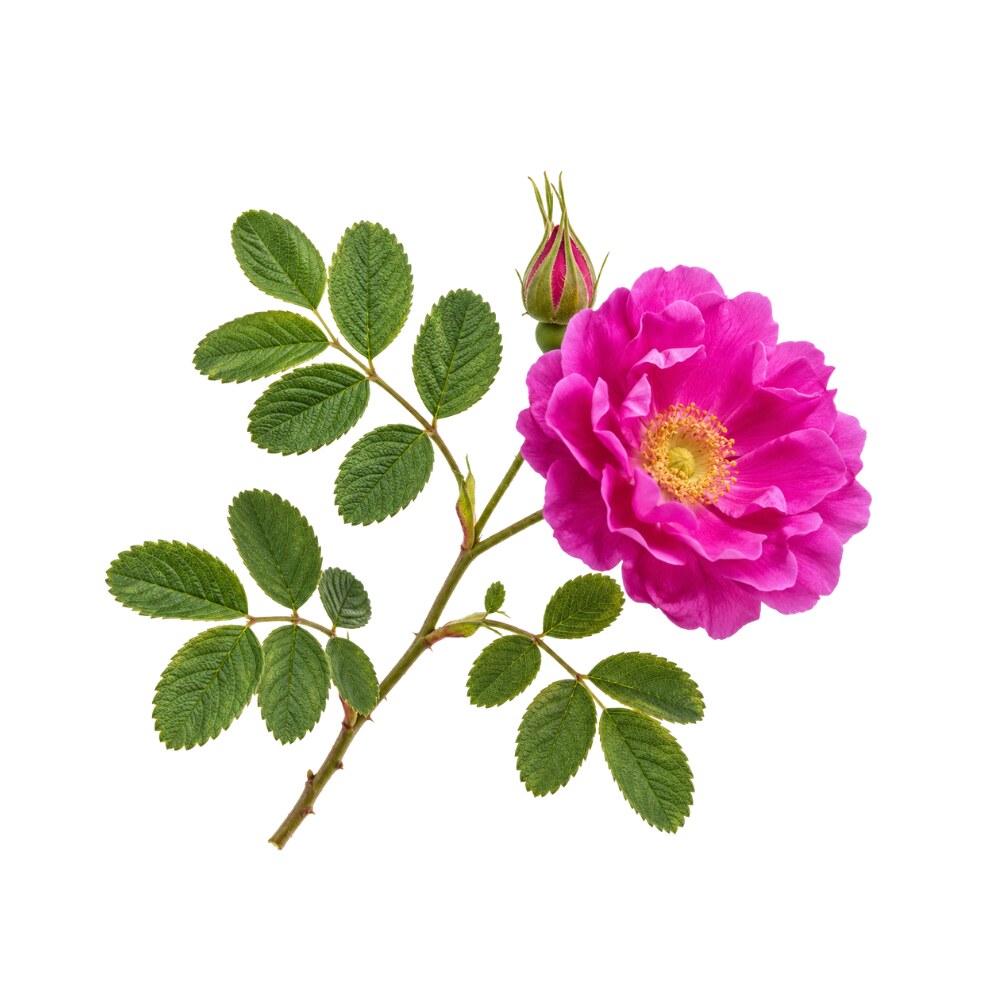
Roses grow as shrubs or climbers, with stems that stand upright, arch or scramble, and most carry prickles. The leaves are pinnate, usually with five to eleven toothed leaflets, and most species shed them in winter 24,
A wild rose flower has five petals in white, pink or red. Garden “double” roses carry many more 24,
After the petals fall, the fleshy cup at the base of the flower swells into the hip. The hip is usually red or orange-red and holds many small, hard, seed-like fruits 24,
The apothecary rose (Rosa gallica) is a shrub with five-leaflet leaves and petals about 3 cm long 26Reference 26H., Ertter, B., & Bruneau, AView study →.
The damask rose (R. × damascena) is a cultivated hybrid. It is thought to share its parentage with the cabbage rose, which descends from R. gallica crossed with the musk rose 26Reference 26H., Ertter, B., & Bruneau, AView study →.
The dog rose (R. canina) is an arching shrub 1 to 2.5 m tall, with paired curved prickles. It has sweet-scented pink or white flowers 3.5–5 cm across and red hips 1–1.6 cm long 25Reference 25H., Ertter, B., & Bruneau, AView study →.
Distribution
Wild roses grow mostly in the cooler parts of the Northern Hemisphere, across North America, Europe, Asia and northern Africa. Only three or four species reach south of the Tropic of Cancer in the Old World, and none in the New World 24Reference 24H., Ertter, B., & Bruneau, AView study →. China alone has 95 native species 27Reference 27Gu, C., & Robertson, K. R. (n.d.). Rosa Linnaeus — genus description and distribution — flora. In Wu, Z. Y., & Raven, P. H. (eds.), Flora of China, Vol. 9 (Rosaceae). http://www.efloras.org/florataxon.aspx?flora_id=2&taxon_id=128746View study →.
The dog rose is native to Europe, west-central Asia and northern Africa. It has naturalised along roads, railways and old homesteads in North America, and also in South America, Australia and New Zealand 25Reference 25H., Ertter, B., & Bruneau, AView study →.
The apothecary rose is native to central and southern Europe and western Asia 26Reference 26H., Ertter, B., & Bruneau, AView study →. The damask rose originated in the Middle East and is cultivated in Iran, Europe, Bulgaria, Turkey and India for its oil and rose water 1Reference 1ReviewPharmacological effects of Rosa damascena — reviewView study →.
Growing Conditions
Cultivation snapshot for Rose
- Grows as a hardy deciduous perennial shrub or climber across a wide range of climates, roughly USDA zones 3–9 depending on species and cultivar.
- Wants full sun — at least six hours daily — for the best flowering and hip set.
- Prefers deep, fertile, well-drained soil that stays evenly moist; dog rose in particular favors neutral to calcareous ground.
- Tolerates hard pruning and benefits from good airflow; species roses like R. canina and R. gallica are notably tough and low-maintenance.
Grow it yourself
Farm Wiki is our cultivation-focused sister site, also run by Justin Cooke.
Phytochemistry
Rose’s scent comes from an essential oil rich in monoterpene alcohols. In damask rose oil from Kashan, Iran, the main components were citronellol (14.5–47.5%), the waxy hydrocarbon nonadecane (10.5–40.5%), geraniol (5.5–18%) and nerol 1Reference 1ReviewPharmacological effects of Rosa damascena — reviewView study →. Rose absolute, a solvent extract of the flowers, is instead dominated by 2-phenylethanol, at about 78% 1Reference 1ReviewPharmacological effects of Rosa damascena — reviewView study →.
The petals hold flavonol glycosides and tannins. An industrial dry extract of damask rose flowers contained 14 kaempferol glycosides, 12 quercetin glycosides, phenolic acids, galloyl glycosides and 7 ellagitannins 17Reference 17In vitroPhytochemical profile, antioxidant potential, antimicrobial activity, and cytotoxicity of dry extract from Rosa damascena (2023) — in vitro. https://pubmed.ncbi.nlm.nih.gov/38005389/View study →. Rutin is among the flavonol glycosides.
Two ellagitannins, tellimagrandin I and rugosin B, were isolated from dog-rose petals. Both reduced the dose of β-lactam antibiotics needed to inhibit resistant staphylococci in the laboratory 23Reference 23In vitroRestoration of effectiveness of beta-lactams on methicillin-resistant Staphylococcus aureus by tellimagrandin I from rose red — in vitroView study →. The related ellagitannin rugosin A has been found, with tellimagrandins I and II, in the seeds of the Japanese rose, Rosa rugosa 28Reference 28Rosa rugosa low caloric fiber protein preparations rich in antioxidant flavanols and ellagitannins — analytical study of defatted seedsView study →.
The hips are rich in vitamin C (ascorbic acid), along with phenolics, tannins, triterpene acids, galactolipids, carotenoids and fatty oils 14,
Most of the oil and petal chemistry comes from damask rose, and most of the hip chemistry from dog rose, so figures for one species should be read separately from the other 1,
Constituent Summary
Oil figures are from damask rose oil grown in Iran 1Reference 1ReviewPharmacological effects of Rosa damascena — reviewView study →.
Monoterpene3 compounds2 with data
Phenylpropanoid1 compound1 with data
Tannin1 compoundno data
Vitamin1 compound1 with data
Pharmacology & Research
Rose has a large human trial literature, most of it on damask rose (R. damascena) essential oil given by inhalation. Meta-analyses of randomised trials report benefit for short-term anxiety and stress, sleep quality and acute pain 2,
A smaller set of oral trials has tested petal extract capsules for mood 6,
Laboratory and animal studies have looked at antioxidant, airway- and blood-vessel-relaxing and antibacterial activity 16,
- Best-supported: inhaled rose oil for state anxiety and stress 2Reference 2Meta-analysisRosa Damascena Mill for treating adults’ anxiety, depression, and stress: a systematic review and dose-response meta-analysis of randomised controlled trialsView study →, for sleep quality 3Reference 3Meta-analysisEffect of Rosa damascena on improvement of adults’ sleep quality: a systematic review and meta-analysis of randomised controlled trialsView study →, and for acute pain 4Reference 4Meta-analysisEffect of aromatherapy with Damask rose on alleviating adults’ acute pain severity: a systematic review and meta-analysis of randomised controlled trialsView study →; standardised R. canina hip powder for osteoarthritis pain 12Reference 12Meta-analysisDoes the hip powder of Rosa canina (rosehip) reduce pain in osteoarthritis patients? A meta-analysis of randomised controlled trialsView study →.
-
Emerging, worth watching: oral extract for depression and menopausal mood 2,
6Reference 2Meta-analysisRosa Damascena Mill for treating adults’ anxiety, depression, and stress: a systematic review and dose-response meta-analysis of randomised controlled trialsView study →Reference 6RCTMaturitas. https://pubmed.ncbi.nlm.nih.gov/40628163/View study → , a serotonergic antidepressant effect of the oil in stressed rats 9Reference 9AnimalDeciphering the antidepressant effects of Rosa damascena essential oil mediated through the serotonergic synapse signalling pathway (2024) — rat model. Journal of Ethnopharmacology. https://pubmed.ncbi.nlm.nih.gov/38492791/View study →, and relaxation of blood vessels by the oil and by 2-phenylethanol 21,22Reference 21AnimalRosa damascena Miller essential oil relaxes rat thoracic aorta through the NO-cGMP-dependent pathway — animal studyView study →Reference 22Vasorelaxant property of 2-phenyl ethyl alcohol isolated from the spent floral distillate of damask rose (Rosa damascena Mill.) and its possible mechanism — animal studyView study → . -
Mechanistically thin: antioxidant and antibacterial activity rest on laboratory extracts and one animal liver study 16,
17, .18Reference 16In vitroPromising effects of Rosa damascena petal extracts as antioxidant and antibacterial agents (2021) — in vitro. https://pubmed.ncbi.nlm.nih.gov/34247996/View study →Reference 17In vitroPhytochemical profile, antioxidant potential, antimicrobial activity, and cytotoxicity of dry extract from Rosa damascena (2023) — in vitro. https://pubmed.ncbi.nlm.nih.gov/38005389/View study →Reference 18AnimalEvaluation of the flavonol-rich fraction of Rosa damascena in an animal model of liver fibrosis (2023) — rat model. Life Sciences. https://pubmed.ncbi.nlm.nih.gov/37797686/View study → - The caveat: nearly all positive human data use inhaled rose essential oil or a standardised hip powder, not the petal tea.
Most of the human evidence uses rose essential oil or a standardised hip powder. The dried petal tea has not been tested in trials. Most trials are of fair quality, and the certainty of the pooled results ranges from very low to moderate 2,
1. Anxiety & Stress
A 2021 systematic review and dose-response meta-analysis of randomised controlled trials pooled 32 publications. R. damascena significantly reduced state anxiety (24 effect sizes, standardised mean difference −1.74) and stress (4 effect sizes, SMD −1.33). It had no significant effect on trait anxiety, the long-standing, dispositional form 2Reference 2Meta-analysisRosa Damascena Mill for treating adults’ anxiety, depression, and stress: a systematic review and dose-response meta-analysis of randomised controlled trialsView study →.
The effect did not rise with total dose or duration 2Reference 2Meta-analysisRosa Damascena Mill for treating adults’ anxiety, depression, and stress: a systematic review and dose-response meta-analysis of randomised controlled trialsView study →.
Two labour trials report lower anxiety in the first stage of labour with inhaled damask rose. One randomised 110 first-time mothers to rose essence or saline 11Reference 11RCThttps://pubmed.ncbi.nlm.nih.gov/29526235/View study →, and the other analysed 76 women across rose, saline-placebo and usual-care groups 10Reference 10RCThttps://pubmed.ncbi.nlm.nih.gov/39212535/View study →.
A systematic review of animal studies and clinical trials reached the same conclusion across anxiety, sleep and depression 7Reference 7Systematic reviewPhytotherapy Research. https://pubmed.ncbi.nlm.nih.gov/35653142/View study →.
Gap: the effect is on short-term state anxiety, not trait anxiety. Almost every trial used inhaled essential oil rather than petal tea, most trials were of fair quality, and GRADE certainty ranged from very low to moderate 2Reference 2Meta-analysisRosa Damascena Mill for treating adults’ anxiety, depression, and stress: a systematic review and dose-response meta-analysis of randomised controlled trialsView study →.
2. Sleep Quality
A 2021 systematic review of 10 randomised controlled trials found that inhaled R. damascena improved sleep quality, with a pooled standardised mean difference of 2.24 across seven effect sizes 3Reference 3Meta-analysisEffect of Rosa damascena on improvement of adults’ sleep quality: a systematic review and meta-analysis of randomised controlled trialsView study →. Oral intake also improved some sleep outcomes in the trials reviewed 3Reference 3Meta-analysisEffect of Rosa damascena on improvement of adults’ sleep quality: a systematic review and meta-analysis of randomised controlled trialsView study →.
Two of the trials recorded adverse effects: headache, nausea, vomiting and frequent sneezing 3Reference 3Meta-analysisEffect of Rosa damascena on improvement of adults’ sleep quality: a systematic review and meta-analysis of randomised controlled trialsView study →.
A systematic review of mental-health trials noted the same direction of effect, and lists reduced sympathetic nervous activity among the proposed mechanisms 7Reference 7Systematic reviewPhytotherapy Research. https://pubmed.ncbi.nlm.nih.gov/35653142/View study →.
The pooled estimate rests on fair-quality trials of inhaled oil, and no trial has tested the petal infusion.
3. Acute Pain
A 2021 meta-analysis of 16 randomised controlled trials found that aromatherapy with damask rose reduced acute pain severity (weighted mean difference −2.12). Both inhalation (−2.39) and aromatherapy massage (−1.16) were effective, and the quality of evidence was low 4Reference 4Meta-analysisEffect of aromatherapy with Damask rose on alleviating adults’ acute pain severity: a systematic review and meta-analysis of randomised controlled trialsView study →.
A second meta-analysis of 11 trials looked at rose taken by mouth or applied to the skin. Oral intake reduced pain, but not significantly (SMD −0.55), and topical application had no effect 5Reference 5Meta-analysishttps://pubmed.ncbi.nlm.nih.gov/36188887/View study →.
The two labour trials above report lower pain alongside lower anxiety 10,
The pooled trials span very different pain types, including labour, burns, surgery and needle procedures, and the positive result is tied to the inhaled or massaged oil.
4. Osteoarthritis (Rosehip)
This indication belongs to a different part of the plant: the hip of the dog rose (R. canina), taken as a standardised powder. A 2008 meta-analysis of three randomised controlled trials (287 patients, median duration three months) found that rosehip powder reduced osteoarthritis pain versus placebo (effect size 0.37, number needed to treat six) 12Reference 12Meta-analysisDoes the hip powder of Rosa canina (rosehip) reduce pain in osteoarthritis patients? A meta-analysis of randomised controlled trialsView study →.
All three trials were supported by the manufacturer 12Reference 12Meta-analysisDoes the hip powder of Rosa canina (rosehip) reduce pain in osteoarthritis patients? A meta-analysis of randomised controlled trialsView study →.
In the crossover trial, 112 patients took Hyben Vital 5 g/day or placebo for three months and then switched. The group given placebo first improved significantly more on the powder. In the group given the powder first, both periods looked similar, which the authors read as a carry-over effect. Over the first three months, 66% responded on the powder against 36% on placebo 13Reference 13RCTA herbal remedy, Hyben Vital (standardised powder of a subspecies of Rosa canina fruits), reduces pain and improves general wellbeing in patients with osteoarthritis — double-blind, placebo-controlled, randomised trialView study →.
Reviews attribute the effect to antioxidant activity, NF-κB inhibition, lower pro-inflammatory cytokines and lower C-reactive protein. The galactolipid GOPO, isolated from hip seeds and fruit, is singled out as an anti-inflammatory constituent 14,
Gap: the evidence is for a standardised R. canina hip powder, not rose petals or rose tea. The trials were small and manufacturer-funded, and the effect size is modest.
5. Depression & Low Mood
The 2021 dose-response meta-analysis that pooled the anxiety data also found lower depression scores (SMD −0.87 across seven effect sizes) 2Reference 2Meta-analysisRosa Damascena Mill for treating adults’ anxiety, depression, and stress: a systematic review and dose-response meta-analysis of randomised controlled trialsView study →.
A 2025 triple-blind RCT gave 82 menopausal women 500 mg of oral R. damascena extract or placebo twice daily for eight weeks. Depression, anxiety and stress scores fell significantly on the extract 6Reference 6RCTMaturitas. https://pubmed.ncbi.nlm.nih.gov/40628163/View study →.
In a double-blind trial in 40 people with dementia, R. damascena capsules added to donepezil improved cognition, depression and behaviour over three months compared with placebo 8Reference 8Clinical trialInternational Journal of Preventive Medicine. https://pubmed.ncbi.nlm.nih.gov/30050668/View study →.
In a rat model of chronic stress, rose essential oil reduced depressive-like behaviour, raised serotonin (5-HT) and acted on the serotonergic synapse pathway. Docking pointed to citronellol, geraniol and farnesol as the likely active compounds 9Reference 9AnimalDeciphering the antidepressant effects of Rosa damascena essential oil mediated through the serotonergic synapse signalling pathway (2024) — rat model. Journal of Ethnopharmacology. https://pubmed.ncbi.nlm.nih.gov/38492791/View study →.
The depression pooling rests on far fewer effect sizes than the anxiety data, and the serotonergic mechanism has been shown only in animals.
6. Antioxidant
Methanolic and ethyl-acetate fractions of R. damascena petals were active in free-radical scavenging assays 16Reference 16In vitroPromising effects of Rosa damascena petal extracts as antioxidant and antibacterial agents (2021) — in vitro. https://pubmed.ncbi.nlm.nih.gov/34247996/View study →. An industrial flower extract and its phenolic-enriched fraction were also active, with the enriched fraction stronger 17Reference 17In vitroPhytochemical profile, antioxidant potential, antimicrobial activity, and cytotoxicity of dry extract from Rosa damascena (2023) — in vitro. https://pubmed.ncbi.nlm.nih.gov/38005389/View study →.
In rats with chemically induced liver fibrosis, a flavonol-rich fraction standardised for quercetin and kaempferol lowered fibrosis markers (TGF-β1, PDGF and collagen cross-linking), lowered malondialdehyde and raised catalase 18Reference 18AnimalEvaluation of the flavonol-rich fraction of Rosa damascena in an animal model of liver fibrosis (2023) — rat model. Life Sciences. https://pubmed.ncbi.nlm.nih.gov/37797686/View study →.
No human study has measured an antioxidant endpoint after taking rose. The data are laboratory fractions plus a single animal liver study.
7. Bronchodilatory
Rose relaxes airway smooth muscle in isolated tissue. In guinea-pig tracheal chains, both an ethanolic extract and the essential oil relaxed pre-contracted tissue in a concentration-dependent way, comparably to theophylline 19Reference 19Relaxant effects of Rosa damascena on guinea-pig tracheal chains and its possible mechanism(s) — animal studyView study →. In rat trachea, the oil’s relaxing effect was blocked by inhibitors of voltage-gated (Kᵥ), ATP-sensitive (K_ATP) and calcium-activated (BK_Ca) potassium channels 20Reference 20AnimalRosa damascena Miller essential oil relaxes rat trachea via Kᵥ, K_ATP and BK_Ca channels (2022) — animal study. Prostaglandins & Other Lipid Mediators. https://pubmed.ncbi.nlm.nih.gov/36115499/View study →.
The same research group found that ethanolic and aqueous extracts reduced citric-acid-induced coughing in guinea pigs 1Reference 1ReviewPharmacological effects of Rosa damascena — reviewView study →.
All of this is animal work with the oil or extracts. No human respiratory trial has been done.
8. Vasorelaxant
Rose essential oil relaxed pre-contracted rat aorta. The effect was partly dependent on the vessel lining (endothelium) and was reduced by blocking nitric-oxide synthase and soluble guanylate cyclase, the NO-cGMP pathway 21Reference 21AnimalRosa damascena Miller essential oil relaxes rat thoracic aorta through the NO-cGMP-dependent pathway — animal studyView study →.
2-Phenylethanol, isolated from the water left after rose oil is distilled, relaxed both the rat aorta and the smaller mesenteric arteries. It worked without the endothelium, mainly through calcium-activated (BK_Ca) potassium channels 22Reference 22Vasorelaxant property of 2-phenyl ethyl alcohol isolated from the spent floral distillate of damask rose (Rosa damascena Mill.) and its possible mechanism — animal studyView study →.
This is animal-tissue and isolated-compound work only. No human study has measured blood pressure or any cardiovascular outcome after rose.
9. Antimicrobial
R. damascena petal fractions were most active against Staphylococcus aureus and Bacillus cereus, while Pseudomonas aeruginosa and Escherichia coli were the most resistant 16Reference 16In vitroPromising effects of Rosa damascena petal extracts as antioxidant and antibacterial agents (2021) — in vitro. https://pubmed.ncbi.nlm.nih.gov/34247996/View study →. A dry flower extract was active against Cutibacterium (Propionibacterium) acnes, S. aureus and S. epidermidis, but not against Candida albicans 17Reference 17In vitroPhytochemical profile, antioxidant potential, antimicrobial activity, and cytotoxicity of dry extract from Rosa damascena (2023) — in vitro. https://pubmed.ncbi.nlm.nih.gov/38005389/View study →.
An extract of dog-rose petals sharply lowered the concentration of β-lactam antibiotics needed to inhibit methicillin-resistant S. aureus. The ellagitannin tellimagrandin I was the main active compound, acting synergistically with oxacillin, and it also lowered the tetracycline dose needed against some strains 23Reference 23In vitroRestoration of effectiveness of beta-lactams on methicillin-resistant Staphylococcus aureus by tellimagrandin I from rose red — in vitroView study →.
All of the antibacterial data are from laboratory cultures. There is no clinical infection study.
Mechanisms
The inhaled oil’s effects on mood, sleep and pain have been studied in terms of the nervous system. Animal work points to the serotonergic system and to lower sympathetic activity, with citronellol and geraniol as candidate actives 7,
The hip’s anti-inflammatory activity has been studied separately, centred on the galactolipid GOPO and on NF-κB and cytokine suppression 14,
| Mechanism | Drives | Key compounds |
|---|---|---|
| Serotonergic synapse signalling, ↑ 5-HT (rat); ↓ sympathetic tone | anxietysleepdepression | citronellol, geraniol |
| NF-κB ↓, pro-inflammatory cytokines ↓, CRP ↓ | osteoarthritis | GOPO (rosehip galactolipid) |
| Free-radical scavenging, TGF-β1 ↓ | antioxidantliver fibrosis (animal) | quercetin, kaempferol |
| K⁺-channel opening (Kᵥ/K_ATP/BK_Ca), NO-cGMP | airway & blood-vessel relaxation | rose essential oil, 2-phenylethanol |
| β-lactam resistance reversal | antibacterial | tellimagrandin I |
Clinical Trials
Rose has dozens of published randomised controlled trials. The anxiety, depression and stress meta-analysis alone included 32 publications, with separate pools for sleep and acute pain 2,
| Completed | Planned | Terminated | Preclinical |
|---|---|---|---|
| 40+(published RCTs) | — | 0identified | ~30+ |
Last checked: February 2026.
Dosage
Rose is taken mainly as a petal tea or conserve. The trials used either a standardised hip powder, an oral petal extract or the inhaled oil.
Research Doses
| Indication | Preparation | Dose | Est. dried-herb equivalent | Source |
|---|---|---|---|---|
| Osteoarthritis (joint pain, stiffness) | Rose-hip powder (Hyben Vital) | 5 g/day, three months | — (hip powder, a different part) | 13Reference 13RCTA herbal remedy, Hyben Vital (standardised powder of a subspecies of Rosa canina fruits), reduces pain and improves general wellbeing in patients with osteoarthritis — double-blind, placebo-controlled, randomised trialView study → |
| Depression, anxiety and stress (menopause) | R. damascena extract capsules, oral | 500 mg twice daily, 8 weeks | — (extract; no stated ratio) | 6Reference 6RCTMaturitas. https://pubmed.ncbi.nlm.nih.gov/40628163/View study → |
| Labour pain and anxiety | R. damascena essence, inhaled | 0.08 mL every 30 minutes | — (essential oil) | 11Reference 11RCThttps://pubmed.ncbi.nlm.nih.gov/29526235/View study → |
None of these trials used the petal tea.
Traditional Dosage
| System | Preparation | Dose |
|---|---|---|
| Western herbal / European folk | Dried petals, infusion | 1–2 tsp per cup, up to three times daily |
| Western herbal | 1:5 tincture of dried petals | 20–40 mL/week |
| European folk | Rose hips, decoction or syrup | A vitamin-C food; taken freely |
| Ayurveda | Gulab — petals as gulkand, or rose water | A spoonful of the conserve, or rose water in drinks |
Safety & Pregnancy
Rose is gentle and widely eaten as food. The practical cautions are about sourcing unsprayed petals and using the essential oil only by inhalation or on the skin.
- Gentle and food-grade. Petals, rose water and hips are widely eaten, with no significant toxicity.
- Use unsprayed petals. Ornamental roses are often treated with pesticides, so choose food-grade, unsprayed material.
- Smoking any herb. Inhaling combustion products carries respiratory risk, however mild the herb.
- Inhaled oil can cause mild side effects. Two sleep trials recorded headache, nausea, vomiting and sneezing 3Reference 3Meta-analysisEffect of Rosa damascena on improvement of adults’ sleep quality: a systematic review and meta-analysis of randomised controlled trialsView study →.
Full Safety & Interactions Detail
Food use. Rose petals, rose water and hips are widely eaten, with no significant toxicity reported at culinary amounts. In the laboratory, rose extracts showed low toxicity to human skin cells, with toxicity to liver-cancer cells only above 350–500 µg/mL 17Reference 17In vitroPhytochemical profile, antioxidant potential, antimicrobial activity, and cytotoxicity of dry extract from Rosa damascena (2023) — in vitro. https://pubmed.ncbi.nlm.nih.gov/38005389/View study →. Petal fractions caused no damage to human red blood cells 16Reference 16In vitroPromising effects of Rosa damascena petal extracts as antioxidant and antibacterial agents (2021) — in vitro. https://pubmed.ncbi.nlm.nih.gov/34247996/View study →.
Sourcing. Ornamental roses are often treated with pesticides, so use only unsprayed, food-grade material. Smoking any plant material carries respiratory risk.
Essential oil. Inhaled rose oil is generally well tolerated. Two of the sleep trials recorded mild side effects: headache, nausea, vomiting and sneezing 3Reference 3Meta-analysisEffect of Rosa damascena on improvement of adults’ sleep quality: a systematic review and meta-analysis of randomised controlled trialsView study →. Concentrated essential oil should not be taken internally except under professional guidance.
Interactions. No drug-interaction study of rose has been done. The oil relaxes blood vessels in animal tissue, so an added effect with blood-pressure medicines is possible in theory 21,
Rose petals, rose water and hips are ordinary foods.
Medicinal doses and the essential oil have not been studied in pregnancy or breastfeeding. Keep to food amounts unless a practitioner advises otherwise.
References
- Boskabady, M. H., Shafei, M. N., Saberi, Z., & Amini, S. (2011). Pharmacological effects of Rosa damascena — review. Iranian Journal of Basic Medical Sciences. https://pubmed.ncbi.nlm.nih.gov/23493250/
- Rasooli, T., Nasiri, M., Kargarzadeh Aliabadi, Z., et al. (2021). Rosa Damascena Mill for treating adults’ anxiety, depression, and stress: a systematic review and dose-response meta-analysis of randomised controlled trials. Phytotherapy Research. https://pubmed.ncbi.nlm.nih.gov/34405933/
- Ghorbani Rami, M. S., Nasiri, M., Aghili Nasab, M. S., et al. (2021). Effect of Rosa damascena on improvement of adults’ sleep quality: a systematic review and meta-analysis of randomised controlled trials. Sleep Medicine. https://pubmed.ncbi.nlm.nih.gov/34508987/
- Nasiri, M., Torkaman, M., Feizi, S., et al. (2021). Effect of aromatherapy with Damask rose on alleviating adults’ acute pain severity: a systematic review and meta-analysis of randomised controlled trials. Complementary Therapies in Medicine. https://pubmed.ncbi.nlm.nih.gov/33197671/
- Effects of topical application and oral intake of Rosa damascena on acute pain in adults: a systematic review and meta-analysis (2022). https://pubmed.ncbi.nlm.nih.gov/36188887/
- Effect of oral capsules of Rosa damascena Mill extract on depression, anxiety and stress in menopausal women: a randomised controlled trial (2025). Maturitas. https://pubmed.ncbi.nlm.nih.gov/40628163/
- Evidence for Rosa damascena efficacy in mental disorders in preclinical animal studies and clinical trials: a systematic review (2022). Phytotherapy Research. https://pubmed.ncbi.nlm.nih.gov/35653142/
- Novel effects of Rosa damascena extract on patients with neurocognitive disorder and depression: a clinical trial (2018). International Journal of Preventive Medicine. https://pubmed.ncbi.nlm.nih.gov/30050668/
- Deciphering the antidepressant effects of Rosa damascena essential oil mediated through the serotonergic synapse signalling pathway (2024) — rat model. Journal of Ethnopharmacology. https://pubmed.ncbi.nlm.nih.gov/38492791/
- Effects of Rosa damascena on labor pain and anxiety in primiparous women — randomised controlled trial (2025). https://pubmed.ncbi.nlm.nih.gov/39212535/
- Effects of aromatherapy with Rosa damascena on nulliparous women’s pain and anxiety of labor during the first stage — randomised controlled trial (2018). https://pubmed.ncbi.nlm.nih.gov/29526235/
- Christensen, R., et al. (2008). Does the hip powder of Rosa canina (rosehip) reduce pain in osteoarthritis patients? A meta-analysis of randomised controlled trials. Osteoarthritis and Cartilage. https://pubmed.ncbi.nlm.nih.gov/18407528/
- Rein, E., Kharazmi, A., & Winther, K. (2004). A herbal remedy, Hyben Vital (standardised powder of a subspecies of Rosa canina fruits), reduces pain and improves general wellbeing in patients with osteoarthritis — double-blind, placebo-controlled, randomised trial. Phytomedicine. https://pubmed.ncbi.nlm.nih.gov/15330493/
- Rosa canina — rose hip pharmacological ingredients and molecular mechanics counteracting osteoarthritis — a systematic review (2019). Phytomedicine. https://pubmed.ncbi.nlm.nih.gov/31138475/
- Anti-inflammatory and analgesic effects of rosehip in inflammatory musculoskeletal disorders and its active molecules — review (2021). https://pubmed.ncbi.nlm.nih.gov/34348637/
- Promising effects of Rosa damascena petal extracts as antioxidant and antibacterial agents (2021) — in vitro. https://pubmed.ncbi.nlm.nih.gov/34247996/
- Phytochemical profile, antioxidant potential, antimicrobial activity, and cytotoxicity of dry extract from Rosa damascena (2023) — in vitro. https://pubmed.ncbi.nlm.nih.gov/38005389/
- Evaluation of the flavonol-rich fraction of Rosa damascena in an animal model of liver fibrosis (2023) — rat model. Life Sciences. https://pubmed.ncbi.nlm.nih.gov/37797686/
- Boskabady, M. H., et al. (2006). Relaxant effects of Rosa damascena on guinea-pig tracheal chains and its possible mechanism(s) — animal study. Journal of Ethnopharmacology. https://pubmed.ncbi.nlm.nih.gov/16504433/
- Rosa damascena Miller essential oil relaxes rat trachea via Kᵥ, K_ATP and BK_Ca channels (2022) — animal study. Prostaglandins & Other Lipid Mediators. https://pubmed.ncbi.nlm.nih.gov/36115499/
- Demirel, S. (2022). Rosa damascena Miller essential oil relaxes rat thoracic aorta through the NO-cGMP-dependent pathway — animal study. Prostaglandins & Other Lipid Mediators. https://pubmed.ncbi.nlm.nih.gov/35750298/
- Singh MK, Savita K, Singh S, et al. (2023). Vasorelaxant property of 2-phenyl ethyl alcohol isolated from the spent floral distillate of damask rose (Rosa damascena Mill.) and its possible mechanism — animal study. Journal of Ethnopharmacology. https://pubmed.ncbi.nlm.nih.gov/37149069/
- Shiota, S., Shimizu, M., Mizusima, T., Ito, H., Hatano, T., Yoshida, T., & Tsuchiya, T. (2000). Restoration of effectiveness of beta-lactams on methicillin-resistant Staphylococcus aureus by tellimagrandin I from rose red — in vitro. FEMS Microbiology Letters, 185(2), 135–138. https://pubmed.ncbi.nlm.nih.gov/10754237/
- Lewis, W. H., Ertter, B., & Bruneau, A. (n.d.). Rosa Linnaeus — genus description, species count and distribution — flora. In Flora of North America Editorial Committee (eds.), Flora of North America North of Mexico, Vol. 9 (Rosaceae). http://www.efloras.org/florataxon.aspx?flora_id=1&taxon_id=128746
- Lewis, W. H., Ertter, B., & Bruneau, A. (n.d.). Rosa canina Linnaeus — species description, habitat and distribution — flora. In Flora of North America Editorial Committee (eds.), Flora of North America North of Mexico, Vol. 9 (Rosaceae). http://www.efloras.org/florataxon.aspx?flora_id=1&taxon_id=242417146
- Lewis, W. H., Ertter, B., & Bruneau, A. (n.d.). Rosa gallica Linnaeus — species description, distribution, hybrids and uses — flora. In Flora of North America Editorial Committee (eds.), Flora of North America North of Mexico, Vol. 9 (Rosaceae). http://www.efloras.org/florataxon.aspx?flora_id=1&taxon_id=200011253
- Gu, C., & Robertson, K. R. (n.d.). Rosa Linnaeus — genus description and distribution — flora. In Wu, Z. Y., & Raven, P. H. (eds.), Flora of China, Vol. 9 (Rosaceae). http://www.efloras.org/florataxon.aspx?flora_id=2&taxon_id=128746
- Milala J, Kosmala M, Sójka M, Kołodziejczyk K, Klewicki R, Król M, Karlińska E, Rój E (2023). Rosa rugosa low caloric fiber protein preparations rich in antioxidant flavanols and ellagitannins — analytical study of defatted seeds. Molecules, 28(24), 8021. https://pubmed.ncbi.nlm.nih.gov/38138511/



