
Materia Medica
Broom
Cytisus scoparius
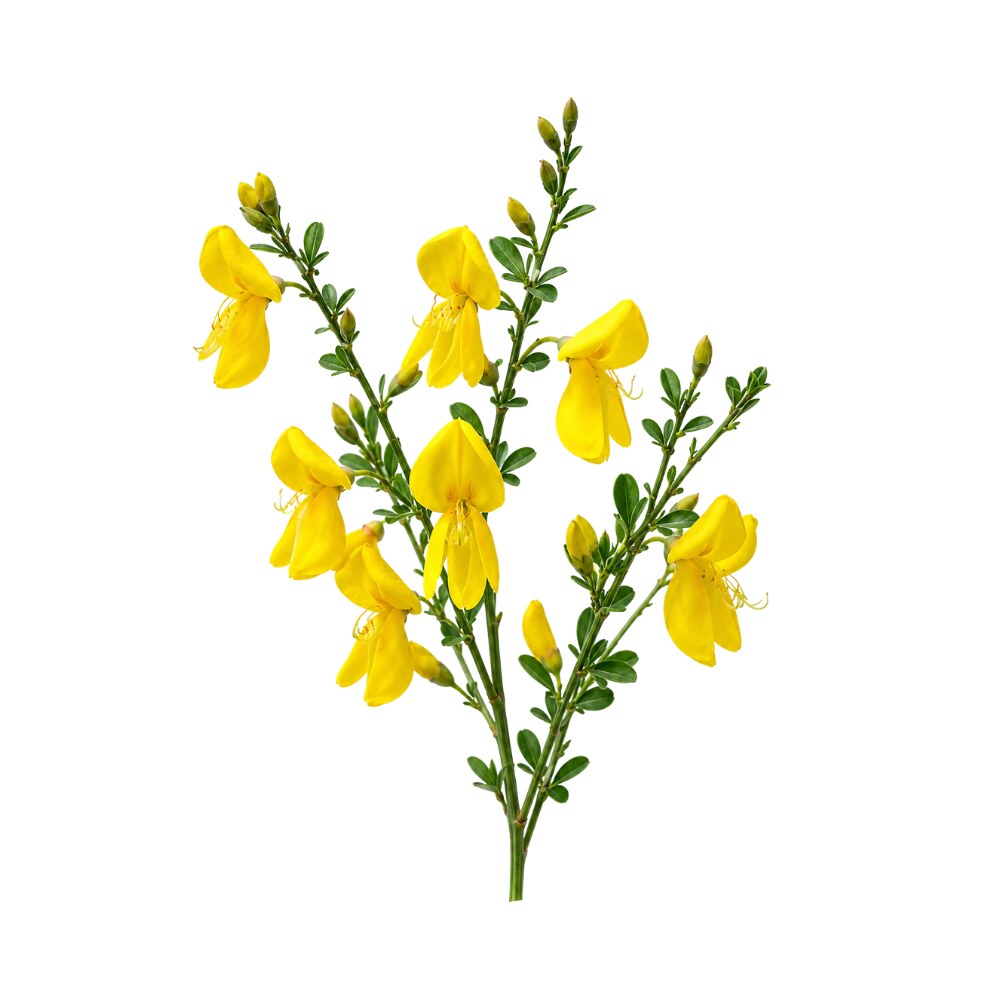
Broom is a European shrub of the pea family with bright yellow flowers, used in herbal medicine for the heart and for fluid retention. Its green tops contain the alkaloid sparteine, which slows the heart and makes the plant toxic in excess.
What Is Broom?
Broom, or Scotch broom, is a shrub of the pea family with slender green stems and masses of bright yellow flowers. European herbal medicine used its flowering tops for the heart and for fluid retention, and the stems were bundled into the sweeping brooms that name it 14Reference 14Cytisus spp.: Cytisus scoparius, C. striatus, brooms: Scotch broom, striated broom — botanical description, distribution and uses — species databaseView study →.
Cytisus scoparius is native to Europe and North Africa. It has been carried around the world as an ornamental and a fodder plant, and in North America, Australia and New Zealand it is now a major invasive weed 14Reference 14Cytisus spp.: Cytisus scoparius, C. striatus, brooms: Scotch broom, striated broom — botanical description, distribution and uses — species databaseView study →.
The tops contain the alkaloid sparteine, which blocks sodium channels in heart muscle and slows the heart 7,
How Is Broom Used?
- Standardised extracts — in German phytotherapy, water-and-alcohol extracts of the herb, equal to 1–1.5 g of herb a day and limited to 1 mg/mL sparteine, for functional heart and circulation complaints 17Reference 17ReviewCytisi scoparii herba — summary of the Commission E monograph (indication, dose, contraindications, interactions, side effects)View study →.
- Flowering tops — the traditional drug, taken as a weak infusion or a tincture for the heart and as a diuretic. Commission E gave the flowers alone a negative monograph, and allows them only as a minor ingredient (up to 1%) of tea blends 17Reference 17ReviewCytisi scoparii herba — summary of the Commission E monograph (indication, dose, contraindications, interactions, side effects)View study →.
- Household uses — the branches were made into brooms and thatch, the bark into rope, and the plant gave a yellow dye and substitutes for hops, capers and coffee 14Reference 14Cytisus spp.: Cytisus scoparius, C. striatus, brooms: Scotch broom, striated broom — botanical description, distribution and uses — species databaseView study →.
Traditional Uses
European Herbal Medicine
Broom’s drug is the flowering top, gathered in spring and taken as a weak infusion or a tincture. European herbalism gave it two main jobs.
The first was as a diuretic, for dropsy and the swollen legs that come with a failing circulation. This action was credited to the flavone glycoside scoparin.
The second was as a heart herb, given to slow and steady a racing or irregular pulse 14Reference 14Cytisus spp.: Cytisus scoparius, C. striatus, brooms: Scotch broom, striated broom — botanical description, distribution and uses — species databaseView study →.
It was also used as an emetic and a purgative, for respiratory complaints, and to bring on abortion 14Reference 14Cytisus spp.: Cytisus scoparius, C. striatus, brooms: Scotch broom, striated broom — botanical description, distribution and uses — species databaseView study →.
Indications
- Functional heart and circulation complaints [herb extract; German phytotherapy]
- Irregular or rapid heartbeat [flowering tops; European herbal medicine]
- Fluid retention and dropsy [flowering tops; European herbal medicine] Caution: No study has measured a diuretic effect of broom or of scoparin.
Botany
Scotch broom is an upright, bushy shrub of the pea family, Fabaceae. It grows 2–4 m tall, with stiff, slender branches that are hairy when young 14Reference 14Cytisus spp.: Cytisus scoparius, C. striatus, brooms: Scotch broom, striated broom — botanical description, distribution and uses — species databaseView study →.
Its leaves are small and short-lived. On young branches each leaf is a single leaflet, and on older branches it has three, each 5–20 mm long. The leaves fall early in the season or under stress 14Reference 14Cytisus spp.: Cytisus scoparius, C. striatus, brooms: Scotch broom, striated broom — botanical description, distribution and uses — species databaseView study →.
The green stems do much of the plant’s photosynthesis. In Scotch broom about half the photosynthetic tissue is in the stems, which lets the shrub keep growing after it has lost its leaves 14Reference 14Cytisus spp.: Cytisus scoparius, C. striatus, brooms: Scotch broom, striated broom — botanical description, distribution and uses — species databaseView study →.
The yellow, pea-like flowers are 15–25 mm long. They grow singly or in pairs where the leaves join the stem, or in leafy clusters at the branch tips 14Reference 14Cytisus spp.: Cytisus scoparius, C. striatus, brooms: Scotch broom, striated broom — botanical description, distribution and uses — species databaseView study →.
The fruit is a flat pod 2.5–7 cm long, with hairs along its seam, holding 3–12 seeds. As the pod dries, its two halves split and twist with an audible snap, throwing the seeds up to about 5 m 14Reference 14Cytisus spp.: Cytisus scoparius, C. striatus, brooms: Scotch broom, striated broom — botanical description, distribution and uses — species databaseView study →.
Like other legumes, broom carries nitrogen-fixing bacteria in nodules on its roots, which helps it establish in poor soil. It has a deep, forked taproot 14Reference 14Cytisus spp.: Cytisus scoparius, C. striatus, brooms: Scotch broom, striated broom — botanical description, distribution and uses — species databaseView study →.
Distribution
Scotch broom is native to North Africa and Europe, from North Africa north to Sweden and the British Isles and east to Ukraine. In Europe it is not found east of Poland and Hungary 14Reference 14Cytisus spp.: Cytisus scoparius, C. striatus, brooms: Scotch broom, striated broom — botanical description, distribution and uses — species databaseView study →.
It has been introduced as an ornamental to Canada, Chile, India, Iran, Australia, New Zealand, South Africa and the United States. It is a major weed in Australia and New Zealand 14Reference 14Cytisus spp.: Cytisus scoparius, C. striatus, brooms: Scotch broom, striated broom — botanical description, distribution and uses — species databaseView study →.
In North America it was brought to Virginia in the early 1800s as fodder for sheep. It now grows along the Atlantic coast from Nova Scotia to Georgia, along the Pacific coast from British Columbia to central California, inland to Idaho, Montana and Utah, and in Hawaii. The worst infestations lie between British Columbia and central California 14Reference 14Cytisus spp.: Cytisus scoparius, C. striatus, brooms: Scotch broom, striated broom — botanical description, distribution and uses — species databaseView study →.
Growing Conditions
Cultivation snapshot for Broom
- Thrives in full sun on poor, dry, sandy, acidic soil; drought-tolerant and undemanding once established.
- Invasive — do not plant. It’s a listed noxious weed across the Pacific Northwest, California, Australia and New Zealand; planting is restricted or prohibited in many places, so check local weed law first.
- Spreads prolifically by explosively dispersed seed. The hard-coated seed survives in the soil for at least 5 years and possibly 30, and some seed in dry storage has lasted up to 80 years, so established stands are very hard to eradicate 14Reference 14Cytisus spp.: Cytisus scoparius, C. striatus, brooms: Scotch broom, striated broom — botanical description, distribution and uses — species databaseView study →.
- Its nitrogen-fixing habit alters soil chemistry and it sharply raises wildfire fuel loads — further reasons it’s managed as a pest rather than cultivated.
Grow it yourself
Farm Wiki is our cultivation-focused sister site, also run by Justin Cooke.
Phytochemistry
Broom’s main constituents are quinolizidine alkaloids. Sparteine makes up about 90% of the alkaloid fraction of the herb, alongside cytisine and N-methylcytisine 17Reference 17ReviewCytisi scoparii herba — summary of the Commission E monograph (indication, dose, contraindications, interactions, side effects)View study →. Lupanine and 17-oxosparteine have also been isolated from the plant 5Reference 5In vitroGavilan, J., Mennickent, D., Ramirez-Molina, O., et al. (2019). 17-Oxo-sparteine and lupanine from Cytisus scoparius exert neuroprotection against soluble amyloid-β oligomers via nicotinic acetylcholine receptors — in vitro. Journal of Alzheimer’s Disease. https://pubmed.ncbi.nlm.nih.gov/30584148/View study →.
Sparteine blocks sodium channels in heart muscle 7,
The herb also contains the amine tyramine, which is the reason for its interaction with MAO inhibitors 17Reference 17ReviewCytisi scoparii herba — summary of the Commission E monograph (indication, dose, contraindications, interactions, side effects)View study →. Its companion amine is hydroxytyramine.
The flavonoid fraction includes the flavone glycoside scoparin, traditionally credited with the diuretic action, together with the isoflavones genistein and genistin. The herb also contains coumarins, tannins and an essential oil containing furfural 17Reference 17ReviewCytisi scoparii herba — summary of the Commission E monograph (indication, dose, contraindications, interactions, side effects)View study →. An aerial-part extract contained a substantial polyphenol fraction 2Reference 2In vitroCytisus scoparius link — a natural antioxidant — in vitroView study →.
Constituent Summary
Sparteine is about 90% of the alkaloids; the other amounts are not published.
Alkaloid4 compounds1 with data
Tannin1 compoundno data
† The characteristic alkaloid of the species.
Pharmacology & Research
Research on broom itself is small and preclinical. The most consistent findings are antioxidant and liver-protective effects of its extracts in rats and in the test tube 1,
The heart action belongs to sparteine. In rats it slowed the heart, lowered blood pressure and prolonged conduction on the ECG, and in heart-muscle preparations it blocked sodium channels 7,
There are no clinical trials of broom as a herb or extract.
-
Best-supported: antioxidant activity across in-vitro assays and two rat models, and protection against CCl₄ liver injury in rats comparable to silymarin 1,
2, .3, 4Reference 1AnimalAntioxidant effect of Cytisus scoparius against carbon tetrachloride treated liver injury — animal model, in vivoView study →Reference 2In vitroCytisus scoparius link — a natural antioxidant — in vitroView study →Reference 3AnimalEvaluation of behavioural and antioxidant activity of Cytisus scoparius in rats exposed to chronic unpredictable mild stress — animal model, in vivoView study →Reference 4In vitroPotential use of Cytisus scoparius extracts in topical applications for skin protection against oxidative damage — in vitroView study → -
Emerging, worth watching: nicotinic-receptor-mediated neuroprotection by isolated broom alkaloids in cells, and antidepressant-like effects of isolated cytisine in mice 5,
11, .12Reference 5In vitroGavilan, J., Mennickent, D., Ramirez-Molina, O., et al. (2019). 17-Oxo-sparteine and lupanine from Cytisus scoparius exert neuroprotection against soluble amyloid-β oligomers via nicotinic acetylcholine receptors — in vitro. Journal of Alzheimer’s Disease. https://pubmed.ncbi.nlm.nih.gov/30584148/View study →Reference 11AnimalCytisine, a partial agonist of α4β2 nicotinic acetylcholine receptors, reduced unpredictable chronic mild stress-induced depression-like behaviors — animal model, in vivoView study →Reference 12In vitroCytisine confers neuronal protection against excitotoxic injury by down-regulating GluN2B-containing NMDA receptors — in vitroView study → - Mechanistically thin: the traditional diuretic use rests on the flavone glycoside scoparin with no modern experimental confirmation; antibacterial activity is in-vitro only 6Reference 6In vitroAntibacterial activity of rich polyphenolic extracts obtained from Cytisus scoparius against foodborne pathogens — in vitroView study →.
- The caveat: all whole-herb data are preclinical, and the heart action is documented for the isolated alkaloid sparteine rather than for a broom preparation.
Alkaloid content varies widely with strain, plant part and season, and none of the tested extracts reports it. A result for one extract does not carry over to another preparation.
1. Antioxidant
This is broom’s most replicated activity, all of it preclinical. A water-and-alcohol extract of the aerial parts scavenged DPPH (IC₅₀ 1.5 µg/mL), nitric oxide and superoxide radicals in vitro, showed reducing power, and protected rat liver microsomes against lipid peroxidation 2Reference 2In vitroCytisus scoparius link — a natural antioxidant — in vitroView study →.
In a rat model of carbon-tetrachloride liver injury, extract at 250 and 500 mg/kg lowered lipid-peroxidation markers (TBARS) and restored the antioxidant enzymes superoxide dismutase, catalase and glutathione peroxidase 1Reference 1AnimalAntioxidant effect of Cytisus scoparius against carbon tetrachloride treated liver injury — animal model, in vivoView study →.
A rat study under chronic unpredictable mild stress found that a 60% methanolic extract raised superoxide dismutase, catalase and ascorbic acid and limited lipid peroxidation in brain, kidney and adrenal tissue 3Reference 3AnimalEvaluation of behavioural and antioxidant activity of Cytisus scoparius in rats exposed to chronic unpredictable mild stress — animal model, in vivoView study →. Flavonoid- and carotenoid-rich extracts scavenged reactive oxygen and nitrogen species and did not irritate skin at 1% 4Reference 4In vitroPotential use of Cytisus scoparius extracts in topical applications for skin protection against oxidative damage — in vitroView study →.
The activity tracks the flavonoid and polyphenol fraction rather than the alkaloids. The tested preparations differ in solvent, none reports alkaloid content, and none has been given to people.
2. Hepatoprotective
In rats with carbon-tetrachloride liver injury, pretreatment with C. scoparius extract lowered serum transaminases (SGOT, SGPT), lactate dehydrogenase and TBARS, and restored the liver’s antioxidant enzymes. At 500 mg/kg the effect was comparable to silymarin at 25 mg/kg 1Reference 1AnimalAntioxidant effect of Cytisus scoparius against carbon tetrachloride treated liver injury — animal model, in vivoView study →.
The effect appears to follow from the antioxidant flavonoid fraction.
Gap: one model from one laboratory, not replicated.
3. Cardiac / Antiarrhythmic
Broom’s reputation as a heart remedy traces to sparteine. In anaesthetised rats it slowed the heart rate, lowered blood pressure and prolonged the PR and QT intervals of the ECG. It raised the threshold for induced arrhythmias and reduced ventricular fibrillation after coronary occlusion, and in rat heart cells it blocked both sodium and potassium currents 7Reference 7AnimalThe cardiac electrophysiological effects of sparteine and its analogue BRB-I-28 in the rat — animal model, in vivoView study →.
In isolated guinea-pig heart muscle, sparteine was a more potent sodium-channel blocker than it was a negative inotrope 8Reference 8In vitroNegative inotropic effects of tetrodotoxin and seven class-1 antiarrhythmic drugs in relation to sodium-channel blockade — in vitroView study →.
Commission E approved water-and-alcohol extracts of the herb, limited to 1 mg/mL sparteine, for functional heart and circulation complaints 17Reference 17ReviewCytisi scoparii herba — summary of the Commission E monograph (indication, dose, contraindications, interactions, side effects)View study →. Sparteine sulfate was also used in obstetrics to induce labour 16Reference 16Clinical trialElective induction of labor with sparteine sulfate — clinical studyView study →.
Gap: the measured data belong to purified sparteine. No trial has tested a broom preparation in people, and the herb’s own alkaloid content is not standardised.
4. Antidepressant / Anxiolytic
In a rat chronic-unpredictable-mild-stress study, a 60% methanolic extract (125 and 250 mg/kg for 21 days) increased movement and reduced freezing in the open-field test, which the authors read as a moderate anti-anxiety effect. It did not change immobility in the behavioural despair test 3Reference 3AnimalEvaluation of behavioural and antioxidant activity of Cytisus scoparius in rats exposed to chronic unpredictable mild stress — animal model, in vivoView study →.
Cytisine, a partial agonist at α4β2 nicotinic acetylcholine receptors, relieved depression-like behaviour in mice under chronic mild stress when given as the purified alkaloid 11Reference 11AnimalCytisine, a partial agonist of α4β2 nicotinic acetylcholine receptors, reduced unpredictable chronic mild stress-induced depression-like behaviors — animal model, in vivoView study →.
Gap: one whole-herb animal study, whose despair test was negative, plus one study of an isolated alkaloid; nothing in humans.
5. Neuroprotective
Two alkaloids isolated from C. scoparius, lupanine and 17-oxosparteine, protected PC12 cells and hippocampal neurons against soluble amyloid-β oligomers at 0.03 µM. The effect was abolished by α-bungarotoxin, implicating nicotinic acetylcholine receptors and downstream PI3K/Akt signalling 5Reference 5In vitroGavilan, J., Mennickent, D., Ramirez-Molina, O., et al. (2019). 17-Oxo-sparteine and lupanine from Cytisus scoparius exert neuroprotection against soluble amyloid-β oligomers via nicotinic acetylcholine receptors — in vitro. Journal of Alzheimer’s Disease. https://pubmed.ncbi.nlm.nih.gov/30584148/View study →.
Cytisine protected cultured cortical neurons from NMDA excitotoxicity by down-regulating GluN2B-containing NMDA receptors 12Reference 12In vitroCytisine confers neuronal protection against excitotoxic injury by down-regulating GluN2B-containing NMDA receptors — in vitroView study →. The cytisine in that study came from laburnum seed.
Gap: the protective concentrations are 0.03 µM of a purified alkaloid, and there is no animal efficacy model.
6. Antibacterial
Two polyphenol-rich hydro-organic extracts of C. scoparius were active in vitro against Gram-positive and Gram-negative foodborne pathogens, and dispersed biofilms of Listeria monocytogenes, Staphylococcus aureus and Pseudomonas aeruginosa 6Reference 6In vitroAntibacterial activity of rich polyphenolic extracts obtained from Cytisus scoparius against foodborne pathogens — in vitroView study →. The authors proposed them for agricultural, livestock, food and pharmaceutical uses. The activity is attributed to the polyphenol content.
Gap: no infection model has followed.
7. Diuretic
The flowering tops were a traditional European diuretic, an action attributed to the flavone glycoside scoparin 14Reference 14Cytisus spp.: Cytisus scoparius, C. striatus, brooms: Scotch broom, striated broom — botanical description, distribution and uses — species databaseView study →.
Gap: no experiment in people, animals or cells has measured a diuretic effect of broom or scoparin.
Mechanisms
Broom’s two alkaloid actions are sodium-channel block by sparteine, which slows the heart, and nicotinic-receptor activity by cytisine, lupanine and 17-oxosparteine. These are also the actions behind its toxicity.
The antioxidant and liver-protective findings come from the flavonoid fraction. The tyramine content accounts for the interaction with MAO inhibitors 17Reference 17ReviewCytisi scoparii herba — summary of the Commission E monograph (indication, dose, contraindications, interactions, side effects)View study →.
| Mechanism | Drives | Key compounds |
|---|---|---|
| Voltage-gated Na⁺-channel and K⁺-current block; slower heart rate | cardiac / antiarrhythmic activity and toxicity | sparteine |
| α4β2 nicotinic acetylcholine receptor partial agonism | antidepressant-like effect | cytisine |
| Nicotinic receptor activation (α-bungarotoxin-sensitive); PI3K/Akt | neuroprotective | lupanine, 17-oxosparteine |
| GluN2B-containing NMDA-receptor down-regulation | neuroprotective | cytisine |
| Free-radical scavenging; ↑ SOD/catalase/glutathione, ↓ lipid peroxidation | antioxidanthepatoprotective | flavonoids, quercetin, rutin |
| CYP2D6 substrate (sparteine oxidation polymorphism) 13, | drug metabolism / interaction potential | sparteine |
Clinical Trials
No registered clinical trials of Cytisus scoparius as a herb or extract were identified. The alkaloid cytisine is being developed separately, as the smoking-cessation drug cytisinicline 10Reference 10RCTCytisinicline for smoking cessation: the ORCA phase-3 replication randomised clinical trialView study →.
| Completed | Planned | Terminated | Preclinical |
|---|---|---|---|
| 0 | 0 | 0 | ~10 |
Last checked: July 2026.
Dosage
Broom is not for self-dosing. The research doses below are rat doses of unstandardised extracts, which do not convert to a human amount.
| Indication | Preparation | Dose | Est. dried-herb equivalent | Source |
|---|---|---|---|---|
| Hepatoprotective / antioxidant | Aerial-part extract (rat) | 250 & 500 mg/kg | — (animal dose; extract yield unreported) | 1Reference 1AnimalAntioxidant effect of Cytisus scoparius against carbon tetrachloride treated liver injury — animal model, in vivoView study → |
| Antioxidant / anxiolytic | 60% methanolic extract (rat) | 125 & 250 mg/kg for 21 days | — (animal dose) | 3Reference 3AnimalEvaluation of behavioural and antioxidant activity of Cytisus scoparius in rats exposed to chronic unpredictable mild stress — animal model, in vivoView study → |
Traditional Dosage
| System | Preparation | Dose |
|---|---|---|
| German phytotherapy (Commission E) | Water-and-alcohol extract of the herb, no more than 1 mg/mL sparteine | Equal to 1–1.5 g of herb per day 17Reference 17ReviewCytisi scoparii herba — summary of the Commission E monograph (indication, dose, contraindications, interactions, side effects)View study → |
| Western herbal (historical) | Flowering tops as infusion or tincture | Not quantified; practitioner use |
Safety & Pregnancy
Broom is toxic and not for self-treatment. Its alkaloids act on heart rhythm, and it interacts with MAO inhibitors and heart medicines.
- Toxic. Not for self-treatment; the alkaloids can disturb heart rhythm.
- Dangerous in overdose. Vomiting, dizziness, low blood pressure and circulatory collapse; cytisine is poisonous in quantity.
- Avoid in pregnancy. It raises the tone of the uterus.
- Contraindicated conditions. High blood pressure, and use with heart medication or MAO inhibitors.
Full Safety Detail
Heart rhythm. Broom’s quinolizidine alkaloids act on the heart. Sparteine blocks sodium and potassium channels in heart muscle and, in rats, slows the heart, lowers blood pressure and prolongs conduction on the ECG 7,
Overdose. Overdose can cause vomiting, dizziness, low blood pressure and circulatory collapse. Cytisine is a nicotinic alkaloid: poisoning with cytisine-rich plants such as laburnum starts with abdominal pain, fast heartbeat, high blood pressure and tremor, and can progress to low blood pressure, slow heartbeat, coma and breathing failure 15Reference 15ReviewNicotinic plant poisoning — reviewView study →.
Side effects at normal doses. Commission E lists occasional headache, dizziness and dilated pupils 17Reference 17ReviewCytisi scoparii herba — summary of the Commission E monograph (indication, dose, contraindications, interactions, side effects)View study →.
High blood pressure. Commission E contraindicates broom in high blood pressure 17Reference 17ReviewCytisi scoparii herba — summary of the Commission E monograph (indication, dose, contraindications, interactions, side effects)View study →.
MAO inhibitors. The herb contains tyramine, and taken with an MAO inhibitor it can cause a blood-pressure crisis 17Reference 17ReviewCytisi scoparii herba — summary of the Commission E monograph (indication, dose, contraindications, interactions, side effects)View study →.
Heart medicines and CYP2D6. Given its action on heart rhythm, broom should not be combined with antiarrhythmic or other heart medication. Sparteine is broken down by CYP2D6, an enzyme whose activity differs widely between people 13,
Allergy. Broom pollen and plant contact can sensitise susceptible people.
Avoid. Commission E contraindicates broom in pregnancy because it raises the tone of the uterus 17Reference 17ReviewCytisi scoparii herba — summary of the Commission E monograph (indication, dose, contraindications, interactions, side effects)View study →. Sparteine sulfate was used in the 1960s to induce labour 16Reference 16Clinical trialElective induction of labor with sparteine sulfate — clinical studyView study →, and in pregnant rats sparteine contracted the uterus and raised its prostaglandin F content 9Reference 9In vitroEffect of sparteine sulfate on uterine prostaglandin F in the rat — animal model, in vivo and in vitroView study →. Broom was also used traditionally to bring on abortion 14Reference 14Cytisus spp.: Cytisus scoparius, C. striatus, brooms: Scotch broom, striated broom — botanical description, distribution and uses — species databaseView study →.
There is no data on use while breastfeeding, so it is best avoided.
References
- Raja, S., et al. (2007). Antioxidant effect of Cytisus scoparius against carbon tetrachloride treated liver injury — animal model, in vivo. Journal of Ethnopharmacology. https://pubmed.ncbi.nlm.nih.gov/16930896/
- Sundararajan, R., et al. (2006). Cytisus scoparius link — a natural antioxidant — in vitro. BMC Complementary and Alternative Medicine. https://pubmed.ncbi.nlm.nih.gov/16542432/
- Nirmal, J., Babu, C. S., Harisudhan, T., et al. (2008). Evaluation of behavioural and antioxidant activity of Cytisus scoparius in rats exposed to chronic unpredictable mild stress — animal model, in vivo. BMC Complementary and Alternative Medicine. https://pubmed.ncbi.nlm.nih.gov/18435835/
- González, N., Ribeiro, D., Fernandes, E., et al. (2013). Potential use of Cytisus scoparius extracts in topical applications for skin protection against oxidative damage — in vitro. Journal of Photochemistry and Photobiology B. https://pubmed.ncbi.nlm.nih.gov/23751539/
- Gavilan, J., Mennickent, D., Ramirez-Molina, O., et al. (2019). 17-Oxo-sparteine and lupanine from Cytisus scoparius exert neuroprotection against soluble amyloid-β oligomers via nicotinic acetylcholine receptors — in vitro. Journal of Alzheimer’s Disease. https://pubmed.ncbi.nlm.nih.gov/30584148/
- Calvo, L. G., Castillo, A., Villarino, R. A., et al. (2023). Antibacterial activity of rich polyphenolic extracts obtained from Cytisus scoparius against foodborne pathogens — in vitro. Antibiotics. https://pubmed.ncbi.nlm.nih.gov/37998847/
- Pugsley, M. K., Saint, D. A., Hayes, E., et al. (1995). The cardiac electrophysiological effects of sparteine and its analogue BRB-I-28 in the rat — animal model, in vivo. European Journal of Pharmacology. https://pubmed.ncbi.nlm.nih.gov/8788447/
- Honerjäger, P., Loibl, E., Steidl, I., et al. (1986). Negative inotropic effects of tetrodotoxin and seven class-1 antiarrhythmic drugs in relation to sodium-channel blockade — in vitro. Naunyn-Schmiedeberg’s Archives of Pharmacology. https://pubmed.ncbi.nlm.nih.gov/2422563/
- Abtahi FS, Auletta FJ, Sadeghi D, et al. (1978). Effect of sparteine sulfate on uterine prostaglandin F in the rat — animal model, in vivo and in vitro. Prostaglandins. https://pubmed.ncbi.nlm.nih.gov/725080/
- Rigotti, N. A., et al. (2025). Cytisinicline for smoking cessation: the ORCA phase-3 replication randomised clinical trial. JAMA Internal Medicine. https://pubmed.ncbi.nlm.nih.gov/40257755/
- Han, J., et al. (2016). Cytisine, a partial agonist of α4β2 nicotinic acetylcholine receptors, reduced unpredictable chronic mild stress-induced depression-like behaviors — animal model, in vivo. Biomol Ther (Seoul). https://pubmed.ncbi.nlm.nih.gov/27098858/
- Li, Y., et al. (2013). Cytisine confers neuronal protection against excitotoxic injury by down-regulating GluN2B-containing NMDA receptors — in vitro. NeuroToxicology. https://pubmed.ncbi.nlm.nih.gov/23022271/
- Christensen, P. M., Gøtzsche, P. C., Brøsen, K., et al. (1997). The sparteine/debrisoquine (CYP2D6) oxidation polymorphism and the risk of lung cancer: a meta-analysis. European Journal of Clinical Pharmacology. https://pubmed.ncbi.nlm.nih.gov/9049580/
- Zouhar, K. (2005). Cytisus spp.: Cytisus scoparius, C. striatus, brooms: Scotch broom, striated broom — botanical description, distribution and uses — species database. In: Fire Effects Information System. U.S. Department of Agriculture, Forest Service, Rocky Mountain Research Station, Fire Sciences Laboratory. https://research.fs.usda.gov/feis/species-reviews/cytspp
- Schep, L. J., Slaughter, R. J., & Beasley, D. M. (2009). Nicotinic plant poisoning — review. Clinical Toxicology, 47(8), 771-781. https://pubmed.ncbi.nlm.nih.gov/19778187/
- Peterson, W. F., & Morese, K. N. (1965). Elective induction of labor with sparteine sulfate — clinical study. Obstetrics and Gynecology, 26, 408-413. https://pubmed.ncbi.nlm.nih.gov/14341212/
- Altmeyer, P., & Bacharach-Buhles, M. (2025). Cytisi scoparii herba — summary of the Commission E monograph (indication, dose, contraindications, interactions, side effects). Altmeyers Encyclopedia, Department Phytotherapy. https://www.altmeyers.org/en/naturopathy/cytisi-scoparii-herba-143514
- Ebner, T., Meese, C. O., & Eichelbaum, M. (1995). Mechanism of cytochrome P450 2D6-catalyzed sparteine metabolism in humans — human in vitro and in vivo. Molecular Pharmacology. https://pubmed.ncbi.nlm.nih.gov/8848008/



