
Materia Medica
Isatis
Isatis indigotica
Isatis is a yellow-flowered plant of the mustard family and the Chinese source of indigo dye. Its root, Ban Lan Gen, is one of the most widely used Chinese herbs for colds, sore throats and feverish viral illness.
What Is Isatis?
Isatis is a yellow-flowered plant of the mustard family, grown in China for medicine and for indigo dye. Its root is the Chinese medicine Ban Lan Gen (Isatidis Radix), and its leaf is Da Qing Ye (Isatidis Folium). Both are classed as herbs that clear heat and resolve toxicity, and they are taken for feverish viral illness and sore throat.
The plant grows wild and in cultivation across China, and has been grown since ancient times for the blue dye in its leaves 25Reference 25Isatis tinctoria Linnaeus (synView study →. Flora of China treats it as the same species as European woad, Isatis tinctoria 25Reference 25Isatis tinctoria Linnaeus (synView study →.
The root contains antiviral lignans and glucosinolates, and the plant’s indigo carries the indole alkaloids indirubin and tryptanthrin 15,
Indigo naturalis (Qing Dai), a processed indigo powder, is made from isatis and from other indigo plants, and is a separate medicine from the root 23Reference 23ReviewThe double-edged sword effect of indigo naturalis — reviewView study →.
How Is Isatis Used?
Ban Lan Gen is sold across China as an over-the-counter granule, dissolved in hot water at the first sign of a cold or sore throat. The root and leaf are also decocted.
- Root decoction — about 9–15 g of dried root a day.
- Granules — dissolved in hot water.
- Leaf — decocted like the root.
Indigo naturalis is taken by mouth for ulcerative colitis and applied as an ointment for psoriasis 1,
Traditional Uses
Traditional Chinese Medicine
Isatis indigotica yields three Chinese medicines. The root is Ban Lan Gen (Isatidis Radix), and the leaf is Da Qing Ye (Isatidis Folium). The third, Qing Dai (indigo naturalis), is a powder prepared from isatis and other indigo plants, including Baphicacanthus cusia and Polygonum tinctorium 23Reference 23ReviewThe double-edged sword effect of indigo naturalis — reviewView study →.
Root and leaf are both classified as bitter and cold, entering the Heart and Stomach channels, and both clear heat and resolve fire toxicity. They are used for viral febrile illness, sore throat and tonsillitis, mumps, and epidemic respiratory infection. Ban Lan Gen is also taken as a household preventive during outbreaks of influenza. Both are decocted, the root at roughly 9–15 g a day.
Because it is strongly cold, classical practice avoids prolonged use, and avoids it altogether in spleen and stomach deficiency.
Qing Dai has been used in China for coughing and vomiting blood, nosebleeds, chest pain, mouth ulcers and childhood convulsions 24Reference 24ReviewA comprehensive review of the chemistry, pharmacokinetics, pharmacology, clinical applications, adverse events, and quality control of indigo naturalis — reviewView study →.
Indications
- Colds and feverish viral illness [root, leaf; TCM] Caution: No trial has tested the root or leaf in people. Antiviral activity has been shown only for isolated constituents and fractions, mostly in cell culture 14,
15, .16, 17, 18, 19 - Sore throat and tonsillitis [root; TCM]
- Mumps [root, leaf; TCM]
- Prevention during influenza outbreaks [root granules; Chinese household use]
- Ulcerative colitis [indigo naturalis] Caution: The trial evidence is for indigo naturalis, a processed preparation often made from other indigo plants. The main trial was stopped after pulmonary arterial hypertension was reported in a patient who had bought it privately 1.
- Psoriasis [indigo naturalis ointment]
- Mouth ulcers and nosebleeds [indigo naturalis; TCM]
Botany
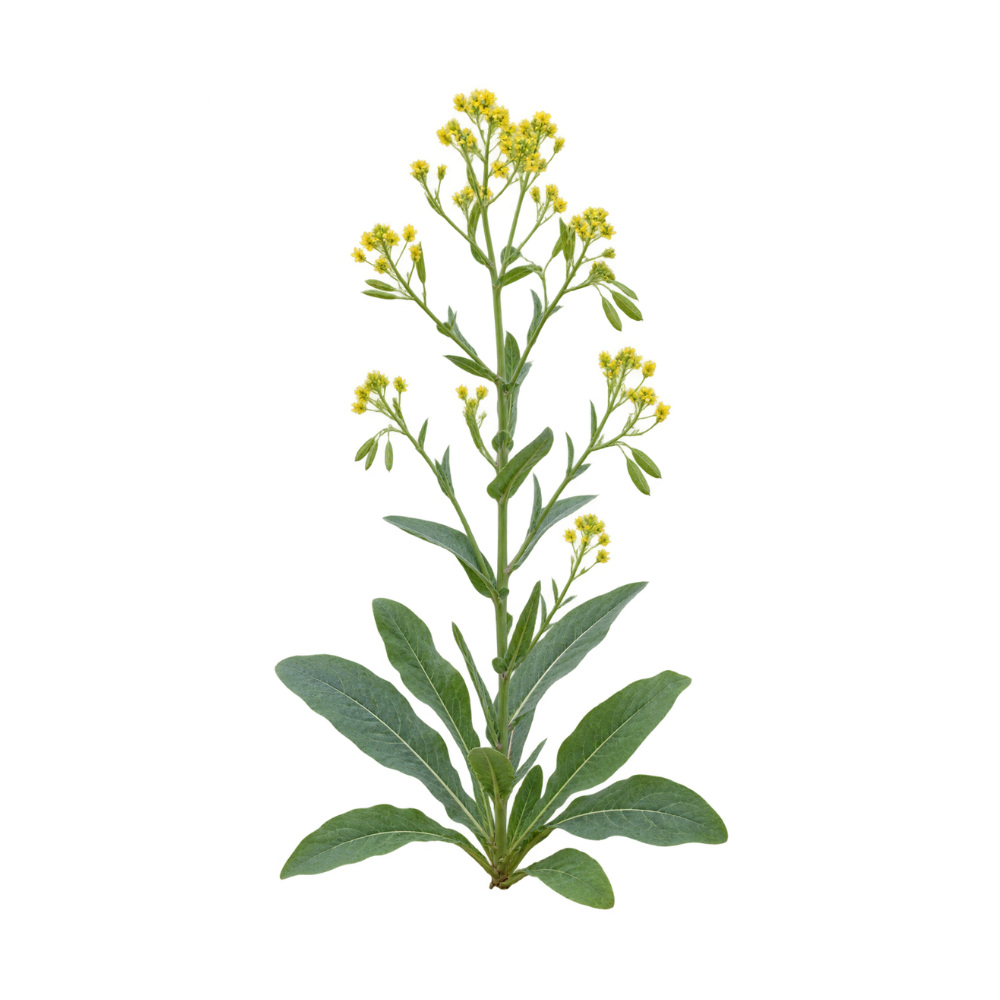
Isatis is an erect biennial herb of the cabbage family (Brassicaceae), usually 40–100 cm tall 25Reference 25Isatis tinctoria Linnaeus (synView study →. Its stems are branched above and are glabrous and somewhat glaucous, or hairy 25Reference 25Isatis tinctoria Linnaeus (synView study →.
The basal leaves form a rosette. They are oblong to oblanceolate and usually 5–15 cm long. The leaves on the stem are stalkless, with arrow-shaped or eared bases that clasp the stem 25Reference 25Isatis tinctoria Linnaeus (synView study →.
The small yellow flowers have four petals 2.5–4 mm long, in the pattern typical of the mustard family 25Reference 25Isatis tinctoria Linnaeus (synView study →. Each fruit is a pod with a wing all round it, 1.1–2 cm long, turning black or dark brown when ripe 25Reference 25Isatis tinctoria Linnaeus (synView study →.
Hairless plants with oblong fruits and small, blunt leaf lobes have been named I. indigotica, and forms with wedge-shaped fruits and well-developed, often pointed lobes I. tinctoria. Every intermediate between them occurs, and Flora of China treats them as one species, Isatis tinctoria 25Reference 25Isatis tinctoria Linnaeus (synView study →.
Distribution
Isatis grows in fields, pastures, roadsides and waste places across much of China, from 600 to 2,800 m 25Reference 25Isatis tinctoria Linnaeus (synView study →. Its range extends to Japan, Korea, Mongolia, Russia, Central and Southwest Asia and Europe 25Reference 25Isatis tinctoria Linnaeus (synView study →.
It has been introduced and naturalised in North America, where it grows along roads and in fields, pastures and sagebrush hillsides 26Reference 26Isatis tinctoria Linnaeus — species description, habitat and distribution — floraView study →.
Growing Conditions
Cultivation snapshot for Isatis
- Full sun on deep, loose, well-drained soil that lets the fleshy taproot down — it is grown as a field crop, and the root (ban lan gen) and the leaf (da qing ye) are harvested as separate drugs.
- Cultivated at scale in China for both medicine and dye. Hebei, Jiangsu, Anhui and Henan were the main growing regions from the 1980s; over the past two decades Shanxi has become the main source of seed, and newer growing areas have developed in Gansu and Heilongjiang 27Reference 27Phenotypic traits, hormonal distribution, and metabolite profiling of Isatis indigotica seeds from 21 samples in China: a traditional Chinese medicinal herb — seed quality studyView study →.
- European woad, which Flora of China treats as the same species, is grown the same way and has naturalised in parts of North America.
Grow it yourself
Farm Wiki is our cultivation-focused sister site, also run by Justin Cooke.
Pharmacology & Research
Isatis has a large laboratory literature. Isolated constituents and fractions of the root inhibit influenza and other viruses in cell culture, and one constituent, indirubin, protected mice against Japanese encephalitis virus 15,
The human trials connected with this plant test indigo naturalis (Qing Dai), a processed indigo powder made from isatis and from other indigo plants 23Reference 23ReviewThe double-edged sword effect of indigo naturalis — reviewView study →. Double-blind randomised trials have tested it for ulcerative colitis and psoriasis 1,
Indirubin, the active constituent of the classical Chinese leukaemia formula Danggui Longhui Wan, inhibits cyclin-dependent kinases and was used to treat leukaemia in China in the 1970s 10,
No trial has tested the root or leaf itself for any indication.
-
Best-supported: anti-inflammatory / immunomodulatory activity — indigo naturalis induced clinical response in a dose-ranging UC RCT and cleared plaque and nail psoriasis in topical trials, with two meta-analyses concordant 1,
2, ; and the indirubin anti-leukaemia lineage, a CDK/GSK-3β inhibitor chemistry 10,3, 5Reference 1RCTEfficacy of indigo naturalis in a multicenter randomized controlled trial of patients with ulcerative colitis — randomised, double-blind, placebo-controlled trialView study →Reference 2Meta-analysisIndigo naturalis (Qing dai) for inflammatory bowel disease — systematic review and meta-analysisView study →Reference 3Meta-analysisHerbal medicines for the treatment of active ulcerative colitis — systematic review and meta-analysis of randomised controlled trialsView study →Reference 5RCTClinical efficacy and IL-17 targeting mechanism of indigo naturalis as a topical agent in moderate psoriasis — randomised, double-blind, placebo-controlled trialView study → 11, .12Reference 10In vitroIndirubin, the active constituent of a Chinese antileukaemia medicine, inhibits cyclin-dependent kinases — in vitroView study →Reference 11In vitroIndirubins inhibit glycogen synthase kinase-3β and CDK5/p25 — in vitroView study →Reference 12In vitroNatural-based indirubins display potent cytotoxicity toward wild-type and T315I-resistant leukemia cell lines — in vitroView study → -
Emerging, worth watching: constituent-level antiviral activity — clemastanin B against influenza A/B and the glucosinolate isomers against H1N1, plus in vivo protection by indirubin against Japanese encephalitis virus 15,
16, .18Reference 15In vitroAntiviral activity of Isatis indigotica root-derived clemastanin B against human and avian influenza A and B viruses in vitroView study →Reference 16In vitroAntiviral activity of Isatidis Radix-derived glucosinolate isomers and their breakdown products against influenza A in vitro / in ovoView study →Reference 18AnimalAntiviral activity of Isatis indigotica extract and its derived indirubin against Japanese encephalitis virus — mouse model / in vivoView study → - Mechanistically thin: antibacterial and antipyretic activity rest on the traditional “resolve-toxin / clear-heat” role, with no dedicated single-herb data.
-
The caveat: the human efficacy evidence is for indigo naturalis and for isolated or derivative molecules, not for the Ban Lan Gen root decoction; indigo naturalis taken for months has caused pulmonary arterial hypertension, intussusception and ischaemic colitis 1,
20, .21, 22Reference 1RCTEfficacy of indigo naturalis in a multicenter randomized controlled trial of patients with ulcerative colitis — randomised, double-blind, placebo-controlled trialView study →Reference 20Clinical trialAdverse events in patients with ulcerative colitis treated with indigo naturalis — Japanese nationwide observational surveyView study →Reference 21ObservationalDramatically improved severe pulmonary arterial hypertension caused by Qing-Dai for ulcerative colitis — observational case reportView study →Reference 22ObservationalIndigo naturalis-associated ischemic injury of colorectal mucosa — observational case seriesView study →
Indigo naturalis and the root are different medicines. Indigo naturalis is a concentrated indigo powder, often made from Baphicacanthus or Polygonum rather than isatis 23Reference 23ReviewThe double-edged sword effect of indigo naturalis — reviewView study →. Its benefits and its harms do not transfer to Ban Lan Gen root decoction.
1. Anti-Inflammatory / Immunomodulatory
In a multicentre, double-blind trial (INDIGO study, 86 patients, 8 weeks), oral indigo naturalis produced a dose-dependent clinical response in active ulcerative colitis. Response rates were 69.6%, 75.0% and 81.0% at 0.5, 1.0 and 2.0 g/day, against 13.6% on placebo. Clinical remission was 55.0% at 1.0 g and 38.1% at 2.0 g, against 4.5% 1Reference 1RCTEfficacy of indigo naturalis in a multicenter randomized controlled trial of patients with ulcerative colitis — randomised, double-blind, placebo-controlled trialView study →.
The trial was stopped early after pulmonary arterial hypertension was reported in a patient who had taken self-purchased indigo naturalis for six months. Mild liver dysfunction occurred in 10 treated patients, and there were no serious adverse events in the trial 1Reference 1RCTEfficacy of indigo naturalis in a multicenter randomized controlled trial of patients with ulcerative colitis — randomised, double-blind, placebo-controlled trialView study →.
Two meta-analyses found clinical response about 3.7–3.8 times more likely than on placebo 2,
In psoriasis, topical indigo naturalis ointment gave 56.3% of patients a PASI 75 response at 8 weeks, against 0% on placebo, in a trial of 24 patients. It turned down the IL-17 pathway in the skin 5Reference 5RCTClinical efficacy and IL-17 targeting mechanism of indigo naturalis as a topical agent in moderate psoriasis — randomised, double-blind, placebo-controlled trialView study →. In an earlier study of 14 patients, each treated one plaque with indigo naturalis and another with a plain ointment, and the treated plaques improved clinically and on biopsy 6Reference 6RCTThe efficacy and safety of topically applied indigo naturalis ointment in patients with plaque-type psoriasis — randomised controlled trialView study →. An oil extract, Lindioil, reduced nail-psoriasis scores more than olive oil over 12 weeks 7Reference 7RCTEfficacy and safety of indigo naturalis extract in oil (Lindioil) in treating nail psoriasis — randomised, observer-blind, vehicle-controlled trialView study →.
Tryptanthrin inhibits IL-17 in keratinocytes and TH17 polarisation in cell studies 5,
Gap: all of this is indigo naturalis or an isolated constituent — a processed, indigo-concentrated preparation frequently made from other plants rather than Isatis, and a different medicine from the Ban Lan Gen root decoction; no trial has tested the whole isatis root for inflammation.
2. Anticancer (Leukaemia Lineage)
Indirubin, the active constituent of the classical Chinese anti-leukaemia formula Danggui Longhui Wan, inhibits cyclin-dependent kinases, as a crystal structure with CDK2 confirms. Its derivative indirubin-3’-monoxime arrests cells at the G2/M phase 10Reference 10In vitroIndirubin, the active constituent of a Chinese antileukaemia medicine, inhibits cyclin-dependent kinases — in vitroView study →.
Indirubins also inhibit GSK-3β, with IC₅₀ values of 5–50 nM 11Reference 11In vitroIndirubins inhibit glycogen synthase kinase-3β and CDK5/p25 — in vitroView study →. Analogues of natural 6-bromoindirubin killed imatinib-resistant T315I-mutant chronic myeloid leukaemia (CML) cells at submicromolar concentrations by inhibiting c-Src and Abl kinases 12Reference 12In vitroNatural-based indirubins display potent cytotoxicity toward wild-type and T315I-resistant leukemia cell lines — in vitroView study →. The derivative E804 triggered apoptosis in resistant CML cell lines and in primary patient cells by blocking Stat5 signalling 13Reference 13In vitroIndirubin derivatives induce apoptosis of chronic myelogenous leukemia cells involving inhibition of Stat5 signaling — in vitroView study →.
Indirubin was used to treat leukaemia in China in the 1970s 24Reference 24ReviewA comprehensive review of the chemistry, pharmacokinetics, pharmacology, clinical applications, adverse events, and quality control of indigo naturalis — reviewView study →. The semi-synthetic derivative meisoindigo has been used clinically for CML in China, and the arsenic-containing Realgar-Indigo Naturalis Formula is in registered trials for acute promyelocytic leukaemia. Both are derivative or combination products.
Gap: the isatis herb itself has never been trialled for cancer.
5. Antibacterial
Resolving “heat toxicity” in Chinese medicine covers bacterial as well as viral infection. Indigo naturalis has shown antibacterial activity in laboratory studies 24Reference 24ReviewA comprehensive review of the chemistry, pharmacokinetics, pharmacology, clinical applications, adverse events, and quality control of indigo naturalis — reviewView study →.
There are no antibacterial data for the root or leaf on their own, and no clinical data.
6. Antipyretic
Clearing heat, which includes bringing down fever, is central to the traditional use of isatis. No study has tested the root or leaf for fever.
In cell studies, indigo naturalis and tryptanthrin lower the inflammatory cytokines IL-1β and TNF-α 8Reference 8In vitroThe anti-Th17 polarization effect of indigo naturalis and tryptanthrin by differentially inhibiting cytokine expression — in vitroView study →.
Mechanisms
The indole alkaloids indirubin, indigo and tryptanthrin are concentrated in indigo naturalis. They have been studied at the aryl-hydrocarbon receptor, in the IL-17 pathway and at cell-cycle kinases.
The antiviral findings come from other constituents: the lignan clemastanin B, the glucosinolate isomers and the root polysaccharides.
| Mechanism | Drives | Key compounds |
|---|---|---|
| Aryl-hydrocarbon-receptor activation → IL-22, mucosal regeneration | anti-inflammatory (ulcerative colitis) | indirubin, indigo |
| Th17 / IL-17 pathway suppression | anti-inflammatory (psoriasis) | tryptanthrin, indirubin |
| IL-1β, TNF-α ↓; TLR-3 signalling ↓ | anti-inflammatoryimmunomodulatory | tryptanthrin, polysaccharides |
| CDK / GSK-3β / c-Src–Abl / Stat5 inhibition, G2/M arrest | anticancer (leukaemia) | indirubin + derivatives (meisoindigo) |
| Viral uncoating / RNP nuclear-export block; envelope attachment | antiviral (influenza) | clemastanin B, epigoitrin |
| IFN-α-dependent JAK/STAT activation | antiviral (hepatitis Bindirect) | root polysaccharide |
Clinical Trials
No trial has tested the root or leaf for efficacy. The registered human trials are for indigo naturalis (psoriasis, ulcerative colitis) and for the arsenic-containing Realgar-Indigo Naturalis Formula in acute promyelocytic leukaemia. The INDIGO ulcerative colitis trial was stopped early after a pulmonary arterial hypertension report in a patient treating herself 1Reference 1RCTEfficacy of indigo naturalis in a multicenter randomized controlled trial of patients with ulcerative colitis — randomised, double-blind, placebo-controlled trialView study →.
| Completed | Planned | Terminated | Preclinical |
|---|---|---|---|
| ~8(indigo naturalis / RIF) | ~4(recruiting; RIF / leukaemia) | 1(INDIGO UC RCT) | ~50+ |
Last checked: August 2026.
Phytochemistry
The root contains the lignan clemastanin B, one of its major lignans 15Reference 15In vitroAntiviral activity of Isatis indigotica root-derived clemastanin B against human and avian influenza A and B viruses in vitroView study →. It also holds the glucosinolates progoitrin and epiprogoitrin, whose breakdown products are goitrin and epigoitrin 16Reference 16In vitroAntiviral activity of Isatidis Radix-derived glucosinolate isomers and their breakdown products against influenza A in vitro / in ovoView study →. The root is rich in polysaccharides 9,
The blue dye comes from fermenting the leaves 25Reference 25Isatis tinctoria Linnaeus (synView study →. Indigo naturalis contains more than sixty identified compounds, of which the indole alkaloids are the most important 24Reference 24ReviewA comprehensive review of the chemistry, pharmacokinetics, pharmacology, clinical applications, adverse events, and quality control of indigo naturalis — reviewView study →. These include indigo, its red isomer indirubin, and tryptanthrin 24Reference 24ReviewA comprehensive review of the chemistry, pharmacokinetics, pharmacology, clinical applications, adverse events, and quality control of indigo naturalis — reviewView study →.
Studies of indigo naturalis and of Isatis tinctoria should be read separately from studies of the Ban Lan Gen root 14,
Constituent Summary
Amounts vary with plant part, processing and source.
Indole Alkaloid3 compoundsno data
Lignan1 compoundno data
Other1 compoundno data
Phenolic Acid1 compoundno data
Dosage
Ban Lan Gen (root) is traditionally decocted at about 9–15 g per day, and is very widely taken as a granule dissolved in hot water at the first sign of a cold or sore throat. Da Qing Ye (leaf) is used in the same way.
Indigo naturalis is a separate preparation. In the ulcerative colitis trial it was taken at 0.5–2.0 g a day for 8 weeks 1Reference 1RCTEfficacy of indigo naturalis in a multicenter randomized controlled trial of patients with ulcerative colitis — randomised, double-blind, placebo-controlled trialView study →.
Safety & Pregnancy
Isatis root has a good record in ordinary short-term use. As a cold herb it is not meant for long or high-dose use.
- Short-term use. Very widely used as an over-the-counter cold granule at normal doses.
- Not for prolonged or high-dose use. Traditionally avoided in spleen and stomach deficiency; rare digestive upset and haemolysis have been reported with heavy or long use.
- Few safety studies. No human safety trial or herb–drug interaction study of the root exists.
- Indigo naturalis is a different medicine. Taken for months, it has caused pulmonary arterial hypertension, intussusception and ischaemic colitis.
Full Safety & Interactions Detail
The root. Ban Lan Gen is one of the most widely used over-the-counter herbal cold remedies in China. As a strongly cold herb it is traditionally avoided by people with digestive cold or deficiency, and it is not meant for prolonged high-dose use. Occasional reports describe digestive upset and, rarely, haemolytic reactions with heavy or extended use. There are no human safety trials and no herb–drug interaction studies.
Indigo naturalis. A Japanese nationwide survey found indigo naturalis used by 877 patients with ulcerative colitis. Adverse events were reported in 91 of them, including liver dysfunction (40), pulmonary arterial hypertension (11) and intussusception (10), and 4 of the 10 intussusception cases needed surgery. The pulmonary hypertension resolved when the powder was stopped, and no deaths were reported 20Reference 20Clinical trialAdverse events in patients with ulcerative colitis treated with indigo naturalis — Japanese nationwide observational surveyView study →.
Pulmonary arterial hypertension. In one case, a woman who had taken Qing Dai for 8 months developed severe pulmonary arterial hypertension. Her mean pulmonary artery pressure fell from 72 to 18 mmHg after she stopped it and received treatment 21Reference 21ObservationalDramatically improved severe pulmonary arterial hypertension caused by Qing-Dai for ulcerative colitis — observational case reportView study →.
Ischaemic colitis. In a Chinese series, 15 of 1,157 patients taking patent medicines containing indigo naturalis developed ischaemic injury of the colon. All recovered after stopping 22Reference 22ObservationalIndigo naturalis-associated ischemic injury of colorectal mucosa — observational case seriesView study →.
Isatis has not been studied as a single herb in pregnancy or while breastfeeding. As a cold, detoxifying herb it is generally used cautiously and short-term; seek professional advice before using it in pregnancy.
References
- Naganuma, M., et al. (2018). Efficacy of indigo naturalis in a multicenter randomized controlled trial of patients with ulcerative colitis — randomised, double-blind, placebo-controlled trial. Gastroenterology. https://pubmed.ncbi.nlm.nih.gov/29174928/
- Kakdiya, R., et al. (2024). Indigo naturalis (Qing dai) for inflammatory bowel disease — systematic review and meta-analysis. Clinical Research in Hepatology and Gastroenterology. https://pubmed.ncbi.nlm.nih.gov/38006941/
- Iyengar, P., et al. (2024). Herbal medicines for the treatment of active ulcerative colitis — systematic review and meta-analysis of randomised controlled trials. Nutrients. https://pubmed.ncbi.nlm.nih.gov/38612967/
- Matsuno, Y., et al. (2022). One-year clinical efficacy and safety of indigo naturalis for active ulcerative colitis — prospective observational cohort study. Intestinal Research. https://pubmed.ncbi.nlm.nih.gov/35508956/
- Cheng, H. M., et al. (2017). Clinical efficacy and IL-17 targeting mechanism of indigo naturalis as a topical agent in moderate psoriasis — randomised, double-blind, placebo-controlled trial. BMC Complementary and Alternative Medicine. https://pubmed.ncbi.nlm.nih.gov/28865459/
- Lin, Y. K., et al. (2007). The efficacy and safety of topically applied indigo naturalis ointment in patients with plaque-type psoriasis — randomised controlled trial. Dermatology. https://pubmed.ncbi.nlm.nih.gov/17341866/
- Lin, Y. K., et al. (2014). Efficacy and safety of indigo naturalis extract in oil (Lindioil) in treating nail psoriasis — randomised, observer-blind, vehicle-controlled trial. Phytomedicine. https://pubmed.ncbi.nlm.nih.gov/24680615/
- Cheng, H. M., et al. (2020). The anti-Th17 polarization effect of indigo naturalis and tryptanthrin by differentially inhibiting cytokine expression — in vitro. Journal of Ethnopharmacology. https://pubmed.ncbi.nlm.nih.gov/32173427/
- Li, Z., et al. (2017). Radix isatidis polysaccharides inhibit influenza A virus and influenza A virus-induced inflammation via suppression of host TLR-3 signalling — in vitro. Molecules. https://pubmed.ncbi.nlm.nih.gov/28085062/
- Hoessel, R., et al. (1999). Indirubin, the active constituent of a Chinese antileukaemia medicine, inhibits cyclin-dependent kinases — in vitro. Nature Cell Biology. https://pubmed.ncbi.nlm.nih.gov/10559866/
- Leclerc, S., et al. (2001). Indirubins inhibit glycogen synthase kinase-3β and CDK5/p25 — in vitro. Journal of Biological Chemistry. https://pubmed.ncbi.nlm.nih.gov/11013232/
- Gaboriaud-Kolar, N., et al. (2016). Natural-based indirubins display potent cytotoxicity toward wild-type and T315I-resistant leukemia cell lines — in vitro. Journal of Natural Products. https://pubmed.ncbi.nlm.nih.gov/27726390/
- Nam, S., et al. (2012). Indirubin derivatives induce apoptosis of chronic myelogenous leukemia cells involving inhibition of Stat5 signaling — in vitro. Molecular Oncology. https://pubmed.ncbi.nlm.nih.gov/22387217/
- Cai, C., et al. (2021). In silico prediction and bioactivity evaluation of chemical ingredients against influenza A virus from Isatis tinctoria — in silico and in vitro. Frontiers in Pharmacology. https://pubmed.ncbi.nlm.nih.gov/34950027/
- Yang, Z., et al. (2013). Antiviral activity of Isatis indigotica root-derived clemastanin B against human and avian influenza A and B viruses in vitro. International Journal of Molecular Medicine. https://pubmed.ncbi.nlm.nih.gov/23403777/
- Nie, L. X., et al. (2020). Antiviral activity of Isatidis Radix-derived glucosinolate isomers and their breakdown products against influenza A in vitro / in ovo. Journal of Ethnopharmacology. https://pubmed.ncbi.nlm.nih.gov/31918015/
- Xiao, P., et al. (2016). Antiviral activities against influenza virus (FM1) of bioactive fractions and representative compounds extracted from Banlangen (Radix Isatidis) — in vitro. Journal of Traditional Chinese Medicine. https://pubmed.ncbi.nlm.nih.gov/27468553/
- Chang, S. J., et al. (2012). Antiviral activity of Isatis indigotica extract and its derived indirubin against Japanese encephalitis virus — mouse model / in vivo. Evidence-Based Complementary and Alternative Medicine. https://pubmed.ncbi.nlm.nih.gov/22911608/
- Wang, T., et al. (2020). Antiviral activity of a polysaccharide from Radix Isatidis against hepatitis B virus in vitro via activation of the JAK/STAT pathway. Journal of Ethnopharmacology. https://pubmed.ncbi.nlm.nih.gov/32217096/
- Naganuma, M., et al. (2019). Adverse events in patients with ulcerative colitis treated with indigo naturalis — Japanese nationwide observational survey. Journal of Gastroenterology. https://pubmed.ncbi.nlm.nih.gov/31102012/
- Kubota, K., et al. (2023). Dramatically improved severe pulmonary arterial hypertension caused by Qing-Dai for ulcerative colitis — observational case report. International Heart Journal. https://pubmed.ncbi.nlm.nih.gov/37005323/
- Ke, Y., et al. (2025). Indigo naturalis-associated ischemic injury of colorectal mucosa — observational case series. Experimental and Therapeutic Medicine. https://pubmed.ncbi.nlm.nih.gov/39991716/
- Xu, Y., et al. (2024). The double-edged sword effect of indigo naturalis — review. Food and Chemical Toxicology. https://pubmed.ncbi.nlm.nih.gov/38301993/
- Sun, Q., et al. (2021). A comprehensive review of the chemistry, pharmacokinetics, pharmacology, clinical applications, adverse events, and quality control of indigo naturalis — review. Frontiers in Pharmacology. https://pubmed.ncbi.nlm.nih.gov/34135755/
- Cheo, T. Y., Lu, L. L., Yang, G., Al-Shehbaz, I. A., & Dorofeev, V. (2001). Isatis tinctoria Linnaeus (syn. I. indigotica Fortune) — species description, habitat and distribution — flora. In Wu, Z. Y., & Raven, P. H. (eds.), Flora of China, Vol. 8. http://www.efloras.org/florataxon.aspx?flora_id=2&taxon_id=200009571
- Al-Shehbaz, I. A. (2010). Isatis tinctoria Linnaeus — species description, habitat and distribution — flora. In Flora of North America Editorial Committee (eds.), Flora of North America North of Mexico, Vol. 7. http://www.efloras.org/florataxon.aspx?flora_id=1&taxon_id=200009571
- Wang L, Liu J, Dong Y, et al. (2025). Phenotypic traits, hormonal distribution, and metabolite profiling of Isatis indigotica seeds from 21 samples in China: a traditional Chinese medicinal herb — seed quality study. Plants (Basel), 14(7), 1096. https://pubmed.ncbi.nlm.nih.gov/40219164/



