
Materia Medica
Lodgepole Pine
Pinus contorta
Lodgepole pine is a two-needled pine of western North America, used by Indigenous peoples as medicine and food. Its resin, or pitch, was applied to wounds and sores, and its needles and inner bark were taken for coughs and colds.
What Is Lodgepole Pine?
Lodgepole pine is a two-needled pine of western North America, used by Indigenous peoples across its range as a medicine and a food. Its resin, or pitch, was made into salves for wounds, sores and aching joints, and its needles and inner bark were taken for coughs and colds 12Reference 12Pinus contorta — species description, subspecies, distribution, ecology, ethnobotany, uses and naturalisation — reference databaseView study →.
Pinus contorta grows from Alaska and the Yukon south through the Rocky Mountains and along the Pacific coast to Baja California 12Reference 12Pinus contorta — species description, subspecies, distribution, ecology, ethnobotany, uses and naturalisation — reference databaseView study →. It takes very different forms: tall, straight trees inland, and short, wind-twisted trees on the coast 12Reference 12Pinus contorta — species description, subspecies, distribution, ecology, ethnobotany, uses and naturalisation — reference databaseView study →. The inland trees gave the species its common name, as poles for the lodges of Plains peoples 12Reference 12Pinus contorta — species description, subspecies, distribution, ecology, ethnobotany, uses and naturalisation — reference databaseView study →.
The needle oil, resin and bark have all been analysed chemically 2,
The needles contain isocupressic acid, which causes abortion in cattle 5Reference 5Abortifacient effects of lodgepole pine (Pinus contorta) and common juniper (Juniperus communis) on cattle — animal feeding trialView study →.
How Is Lodgepole Pine Used?
- Pitch — the resin, applied alone or in salves and poultices to cuts, sores, burns, boils and aching joints 12Reference 12Pinus contorta — species description, subspecies, distribution, ecology, ethnobotany, uses and naturalisation — reference databaseView study →.
- Needle and inner-bark decoction — drunk for coughs, colds and influenza, tuberculosis and stomach pain 12Reference 12Pinus contorta — species description, subspecies, distribution, ecology, ethnobotany, uses and naturalisation — reference databaseView study →.
- Inner bark — the soft cambium layer, peeled and eaten fresh or dried in May and June 12Reference 12Pinus contorta — species description, subspecies, distribution, ecology, ethnobotany, uses and naturalisation — reference databaseView study →.
- Chewing pitch — the pitch was also chewed like gum 12Reference 12Pinus contorta — species description, subspecies, distribution, ecology, ethnobotany, uses and naturalisation — reference databaseView study →.
Traditional Uses
Indigenous Peoples of Western North America
The pitch was used on the skin. The Bella Coola, Okanagan and Thompson peoples used salves or poultices containing it for rheumatism and aching muscles and joints 12Reference 12Pinus contorta — species description, subspecies, distribution, ecology, ethnobotany, uses and naturalisation — reference databaseView study →. The Flathead used it for burns and boils, the Coast Salish for psoriasis, and the Quinault and Bella Coola for open sores, cuts and scrapes 12Reference 12Pinus contorta — species description, subspecies, distribution, ecology, ethnobotany, uses and naturalisation — reference databaseView study →. Carrier pitch preparations were among the remedies later tested for antimicrobial activity 1Reference 1In vitroCarrier herbal medicine: an evaluation of the antimicrobial and anticancer activity in some frequently used remedies — in vitroView study →.
The Klamath and Northern Carrier applied the resin to sore eyes and to treat snow-blindness 12Reference 12Pinus contorta — species description, subspecies, distribution, ecology, ethnobotany, uses and naturalisation — reference databaseView study →. The Nitinaht and Thompson mixed it with tallow as a cosmetic or rubbed it on the skin of newborn babies 12Reference 12Pinus contorta — species description, subspecies, distribution, ecology, ethnobotany, uses and naturalisation — reference databaseView study →.
A decoction of the needles and inner bark was drunk for coughs and colds by many peoples, among them the Kwakiutl, Okanagan, Shuswap, Thompson and Quinault 12Reference 12Pinus contorta — species description, subspecies, distribution, ecology, ethnobotany, uses and naturalisation — reference databaseView study →. It was also taken for tuberculosis, stomach pain, influenza, and as a purgative and diuretic 12Reference 12Pinus contorta — species description, subspecies, distribution, ecology, ethnobotany, uses and naturalisation — reference databaseView study →. The Haisla and Hanaksiala applied smouldering twigs to ease joint pain 12Reference 12Pinus contorta — species description, subspecies, distribution, ecology, ethnobotany, uses and naturalisation — reference databaseView study →.
The inner bark was a valued spring food for many peoples, from the Coast Salish to the Gitksan and Wet’suwet’en 12Reference 12Pinus contorta — species description, subspecies, distribution, ecology, ethnobotany, uses and naturalisation — reference databaseView study →. It was harvested in May and June and eaten fresh or dried 12Reference 12Pinus contorta — species description, subspecies, distribution, ecology, ethnobotany, uses and naturalisation — reference databaseView study →.
Indications
- Wounds, cuts, scrapes and open sores [pitch, applied to the skin; Indigenous use]
- Burns and boils [pitch; Flathead use]
- Rheumatism and aching muscles and joints [pitch salve or poultice; Indigenous use]
- Psoriasis [pitch salve; Coast Salish use]
- Sore eyes and snow-blindness [resin; Klamath and Northern Carrier use]
- Coughs, colds and influenza [needle and inner-bark decoction; Indigenous use]
- Tuberculosis [needle and inner-bark decoction; Indigenous use]
- Stomach pain [needle and inner-bark decoction; Indigenous use]
Botany
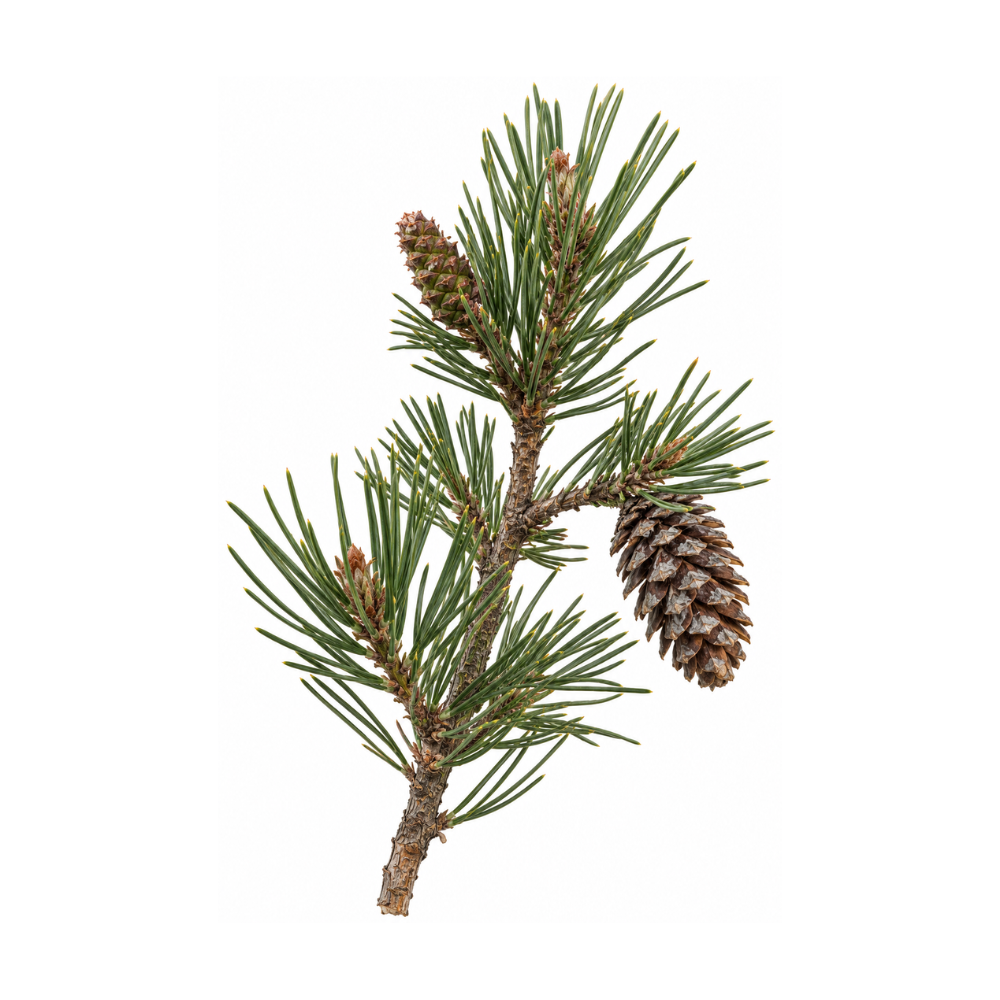
Lodgepole pine is an evergreen conifer of the pine family (Pinaceae). It grows as a shrub or a tree up to 50 m tall and 90 cm in trunk diameter, and its shape varies with its genetic race 12Reference 12Pinus contorta — species description, subspecies, distribution, ecology, ethnobotany, uses and naturalisation — reference databaseView study →.
Its needles grow in bundles of two, rarely three. They are 2–8 cm long, twisted, and yellow-green to dark green, and stay on the tree for three to eight years 12Reference 12Pinus contorta — species description, subspecies, distribution, ecology, ethnobotany, uses and naturalisation — reference databaseView study →.
The seed cones are 3–6 cm long, lopsided, and tan to pale red-brown, and they take 16–20 months to ripen 12Reference 12Pinus contorta — species description, subspecies, distribution, ecology, ethnobotany, uses and naturalisation — reference databaseView study →. Each cone scale carries a prickle up to 6 mm long 12Reference 12Pinus contorta — species description, subspecies, distribution, ecology, ethnobotany, uses and naturalisation — reference databaseView study →. The seeds are about 5 mm long and black, with a wing of 10–14 mm 12Reference 12Pinus contorta — species description, subspecies, distribution, ecology, ethnobotany, uses and naturalisation — reference databaseView study →.
The Gymnosperm Database recognises three subspecies, which are sometimes treated as varieties 12Reference 12Pinus contorta — species description, subspecies, distribution, ecology, ethnobotany, uses and naturalisation — reference databaseView study →:
- Rocky Mountain lodgepole pine (subsp. latifolia) is a straight, evenly tapering tree up to 41 m tall 13Reference 13Pinus contorta subsp. latifolia — description and distribution — reference databaseView study →.
- Shore pine (subsp. contorta) grows to 10 m. On exposed sites it is bent and twisted by wind and salt spray, or reduced to a shrub 14Reference 14Pinus contorta subsp. contorta — description and distribution — reference databaseView study →.
- Sierra lodgepole pine (subsp. murrayana) is a straight tree up to 41 m tall, with a trunk up to 200 cm across 15Reference 15Pinus contorta subsp. murrayana — description and distribution — reference databaseView study →.
Many cones of the inland trees are serotinous. They stay sealed with resin for years, until the heat of a fire, at 45–50 °C, melts the resin and opens them 16Reference 16Pinus contorta var. latifolia — distribution, botanical and ecological characteristics, fire ecology and cone serotiny — species databaseView study →. The seeds released after a fire produce dense stands of even-aged young trees 12Reference 12Pinus contorta — species description, subspecies, distribution, ecology, ethnobotany, uses and naturalisation — reference databaseView study →. Sierra lodgepole cones are not serotinous and are shed soon after ripening 15Reference 15Pinus contorta subsp. murrayana — description and distribution — reference databaseView study →.
Distribution
Lodgepole pine grows in the western United States, western Canada and northern Baja California in Mexico, from sea level to about 3,500 m 12Reference 12Pinus contorta — species description, subspecies, distribution, ecology, ethnobotany, uses and naturalisation — reference databaseView study →.
Shore pine grows along the coast from Alaska to northwestern California, in maritime forest, bogs and dry foothills up to 600 m 14Reference 14Pinus contorta subsp. contorta — description and distribution — reference databaseView study →. Rocky Mountain lodgepole pine grows in the Rocky Mountains and other interior ranges, from the Yukon and Alberta south to Colorado and Utah and east to the Black Hills of South Dakota 13Reference 13Pinus contorta subsp. latifolia — description and distribution — reference databaseView study →. Sierra lodgepole pine grows in the Cascade Range of Oregon, the mountains of California and western Nevada, and the Sierra San Pedro Mártir of Baja California 15Reference 15Pinus contorta subsp. murrayana — description and distribution — reference databaseView study →.
The species grows on sites that defeat most other conifers: cold treelines, bogs, rocky ground and nutrient-poor soils 12Reference 12Pinus contorta — species description, subspecies, distribution, ecology, ethnobotany, uses and naturalisation — reference databaseView study →. After fire or a bark-beetle outbreak it seeds heavily and dominates the new forest 12Reference 12Pinus contorta — species description, subspecies, distribution, ecology, ethnobotany, uses and naturalisation — reference databaseView study →.
Lodgepole pine is an important timber tree, planted widely in Scandinavia and also grown in Britain, Iceland, Chile, Argentina and New Zealand 12Reference 12Pinus contorta — species description, subspecies, distribution, ecology, ethnobotany, uses and naturalisation — reference databaseView study →. It has become naturalised in New Zealand, where it has long been a serious problem for native vegetation, and more locally in Britain 12Reference 12Pinus contorta — species description, subspecies, distribution, ecology, ethnobotany, uses and naturalisation — reference databaseView study →. It has also spread into native vegetation in Australia, Chile and Argentina 12Reference 12Pinus contorta — species description, subspecies, distribution, ecology, ethnobotany, uses and naturalisation — reference databaseView study →.
The species is listed as Least Concern on the IUCN Red List 12Reference 12Pinus contorta — species description, subspecies, distribution, ecology, ethnobotany, uses and naturalisation — reference databaseView study →. Its pitch and needles can be gathered from standing trees.
Growing Conditions
Cultivation snapshot for Lodgepole Pine
ZoneUSDA 4–8 for the inland form; the coastal form takes milder, wetter conditions.
- Full sun and poor ground. It tolerates acid, infertile, sandy, boggy and serpentine soils that defeat most conifers, and it is intolerant of shade at every age.
- Fire is part of its biology. Serotinous cones need heat to open, so natural regeneration follows burns; in cultivation seed germinates without it.
- Fast-growing and short-lived, prone to mountain pine beetle in dense mature stands.
- Outside North America it can spread. It has naturalised in New Zealand and parts of Britain, and invades native vegetation in Australia, Chile and Argentina 12Reference 12Pinus contorta — species description, subspecies, distribution, ecology, ethnobotany, uses and naturalisation — reference databaseView study →.
Grow it yourself
Farm Wiki is our cultivation-focused sister site, also run by Justin Cooke.
Pharmacology & Research
One study has tested a lodgepole pine preparation for a therapeutic effect. In 1996, a screen of Carrier (Dakelh) remedies from British Columbia found that the pine’s pitch preparation was active against bacteria and fungi in the laboratory 1Reference 1In vitroCarrier herbal medicine: an evaluation of the antimicrobial and anticancer activity in some frequently used remedies — in vitroView study →. There is no human clinical evidence and no registered trial.
The rest of the research is chemistry, ecology and veterinary toxicology. The needle oil, the resin acids and the bark have been analysed 2,
- Best-supported: in-vitro antimicrobial activity of the traditional pitch (resin) preparation against bacteria and fungi, from a single agar-dilution study 1Reference 1In vitroCarrier herbal medicine: an evaluation of the antimicrobial and anticancer activity in some frequently used remedies — in vitroView study →.
-
Emerging, worth watching: the needle oil and resin contain monoterpenes and resin acids — β-phellandrene, terpinen-4-ol, α- and β-pinene, abietic acid — that have been studied in other conifers; none has been tested in lodgepole 2,
3, .4Reference 2Essential-oil compositions of Pinus species (P. contorta subsp. contorta, P. ponderosa var. ponderosa and P. flexilis): enantiomeric distribution of terpenoids — analyticalView study →Reference 3Gymnosperms of Idaho: chemical compositions and enantiomeric distributions of essential oils of Abies lasiocarpa, Picea engelmannii, Pinus contorta, Pseudotsuga menziesii and Thuja plicata — analyticalView study →Reference 4In vitroDiterpenoid resin acid biosynthesis in conifers: enzymatic cyclisation of geranylgeranyl pyrophosphate to abietadiene, the precursor of abietic acid — in vitro enzymologyView study → - Mechanistically thin: antioxidant and anti-inflammatory activity has not been measured; the needle phenolics have been profiled but never assayed 9Reference 9Multivariate study of moose browsing in relation to phenol pattern in pine needles — analytical / ecologyView study →.
-
The caveat: there are no human data, and the needles contain a compound that causes abortion in cattle 5,
6, .7Reference 5Abortifacient effects of lodgepole pine (Pinus contorta) and common juniper (Juniperus communis) on cattle — animal feeding trialView study →Reference 6Development of enzyme-linked immunosorbent assays for isocupressic acid and serum metabolites of isocupressic acid — analytical / animalView study →Reference 7In vitroEffects of the pine-needle abortifacient isocupressic acid on bovine oocyte maturation and preimplantation embryo development — in vitro / in vivoView study →
The one therapeutic study reported only whether activity was present. It gave no minimum inhibitory concentrations, and the active compound was never identified 1Reference 1In vitroCarrier herbal medicine: an evaluation of the antimicrobial and anticancer activity in some frequently used remedies — in vitroView study →.
1. Antimicrobial
Ritch-Krc and colleagues screened traditional Carrier (Dakelh) herbal remedies from British Columbia by agar dilution. The pitch (resin) preparations of P. contorta and of white spruce, Picea glauca, showed definite activity against Escherichia coli, Staphylococcus aureus, Pseudomonas aeruginosa, the yeast Candida albicans and the mould Aspergillus fumigatus 1Reference 1In vitroCarrier herbal medicine: an evaluation of the antimicrobial and anticancer activity in some frequently used remedies — in vitroView study →.
The tested material was the pitch remedy itself, the same preparation used on skin infections and wounds. The resin is rich in diterpene resin acids such as abietic acid, along with volatile monoterpenes 3,
⚠ One study, one laboratory, and presence or absence of activity only. There were no minimum inhibitory concentrations, no tests in animals, and no isolation of the active compound.
⚠⚠ The cytotoxicity (“anticancer”) results in the same paper were for Alnus and Shepherdia extracts, not for pine.
Gap: no potency data, no in-vivo or clinical testing, and no identified active constituent.
2. Anti-Inflammatory
⚠ No study has measured an anti-inflammatory effect of P. contorta.
Lodgepole needle oil and resin contain monoterpenes including α-pinene, β-pinene, β-phellandrene and terpinen-4-ol 2,
Pine essential oils differ in composition, and the ratios of the two mirror-image forms of α-pinene and limonene vary between samples 2Reference 2Essential-oil compositions of Pinus species (P. contorta subsp. contorta, P. ponderosa var. ponderosa and P. flexilis): enantiomeric distribution of terpenoids — analyticalView study →. Activity shown in another pine’s oil cannot be assumed for this one.
Gap: no P. contorta-specific anti-inflammatory data, in vitro, in vivo or in people.
3. Antioxidant
The needle phenolics of P. contorta have been separated and profiled by HPLC, in a study of moose browsing. Their pattern differed between species and between habitats 9Reference 9Multivariate study of moose browsing in relation to phenol pattern in pine needles — analytical / ecologyView study →.
⚠ The antioxidant activity itself has never been assayed for lodgepole: there is no DPPH, ABTS, ORAC or cell-based work on the species.
Gap: the phenolics are documented, but no antioxidant assay has been run on P. contorta material.
Mechanisms
The pitch is rich in diterpene resin acids, chiefly abietic acid, and volatile monoterpenes 3,
The needles contain isocupressic acid, a labdane diterpene. In cattle it is broken down to agathic and dihydroagathic acids, and in cell studies it blocks progesterone production by the corpus luteum 6,
| Mechanism | Drives | Key compounds |
|---|---|---|
| Lipophilic antimicrobial action of the resin | antimicrobial | abietic acid, diterpene resin acids, volatile monoterpenes |
| Monoterpene and resin-acid modulation of inflammatory signalling (inferred from other conifers) | anti-inflammatory | alpha-pinene, beta-phellandrene, terpinen-4-ol |
| Phenolic radical scavenging — unassayed in this species | antioxidant | needle phenolics (profiled, not identified as actives) |
| Suppression of luteal progesterone production | safety — abortion in cattle | isocupressic acid and its agathic and dihydroagathic acid metabolites |
Clinical Trials
No registered clinical trials of Pinus contorta were identified. The only ClinicalTrials.gov entry naming the species is a wildfire-smoke study that lists it as forest fuel.
| Completed | Planned | Terminated | Preclinical |
|---|---|---|---|
| 0 | 0 | 0 | ~1in vitro, plus chemistry and toxicology |
Last checked: August 2026.
Phytochemistry
The needle essential oil of shore pine (subsp. contorta) from Oregon is led by β-phellandrene at 23.8% and terpinen-4-ol at 11.0% 2Reference 2Essential-oil compositions of Pinus species (P. contorta subsp. contorta, P. ponderosa var. ponderosa and P. flexilis): enantiomeric distribution of terpenoids — analyticalView study →. Chiral analysis found that the ratios of the mirror-image forms of α-pinene and limonene vary between pine samples, while (−)-β-pinene predominates 2Reference 2Essential-oil compositions of Pinus species (P. contorta subsp. contorta, P. ponderosa var. ponderosa and P. flexilis): enantiomeric distribution of terpenoids — analyticalView study →. Foliar oil from lodgepole pine in Idaho was analysed alongside four other conifers, whose oil yields ranged from 0.66% to 4.70% 3Reference 3Gymnosperms of Idaho: chemical compositions and enantiomeric distributions of essential oils of Abies lasiocarpa, Picea engelmannii, Pinus contorta, Pseudotsuga menziesii and Thuja plicata — analyticalView study →.
The resin, or oleoresin, carries the diterpene resin acids. Abietic acid is a major component of its rosin fraction, and lodgepole pine makes resin acids at a high level in its stem all the time 4Reference 4In vitroDiterpenoid resin acid biosynthesis in conifers: enzymatic cyclisation of geranylgeranyl pyrophosphate to abietadiene, the precursor of abietic acid — in vitro enzymologyView study →. Saplings that are wounded or infected with blue-stain fungus make more monoterpenes and resin acids 10Reference 10In vitroBiochemistry of oleoresinosis: monoterpene and diterpene biosynthesis in lodgepole pine saplings infected with Ceratocystis clavigera or treated with carbohydrate elicitors — in vitro enzymologyView study →.
The needles contain isocupressic acid at about 0.8% of dry weight, against 2.0% in common juniper 5Reference 5Abortifacient effects of lodgepole pine (Pinus contorta) and common juniper (Juniperus communis) on cattle — animal feeding trialView study →. They also carry small amounts of vasoactive lipid esters, about 0.023% 5Reference 5Abortifacient effects of lodgepole pine (Pinus contorta) and common juniper (Juniperus communis) on cattle — animal feeding trialView study →. In an outbreak of pine-needle abortion in Argentine Patagonia, isocupressic acid was found in the ponderosa pine needles collected but not in the lodgepole needles 8Reference 8Case reportPine-needle abortions in cattle due to consumption of Pinus ponderosa in Argentina: case reports — veterinary field reportView study →.
The bark contains ethyl trans-cinnamate, which deters feeding by the pine weevil 17Reference 17Pine weevil (Hylobius abietis) antifeedants from lodgepole pine (Pinus contorta) — analytical / bioassayView study →. The needle phenolics have been profiled by HPLC, but the individual compounds were not identified 9Reference 9Multivariate study of moose browsing in relation to phenol pattern in pine needles — analytical / ecologyView study →.
Studies of other pines’ oils should be read separately from those of lodgepole pine, because the composition of pine oils varies between species and samples 2,
Constituent Summary
The main compounds of the needles, resin and bark:
Monoterpene4 compounds4 with data
Diterpene2 compounds2 with data
Other1 compound1 with data
Diterpene resin acids, monoterpene hydrocarbons, needle phenolics and the oleoresin as a whole are compound classes and are described above.
Dosage
There is no standardised medicinal preparation and no established dose. The one laboratory study reported whether the pitch was active, not at what concentration 1Reference 1In vitroCarrier herbal medicine: an evaluation of the antimicrobial and anticancer activity in some frequently used remedies — in vitroView study →.
| Indication | Preparation | Dose | Est. dried-herb equivalent | Source |
|---|---|---|---|---|
| Antimicrobial (in vitro) | Traditional pitch (resin) preparation, agar dilution | Activity reported qualitatively; no MIC given | — | 1Reference 1In vitroCarrier herbal medicine: an evaluation of the antimicrobial and anticancer activity in some frequently used remedies — in vitroView study → |
Traditional Dosage
| System | Preparation | Dose |
|---|---|---|
| Indigenous western North America | Pitch, alone or in salves and poultices, applied to the skin | Not quantified |
| Indigenous western North America | Needle and inner-bark decoction, for coughs and colds | Not quantified |
| Indigenous western North America (food) | Inner bark, harvested in May and June | Culinary quantities |
Safety & Pregnancy
Lodgepole pine is well tolerated in its traditional uses. The needles contain isocupressic acid, which causes abortion in cattle, so needle tea is the one preparation to keep away from pregnancy.
- Traditional use is well tolerated. The pitch, needles and inner bark have a long record of medicinal and food use with no reported serious harm in people.
- Avoid the needles in pregnancy. They contain isocupressic acid, which caused abortion in late-pregnant cattle fed the needles 5Reference 5Abortifacient effects of lodgepole pine (Pinus contorta) and common juniper (Juniperus communis) on cattle — animal feeding trialView study →. The risk in people has not been studied.
- Pine pollen is a common allergen. Test for a reaction before using pollen products.
- Resin tinctures can irritate the gut. Concentrated resin and turpentine fractions irritate the digestive tract.
- Interactions and lactation not assessed. There are no human data.
Full Safety Detail
Traditional use. The pitch, needles and inner bark have a long record of medicinal and food use across western North America, with no reported serious toxicity in people 12Reference 12Pinus contorta — species description, subspecies, distribution, ecology, ethnobotany, uses and naturalisation — reference databaseView study →.
The needles in pregnancy. Lodgepole needles contain isocupressic acid at about 0.8% of dry weight, the same compound that makes ponderosa pine needles cause abortion in cattle 5Reference 5Abortifacient effects of lodgepole pine (Pinus contorta) and common juniper (Juniperus communis) on cattle — animal feeding trialView study →. Two cows fed ground lodgepole needles from day 250 of pregnancy aborted after 8 and 10 days 5Reference 5Abortifacient effects of lodgepole pine (Pinus contorta) and common juniper (Juniperus communis) on cattle — animal feeding trialView study →.
How it acts. In cattle, isocupressic acid is quickly broken down to agathic, dihydroagathic and tetrahydroagathic acids, which are used to diagnose poisoned animals 6Reference 6Development of enzyme-linked immunosorbent assays for isocupressic acid and serum metabolites of isocupressic acid — analytical / animalView study →. In cell studies it blocked progesterone production by bovine luteal cells at every concentration tested 11Reference 11In vitroIsocupressic acid blocks progesterone production from bovine luteal cells — in vitroView study →.
The embryo. Isocupressic acid did not impair the maturation of bovine eggs or early embryo development in the laboratory. Embryos cultured with it and transferred to heifers produced normal pregnancies, and all but two of the calves were normal at birth 7Reference 7In vitroEffects of the pine-needle abortifacient isocupressic acid on bovine oocyte maturation and preimplantation embryo development — in vitro / in vivoView study →. The effect seen in cattle is on the pregnant mother late in pregnancy.
No human data. No study has looked at the needles in human pregnancy, so needle tea and needle extracts are best avoided in pregnancy.
Pollen. Pine pollen is a recognised allergen.
Resin taken by mouth. Concentrated resin tinctures irritate the digestive tract. The traditional resin use is on the skin.
Interactions. No human interaction, allergy or toxicity study exists for this species.
Avoid needle preparations in pregnancy. Lodgepole needles contain isocupressic acid, which causes pine-needle abortion in cattle. Cows fed the needles late in pregnancy aborted within 8–10 days 5Reference 5Abortifacient effects of lodgepole pine (Pinus contorta) and common juniper (Juniperus communis) on cattle — animal feeding trialView study →. The likely route is suppression of progesterone production by the corpus luteum, rather than an effect on the embryo itself 7,
There are no human data. Topical use of the pitch has not been studied in pregnancy, and use while breastfeeding has not been assessed.
References
- Ritch-Krc, E. M., Turner, N. J., & Towers, G. H. N. (1996). Carrier herbal medicine: an evaluation of the antimicrobial and anticancer activity in some frequently used remedies — in vitro. Journal of Ethnopharmacology, 52(3), 151–156. https://pubmed.ncbi.nlm.nih.gov/8771456/
- Ankney, E., Swor, K., Satyal, P., & Setzer, W. N. (2022). Essential-oil compositions of Pinus species (P. contorta subsp. contorta, P. ponderosa var. ponderosa and P. flexilis): enantiomeric distribution of terpenoids — analytical. Molecules, 27(17), 5658. https://pubmed.ncbi.nlm.nih.gov/36080426/
- Swor, K., Satyal, P., Poudel, A., & Setzer, W. N. (2023). Gymnosperms of Idaho: chemical compositions and enantiomeric distributions of essential oils of Abies lasiocarpa, Picea engelmannii, Pinus contorta, Pseudotsuga menziesii and Thuja plicata — analytical. Molecules, 28(6), 2477. https://pubmed.ncbi.nlm.nih.gov/36985451/
- LaFever, R. E., Vogel, B. S., & Croteau, R. (1994). Diterpenoid resin acid biosynthesis in conifers: enzymatic cyclisation of geranylgeranyl pyrophosphate to abietadiene, the precursor of abietic acid — in vitro enzymology. Archives of Biochemistry and Biophysics, 313(1), 139–149. https://pubmed.ncbi.nlm.nih.gov/8053674/
- Gardner, D. R., Panter, K. E., James, L. F., & Stegelmeier, B. L. (1998). Abortifacient effects of lodgepole pine (Pinus contorta) and common juniper (Juniperus communis) on cattle — animal feeding trial. Veterinary and Human Toxicology, 40(5), 260–263. https://pubmed.ncbi.nlm.nih.gov/9778758/
- Lee, S. T., Gardner, D. R., Garrosian, M., Panter, K. E., Serrequi, A. N., Schoch, T. K., & Stegelmeier, B. L. (2003). Development of enzyme-linked immunosorbent assays for isocupressic acid and serum metabolites of isocupressic acid — analytical / animal. Journal of Agricultural and Food Chemistry, 51(11), 3228–3233. https://pubmed.ncbi.nlm.nih.gov/12744647/
- Wang, S., Panter, K. E., Gardner, D. R., Evans, R. C., & Bunch, T. D. (2004). Effects of the pine-needle abortifacient isocupressic acid on bovine oocyte maturation and preimplantation embryo development — in vitro / in vivo. Animal Reproduction Science, 81(3–4), 237–244. https://pubmed.ncbi.nlm.nih.gov/14998650/
- Martinez, A., Apostolo, R., Herrera, R., et al. (2024). Pine-needle abortions in cattle due to consumption of Pinus ponderosa in Argentina: case reports — veterinary field report. Toxicon, 242, 107712. https://pubmed.ncbi.nlm.nih.gov/38614243/
- Sunnerheim-Sjöberg, K., & Hämäläinen, M. (1992). Multivariate study of moose browsing in relation to phenol pattern in pine needles — analytical / ecology. Journal of Chemical Ecology, 18(4), 659–672. https://pubmed.ncbi.nlm.nih.gov/24253873/
- Croteau, R., Gurkewitz, S., Johnson, M. A., & Fisk, H. J. (1987). Biochemistry of oleoresinosis: monoterpene and diterpene biosynthesis in lodgepole pine saplings infected with Ceratocystis clavigera or treated with carbohydrate elicitors — in vitro enzymology. Plant Physiology, 85(4), 1123–1128. https://pubmed.ncbi.nlm.nih.gov/16665815/
- Wu, L. S., Chen, J. C., Sheu, S. Y., Huang, C. C., Kuo, Y. H., Chiu, C. H., Lian, W. X., Yang, C. J., Kaphle, K., & Lin, J. H. (2002). Isocupressic acid blocks progesterone production from bovine luteal cells — in vitro. American Journal of Chinese Medicine, 30(4), 533–541. https://pubmed.ncbi.nlm.nih.gov/12568280/
- Earle, C. J. (ed.) (2026). Pinus contorta — species description, subspecies, distribution, ecology, ethnobotany, uses and naturalisation — reference database. The Gymnosperm Database. https://www.conifers.org/pi/Pinus_contorta.php
- Earle, C. J. (ed.) (2026). Pinus contorta subsp. latifolia — description and distribution — reference database. The Gymnosperm Database. https://www.conifers.org/pi/Pinus_contorta_latifolia.php
- Earle, C. J. (ed.) (2026). Pinus contorta subsp. contorta — description and distribution — reference database. The Gymnosperm Database. https://www.conifers.org/pi/Pinus_contorta_contorta.php
- Earle, C. J. (ed.) (2026). Pinus contorta subsp. murrayana — description and distribution — reference database. The Gymnosperm Database. https://www.conifers.org/pi/Pinus_contorta_murrayana.php
- Anderson, M. D. (2003). Pinus contorta var. latifolia — distribution, botanical and ecological characteristics, fire ecology and cone serotiny — species database. In: Fire Effects Information System, U.S. Department of Agriculture, Forest Service, Rocky Mountain Research Station. https://www.fs.usda.gov/database/feis/plants/tree/pinconl/all.html
- Bratt, K., Sunnerheim, K., Nordenhem, H., Nordlander, G., & Långström, B. (2001). Pine weevil (Hylobius abietis) antifeedants from lodgepole pine (Pinus contorta) — analytical / bioassay. Journal of Chemical Ecology, 27(11), 2253–2262. https://pubmed.ncbi.nlm.nih.gov/11817079/



