

Overview
5-Alpha-Reductase Inhibitor at a Glance
5α-reductase inhibitors reduce the conversion of testosterone into dihydrotestosterone (DHT).
DHT is a more potent androgen than testosterone and is particularly important in tissues such as the prostate, scalp, and skin.
This is why the action is most relevant to benign prostatic enlargement and androgenic hair loss.
There are two main forms of the enzyme.
Type I is found largely in the skin and sebaceous glands, while type II is especially important in the prostate and hair follicles.
Finasteride works mainly by blocking type II, while dutasteride inhibits both.
Saw palmetto and reishi have both shown 5α-reductase inhibition in laboratory studies, although neither has been clearly assigned to one enzyme subtype.
Saw palmetto is the better-known example, with fatty acids in its liposterolic extract thought to contribute to the effect.
This action differs from simply lowering testosterone. Testosterone can remain present while less of it is converted into the more potent DHT signal.
The enzyme findings are clearer than the downstream hormonal evidence, however. Neither herb has been convincingly shown to lower DHT in humans.
The enzyme was described in the twentieth century, so no tradition points at it.
Saw palmetto reached this action from the other direction: the berry was a long-standing remedy for prostate and urinary complaints, and the Eclectics called it “the old man’s friend”. The enzyme work came afterwards, looking for a reason.
Caution
Not in pregnancy — dihydrotestosterone is required for normal male fetal development.
Diagnose urinary symptoms first — benign enlargement, prostate cancer, infection and stricture all present the same way.
Adds to finasteride — effects are theoretically additive with finasteride, dutasteride and other antiandrogens, and the combination is unstudied.
Mechanisms
How It Works
01
Enzyme Inhibition
Blocking 5α-reductase lowers dihydrotestosterone while leaving testosterone itself broadly intact.
Saw palmetto’s inhibition comes from the free fatty acids lauric, oleic and myristic acid, and it is weak and non-competitive rather than a tight ligand fit.
The reishi ethanol extract used in its two placebo-controlled trials was selected on the strength of its enzyme inhibition in the first place, which is a chain most herbal enzyme claims never complete.
Finasteride blocks type II almost completely and dutasteride blocks both isoforms. Neither herb’s assay work specifies an isoform, and neither produces inhibition of that order.
An IC₅₀ in an enzyme preparation says nothing about how much compound reaches the tissue, at what concentration, or for how long.
Herbs: ReishiSaw Palmetto
Key compounds: Lauric AcidOleic AcidMyristic Acid
02
Unmeasured Downstream Effect
Whether the enzyme result reaches the patient is a separate question from whether the enzyme is inhibited, and it has not been answered for either herb.
Serum PSA falls reliably when prostatic androgen signalling is meaningfully suppressed, enough that clinicians correct for it in men taking finasteride.
PSA did not move in either large saw palmetto trial. No study measured DHT in the reishi trial participants, and the endpoint there was symptomatic.
Symptom relief in benign prostatic hyperplasia has several possible routes, and anti-inflammatory and smooth-muscle effects are among them.
Herbs: ReishiSaw Palmetto
Materia Medica
5-Alpha-Reductase-Inhibiting Herbs by Potency
The 5α-reductase inhibitor herbs, ordered by the relative strength of the effect rather than by how well studied it is. Each herb is described by the mechanism behind its effect and the evidence for it.
None of this is a substitute for professional care.
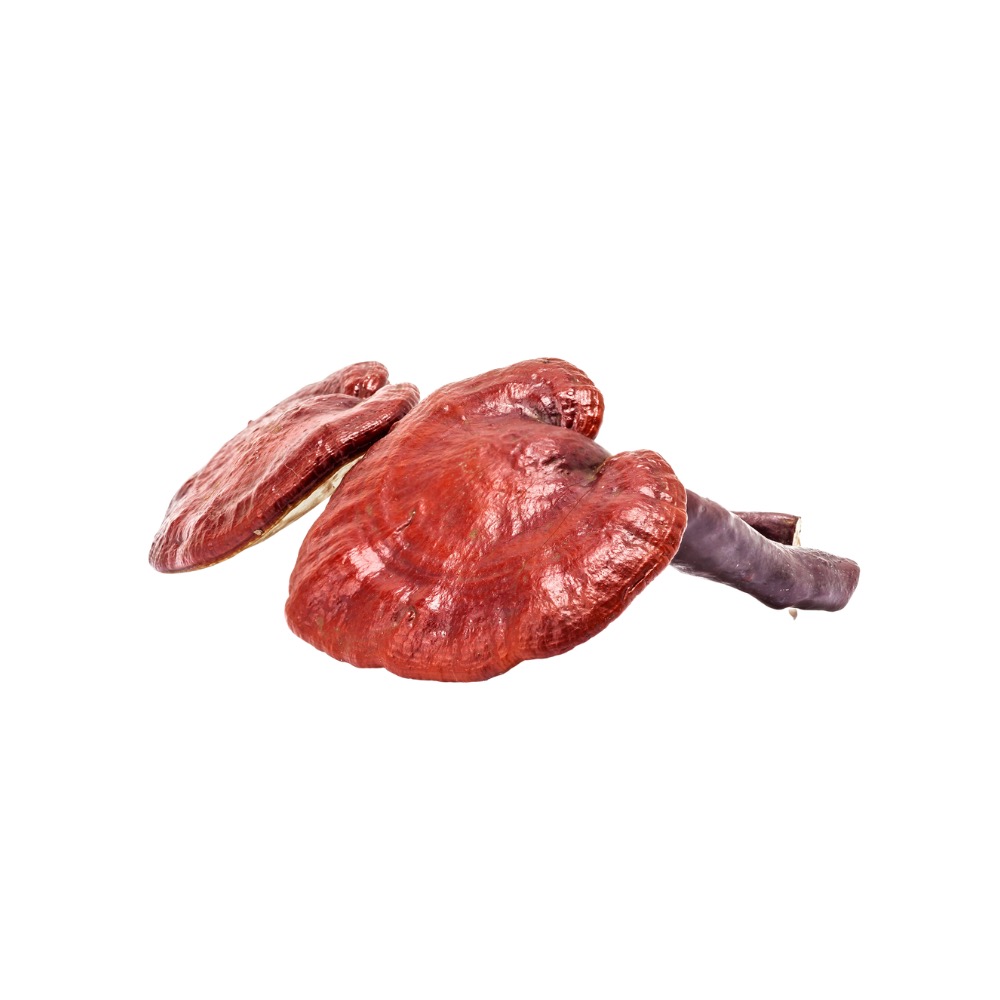 ModerateModerateReishiGanoderma lucidumThe ethanol extract trialled for lower urinary tract symptoms was selected for its 5α-reductase inhibition, the one herbal claim here that runs from enzyme assay to a placebo-controlled trial.Mechanism5α-reductase inhibition by the ethanol-extract fraction — enzyme assay, isoform not specifiedRead the evidenceShow lessMonograph →
The extract used in both 2008 randomised trials was chosen on the strength of its 5α-reductase inhibition, and the improvement in lower urinary tract symptoms is attributed to that property 1,
The assay work does not specify isoform selectivity. Type I sits in skin, type II in the prostate and hair follicle, and which one is inhibited decides which tissue the effect could reach.
No study measured DHT in the trial participants, and the clinical endpoint was symptomatic. The enzyme inhibition is inferred to be the cause rather than shown to be, and symptom relief in benign prostatic hyperplasia has several possible routes.
This is a suppressive hormone-modulating mechanism. It lowers androgen signal.
 ModerateModerateSaw PalmettoSerenoa repensInhibits 5α-reductase in vitro through its free fatty acids — weakly and non-competitively — and does not lower PSA the way finasteride does.Mechanism5α-reductase type I/II inhibition (weak, non-competitive)Read the evidenceShow lessMonograph →
The inhibition is demonstrable but only in vitro, and it is explicitly weak and non-competitive, driven by the free fatty acids lauric, oleic and myristic acid rather than by a high-affinity ligand 3Reference 3In vitroInhibition of androgen metabolism and binding by a liposterolic extract of Serenoa repens in human foreskin fibroblasts — in vitroView study →. Permixon inhibits 5α-reductase activity in human prostate cancer cell lines without altering PSA expression 4Reference 4In vitroSerenoa repens (Permixon) inhibits the 5α-reductase activity of human prostate cancer cell lines without interfering with PSA expression — in vitroView study →.
Two large, well-conducted, dose-escalated randomised trials found no symptom benefit over placebo 5,
PSA did not move in either trial 5,
That has a clinical use of its own. Because saw palmetto leaves PSA intact, it will not mask a rising reading on a screening test the way finasteride does.
No herbs match these filters.
Safety
- Urinary symptoms need a diagnosis before a herb, because benign enlargement, prostate cancer, infection and stricture all present the same way.
- These herbs are contraindicated in pregnancy, since dihydrotestosterone is required for normal male genital development.
- They lower androgen signal, which is the opposite of the testosterone support they are often sold for.
- Effects on this action are theoretically additive with finasteride, dutasteride and other antiandrogens, and the combination is unstudied.
- Tell the doctor interpreting a PSA result what is being taken; unlike finasteride these herbs are not known to suppress the marker.
- Prostate symptoms and hair loss both change over months, so anything promising a faster answer is not working through this enzyme.
References
- Noguchi M, Kakuma T, Tomiyasu K, et al. (2008). Randomised clinical trial of an ethanol extract of Ganoderma lucidum in men with lower urinary tract symptoms — randomised controlled trial. Asian J Androl. https://pubmed.ncbi.nlm.nih.gov/18097505/
- Noguchi M, Kakuma T, Tomiyasu K, et al. (2008). Effect of an extract of Ganoderma lucidum in men with lower urinary tract symptoms: a double-blind, placebo-controlled, randomised dose-ranging study — randomised controlled trial. Asian J Androl. https://pubmed.ncbi.nlm.nih.gov/18097503/
- Sultan, C., Terraza, A., Devillier, C., et al. (1984). Inhibition of androgen metabolism and binding by a liposterolic extract of Serenoa repens in human foreskin fibroblasts — in vitro. Journal of Steroid Biochemistry. https://pubmed.ncbi.nlm.nih.gov/6708534/
- Habib, F. K., Ross, M., Ho, C. K., Lyons, V., & Chapman, K. (2005). Serenoa repens (Permixon) inhibits the 5α-reductase activity of human prostate cancer cell lines without interfering with PSA expression — in vitro. International Journal of Cancer. https://pubmed.ncbi.nlm.nih.gov/15543614/
- Bent, S., Kane, C., Shinohara, K., et al. (2006). Saw palmetto for benign prostatic hyperplasia — randomized controlled trial (RCT). New England Journal of Medicine. https://pubmed.ncbi.nlm.nih.gov/16467543/
- Barry, M. J., Meleth, S., Lee, J. Y., et al. (2011). Effect of increasing doses of saw palmetto extract on lower urinary tract symptoms — a randomized trial (RCT). JAMA. https://pubmed.ncbi.nlm.nih.gov/21954478/
Keep Exploring