
Materia Medica
Honeysuckle
Lonicera japonica
Honeysuckle is a climbing vine whose unopened flower bud, jin yin hua, is one of the most widely used cooling herbs in Chinese medicine. It is taken for the early, feverish stage of colds and flu and for sore throats, and its bud is rich in chlorogenic acid.
What Is Honeysuckle?
Honeysuckle is a fragrant climbing vine whose unopened flower bud, jin yin hua, is one of the most widely used cooling herbs in Chinese medicine. The name means “gold and silver flower”, because the blossoms open white and turn yellow. The stem is a separate medicine, ren dong teng 9Reference 9Comparison of multiple bioactive constituents in the flower and the caulis of Lonicera japonica — analytical studyView study →.
Lonicera japonica is native to China, Korea and Japan, where it grows in scrub, open forest and on rocky slopes and roadsides 38Reference 38Lonicera japonica Thunberg — species description, habitat and distribution — floraView study →. In Chinese medicine the bud is given for the early, feverish stage of colds and flu, for sore throats and for hot skin sores, most famously alongside forsythia in the formula Yin Qiao San 11,
The bud is rich in chlorogenic acid and related caffeoylquinic acids, with the flavone glycoside luteoloside as its official quality marker 9,
Several cheaper Lonicera species, sold as shan yin hua, look and taste much like jin yin hua and are often substituted for it 11,
How Is Honeysuckle Used?
- Flower bud (jin yin hua) — decocted, usually as part of a formula, or brewed as a light cooling tea. It is also an ingredient in commercial herbal drinks in China 11Reference 11Systematic reviewLonicerae japonicae flos and Lonicerae flos: a systematic review of ethnopharmacology, phytochemistry and pharmacology — systematic reviewView study →.
- Stem (ren dong teng) — listed as a separate medicine in the Chinese Pharmacopoeia, with a different chemical profile from the bud 9Reference 9Comparison of multiple bioactive constituents in the flower and the caulis of Lonicera japonica — analytical studyView study →.
- Formulas — the bud is paired with forsythia fruit in Yin Qiao San, a classical formula for headache, fever and cough at the start of a feverish illness 11Reference 11Systematic reviewLonicerae japonicae flos and Lonicerae flos: a systematic review of ethnopharmacology, phytochemistry and pharmacology — systematic reviewView study →.
Traditional Uses
Traditional Chinese Medicine
The medicine is the unopened flower bud of Lonicera japonica, not the open flower, the leaf or the whole plant. It is classed as sweet and cold, and its action is to clear heat and resolve toxicity.
It is given at the wind-heat stage, the early and feverish phase of a cold or influenza-like illness, and for epidemic febrile disease 12Reference 12ReviewLonicera japonica Thunb.: ethnopharmacology, phytochemistry and pharmacology — reviewView study →. It is also used for sore throat, for hot skin sores, carbuncles and abscesses, and for heat-type dysentery.
It is decocted, most often in combination. Its classic partner is forsythia in Yin Qiao San, recorded in the Wenbing Tiaobian 11Reference 11Systematic reviewLonicerae japonicae flos and Lonicerae flos: a systematic review of ethnopharmacology, phytochemistry and pharmacology — systematic reviewView study →.
Among the heat-clearing herbs it is one of the mildest, gentle enough to be drunk daily. Across China it is taken as an ordinary summer tea, and it is an ingredient in the herbal tea drink Wanglaoji 11Reference 11Systematic reviewLonicerae japonicae flos and Lonicerae flos: a systematic review of ethnopharmacology, phytochemistry and pharmacology — systematic reviewView study →.
Indications
- Early stage of colds and flu with fever [flower bud; TCM]
- Sore throat [flower bud; TCM]
- Chronic sore throat [flower bud, in a multi-herb lozenge]
- Hot skin sores, boils and abscesses [flower bud; TCM]
- Heat-type dysentery [flower bud; TCM]
- Influenza [flower bud decoction] Caution: The antiviral work on the microRNA MIR2911 comes from cell and mouse studies by one research group. Studies of other dietary plant microRNAs found they are not absorbed in meaningful amounts 1,
3 . - COVID-19 [flower bud decoction] Caution: The only human data is a non-randomised comparison in which six patients drank the decoction, from the same research group that proposed the MIR2911 mechanism 2,
29 . - Fatty liver and liver injury [flower bud extract]
Botany
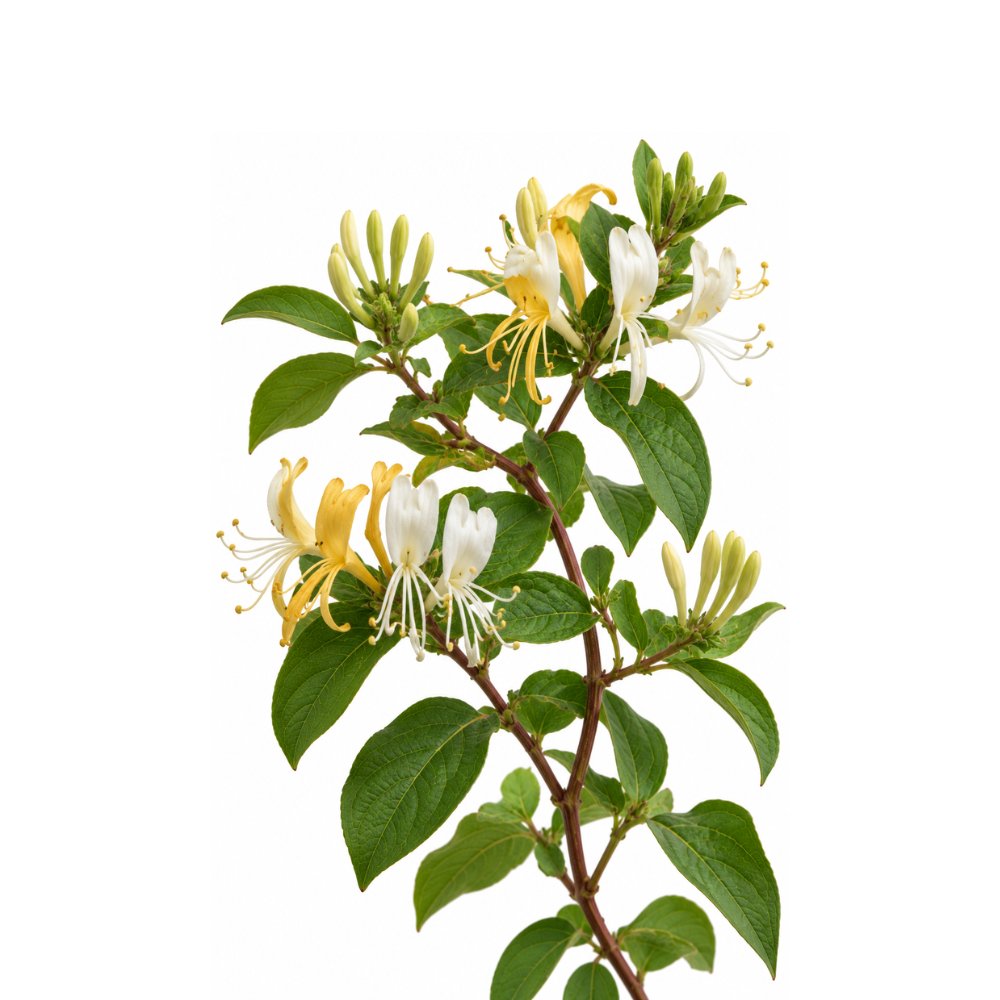
Honeysuckle is a semi-evergreen woody vine that climbs by twining. Its branches become hollow with age and are covered in dense, stiff yellow-brown hairs mixed with glandular hairs 38Reference 38Lonicera japonica Thunberg — species description, habitat and distribution — floraView study →.
The leaves grow in opposite pairs. They are oval to lance-shaped, 3–8 cm long, and hairy, with a fringe of hairs along the edge 38Reference 38Lonicera japonica Thunberg — species description, habitat and distribution — floraView study →.
The flowers are fragrant and grow in pairs where the leaves meet the stem, toward the tips of the branches. Each is two-lipped and 3–5 cm long, and opens white before turning yellow 38Reference 38Lonicera japonica Thunberg — species description, habitat and distribution — floraView study →. It flowers from April to June 38Reference 38Lonicera japonica Thunberg — species description, habitat and distribution — floraView study →.
The fruits are glossy black berries 6–7 mm across, ripening from October to November 38Reference 38Lonicera japonica Thunberg — species description, habitat and distribution — floraView study →.
A variety with flowers purple on the outside and white inside, var. chinensis, also occurs in China 38Reference 38Lonicera japonica Thunberg — species description, habitat and distribution — floraView study →.
Distribution
Honeysuckle grows across much of China, in Taiwan, Korea and Japan, and is widely cultivated in Southeast Asia 38Reference 38Lonicera japonica Thunberg — species description, habitat and distribution — floraView study →. In China it grows in scrub, open forest, on mountain slopes, stony places and roadsides, at elevations up to about 1,500 m 38Reference 38Lonicera japonica Thunberg — species description, habitat and distribution — floraView study →.
It was brought to North America as an ornamental in the early 1800s. It has since spread from southern New England and the Ohio Valley south to the Gulf coast and west to Missouri and Arkansas 37Reference 37Lonicera japonica, Japanese honeysuckle — introduction to North America, invasive range, growth habit and control — species databaseView study →. There it is an invasive weed that smothers and pulls down young trees and can form dense mats on the ground 37Reference 37Lonicera japonica, Japanese honeysuckle — introduction to North America, invasive range, growth habit and control — species databaseView study →.
Where it has become invasive, pulling it out helps native plants. Seedlings can be pulled by hand, although mature plants have extensive roots 37Reference 37Lonicera japonica, Japanese honeysuckle — introduction to North America, invasive range, growth habit and control — species databaseView study →.
Growing Conditions
Cultivation snapshot for Honeysuckle
- Full sun to part shade on almost any soil, with strong support — it is vigorous, twining and quick to cover.
- Cultivated for medicine in China, where the crop is the unopened flower bud, so harvest timing is tight and picking is done by hand before the buds open.
- Plant it with care outside East Asia. It has naturalised aggressively in the south-eastern United States and other temperate regions, where it is treated as an invasive weed.
Grow it yourself
Farm Wiki is our cultivation-focused sister site, also run by Justin Cooke.
Pharmacology & Research
Most of the research on honeysuckle flower bud is preclinical: dozens of cell, network-pharmacology and rodent studies, gathered in two systematic reviews 11,
The most consistent findings are anti-inflammatory and antioxidant activity, linked to its phenolic acids and flavones, and liver protection in rodent models of fatty liver and fibrosis 13,
The best-known modern finding concerns MIR2911, a microRNA encoded by the plant that survives in the decoction. In cells and mice it binds the genes of influenza viruses and blocks their replication 1Reference 1Honeysuckle-encoded atypical microRNA2911 directly targets influenza A virusesView study →. The same group reported activity against SARS-CoV-2 2Reference 2Absorbed plant MIR2911 in honeysuckle decoction inhibits SARS-CoV-2 replication and accelerates the negative conversion of infected patientsView study →.
The human evidence is one randomised trial of a multi-herb lozenge that includes honeysuckle 32Reference 32RCTEfficacy of botanical lozenges (multi-herb, honeysuckle-containing) in the treatment of chronic pharyngitis — randomised placebo-controlled trialView study →, and a non-randomised comparison of six COVID-19 patients who drank the decoction 2Reference 2Absorbed plant MIR2911 in honeysuckle decoction inhibits SARS-CoV-2 replication and accelerates the negative conversion of infected patientsView study →.
-
Best-supported: anti-inflammatory activity through NF-κB and TLR4 suppression by chlorogenic acid, luteolin and related compounds 13,
14, ; antioxidant activity from a high phenolic-acid content 23Reference 23In vitroPharmacognostic specification, chlorogenic acid content, and in vitro antioxidant activities of Lonicera japonica flowering bud — in vitro studyView study →; and liver protection in rodent fatty-liver and fibrosis models 18,15Reference 13AnimalHS-23, a Lonicera japonica extract, attenuates septic injury by suppressing toll-like receptor 4 — mouse in vivo studyView study →Reference 14AnimalLonicerin targets EZH2 to alleviate ulcerative colitis by autophagy-mediated NLRP3 inflammasome inactivation — mouse in vivo studyView study →Reference 15In vitroCaffeoylquinic acids from Lonicera japonica as TAK1 inhibitors protect against LPS + IFN-γ inflammation via KEAP1/NRF2 — in vitro studyView study → 19, .20, 21Reference 18AnimalThe hepatoprotective effect of Lonicera japonica Flos on rats with high-fat-diet-induced non-alcoholic fatty liver disease — rat in vivo studyView study →Reference 19In vitroInvestigation of Lonicera japonica Flos against non-alcoholic fatty liver disease using network integration and experimental validation — in vitro studyView study →Reference 20In vitroAn alleviative effect of Lonicerae japonicae flos water extract against liver fibrogenesis in vitro and in vivo — rat in vivo and in vitro studyView study →Reference 21AnimalTargeting JAK2/STAT3-dependent macrophage polarization by chlorogenic acid attenuates hepatic inflammation in chronic stress — rat in vivo studyView study → -
Emerging, worth watching: antidiabetic PPAR-γ activation 27Reference 27AnimalEffects of Lonicera japonica Thunb. on type 2 diabetes via PPAR-γ activation — rat in vivo studyView study →, anti-hyperuricemic polysaccharides 35Reference 35AnimalAnti-hyperuricemic and anti-gouty arthritis activities of a polysaccharide purified from Lonicera japonica — rat in vivo studyView study →, and the MIR2911 antiviral line if independent groups confirm its absorption from food 1,
28Reference 1Honeysuckle-encoded atypical microRNA2911 directly targets influenza A virusesView study →Reference 28In vitroPlant MIR2911 in honeysuckle is effective against a SARS-CoV-2 variant — in vitro studyView study → . -
Mechanistically thin: fever-lowering and antibacterial activity of the single herb, which is traditional and in vitro, with little dedicated testing 24,
25, .26Reference 24In vitroScreening and identification of the antibacterial bioactive compounds from Lonicera japonica Thunb. leaves — in vitro studyView study →Reference 25In vitroSynergistic antimicrobial effect of Lonicera japonica and Magnolia obovata extracts — in vitro studyView study →Reference 26In vitroLonicera japonica Thunb. as a promising antibacterial agent for Bacillus cereus — network pharmacology, metabolomics and in vitro studyView study → - The caveat: no whole-herb efficacy trial exists; the only human antiviral data is a six-patient non-randomised comparison, and no standardised research dose has been established 2Reference 2Absorbed plant MIR2911 in honeysuckle decoction inhibits SARS-CoV-2 replication and accelerates the negative conversion of infected patientsView study →.
Most studies use concentrated extracts or isolated compounds. An ethanol extract or a single caffeoylquinic acid does not necessarily behave like the water decoction or the tea.
1. Anti-Inflammatory
The dominant constituents, chlorogenic acid and the flavone luteolin, suppress NF-κB-driven cytokine production.
HS-23, an ethanol extract of the flower buds given intravenously, improved survival in septic mice by suppressing TLR4 signalling 13Reference 13AnimalHS-23, a Lonicera japonica extract, attenuates septic injury by suppressing toll-like receptor 4 — mouse in vivo studyView study →. The flavonoid lonicerin eased experimental colitis by targeting EZH2 and inactivating the NLRP3 inflammasome 14Reference 14AnimalLonicerin targets EZH2 to alleviate ulcerative colitis by autophagy-mediated NLRP3 inflammasome inactivation — mouse in vivo studyView study →. Caffeoylquinic acids isolated from the buds inhibited LPS- and IFN-γ-driven inflammation in vitro through TAK1 inhibition and KEAP1/NRF2 activation 15Reference 15In vitroCaffeoylquinic acids from Lonicera japonica as TAK1 inhibitors protect against LPS + IFN-γ inflammation via KEAP1/NRF2 — in vitro studyView study →.
An oral water extract reduced PAR-2-mediated paw oedema in mice 36Reference 36AnimalAnti-inflammatory effect of Lonicera japonica in proteinase-activated receptor 2-mediated paw oedema — animal modelView study →. An ethanol extract showed anti-angiogenic activity in chick embryo membrane and antinociceptive and anti-inflammatory activity in mice 17Reference 17AnimalAnti-angiogenic, antinociceptive and anti-inflammatory activities of Lonicera japonica extract — animal modelView study →.
A water extract, BST-104, reduced gastric lesions in rat models of gastritis and ulcer through antioxidant and anti-inflammatory effects 16Reference 16AnimalBST-104, a water extract of Lonicera japonica, has a gastroprotective effect via antioxidant and anti-inflammatory activities — rat in vivo studyView study →. The water extract is the preparation closest to the decoction. Reviews cover the wider picture, including acute lung injury 33Reference 33Systematic reviewLonicera japonica Thunb. in acute lung injury: bioactive components and multi-target mechanisms — systematic reviewView study → and COVID-19 34Reference 34ReviewUpdated pharmacological effects of Lonicerae japonicae flos, with a focus on COVID-19 — reviewView study →.
This is constituent-level and animal-model support. There is no whole-herb human trial, and most of the mechanistic work uses isolated compounds or extracts other than the decoction.
2. Hepatoprotective
A consistent rodent and cell literature has built up around liver protection. A flower-bud extract improved steatosis, serum liver enzymes, liver lipid content and oxidative-stress markers in rats with high-fat-diet fatty liver disease 18Reference 18AnimalThe hepatoprotective effect of Lonicera japonica Flos on rats with high-fat-diet-induced non-alcoholic fatty liver disease — rat in vivo studyView study →. A network-pharmacology and cell-model study pointed to lower TNF-α and CASP3 expression 19Reference 19In vitroInvestigation of Lonicera japonica Flos against non-alcoholic fatty liver disease using network integration and experimental validation — in vitro studyView study →.
A water extract reduced thioacetamide-induced liver fibrosis in rats and protected cultured liver cells by lowering inflammation and apoptosis 20Reference 20In vitroAn alleviative effect of Lonicerae japonicae flos water extract against liver fibrogenesis in vitro and in vivo — rat in vivo and in vitro studyView study →. Isolated chlorogenic acid reduced liver injury from chronic stress in rats by shifting macrophage polarisation through JAK2/STAT3 21Reference 21AnimalTargeting JAK2/STAT3-dependent macrophage polarization by chlorogenic acid attenuates hepatic inflammation in chronic stress — rat in vivo studyView study →.
Terpenoids and other compounds from the flower bud showed activity against liver-cancer cells and hepatitis B virus in cell lines 22Reference 22In vitroChemical constituents from Lonicera japonica flower buds and their anti-hepatoma and anti-HBV activities — in vitro studyView study →.
Gap: no human liver-endpoint study; effective doses in rats are high and use concentrated extracts, not the traditional tea.
3. Antioxidant
The flower bud carries a high phenolic-acid load. Buds bought from Thai herbal drugstores contained about 2.2 g of chlorogenic acid per 100 g, and an extract showed DPPH and nitric-oxide scavenging and reducing power in vitro 23Reference 23In vitroPharmacognostic specification, chlorogenic acid content, and in vitro antioxidant activities of Lonicera japonica flowering bud — in vitro studyView study →.
The same radical-scavenging activity appears in several of the anti-inflammatory and liver findings, as NRF2/HO-1 induction and lower malondialdehyde 15,
No human biomarker study has been done, such as plasma antioxidant status after drinking the decoction.
4. Antibacterial
Screening of leaf extracts traced the activity against Staphylococcus aureus and Escherichia coli mainly to the dicaffeoylquinic acids and luteoloside 24Reference 24In vitroScreening and identification of the antibacterial bioactive compounds from Lonicera japonica Thunb. leaves — in vitro studyView study →.
An ethyl acetate fraction of honeysuckle acted synergistically with one from Magnolia obovata against S. aureus, Bacillus subtilis and Candida albicans; caffeic acid and luteolin accounted for honeysuckle’s share of the activity 25Reference 25In vitroSynergistic antimicrobial effect of Lonicera japonica and Magnolia obovata extracts — in vitro studyView study →.
Water and ethanol extracts inhibited Bacillus cereus. Quercetin, kaempferol and luteolin disrupted its cell wall and membrane, while chlorogenic acid had no effect 26Reference 26In vitroLonicera japonica Thunb. as a promising antibacterial agent for Bacillus cereus — network pharmacology, metabolomics and in vitro studyView study →.
Species-specific potency data for the medicinal bud are limited, much of the work uses leaf or whole-plant material, and none of it is clinical.
6. Antidiabetic
In rats with high-fat-diet and streptozotocin-induced type 2 diabetes, oral L. japonica at 100 mg/kg for four weeks lowered blood glucose and insulin resistance. It restored body weight and food intake, protected pancreatic islets, and raised PPAR-γ and insulin-receptor-substrate-1 expression 27Reference 27AnimalEffects of Lonicera japonica Thunb. on type 2 diabetes via PPAR-γ activation — rat in vivo studyView study →.
Gap: no replication and no human glycaemic data; effect is single-study, animal-only.
7. Antipyretic
Fever-clearing is central to honeysuckle’s traditional use 23Reference 23In vitroPharmacognostic specification, chlorogenic acid content, and in vitro antioxidant activities of Lonicera japonica flowering bud — in vitro studyView study →, and fits its anti-inflammatory chemistry. Dedicated fever testing of the single herb is scarce, and most fever data belong to the multi-herb formulas it sits in.
Mechanisms
Chlorogenic acid, the bud’s dominant constituent, has been studied for suppression of NF-κB and TLR4 signalling, activation of NRF2/HO-1, and a shift in macrophages from the inflammatory M1 to the M2 type. Luteolin and lonicerin act on some of the same pathways.
MIR2911 is a plant microRNA rather than a small molecule. It has been studied for binding directly to viral genes.
| Mechanism | Drives | Key compounds |
|---|---|---|
| NF-κB ↓, TLR4/MyD88 ↓, cytokine suppression | anti-inflammatoryhepatoprotectiveantipyretic | chlorogenic acid, luteolin, lonicerin |
| NRF2/HO-1 ↑, radical scavenging | antioxidanthepatoprotective | chlorogenic acid, caffeoylquinic acids |
| JAK2/STAT3 ↓, macrophage M1→M2 shift | hepatoprotective | chlorogenic acid |
| PPAR-γ ↑ | antidiabetic | whole extract |
| Cell wall and membrane disruption | antibacterial | luteoloside, quercetin, kaempferol |
| Sequence-specific binding of viral PB2 / NS1 / RdRP | antiviral (influenzaSARS-CoV-2) | MIR2911 (plant microRNA) |
Clinical Trials
No efficacy trial of honeysuckle on its own has been published. The human evidence is a randomised placebo-controlled trial of a botanical lozenge containing honeysuckle with monk fruit, balloon flower, licorice and other plant extracts, in 103 people with chronic pharyngitis over 15 days 32Reference 32RCTEfficacy of botanical lozenges (multi-herb, honeysuckle-containing) in the treatment of chronic pharyngitis — randomised placebo-controlled trialView study →, and the six-patient COVID-19 comparison 2Reference 2Absorbed plant MIR2911 in honeysuckle decoction inhibits SARS-CoV-2 replication and accelerates the negative conversion of infected patientsView study →.
| Completed | Planned | Terminated | Preclinical |
|---|---|---|---|
| 1(multi-herb) | 0 | 0 | ~50+ |
Last checked: August 2026.
Phytochemistry
The flower bud is dominated by phenolic acids. The main one is chlorogenic acid (5-caffeoylquinic acid), measured at about 2.2 g per 100 g of dried bud 23Reference 23In vitroPharmacognostic specification, chlorogenic acid content, and in vitro antioxidant activities of Lonicera japonica flowering bud — in vitro studyView study →. It occurs with its isomers neochlorogenic acid and cryptochlorogenic acid, and with the dicaffeoylquinic acids 3,5-dicaffeoylquinic acid (isochlorogenic acid A) and 4,5-dicaffeoylquinic acid (isochlorogenic acid C) 9Reference 9Comparison of multiple bioactive constituents in the flower and the caulis of Lonicera japonica — analytical studyView study →.
The flavones include luteolin, its 7-O-glucoside luteoloside, and lonicerin 9,
The shan yin hua species substituted for the bud contain more chlorogenic acid but much less luteoloside, along with oleanolic acid saponins 31Reference 31Rapid identification of Lonicera japonica via Proofman-LMTIA technology — ITS2 SNP authenticationView study →.
The stem, ren dong teng, contains lower amounts of most of these compounds. The iridoid loganin is its characteristic marker 9Reference 9Comparison of multiple bioactive constituents in the flower and the caulis of Lonicera japonica — analytical studyView study →. An LC-MS comparison of the bud, stem, leaf and fruit identified 86 compounds: 25 flavonoids, 24 phenolic acids, 24 iridoid glycosides, 9 amino acids and 4 others. Chlorogenic acid, loganin, lonicerin, sweroside and luteolin were among those that differed most between parts 10Reference 10Comparative study on chemical constituents of different medicinal parts of Lonicera japonica Thunb. — LC-MS profilingView study →.
More than 140 compounds have been isolated from the plant, including essential oils 12Reference 12ReviewLonicera japonica Thunb.: ethnopharmacology, phytochemistry and pharmacology — reviewView study →. The bud also yields a water-soluble polysaccharide 35Reference 35AnimalAnti-hyperuricemic and anti-gouty arthritis activities of a polysaccharide purified from Lonicera japonica — rat in vivo studyView study → and the microRNA MIR2911 1Reference 1Honeysuckle-encoded atypical microRNA2911 directly targets influenza A virusesView study →.
Contents differ between bud, stem, leaf and fruit, so findings for one part should not be applied to another 9,
Constituent Summary
Compared by plant part.
Phenolic Acid1 compound1 with data
Flavonoid2 compounds1 with data
Iridoid2 compounds1 with data
Dosage
- Flower bud decoction — traditionally 6–15 g a day, usually within a formula.
- Tea — drunk as a light cooling tea.
| Indication | Preparation | Dose | Est. dried-herb equivalent | Source |
|---|---|---|---|---|
| COVID-19 (non-randomised) | Decoction of 30 g dried honeysuckle boiled down to 200 mL | 100 mL twice daily | 30 g/day | 2Reference 2Absorbed plant MIR2911 in honeysuckle decoction inhibits SARS-CoV-2 replication and accelerates the negative conversion of infected patientsView study → |
| Chronic pharyngitis | Multi-herb botanical lozenge | 15 days | — (multi-herb product) | 32Reference 32RCTEfficacy of botanical lozenges (multi-herb, honeysuckle-containing) in the treatment of chronic pharyngitis — randomised placebo-controlled trialView study → |
Safety & Pregnancy
Honeysuckle flower bud is one of the gentler heat-clearing herbs, with a long history as both medicine and tea. The main practical issue is substitution with other species.
- Gentle and low in toxicity. A mild cooling herb with a long history as a tea, well tolerated at customary amounts.
- Species substitution. Genuine jin yin hua (L. japonica bud) is widely replaced with cheaper shan yin hua species. DNA tests can now tell them apart 30,
31Reference 30Convenient, sensitive and high-throughput method for screening botanic origin — DNA authentication of Lonicera speciesView study →Reference 31Rapid identification of Lonicera japonica via Proofman-LMTIA technology — ITS2 SNP authenticationView study → . - Interactions not studied. No herb–drug interaction study has been done.
Full Safety Detail
Tolerance. Honeysuckle flower bud has a long record of use as a cooling tea and functional-food ingredient, and is regarded as gentle at customary amounts.
Substitution. True jin yin hua sells for about 2.5 times the price of the shan yin hua honeysuckles (L. macranthoides, L. hypoglauca, L. confusa and L. fulvotomentosa) 31Reference 31Rapid identification of Lonicera japonica via Proofman-LMTIA technology — ITS2 SNP authenticationView study →. These look and taste similar. They were listed as the same herb in earlier editions of the Chinese Pharmacopoeia and as separate herbs from 2005 11Reference 11Systematic reviewLonicerae japonicae flos and Lonicerae flos: a systematic review of ethnopharmacology, phytochemistry and pharmacology — systematic reviewView study →. DNA-based tests can identify the species in raw material and finished products 30,
Interactions. No human safety trial or herb–drug interaction study of the single herb has been done.
Honeysuckle has not been studied as a single herb in pregnancy or while breastfeeding. It is used within formulas in traditional practice, but there are no modern safety data.
References
- Zhou, Z., Li, X., Liu, J., et al. (2015). Honeysuckle-encoded atypical microRNA2911 directly targets influenza A viruses. Cell Research, 25(1), 39–49. https://pubmed.ncbi.nlm.nih.gov/25287280/
- Zhou, L.-K., et al. (2020). Absorbed plant MIR2911 in honeysuckle decoction inhibits SARS-CoV-2 replication and accelerates the negative conversion of infected patients. Cell Discovery, 6, 54. https://pubmed.ncbi.nlm.nih.gov/32802404/
- Snow, J. W., Hale, A. E., Isaacs, S. K., et al. (2013). Ineffective delivery of diet-derived microRNAs to recipient animal organisms — animal model. RNA Biology. https://pubmed.ncbi.nlm.nih.gov/23669076/
- Yuan, Y., Jiang, C., Liu, L., et al. (2014). Convenient, sensitive and high-throughput method for screening botanic origin — analytical (DNA authentication). Scientific Reports, 4, 5395. https://www.ncbi.nlm.nih.gov/pmc/articles/PMC4066250/
- Zhang, X., Li, C., Lan, D., Liu, J., & Wang, D. (2025). Rapid identification of Lonicera japonica via Proofman-LMTIA technology — analytical (DNA authentication). Scientific Reports, 15(1), 7913. https://www.nature.com/articles/s41598-025-91797-0
- Cai, Z., Wang, C., Zou, L., et al. (2019). Comparison of multiple bioactive constituents in the flower and the caulis of Lonicera japonica based on UFLC-QTRAP-MS/MS combined with multivariate statistical analysis — analytical. Molecules, 24(10), 1936. https://www.ncbi.nlm.nih.gov/pmc/articles/PMC6572465/
- Cai, Z., Wang, C., Zou, L., et al. (2019). Comparison of multiple bioactive constituents in the flower and the caulis of Lonicera japonica — analytical (same paper as reference 6). Molecules, 24(10), 1936. https://www.ncbi.nlm.nih.gov/pmc/articles/PMC6572465/
- Zhang, X., Yu, X., Sun, X., et al. (2024). Comparative study on chemical constituents of different medicinal parts of Lonicera japonica Thunb. based on LC-MS combined with multivariate statistical analysis — analytical. Heliyon, 10(12), e31722. https://www.ncbi.nlm.nih.gov/pmc/articles/PMC11225679/
- Cai, Z., et al. (2019). Comparison of multiple bioactive constituents in the flower and the caulis of Lonicera japonica — analytical study. Molecules. https://pubmed.ncbi.nlm.nih.gov/31137485/
- Zhang, X., et al. (2024). Comparative study on chemical constituents of different medicinal parts of Lonicera japonica Thunb. — LC-MS profiling. Heliyon. https://pubmed.ncbi.nlm.nih.gov/38975169/
- Li, Y., Li, W., Fu, C., Song, Y., & Fu, Q. (2020). Lonicerae japonicae flos and Lonicerae flos: a systematic review of ethnopharmacology, phytochemistry and pharmacology — systematic review. Phytochemistry Reviews. https://pubmed.ncbi.nlm.nih.gov/32206048/
- Shang, X., et al. (2011). Lonicera japonica Thunb.: ethnopharmacology, phytochemistry and pharmacology — review. Journal of Ethnopharmacology. https://pubmed.ncbi.nlm.nih.gov/21864666/
- Kim, S. J., et al. (2014). HS-23, a Lonicera japonica extract, attenuates septic injury by suppressing toll-like receptor 4 — mouse in vivo study. Journal of Ethnopharmacology. https://pubmed.ncbi.nlm.nih.gov/24862492/
- Lv, Q., et al. (2021). Lonicerin targets EZH2 to alleviate ulcerative colitis by autophagy-mediated NLRP3 inflammasome inactivation — mouse in vivo study. Acta Pharmaceutica Sinica B. https://pubmed.ncbi.nlm.nih.gov/34589402/
- Ge, L., et al. (2023). Caffeoylquinic acids from Lonicera japonica as TAK1 inhibitors protect against LPS + IFN-γ inflammation via KEAP1/NRF2 — in vitro study. Biomedicine & Pharmacotherapy. https://pubmed.ncbi.nlm.nih.gov/37418981/
- Bang, B. W., et al. (2019). BST-104, a water extract of Lonicera japonica, has a gastroprotective effect via antioxidant and anti-inflammatory activities — rat in vivo study. Journal of Medicinal Food. https://pubmed.ncbi.nlm.nih.gov/30676853/
- Yoo, H. J., et al. (2008). Anti-angiogenic, antinociceptive and anti-inflammatory activities of Lonicera japonica extract — animal model. Journal of Pharmacy and Pharmacology. https://pubmed.ncbi.nlm.nih.gov/18498715/
- Ma, X., Sun, C. Y., Zhang, Y., Li, J., & Zhao, D. S. (2025). The hepatoprotective effect of Lonicera japonica Flos on rats with high-fat-diet-induced non-alcoholic fatty liver disease — rat in vivo study. Fitoterapia. https://pubmed.ncbi.nlm.nih.gov/40188994/
- Sun, C. Y., et al. (2022). Investigation of Lonicera japonica Flos against non-alcoholic fatty liver disease using network integration and experimental validation — in vitro study. Medicina (Kaunas). https://pubmed.ncbi.nlm.nih.gov/36143853/
- Lin, Y. L., et al. (2024). An alleviative effect of Lonicerae japonicae flos water extract against liver fibrogenesis in vitro and in vivo — rat in vivo and in vitro study. Environmental Toxicology. https://pubmed.ncbi.nlm.nih.gov/38294203/
- Ji, Y., et al. (2025). Targeting JAK2/STAT3-dependent macrophage polarization by chlorogenic acid attenuates hepatic inflammation in chronic stress — rat in vivo study. Cells. https://pubmed.ncbi.nlm.nih.gov/41369337/
- Ge, L., et al. (2019). Chemical constituents from Lonicera japonica flower buds and their anti-hepatoma and anti-HBV activities — in vitro study. Bioorganic Chemistry. https://pubmed.ncbi.nlm.nih.gov/31446242/
- Chaowuttikul, C., Palanuvej, C., & Ruangrungsi, N. (2017). Pharmacognostic specification, chlorogenic acid content, and in vitro antioxidant activities of Lonicera japonica flowering bud — in vitro study. Pharmacognosy Research. https://pubmed.ncbi.nlm.nih.gov/28539735/
- Xiong, J., et al. (2013). Screening and identification of the antibacterial bioactive compounds from Lonicera japonica Thunb. leaves — in vitro study. Food Chemistry. https://pubmed.ncbi.nlm.nih.gov/23265495/
- Lee, Y. S., Lee, Y. J., & Park, S. N. (2018). Synergistic antimicrobial effect of Lonicera japonica and Magnolia obovata extracts — in vitro study. Journal of Microbiology and Biotechnology. https://pubmed.ncbi.nlm.nih.gov/30270607/
- Xu, N., et al. (2023). Lonicera japonica Thunb. as a promising antibacterial agent for Bacillus cereus — network pharmacology, metabolomics and in vitro study. RSC Advances. https://pubmed.ncbi.nlm.nih.gov/37223411/
- Han, J. M., et al. (2015). Effects of Lonicera japonica Thunb. on type 2 diabetes via PPAR-γ activation — rat in vivo study. Phytotherapy Research. https://pubmed.ncbi.nlm.nih.gov/26174209/
- Shen, C. H., et al. (2025). Plant MIR2911 in honeysuckle is effective against a SARS-CoV-2 variant — in vitro study. Virus Research. https://pubmed.ncbi.nlm.nih.gov/40374123/
- Zhou, Z., et al. (2020). Decreased HD-MIR2911 absorption in human subjects with the SIDT1 polymorphism fails to inhibit SARS-CoV-2 replication — human observational study. Cell Discovery. https://pubmed.ncbi.nlm.nih.gov/32934821/
- Yuan, Y., et al. (2014). Convenient, sensitive and high-throughput method for screening botanic origin — DNA authentication of Lonicera species. Scientific Reports. https://pubmed.ncbi.nlm.nih.gov/24953704/
- Zhang, X., et al. (2025). Rapid identification of Lonicera japonica via Proofman-LMTIA technology — ITS2 SNP authentication. Scientific Reports. https://pubmed.ncbi.nlm.nih.gov/40050336/
- Wu, Y., Zhang, F., Kuang, D., et al. (2024). Efficacy of botanical lozenges (multi-herb, honeysuckle-containing) in the treatment of chronic pharyngitis — randomised placebo-controlled trial. Frontiers in Pharmacology. https://pubmed.ncbi.nlm.nih.gov/38549665/
- Cao, Y. F., et al. (2025). Lonicera japonica Thunb. in acute lung injury: bioactive components and multi-target mechanisms — systematic review. Fitoterapia. https://pubmed.ncbi.nlm.nih.gov/40721118/
- Zhao, H., et al. (2021). Updated pharmacological effects of Lonicerae japonicae flos, with a focus on COVID-19 — review. Current Opinion in Pharmacology. https://pubmed.ncbi.nlm.nih.gov/34461565/
- Yang, Q., et al. (2019). Anti-hyperuricemic and anti-gouty arthritis activities of a polysaccharide purified from Lonicera japonica — rat in vivo study. International Journal of Biological Macromolecules. https://pubmed.ncbi.nlm.nih.gov/30445085/
- Tae, J., et al. (2003). Anti-inflammatory effect of Lonicera japonica in proteinase-activated receptor 2-mediated paw oedema — animal model. Clinica Chimica Acta. https://pubmed.ncbi.nlm.nih.gov/12636936/
- Munger, G. T. (2002). Lonicera japonica, Japanese honeysuckle — introduction to North America, invasive range, growth habit and control — species database. In Fire Effects Information System. U.S. Department of Agriculture, Forest Service, Rocky Mountain Research Station, Fire Sciences Laboratory. https://research.fs.usda.gov/feis/species-reviews/lonjap
- Yang, Q., Landrein, S., Osborne, J., & Borosova, R. (2011). Lonicera japonica Thunberg — species description, habitat and distribution — flora. In Wu, Z. Y., Raven, P. H., & Hong, D. Y. (eds.), Flora of China, Vol. 19 (Caprifoliaceae). http://www.efloras.org/florataxon.aspx?flora_id=2&taxon_id=200022324



