
Materia Medica
Oregano
Origanum vulgare
Oregano is a Mediterranean herb of the mint family, used in cooking and in herbal medicine for digestion, coughs and sore throats. Its essential oil is rich in carvacrol, a compound studied for its antibacterial and antifungal activity.
What Is Oregano?
Oregano, or wild marjoram, is an aromatic perennial of the mint family, used as a kitchen herb and as a medicine for digestion, coughs and sore throats. Herbalists have used it as a tea, a tincture and an ointment 1Reference 1A Recent Insight Regarding the Phytochemistry and Bioactivity of Origanum vulgare LView study →.
Origanum vulgare is native to Europe, North Africa and much of temperate Asia, and its greatest diversity is in the Mediterranean, especially Turkey 1Reference 1A Recent Insight Regarding the Phytochemistry and Bioactivity of Origanum vulgare LView study →. It grows on hills, in grasslands and in forests 23Reference 23Origanum vulgare Linnaeus — species description, habitat and distribution — floraView study →.
Its essential oil is rich in carvacrol and thymol 1Reference 1A Recent Insight Regarding the Phytochemistry and Bioactivity of Origanum vulgare LView study →. Research has focused on the oil’s antibacterial and antifungal activity, mostly in the laboratory, and a handful of small human trials have tested the oil or extracts 4,
The name “oregano” is used for several other plants, including sweet marjoram (Origanum majorana), Turkish oregano (O. onites), and species of Thymus, Satureja and Lippia 1Reference 1A Recent Insight Regarding the Phytochemistry and Bioactivity of Origanum vulgare LView study →.
How Is Oregano Used?
- Dried or fresh leaf — as a kitchen herb, and as a tea for digestion, coughs and colds 1Reference 1A Recent Insight Regarding the Phytochemistry and Bioactivity of Origanum vulgare LView study →.
- Tincture — for respiratory and digestive complaints 1Reference 1A Recent Insight Regarding the Phytochemistry and Bioactivity of Origanum vulgare LView study →.
- Ointment — for wounds 1Reference 1A Recent Insight Regarding the Phytochemistry and Bioactivity of Origanum vulgare LView study →.
- Essential oil — sold as “oil of oregano”, taken diluted or in emulsified capsules; the form used in the parasite trial 4Reference 4Clinical trialInhibition of enteric parasites by emulsified oil of oregano in vivo — clinical trialView study →.
Traditional Uses
Western Herbal Medicine
In European herbalism oregano is a stomachic, carminative, expectorant and emmenagogue 1Reference 1A Recent Insight Regarding the Phytochemistry and Bioactivity of Origanum vulgare LView study →.
It was given as a tea or tincture for respiratory and digestive complaints, including indigestion, diarrhoea, cough and bronchitis, and as an ointment for wounds 1Reference 1A Recent Insight Regarding the Phytochemistry and Bioactivity of Origanum vulgare LView study →.
It was also used for itching, headaches and low mood 1Reference 1A Recent Insight Regarding the Phytochemistry and Bioactivity of Origanum vulgare LView study →. The flowering branches were rubbed on the skin over fractures and used for toothache 1Reference 1A Recent Insight Regarding the Phytochemistry and Bioactivity of Origanum vulgare LView study →.
The Greek name comes from oros (mountain) and ganos (joy).
Turkish Folk Medicine
In Turkey the flowering branches and leaves were made into infusions for colds, flu, headache and toothache 1Reference 1A Recent Insight Regarding the Phytochemistry and Bioactivity of Origanum vulgare LView study →.
Transylvanian Folk Medicine
In Transylvania a tea of the herb was a traditional remedy for sore throat 1Reference 1A Recent Insight Regarding the Phytochemistry and Bioactivity of Origanum vulgare LView study →.
Indications
- Indigestion, bloating and colic [leaf tea; Western herbal medicine]
- Diarrhoea [leaf tea; Western herbal medicine]
- Coughs, colds and bronchitis [leaf tea or tincture; Western and Turkish folk medicine]
- Sore throat [leaf tea; Transylvanian folk medicine]
- Wounds [ointment; Western herbal medicine]
- Intestinal parasites [emulsified essential oil]
- Candida and other fungal infections [essential oil]
- Chronic sinusitis [O. vulgare preparation]
Botany
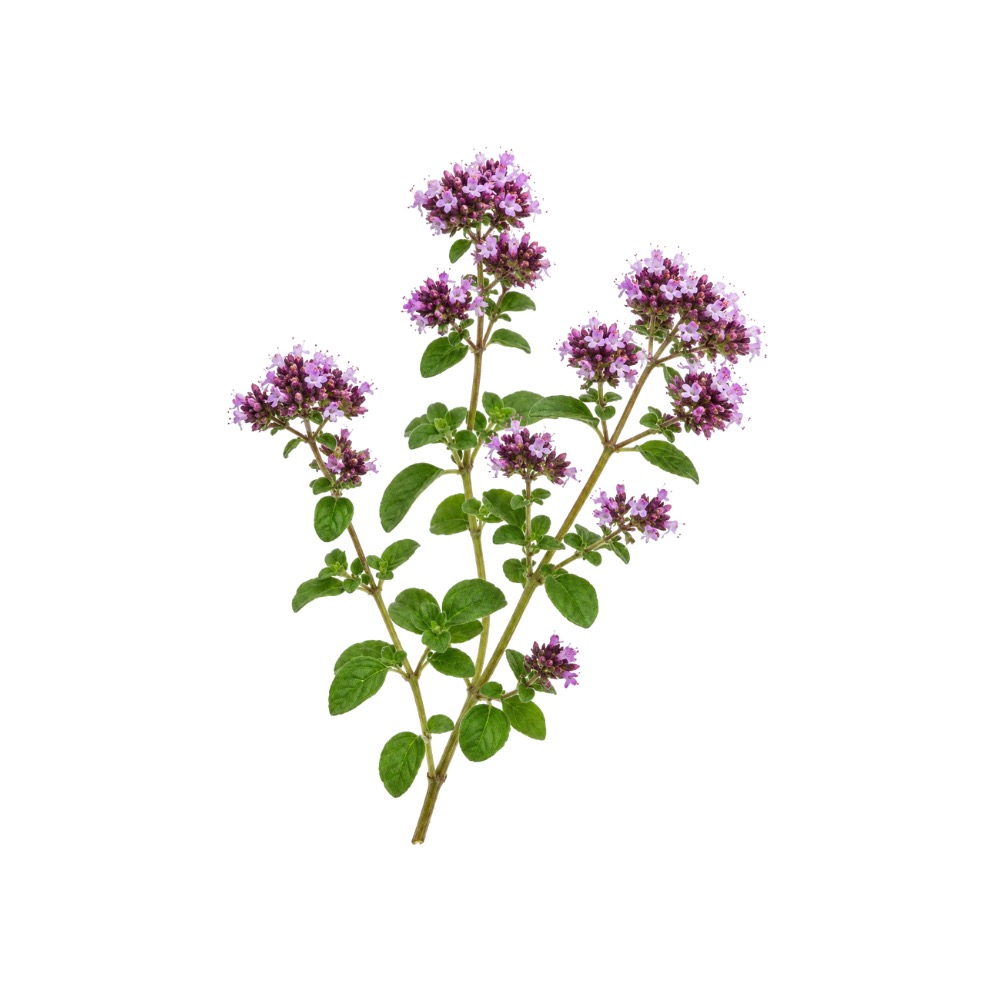
Oregano is a perennial herb of the mint family, Lamiaceae. It grows from a slanting, somewhat woody rootstock, and its stems are 25–60 cm tall, purplish and hairy 23Reference 23Origanum vulgare Linnaeus — species description, habitat and distribution — floraView study →. Like most of its family, it has square stems and leaves in opposite pairs 23Reference 23Origanum vulgare Linnaeus — species description, habitat and distribution — floraView study →.
The leaves are oval, 1–4 cm long and 0.4–1.5 cm wide, dotted with glands, and shiny green above 23Reference 23Origanum vulgare Linnaeus — species description, habitat and distribution — floraView study →. The essential oil is made in glandular hairs on the stems, leaves and flowers 1Reference 1A Recent Insight Regarding the Phytochemistry and Bioactivity of Origanum vulgare LView study →.
The flowers are purple-red to white, 5–7 mm long, and borne in dense spikes among green or purple bracts. The fruits are tiny brown nutlets 23Reference 23Origanum vulgare Linnaeus — species description, habitat and distribution — floraView study →.
Origanum vulgare is a highly variable species with six recognised subspecies. Greek oregano, subsp. hirtum, is one of the southern subspecies that are rich in essential oil 1Reference 1A Recent Insight Regarding the Phytochemistry and Bioactivity of Origanum vulgare LView study →.
Distribution
Oregano grows wild from Macaronesia, southern Europe and the Mediterranean through southwestern and central Asia and along the Himalaya to China and Taiwan 24Reference 24Hedge, I. C. (n.d.). Origanum vulgare L. — species description and distribution — flora. In Ali, S. I., & Qaiser, M. (eds.), Flora of Pakistan. http://www.efloras.org/florataxon.aspx?flora_id=5&taxon_id=200019922View study →. It also grows in North Africa and in Europe north of the Mediterranean, and has been introduced to North America 1,
In China it grows on hills, in grasslands and in forests at 500–3,600 m 23Reference 23Origanum vulgare Linnaeus — species description, habitat and distribution — floraView study →.
Commercial oregano is both wild-collected and cultivated, and Turkey is the largest supplier of Mediterranean oregano 1Reference 1A Recent Insight Regarding the Phytochemistry and Bioactivity of Origanum vulgare LView study →.
Growing Conditions
Cultivation snapshot for Oregano
- Wants full sun and sharp drainage — it resents wet, heavy soil and rots in it.
- Hardy roughly in USDA zones 4–9 as a returning perennial; tolerates poor, dry, even limey ground.
- Flavor and aromatic oil peak in hot, sunny, somewhat lean conditions and just before the plant flowers.
- Grow the best-tasting strains (including Greek oregano) from cuttings or division; seed-raised plants can come up disappointingly bland.
Grow it yourself
Farm Wiki is our cultivation-focused sister site, also run by Justin Cooke.
Phytochemistry
Oregano essential oil is built on the phenolic monoterpenes carvacrol and thymol, which together make up about 78–85% of the oil 1Reference 1A Recent Insight Regarding the Phytochemistry and Bioactivity of Origanum vulgare LView study →. The oil’s composition varies with the plant’s origin, the season and its stage of growth 1Reference 1A Recent Insight Regarding the Phytochemistry and Bioactivity of Origanum vulgare LView study →.
A survey of 502 plants from 17 European countries found three main chemotypes: one dominated by carvacrol and thymol, one by linalool and linalyl acetate, and one by sabinyl compounds 1Reference 1A Recent Insight Regarding the Phytochemistry and Bioactivity of Origanum vulgare LView study →. In two Sicilian genotypes, carvacrol made up 81–85% of the oil in the carvacrol type, and thymol 47–65% in the thymol type 2Reference 2Chemical Composition and Biological Activities of Essential Oils from Origanum vulgare Genotypes Belonging to the Carvacrol and Thymol ChemotypesView study →.
γ-Terpinene and p-cymene are the main monoterpene hydrocarbons of the oil. They are the precursors from which the plant makes carvacrol and thymol 2Reference 2Chemical Composition and Biological Activities of Essential Oils from Origanum vulgare Genotypes Belonging to the Carvacrol and Thymol ChemotypesView study →. The sesquiterpene β-caryophyllene is a smaller component 1Reference 1A Recent Insight Regarding the Phytochemistry and Bioactivity of Origanum vulgare LView study →.
The water-soluble fraction of the leaf is dominated by rosmarinic acid. Across seven Iranian accessions it made up 6.6–16.5 mg/g of dry leaf, followed by luteolin, chicoric acid and quercetin, with smaller amounts of apigenin 3Reference 3Natural diversity in phenolic components and antioxidant properties of oregano (Origanum vulgare L.) accessions, grown under the same conditionsView study →.
Constituent Summary
Monoterpene figures are percentages of the essential oil; the phenolic figures are per dry weight of leaf.
Monoterpene5 compounds4 with data
Phenolic Acid1 compound1 with data
Flavonoid3 compounds3 with data
† Chemotype-defining compounds.
Pharmacology & Research
Oregano has a large laboratory literature and a small clinical one. Most of the mechanistic work concerns the essential oil and its main phenol, carvacrol, which has antibacterial, antioxidant and anti-inflammatory activity in cells and animals 22Reference 22ReviewCarvacrol and human health: a comprehensive reviewView study →.
A handful of controlled human studies exist. They test the essential oil for enteric parasites, an extract ointment on surgical wounds, and extracts as antioxidants, with mixed results 4,
-
Best-supported: broad-spectrum antibacterial activity of the carvacrol-rich oil in vitro 5,
6, , and fewer infected surgical wounds with a topical extract ointment 8Reference 8RCTOregano extract ointment for wound healing: a randomized, double-blind, petrolatum-controlled studyView study →.7Reference 5ReviewAntimicrobial activity of basil, oregano, and thyme essential oils — reviewView study →Reference 6In vitroEssential oils: their antibacterial properties and potential applications in foods — review; in vitro dataView study →Reference 7In vitroThe antibacterial mechanism of carvacrol and thymol against Escherichia coli — in vitroView study → -
Emerging, worth watching: antifungal activity against Candida and Malassezia 10,
11Reference 10Systematic reviewOriganum essential oil and antifungal activity: a systematic reviewView study →Reference 11In vitroModulatory effect of Origanum vulgare essential oil and carvacrol on Malassezia spp. virulence factors — in vitroView study → ; carvacrol’s anti-inflammatory action in the respiratory system, pooled mostly from animal studies 12Reference 12Meta-analysisAnti-inflammatory and antioxidant activity of carvacrol in the respiratory system: a systematic review and meta-analysisView study →; a low-certainty ranking in chronic sinusitis 9Reference 9Meta-analysisHerbal medicines for rhinosinusitis: a systematic review and network meta-analysisView study →. -
Mechanistically thin: anticancer, antidiabetic and liver-protective findings rest on purified carvacrol in cells and rodents 17,
18, .19, 20, 21Reference 17In vitroCarvacrol affects breast cancer cells through TRPM7-mediated cell-cycle regulation — in vitroView study →Reference 18ReviewTherapeutic application of carvacrol: a comprehensive reviewView study →Reference 19AnimalCarvacrol exerts anti-inflammatory, anti-oxidative-stress and hepatoprotective effects against diclofenac-induced liver injury in male ratsView study →Reference 20AnimalCarvacrol prevents acrylamide-induced oxidative and inflammatory liver damage and dysfunction in ratsView study →Reference 21AnimalCarvacrol may alleviate vascular inflammation in diabetic db/db mice — animal modelView study → - The caveat: little human data on the whole herb, and large differences between chemotypes and preparations.
The antimicrobial findings belong to the essential oil, not to the tea. Oregano is sold as carvacrol, thymol and linalool chemotypes whose oils differ markedly, so a result for one oil does not carry over to another oil or to the leaf 1,
1. Antibacterial
This is oregano’s most replicated activity, and it belongs to the essential oil. In vitro, essential oils such as oregano’s inhibit foodborne bacteria including Listeria monocytogenes, Salmonella, E. coli O157:H7 and Staphylococcus aureus at 0.2–10 µL/mL. Their active components, carvacrol and thymol among them, have minimum inhibitory concentrations of 0.05–5 µL/mL. Gram-negative bacteria are slightly less susceptible than Gram-positive ones 5,
Carvacrol and thymol at 200 mg/L permeabilise and depolarise the membrane of E. coli 7Reference 7In vitroThe antibacterial mechanism of carvacrol and thymol against Escherichia coli — in vitroView study →. Essential oils partition into the lipids of the bacterial membrane, making it leaky, so the cell loses its contents 6Reference 6In vitroEssential oils: their antibacterial properties and potential applications in foods — review; in vitro dataView study →. Carvacrol’s free hydroxyl group and its fat-solubility are credited for its strong antimicrobial activity 22Reference 22ReviewCarvacrol and human health: a comprehensive reviewView study →.
In humans the evidence is topical. In a randomised, double-blind trial in 40 patients after surgical excision, a 3% oregano-extract ointment left 19% of wound cultures positive for S. aureus, against 41% with petrolatum. One patient in the oregano group developed cellulitis, against three with petrolatum, and scar colour, pigmentation and pliability were better 8Reference 8RCTOregano extract ointment for wound healing: a randomized, double-blind, petrolatum-controlled studyView study →.
Gap: there are no controlled trials of oral oregano oil for a defined bacterial infection.
2. Antioxidant
Twenty-one phenolic compounds isolated from the whole plant were tested in DPPH and FRAP assays. Twelve showed antioxidant activity comparable to vitamin C 16Reference 16In vitroPhenolic compounds from Origanum vulgare and their antioxidant and antiviral activities — in vitroView study →. Across Iranian accessions, rosmarinic acid content went with antioxidant activity 3Reference 3Natural diversity in phenolic components and antioxidant properties of oregano (Origanum vulgare L.) accessions, grown under the same conditionsView study →.
Two small human RCTs disagree. In a 4-week trial in 45 healthy men, juice enriched with 300 or 600 mg/day of oregano phenolics markedly raised phenolic excretion in the urine but did not change serum lipids or lipid-peroxidation markers 14Reference 14RCTConsumption of juice fortified with oregano extract markedly increases excretion of phenolic acids but lacks short- and long-term effects on lipid peroxidation in healthy nonsmoking men — randomised controlled trialView study →.
In 24 soldiers, a single 500 mg O. vulgare capsule taken after a combat readiness test lowered malondialdehyde and muscle-damage markers (creatine kinase, lactate dehydrogenase) and raised total antioxidant capacity, superoxide dismutase and glutathione peroxidase over the next two hours, compared with placebo 15Reference 15RCTOregano (Origanum vulgare) supplementation and antioxidant/muscle-damage markers after exercise — randomised controlled trialView study →.
Gap: the chronic trial was null on lipid peroxidation; the positive study was acute, small and measured blood markers.
3. Antifungal
A systematic review of Origanum essential oils sold in Brazil found O. vulgare the most-studied species. Candida, Aspergillus and Penicillium were the most-tested fungi, and carvacrol, thymol, p-cymene and γ-terpinene were the constituents linked to the antifungal effect. O. compactum gave the best results 10Reference 10Systematic reviewOriganum essential oil and antifungal activity: a systematic reviewView study →.
O. vulgare oil and carvacrol were active against Malassezia sympodialis and M. furfur, yeasts of the skin microbiota linked to skin infections. They reduced the yeasts’ adherence, biofilm formation and surface hydrophobicity, and carvacrol was more active and less toxic than the whole oil at low concentrations 11Reference 11In vitroModulatory effect of Origanum vulgare essential oil and carvacrol on Malassezia spp. virulence factors — in vitroView study →.
Gap: all robust data are in vitro; there are no controlled human trials of oral oregano for candidiasis or any systemic fungal infection.
4. Anti-Inflammatory
In LPS-stimulated macrophages, O. vulgare leaf extracts and an isolated compound lowered IL-6, TNF-α and nitric oxide without harming the cells 13Reference 13In vitroOriganum vulgare L.: in vitro assessment of cytotoxicity, molecular docking, antioxidant and anti-inflammatory activity in LPS-stimulated RAW 264.7 cellsView study →.
A systematic review of carvacrol in respiratory injury included 17 studies, 5 in humans and 12 in rodents. A meta-analysis of 9 animal studies found carvacrol lowered IL-1β, IL-4, IL-8 and malondialdehyde, but had no effect on IL-6 or TNF-α 12Reference 12Meta-analysisAnti-inflammatory and antioxidant activity of carvacrol in the respiratory system: a systematic review and meta-analysisView study →.
Gap: the pooled evidence is from rodents, and whole-herb oregano has not been shown to change inflammatory markers in people.
5. Antiparasitic
In a small open study, 14 adults with stool-confirmed enteric parasites (Blastocystis hominis, Entamoeba hartmanni, Endolimax nana) took 600 mg/day of emulsified oregano oil for 6 weeks. Entamoeba hartmanni disappeared in all four cases, Endolimax nana in the one case, and Blastocystis hominis in eight cases, with lower counts in three more. Gastrointestinal symptoms improved in 7 of the 11 patients with Blastocystis 4Reference 4Clinical trialInhibition of enteric parasites by emulsified oil of oregano in vivo — clinical trialView study →.
Gap: the trial was small, uncontrolled and unblinded, and has not been repeated in a controlled trial.
6. Hepatoprotective
Carvacrol protects the rat liver against chemical injury. Oral carvacrol at 10 mg/kg limited diclofenac-induced liver injury, raising the antioxidant enzymes catalase, superoxide dismutase and glutathione peroxidase and lowering TNF-α 19Reference 19AnimalCarvacrol exerts anti-inflammatory, anti-oxidative-stress and hepatoprotective effects against diclofenac-induced liver injury in male ratsView study →. Injected carvacrol at 50 mg/kg prevented acrylamide-induced oxidative and inflammatory liver damage 20Reference 20AnimalCarvacrol prevents acrylamide-induced oxidative and inflammatory liver damage and dysfunction in ratsView study →.
Gap: rodent studies of purified carvacrol; no human liver data.
7. Anticancer
Carvacrol reduced the viability of five breast-cancer cell lines, triggered cell death above 200 µM, and arrested the cell cycle through the TRPM7 ion channel 17Reference 17In vitroCarvacrol affects breast cancer cells through TRPM7-mediated cell-cycle regulation — in vitroView study →. Reviews list reduced matrix metalloproteinase 2 and 9 expression and induction of apoptosis across tumour cell types 18Reference 18ReviewTherapeutic application of carvacrol: a comprehensive reviewView study →.
Gap: cell-line work only, with no animal tumour data for oregano and no human evidence.
8. Antidiabetic
In diabetic db/db mice, carvacrol reduced vascular inflammation, lowered serum insulin, triglycerides and inflammatory cytokines, and damped TLR4/NF-κB signalling 21Reference 21AnimalCarvacrol may alleviate vascular inflammation in diabetic db/db mice — animal modelView study →. A review lists lower glucose and restored insulin among carvacrol’s reported effects in animals 18Reference 18ReviewTherapeutic application of carvacrol: a comprehensive reviewView study →.
Gap: single-constituent animal work; no human trial of oregano or carvacrol for blood sugar.
Mechanisms
Carvacrol and thymol are phenols that dissolve into microbial membranes, making them leaky and collapsing their electrical potential 6,
The leaf’s water-soluble phenolics, led by rosmarinic acid, carry much of its antioxidant capacity 3,
| Mechanism | Drives | Key compounds |
|---|---|---|
| Membrane permeabilisation and depolarisation, leakage of cell contents | antibacterialantifungalantiparasitic | carvacrol, thymol |
| Free-radical scavenging, ferric reduction, ↑ antioxidant enzymes (SOD, GPX) | antioxidant | rosmarinic acid, luteolin, quercetin |
| NF-κB ↓, TLR4 ↓, cytokine (TNF-α, IL-1β, IL-6) suppression | anti-inflammatoryhepatoprotectiveantidiabetic | carvacrol |
| TRP-channel modulation (TRPM7), apoptosis induction, MMP downregulation | anticancer (in vitro) | carvacrol |
Clinical Trials
A pharmacokinetic study of oregano–drug interactions is recruiting, and several diet and spice trials include oregano in blends. There are few completed trials of oregano as a single intervention, and one dermatology trial of an oregano cream was terminated.
| Completed | Planned | Terminated | Preclinical |
|---|---|---|---|
| ~4 | ~2 | 1 | ~hundreds |
Last checked: July 2026.
Dosage
The antimicrobial results belong to the concentrated essential oil, not the leaf tea. Oil doses have no whole-herb equivalent.
| Indication | Preparation | Dose | Est. dried-herb equivalent | Source |
|---|---|---|---|---|
| Enteric parasites | Emulsified oregano essential oil, oral | 600 mg/day × 6 weeks | — (oil concentrate) | 4Reference 4Clinical trialInhibition of enteric parasites by emulsified oil of oregano in vivo — clinical trialView study → |
| Antioxidant (chronic) | Oregano extract in juice, oral | 300–600 mg/day total phenolics × 4 weeks | — | 14Reference 14RCTConsumption of juice fortified with oregano extract markedly increases excretion of phenolic acids but lacks short- and long-term effects on lipid peroxidation in healthy nonsmoking men — randomised controlled trialView study → |
| Antioxidant (acute, exercise) | O. vulgare capsule, oral | 500 mg single dose | ~0.5 g dried herb (powdered herb) | 15Reference 15RCTOregano (Origanum vulgare) supplementation and antioxidant/muscle-damage markers after exercise — randomised controlled trialView study → |
| Wound care | 3% oregano-extract ointment, topical | Applied after excision | n/a (topical) | 8Reference 8RCTOregano extract ointment for wound healing: a randomized, double-blind, petrolatum-controlled studyView study → |
Traditional Dosage
| System | Preparation | Dose |
|---|---|---|
| Western herbal | Dried herb as infusion (tea) | ~1–2 g dried leaf per cup, up to 3× daily |
| Western herbal | Tincture 1:5 in 45% ethanol | ~2–4 mL, up to 3× daily |
| Western herbal | ”Oil of oregano” (diluted essential oil) | Varies by product; always diluted |
Safety & Pregnancy
As a kitchen herb oregano is very low-risk. The concentrated essential oil is a strong irritant that must be diluted, and medicinal doses are best avoided in pregnancy.
- Avoid medicinal doses in pregnancy. Concentrated herb or oil is best avoided; culinary amounts are fine.
- Essential oil is a strong irritant. Irritates skin and mucous membranes — dilute well, never take neat or in large amounts.
- Blood thinners. Oil constituents inhibit platelet aggregation in preclinical models — take care with anticoagulant or antiplatelet drugs.
- Lamiaceae allergy. Rare reactions in people sensitised to other mint-family herbs (thyme, basil, sage, marjoram).
- Culinary use very low-risk. Widely eaten; no significant concerns in cooking or tea.
Full Safety Detail
Culinary use. As a kitchen herb and tea, oregano is widely eaten with no significant safety concerns.
Essential oil. The oil is a strong irritant to skin and mucous membranes and must be well diluted, never taken neat or in large amounts. In the small parasite trial, 600 mg/day of emulsified oil for six weeks was taken without reported serious side effects 4Reference 4Clinical trialInhibition of enteric parasites by emulsified oil of oregano in vivo — clinical trialView study →. That trial was small and uncontrolled, so tolerability at medicinal doses is not well established.
Blood thinners. Oregano oil constituents inhibit platelet aggregation in preclinical models, so take care alongside anticoagulant or antiplatelet medication.
Drug metabolism. A clinical study of how oregano affects the breakdown of other drugs is recruiting (NCT06693960).
Allergy. Rare allergic reactions occur in people sensitised to other mint-family herbs such as thyme, basil, sage and marjoram.
Medicinal doses of the herb or oil are best avoided in pregnancy; oregano was traditionally used as an emmenagogue, to bring on menstruation 1Reference 1A Recent Insight Regarding the Phytochemistry and Bioactivity of Origanum vulgare LView study →. Culinary amounts are fine.
There are no studies of medicinal doses while breastfeeding, so the concentrated herb and the essential oil are best avoided.
References
- Lombrea, A., Antal, D., Ardelean, F., Avram, S., Pavel, I. Z., Vlaia, L., … Danciu, C. (2020). A Recent Insight Regarding the Phytochemistry and Bioactivity of Origanum vulgare L. Essential Oil. International Journal of Molecular Sciences, 21(24), 9653. doi:10.3390/ijms21249653
- Zinno, P., Guantario, B., Lombardi, G., Ranaldi, G., Finamore, A., Allegra, S., … Roselli, M. (2023). Chemical Composition and Biological Activities of Essential Oils from Origanum vulgare Genotypes Belonging to the Carvacrol and Thymol Chemotypes. Plants, 12(6), 1344. doi:10.3390/plants12061344
- Jafari Khorsand, G., Morshedloo, M. R., Mumivand, H., Emami Bistgani, Z., Maggi, F., & Khademi, A. (2022). Natural diversity in phenolic components and antioxidant properties of oregano (Origanum vulgare L.) accessions, grown under the same conditions. Scientific Reports, 12, 5512. doi:10.1038/s41598-022-09742-4
- Force, M., Sparks, W. S., & Ronzio, R. A. (2000). Inhibition of enteric parasites by emulsified oil of oregano in vivo — clinical trial. Phytotherapy Research. https://pubmed.ncbi.nlm.nih.gov/10815019/
- Sakkas, H., & Papadopoulou, C. (2017). Antimicrobial activity of basil, oregano, and thyme essential oils — review. Journal of Microbiology and Biotechnology. https://pubmed.ncbi.nlm.nih.gov/27994215/
- Burt, S. (2004). Essential oils: their antibacterial properties and potential applications in foods — review; in vitro data. International Journal of Food Microbiology. https://pubmed.ncbi.nlm.nih.gov/15246235/
- Xu, J., Zhou, F., Ji, B.-P., et al. (2008). The antibacterial mechanism of carvacrol and thymol against Escherichia coli — in vitro. Letters in Applied Microbiology. https://pubmed.ncbi.nlm.nih.gov/19552781/
- Ragi, J., Pappert, A., Rao, B., et al. (2011). Oregano extract ointment for wound healing: a randomized, double-blind, petrolatum-controlled study. Journal of Drugs in Dermatology. https://pubmed.ncbi.nlm.nih.gov/21968667/
- Hoang, M. P., Seresirikachorn, K., Chitsuthipakorn, W., & Snidvongs, K. (2023). Herbal medicines for rhinosinusitis: a systematic review and network meta-analysis. Current Allergy and Asthma Reports. https://pubmed.ncbi.nlm.nih.gov/36609950/
- Mezzomo, L., et al. (2025). Origanum essential oil and antifungal activity: a systematic review. Chemistry & Biodiversity. https://pubmed.ncbi.nlm.nih.gov/39948037/
- Angiolella, L., et al. (2023). Modulatory effect of Origanum vulgare essential oil and carvacrol on Malassezia spp. virulence factors — in vitro. Medical Mycology. https://pubmed.ncbi.nlm.nih.gov/36958865/
- de Carvalho, F. O., et al. (2020). Anti-inflammatory and antioxidant activity of carvacrol in the respiratory system: a systematic review and meta-analysis. Phytotherapy Research. https://pubmed.ncbi.nlm.nih.gov/32249518/
- Mir, R. H., et al. (2021). Origanum vulgare L.: in vitro assessment of cytotoxicity, molecular docking, antioxidant and anti-inflammatory activity in LPS-stimulated RAW 264.7 cells. Medicinal Chemistry. https://pubmed.ncbi.nlm.nih.gov/32885758/
- Nurmi, A., Mursu, J., Nurmi, T., et al. (2006). Consumption of juice fortified with oregano extract markedly increases excretion of phenolic acids but lacks short- and long-term effects on lipid peroxidation in healthy nonsmoking men — randomised controlled trial. Journal of Agricultural and Food Chemistry. https://pubmed.ncbi.nlm.nih.gov/16881679/
- Shirvani, H., et al. (2022). Oregano (Origanum vulgare) supplementation and antioxidant/muscle-damage markers after exercise — randomised controlled trial. Nutrients. https://pubmed.ncbi.nlm.nih.gov/36615794/
- Zhang, X.-L., Guo, Y.-S., Wang, C.-H., et al. (2014). Phenolic compounds from Origanum vulgare and their antioxidant and antiviral activities — in vitro. Food Chemistry. https://pubmed.ncbi.nlm.nih.gov/24444941/
- Li, L., et al. (2021). Carvacrol affects breast cancer cells through TRPM7-mediated cell-cycle regulation — in vitro. Life Sciences. https://pubmed.ncbi.nlm.nih.gov/33310045/
- Imran, M., et al. (2022). Therapeutic application of carvacrol: a comprehensive review. Food Science & Nutrition. https://pubmed.ncbi.nlm.nih.gov/36348778/
- Barzan, M., et al. (2023). Carvacrol exerts anti-inflammatory, anti-oxidative-stress and hepatoprotective effects against diclofenac-induced liver injury in male rats. International Journal of Preventive Medicine. https://pubmed.ncbi.nlm.nih.gov/37351047/
- Cerrah, S., et al. (2023). Carvacrol prevents acrylamide-induced oxidative and inflammatory liver damage and dysfunction in rats. Frontiers in Pharmacology. https://pubmed.ncbi.nlm.nih.gov/37089925/
- Zhao, W., et al. (2020). Carvacrol may alleviate vascular inflammation in diabetic db/db mice — animal model. International Journal of Molecular Medicine. https://pubmed.ncbi.nlm.nih.gov/32583003/
- Sharifi-Rad, M., et al. (2018). Carvacrol and human health: a comprehensive review. Phytotherapy Research. https://pubmed.ncbi.nlm.nih.gov/29744941/
- Li, X. W., & Hedge, I. C. (1994). Origanum vulgare Linnaeus — species description, habitat and distribution — flora. In Wu, Z. Y., & Raven, P. H. (eds.), Flora of China, Vol. 17. http://www.efloras.org/florataxon.aspx?flora_id=2&taxon_id=200019922
- Hedge, I. C. (n.d.). Origanum vulgare L. — species description and distribution — flora. In Ali, S. I., & Qaiser, M. (eds.), Flora of Pakistan. http://www.efloras.org/florataxon.aspx?flora_id=5&taxon_id=200019922



