
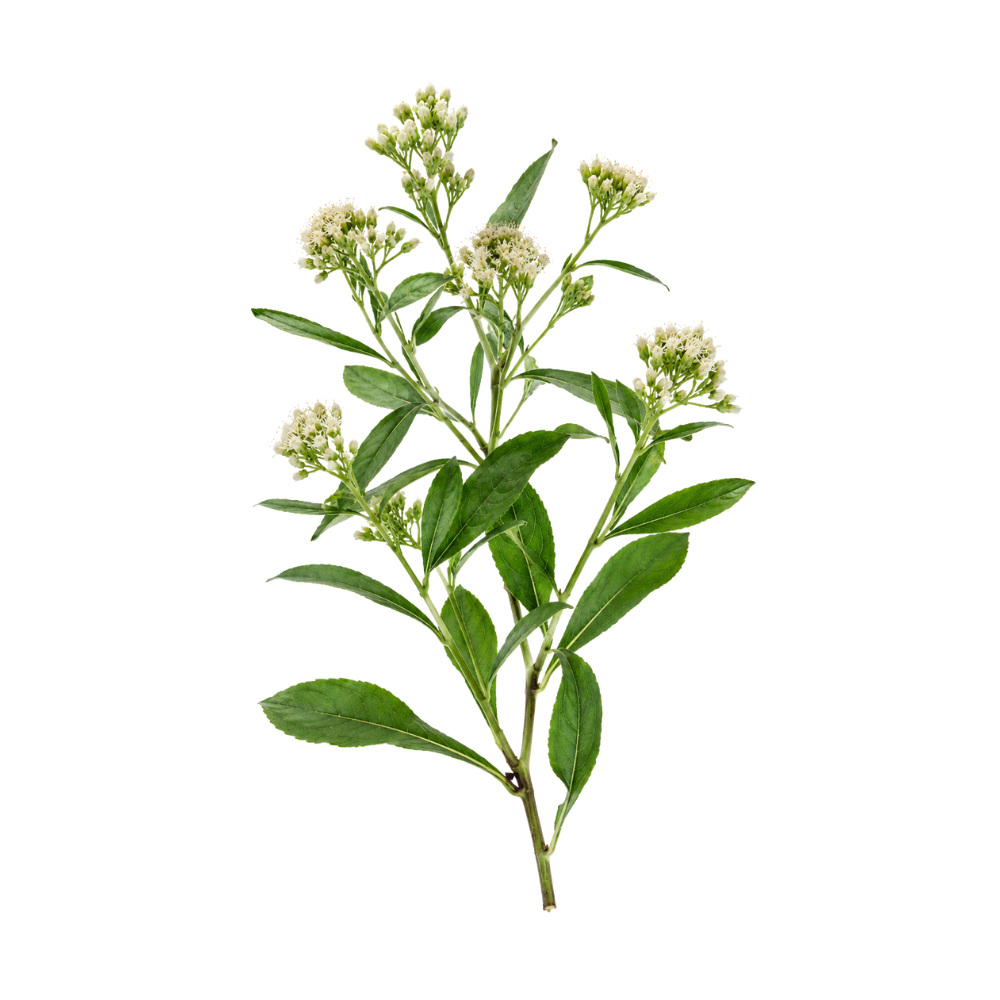
Materia Medica
Chilca
Baccharis latifolia
Chilca is a resinous Andean shrub of the daisy family whose leaves are laid on as a warm poultice for sprains, bruises and aching muscles and joints. Its leaves contain the flavonoids quercetin and rutin and a limonene-rich essential oil.
What Is Chilca?
Chilca is a resinous shrub of the Andes, used across the region as a leaf poultice for sprains, bruises and aching muscles and joints. It belongs to the daisy family (Asteraceae) 2Reference 2Phytochemical and therapeutic use of Baccharis latifolia (Ruiz & Pav.) PersView study →.
Baccharis latifolia grows along the Andes from Mérida in Venezuela to Tucumán in northern Argentina 2Reference 2Phytochemical and therapeutic use of Baccharis latifolia (Ruiz & Pav.) PersView study →. Across that range it is known as chilca, chilca blanca or chilco. The fresh leaves are crushed and applied warm over the painful area, or made into a wash for wounds 2Reference 2Phytochemical and therapeutic use of Baccharis latifolia (Ruiz & Pav.) PersView study →.
The leaves contain the flavonoids quercetin and rutin and an essential oil rich in limonene 2Reference 2Phytochemical and therapeutic use of Baccharis latifolia (Ruiz & Pav.) PersView study →. Laboratory studies have looked mainly at its effect on inflammatory enzymes, and have found leaf extracts active in cell assays and in one mouse model 1,
How Is Chilca Used?
Chilca is used mainly on the skin. The leaves are crushed, warmed and laid over the painful area.
- Leaf poultice — fresh leaves crushed and applied warm to sprains, bruises, dislocations and rheumatic joints. In Bolivia the mashed leaves are heated with urine to make the poultice 2Reference 2Phytochemical and therapeutic use of Baccharis latifolia (Ruiz & Pav.) PersView study →.
- Leaf wash — leaves boiled in water, cooled, and used to wash wounds 2Reference 2Phytochemical and therapeutic use of Baccharis latifolia (Ruiz & Pav.) PersView study →.
- Leaf infusion — taken for diarrhoea, flatulence, heartburn and stomach pain, and at about 5% strength as a tonic for digestion, blood sugar and the liver 2Reference 2Phytochemical and therapeutic use of Baccharis latifolia (Ruiz & Pav.) PersView study →.
- Leaf and flower decoction — taken for cough and bronchitis 2Reference 2Phytochemical and therapeutic use of Baccharis latifolia (Ruiz & Pav.) PersView study →.
Traditional Uses
Andean Folk Medicine
Chilca is used across the folk medicine of Venezuela, Colombia, Ecuador, Peru and Bolivia 2Reference 2Phytochemical and therapeutic use of Baccharis latifolia (Ruiz & Pav.) PersView study →. The main medicine is the fresh leaf, and the main preparation is a poultice.
The leaves are crushed, warmed and laid over sore muscles, sprains, bruises and rheumatic joints. In Ecuador the leaves are applied as a plaster over bone fractures to reduce swelling 2Reference 2Phytochemical and therapeutic use of Baccharis latifolia (Ruiz & Pav.) PersView study →. In Bolivia chilca is mainly an anti-inflammatory: the leaves are mashed, heated with urine and applied to bruises, dislocations and sprains, including by physiotherapists and chiropractors 2Reference 2Phytochemical and therapeutic use of Baccharis latifolia (Ruiz & Pav.) PersView study →.
In the Canta province of Peru, a decoction of the leaves and bark is used for headache and muscle pain, painful areas are massaged with the fresh leaves, and cooled leaf water is used to wash wounds 2Reference 2Phytochemical and therapeutic use of Baccharis latifolia (Ruiz & Pav.) PersView study →. Elsewhere the leaves are mixed with animal fat as an ointment for wounds, or used in steam baths 2Reference 2Phytochemical and therapeutic use of Baccharis latifolia (Ruiz & Pav.) PersView study →.
Taken internally, a leaf infusion is used for diarrhoea, flatulence, heartburn, stomach pain and insomnia 2Reference 2Phytochemical and therapeutic use of Baccharis latifolia (Ruiz & Pav.) PersView study →. A 5% infusion is taken as a tonic, for diabetes and digestion, and for liver disease 2Reference 2Phytochemical and therapeutic use of Baccharis latifolia (Ruiz & Pav.) PersView study →. A decoction of the flowers and leaves is taken for cough and bronchitis, and decoctions are also used for rheumatism, ulcers and intestinal worms 2Reference 2Phytochemical and therapeutic use of Baccharis latifolia (Ruiz & Pav.) PersView study →.
Indications
- Sprains, bruises and dislocations [fresh leaf poultice; Andean folk use]
- Muscle and joint pain, including rheumatism [leaf poultice; Andean folk use]
- Swelling around bone fractures [leaf plaster; Ecuadorian folk use]
- Headache [leaf and bark decoction; Peruvian folk use]
- Wounds [leaf wash or ointment; Andean folk use]
- Diarrhoea, flatulence, heartburn and stomach pain [leaf infusion; Andean folk use]
- Diabetes [leaf infusion; Andean folk use]
- Liver complaints [leaf infusion; Andean folk use]
- Cough and bronchitis [leaf and flower decoction; Andean folk use]
- Insomnia [leaf infusion; Andean folk use]
Botany
Chilca is an evergreen shrub of the daisy family, Asteraceae 2Reference 2Phytochemical and therapeutic use of Baccharis latifolia (Ruiz & Pav.) PersView study →. Like almost all Baccharis, it is dioecious: male and female flower heads grow on separate plants 9Reference 9BaccharisView study →.
Plants in the genus are usually hairless and often resinous, and their leaves are often dotted with glands 9Reference 9BaccharisView study →. The small flower heads have white to pale yellow florets 9Reference 9BaccharisView study →.
Distribution
Chilca grows in the Andes, from north-western Venezuela through Colombia, Ecuador, Peru and Bolivia to north-western Argentina 2,
Baccharis species often grow in wet places such as stream banks, ditches and marshes 9Reference 9BaccharisView study →.
Growing Conditions
Cultivation snapshot for Chilca
- Grows in cool to temperate Andean mountain climates.
- Needs both a male and a female plant to set seed.
Grow it yourself
Farm Wiki is our cultivation-focused sister site, also run by Justin Cooke.
Pharmacology & Research
A handful of laboratory studies have been published on Baccharis latifolia, and no human trial. Much of the work is summarised in one review 2Reference 2Phytochemical and therapeutic use of Baccharis latifolia (Ruiz & Pav.) PersView study →.
Leaf extracts inhibit the two cyclooxygenase enzymes (COX-1 and COX-2) and lower other inflammatory signals in mouse immune cells 1,
The leaf essential oil is active against some fungi. A leaf extract slowed the growth of liver-cancer cells in the laboratory 6Reference 6Antiproliferative activity and phenotypic modification induced by selected Peruvian medicinal plants on human hepatocellular carcinoma Hep3B cellsView study →.
-
Best-supported: COX-1/COX-2 inhibition and suppression of PGE₂, NO and TNF-α by leaf extracts in cell assays, consistent with the topical anti-inflammatory tradition 1,
2Reference 1Anti-inflammatory activity of four Bolivian Baccharis species (Compositae)View study →Reference 2Phytochemical and therapeutic use of Baccharis latifolia (Ruiz & Pav.) PersView study → ; a supporting in-vivo mouse-ear-edema report 2Reference 2Phytochemical and therapeutic use of Baccharis latifolia (Ruiz & Pav.) PersView study →. - Emerging, worth watching: antifungal leaf essential oil against Aspergillus fumigatus without Vero-cell cytotoxicity 4Reference 4Antifungal activity, cytotoxicity and composition of essential oils from the Asteraceae plant familyView study →, and antiproliferative activity against hepatocellular-carcinoma cells in vitro without toxicity to normal liver cells 6Reference 6Antiproliferative activity and phenotypic modification induced by selected Peruvian medicinal plants on human hepatocellular carcinoma Hep3B cellsView study →.
-
Mechanistically thin: antioxidant activity rests on partial inhibition of the neutrophil respiratory burst 2,
3Reference 2Phytochemical and therapeutic use of Baccharis latifolia (Ruiz & Pav.) PersView study →Reference 3Activity of plant extracts on the respiratory burst and the stress protein synthesisView study → and the herb’s known flavonoid content rather than direct radical-scavenging data. - The caveat: no human data exist, and flavonoid levels vary widely with leaf type and soil 7Reference 7Flavonoid contents in leaves of Baccharis latifolia according to the type of leaf and its dependence on the physicochemical properties of soilsView study →.
Chilca extracts are not all the same. Leaf flavonoid content varies with the position of the leaf on the plant and with soil chemistry 7Reference 7Flavonoid contents in leaves of Baccharis latifolia according to the type of leaf and its dependence on the physicochemical properties of soilsView study →, and the studies used different solvent extracts and the essential oil rather than the fresh-leaf poultice.
1. Anti-Inflammatory
In a comparison of four Bolivian Baccharis species, hexane, dichloromethane, ethanol and water extracts were tested in mouse immune cells (peritoneal macrophages) for their effect on COX-1, 5-lipoxygenase, COX-2, nitric oxide and TNF-α 1Reference 1Anti-inflammatory activity of four Bolivian Baccharis species (Compositae)View study →. Most of the extracts were active in all the assays 1Reference 1Anti-inflammatory activity of four Bolivian Baccharis species (Compositae)View study →.
For B. latifolia, the review of this work reports that the hexane and dichloromethane extracts inhibited COX-1 more strongly than the reference drug indomethacin, with a significant effect on the 5-lipoxygenase product LTC₄ 2Reference 2Phytochemical and therapeutic use of Baccharis latifolia (Ruiz & Pav.) PersView study →. COX-2 was inhibited by 98.8% (hexane), 100% (dichloromethane) and 98.1% (water extract), similar to the reference drug 2Reference 2Phytochemical and therapeutic use of Baccharis latifolia (Ruiz & Pav.) PersView study →.
A Colombian study found the dichloromethane extract active at 300 mg/kg in the mouse-ear edema model 2Reference 2Phytochemical and therapeutic use of Baccharis latifolia (Ruiz & Pav.) PersView study →.
The leaves contain the flavonoids quercetin and rutin, which are known COX and lipoxygenase inhibitors, but no single compound from chilca has been tested.
Gap: No study has tested the fresh-leaf poultice, and there is no human or standardised-preparation data.
2. Antimicrobial
The activity here belongs to the essential oil of the aerial parts. Of 15 Asteraceae essential oils, those of B. latifolia and Achyrocline alata were the only ones active against the mould Aspergillus fumigatus; the chilca oil’s MIC was 157.4 µg/mL 4Reference 4Antifungal activity, cytotoxicity and composition of essential oils from the Asteraceae plant familyView study →. Neither oil harmed Vero cells, and neither was active against Candida yeasts 4Reference 4Antifungal activity, cytotoxicity and composition of essential oils from the Asteraceae plant familyView study →.
An Ecuadorian oil showed moderate activity against the skin fungi Trichophyton rubrum and T. mentagrophytes 8,
Against the honeybee pathogen Paenibacillus larvae, the chilca oil was active, but unlike the other oils tested it did not break down the bacterial membrane 5Reference 5Chemical composition, antimicrobial activity and mode of action of essential oils against Paenibacillus larvaeView study →.
The oil is mostly limonene, at about 34% 2,
Gap: These results are for the essential oil, not the fresh-leaf poultice or an infusion. There is no infection model or human data.
3. Antioxidant
In human neutrophils, the leaf methanol extract reduced the production of reactive oxygen species triggered by phorbol ester (PMA) by 55% 2,
This is a test of the cells’ oxidative burst, not a chemical radical-scavenging test. The leaves contain quercetin and rutin, flavonoids with strong antioxidant activity, and total flavonoid content differs between leaf types and varies with soil chemistry 7Reference 7Flavonoid contents in leaves of Baccharis latifolia according to the type of leaf and its dependence on the physicochemical properties of soilsView study →.
Gap: One cell assay, with no ORAC or DPPH data and nothing in animals.
4. Anticancer (Hepatocellular)
A Peruvian survey collected 51 plants used locally for liver and digestive complaints and tested 61 ethanol extracts against the liver-cancer cell line Hep3B 6Reference 6Antiproliferative activity and phenotypic modification induced by selected Peruvian medicinal plants on human hepatocellular carcinoma Hep3B cellsView study →. The B. latifolia leaf extract was one of 14 extracts that significantly slowed the cells’ growth, at concentrations of 50 µg/mL or less 6Reference 6Antiproliferative activity and phenotypic modification induced by selected Peruvian medicinal plants on human hepatocellular carcinoma Hep3B cellsView study →. These active extracts were not toxic to normal human liver cells (primary hepatocytes) in the same study 6Reference 6Antiproliferative activity and phenotypic modification induced by selected Peruvian medicinal plants on human hepatocellular carcinoma Hep3B cellsView study →.
A review of this work reports that the chilca extract was also active against three other liver-cancer cell lines, HepG2, PLC/PRF/5 and SNU-182 2Reference 2Phytochemical and therapeutic use of Baccharis latifolia (Ruiz & Pav.) PersView study →.
Gap: Cell lines only. No animal data, no isolated active compound, and nothing on internal use.
5. Antidiabetic
Andean folk medicine uses a leaf infusion of about 5% as a tonic for diabetes and digestion, and recommends it for liver disease 2Reference 2Phytochemical and therapeutic use of Baccharis latifolia (Ruiz & Pav.) PersView study →. No glucose-uptake, α-glucosidase or animal study has been published for B. latifolia, and no clinical study.
Gap: No experimental or clinical data.
Mechanisms
Leaf extracts of chilca block both cyclooxygenase enzymes, which lowers production of the inflammatory messenger PGE₂. They also lower nitric oxide, TNF-α and the leukotriene LTC₄ in mouse immune cells 1,
The leaf flavonoids and the essential oil are the likely active parts, though no single compound from chilca has been isolated and tested.
| Mechanism | Drives | Key compounds |
|---|---|---|
| COX-1 & COX-2 inhibition | anti-inflammatoryanalgesic | quercetin, rutin |
| 5-LOX / LTC₄ ↓, NO & TNF-α suppression | anti-inflammatory | flavonoids |
| Neutrophil respiratory-burst (ROS) ↓ | antioxidant | quercetin, rutin |
| Monoterpene membrane activity | antimicrobial (antifungal) | limonene |
Clinical Trials
No clinical trial of chilca is registered on ClinicalTrials.gov, and no human study has been published.
| Completed | Planned | Terminated | Preclinical |
|---|---|---|---|
| 0 | 0 | 0 | ~7 |
Last checked: July 2026.
Phytochemistry
The leaves contain the flavonoids quercetin and rutin, gallic tannins, resin, and the triterpene friedelin 2Reference 2Phytochemical and therapeutic use of Baccharis latifolia (Ruiz & Pav.) PersView study →. They also contain clerodane- and labdane-type diterpenes and germacrene- and eudesmane-type sesquiterpenes 2Reference 2Phytochemical and therapeutic use of Baccharis latifolia (Ruiz & Pav.) PersView study →.
The essential oil of the aerial parts from Ecuador is mainly limonene (33.7%), with β-phellandrene (10.3%), sabinene (10.3%), β-pinene (7.0%) and α-pinene (5.4%) 2,
Flavonoid content changes within a single plant. It differs between leaf types on the same plant, and varies with the soil the plant grows in 7Reference 7Flavonoid contents in leaves of Baccharis latifolia according to the type of leaf and its dependence on the physicochemical properties of soilsView study →.
Constituent Summary
Reported from the leaves and the aerial-part essential oil.
Terpenoids7 compounds5 with data
Polyphenols1 compoundno data
Dosage
Chilca is used mostly as a fresh-leaf poultice, applied without a set weight.
Research Doses
| Indication | Preparation | Dose | Source |
|---|---|---|---|
| Anti-inflammatory (in vivo) | Dichloromethane leaf extract | 300 mg/kg (mouse-ear edema) | 2Reference 2Phytochemical and therapeutic use of Baccharis latifolia (Ruiz & Pav.) PersView study → |
| Antifungal (in vitro) | Aerial-part essential oil | MIC 157.4 µg/mL (A. fumigatus) | 4Reference 4Antifungal activity, cytotoxicity and composition of essential oils from the Asteraceae plant familyView study → |
| Anticancer (in vitro) | Ethanol leaf extract | Active at 50 µg/mL or less (Hep3B cells) | 6Reference 6Antiproliferative activity and phenotypic modification induced by selected Peruvian medicinal plants on human hepatocellular carcinoma Hep3B cellsView study → |
Traditional Dosage
| System | Preparation | Dose |
|---|---|---|
| Andean folk (topical) | Fresh crushed leaves as a warm poultice, or a leaf wash | Applied over the affected area |
| Andean folk (internal tonic) | Leaf infusion | About 5% strength 2Reference 2Phytochemical and therapeutic use of Baccharis latifolia (Ruiz & Pav.) PersView study → |
| Andean folk (cough, bronchitis) | Leaf and flower decoction | Not quantified |
Safety & Pregnancy
Chilca is used mainly on the skin. In rodents the extract has low acute toxicity, and there are no human safety studies.
- Low acute toxicity. Rodent studies found only slight depression and loose stools 2Reference 2Phytochemical and therapeutic use of Baccharis latifolia (Ruiz & Pav.) PersView study →.
- Kidney changes with repeated dosing. Repeated oral dosing in rats changed spleen and kidney weights and caused mild kidney tissue injury, without deaths 2Reference 2Phytochemical and therapeutic use of Baccharis latifolia (Ruiz & Pav.) PersView study →.
- No set internal dose. Internal use is traditional and has not been studied in people.
- Pregnancy and breastfeeding not studied. Avoid medicinal use as a precaution.
Full Safety Detail
Toxicity. In acute toxicity studies in rodents, the extract caused slight depression and loose stools, with no change in weight and no tissue damage 2Reference 2Phytochemical and therapeutic use of Baccharis latifolia (Ruiz & Pav.) PersView study →. A repeated-dose oral study in rats caused no deaths, but changed the relative weights of the spleen and kidneys and caused kidney tissue injury, which the authors read as a slight toxic response 2Reference 2Phytochemical and therapeutic use of Baccharis latifolia (Ruiz & Pav.) PersView study →. The Colombian handbook of medicinal plants lists no contraindications 2Reference 2Phytochemical and therapeutic use of Baccharis latifolia (Ruiz & Pav.) PersView study →.
Use on the skin. The traditional poultice and wash are applied to the skin. There are no human safety studies of internal use.
Possible interactions. Leaf extracts block the COX enzymes 1,
Essential oil. The limonene-rich essential oil is a different product from the leaf. Oxidised citrus-type monoterpene oils can sensitise the skin.
Avoid medicinal use. There are no pregnancy or breastfeeding safety data for chilca, so internal and concentrated preparations are best avoided during pregnancy and breastfeeding.
References
- Abad MJ, Bessa AL, Ballarin B, et al. (2006). Anti-inflammatory activity of four Bolivian Baccharis species (Compositae). J Ethnopharmacol. 103(3):338–344. https://pubmed.ncbi.nlm.nih.gov/16202549/
- Sequeda-Castañeda LG, Célis C, Luengas-Caicedo PE. Phytochemical and therapeutic use of Baccharis latifolia (Ruiz & Pav.) Pers. (Asteraceae). PharmacologyOnline. 2015;2:14–17. https://pharmacologyonline.silae.it/files/archives/2015/vol2/PhOL_2015_2_A003_Celis_14_17.pdf
- Pérez-García F, Marín E, Adzet T, Cañigueral S. Activity of plant extracts on the respiratory burst and the stress protein synthesis. Phytomedicine. 2001;8(1):31–38. https://pubmed.ncbi.nlm.nih.gov/11292237/
- Zapata B, Durán C, Stashenko E, Betancur-Galvis L, Mesa-Arango AC. Antifungal activity, cytotoxicity and composition of essential oils from the Asteraceae plant family. Rev Iberoam Micol. 2010;27(2):101–103. https://pubmed.ncbi.nlm.nih.gov/20346291/
- Pellegrini MC, Alonso-Salces RM, Umpierrez ML, Rossini C, Fuselli SR. Chemical composition, antimicrobial activity and mode of action of essential oils against Paenibacillus larvae. Chem Biodivers. 2017;14(4):e1600382. https://pubmed.ncbi.nlm.nih.gov/27943550/
- Carraz M, Lavergne C, Jullian V, Wright M, Gairin JE, Gonzales de la Cruz M, Bourdy G. Antiproliferative activity and phenotypic modification induced by selected Peruvian medicinal plants on human hepatocellular carcinoma Hep3B cells. J Ethnopharmacol. 2015;166:185–199. https://pubmed.ncbi.nlm.nih.gov/25701751/
- Enríquez S, Quispe RE, Amurrio P, Peñaranda JC, Calle A, Orsag V, Almanza GR. Flavonoid contents in leaves of Baccharis latifolia according to the type of leaf and its dependence on the physicochemical properties of soils. Rev Bol Quim. 2018;35(5):152–160. https://www.redalyc.org/journal/4263/426358213004/html/
- Valarezo E, Rosillo M, Cartuche L, Malagón O, Meneses M, Morocho V. Chemical composition, antifungal and antibacterial activity of the essential oil from Baccharis latifolia (Ruiz & Pav.) Pers. (Asteraceae) from Loja, Ecuador. J Essent Oil Res. 2013;25(3):233–238. https://doi.org/10.1080/10412905.2013.775679
- Sundberg SD, Bogler DJ. Baccharis. In: Flora of North America Editorial Committee, eds. Flora of North America North of Mexico. Vol. 20 (Asteraceae). http://www.efloras.org/florataxon.aspx?flora_id=1&taxon_id=103317
- Colombian Plants made accessible (ColPlanta), Royal Botanic Gardens, Kew. Baccharis latifolia (Ruiz & Pav.) Pers. https://colplanta.org/taxon/urn:lsid:ipni.org:names:183399-1
- Armijos C, Ramírez J, Vidari G. Poorly investigated Ecuadorian medicinal plants. Plants (Basel). 2022;11(12):1590. https://pubmed.ncbi.nlm.nih.gov/35736741/



