
Materia Medica
Black Wattle
Acacia mearnsii
Black wattle is a fast-growing Australian tree grown on plantations for its tannin-rich bark, which supplies the leather and adhesive industries. A polyphenol extract of the bark is sold as an antioxidant supplement, and the bark is a folk remedy for infections and diarrhoea in South Africa.
What Is Black Wattle?
Black wattle is a fast-growing Australian tree grown for its tannin-rich bark. Acacia mearnsii is planted on a large scale to supply bark for leather tanning and wood adhesives, and a polyphenol extract of the bark is sold as an antioxidant supplement 11Reference 11In vitroTannins from Acacia mearnsii De Wild. bark: tannin determination and biological activities — review, in vitroView study →.
The tree is native to south-eastern Australia and Tasmania 11,
The bark’s tannins are proanthocyanidins built mainly from fisetinidol and robinetinidol units 8,
Black wattle is one of the acacias that kept the genus name when Acacia was divided. Catechu, babul and gum arabic, which carry the older “acacia” traditions, are now in other genera.
How Is Black Wattle Used?
- Tanning and adhesives — most of the harvested bark is extracted for leather tanning and wood adhesives 11Reference 11In vitroTannins from Acacia mearnsii De Wild. bark: tannin determination and biological activities — review, in vitroView study →.
- Bark-extract supplements — standardised proanthocyanidin extracts, sold as antioxidants and taken as tablets or capsules 1,
11Reference 1RCTImpact of Acacia bark extract tablets on the skin of healthy humans — randomised, double-blind, placebo-controlled trialView study →Reference 11In vitroTannins from Acacia mearnsii De Wild. bark: tannin determination and biological activities — review, in vitroView study → . - Bark decoction or extract — used in South African folk practice for infections and diarrhoea 16,
17Reference 16In vitroPharmacological assessment of the medicinal potential of Acacia mearnsii De Wild.: antimicrobial and toxicity activities — in vitroView study →Reference 17In vitroIn vitro antibacterial and time-kill assessment of crude methanolic stem bark extract of Acacia mearnsii De Wild against bacteria in shigellosis — in vitroView study → .
Traditional Uses
South African Folk Medicine
In South Africa, where black wattle was introduced as a plantation crop, the bark is used in folk practice to treat microbial infections and diarrhoea 16,
Botany
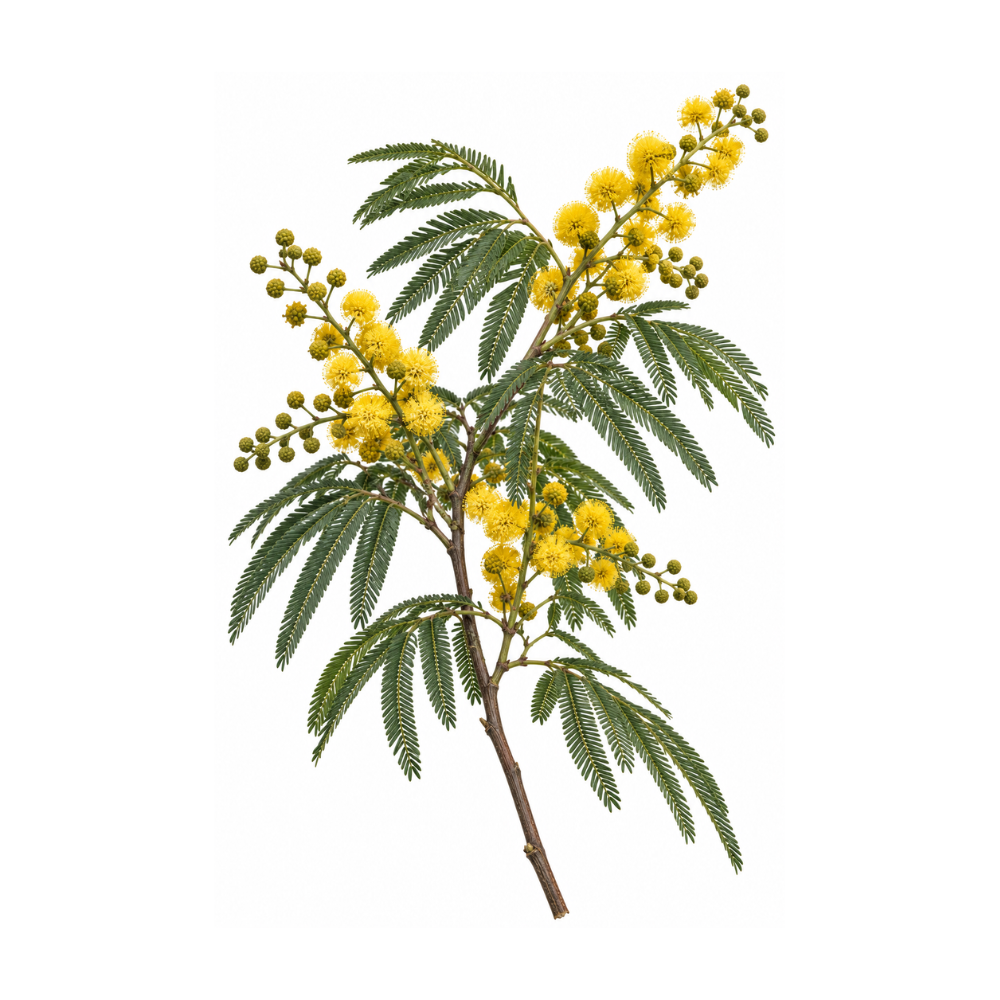
Black wattle is an evergreen shrub or tree in the legume family (Fabaceae). It is usually 3–10 m tall and sometimes taller 22Reference 22Acacia mearnsii De Wild. — species description, habitat and distribution — floraView study →. Its bark ranges from smooth to fissured and from brown or greenish to blackish, and its young branches are hairy 22Reference 22Acacia mearnsii De Wild. — species description, habitat and distribution — floraView study →.
Many wattles lose their true leaves as they mature and carry flattened leaf stalks called phyllodes instead 24Reference 24G., & Harden, GView study →. Black wattle keeps its fern-like, twice-divided leaves throughout its life 22Reference 22Acacia mearnsii De Wild. — species description, habitat and distribution — floraView study →. Each leaf has 7–31 pairs of side branches carrying 16–78 pairs of small leaflets, and raised glands sit on the main leaf stalk at and between the branch pairs 22,
The flowers are pale yellow or cream. They are packed 20–40 together into round heads 6–8 mm across, carried in branched sprays, and they appear mainly from October to December in New South Wales 22Reference 22Acacia mearnsii De Wild. — species description, habitat and distribution — floraView study →.
The pods are 3–12 cm long, leathery and finely hairy. They range from barely to deeply constricted between the seeds 22Reference 22Acacia mearnsii De Wild. — species description, habitat and distribution — floraView study →.
Distribution
Black wattle grows wild in south-eastern Australia, in New South Wales, Victoria, Tasmania and South Australia 22Reference 22Acacia mearnsii De Wild. — species description, habitat and distribution — floraView study →. It grows in wet sclerophyll forest, woodland and coastal scrub, on hillsides, ridgetops and creek banks, in clay or sandy soils 22Reference 22Acacia mearnsii De Wild. — species description, habitat and distribution — floraView study →.
It has been planted or has naturalised across Africa, the Americas, Asia, Europe, the Pacific and New Zealand 11Reference 11In vitroTannins from Acacia mearnsii De Wild. bark: tannin determination and biological activities — review, in vitroView study →. Commercial bark comes mainly from plantations in South Africa, Brazil, China and Vietnam 11Reference 11In vitroTannins from Acacia mearnsii De Wild. bark: tannin determination and biological activities — review, in vitroView study →.
Black wattle is on the IUCN list of 100 of the world’s worst invasive alien species 23Reference 23Species profile: Acacia mearnsii — description, habitat, reproduction and impacts — invasive species databaseView study →. It produces large numbers of long-lived seeds that can germinate together after a fire, resprouts from the base, and forms dense thickets 23Reference 23Species profile: Acacia mearnsii — description, habitat, reproduction and impacts — invasive species databaseView study →. These stands replace native vegetation and grassland and increase water loss along rivers, which reduces streamflow 23Reference 23Species profile: Acacia mearnsii — description, habitat, reproduction and impacts — invasive species databaseView study →.
Where black wattle is an invader, harvesting it removes an unwanted plant rather than depleting a wild one.
Growing Conditions
Cultivation snapshot for Black Wattle
Lifeperennial tree, relatively short-lived (20–50 years).
- Temperate to subtropical; full sun; tolerates a wide range of soils but prefers deep and moderately fertile ground.
- Very fast growing and a nitrogen fixer; harvested for bark on roughly a 7–10 year rotation.
- It seeds prolifically and resprouts, and is a declared invasive in several countries.
Grow it yourself
Farm Wiki is our cultivation-focused sister site, also run by Justin Cooke.
Indications
- Dry, itchy skin [bark extract, by mouth]
- Blood sugar and blood fats after meals [bark extract]
- Infections and diarrhoea [bark decoction; South African folk use]
- Antioxidant support [bark extract]
Pharmacology & Research
About forty biological studies have been published on black wattle, most of them in vitro. Much of the chemistry behind them was worked out by the tanning industry 11Reference 11In vitroTannins from Acacia mearnsii De Wild. bark: tannin determination and biological activities — review, in vitroView study →.
One randomised, double-blind, placebo-controlled trial has tested a bark-extract tablet on the skin 1Reference 1RCTImpact of Acacia bark extract tablets on the skin of healthy humans — randomised, double-blind, placebo-controlled trialView study →. The skin and blood-sugar findings are also supported by studies in mice 2,
-
Best-supported: a bark-extract tablet reduced water loss from the skin and the desire to scratch in an 8-week human trial, consistent with two mouse dermatitis models 1,
2, ; and the bark’s condensed tannins are strong radical scavengers across a large in vitro literature 11,3Reference 1RCTImpact of Acacia bark extract tablets on the skin of healthy humans — randomised, double-blind, placebo-controlled trialView study →Reference 2AnimalInhibitory effect of polyphenol-rich fraction from the bark of Acacia mearnsii on itching associated with allergic dermatitis — animal modelView study →Reference 3AnimalAcacia polyphenol ameliorates atopic dermatitis in trimellitic anhydride-induced model mice via changes in the gut microbiota — animal modelView study → 12Reference 11In vitroTannins from Acacia mearnsii De Wild. bark: tannin determination and biological activities — review, in vitroView study →Reference 12In vitroCharacterisation and biological activities of proanthocyanidins from the barks of Pinus massoniana and Acacia mearnsii — in vitroView study → . -
Emerging, worth watching: proanthocyanidins lowered fasting glucose and weight gain in diabetic mice and blunted glucose rises after a sugar load 4,
5Reference 4AnimalAnalysis of anti-obesity and anti-diabetic effects of acacia bark-derived proanthocyanidins in type 2 diabetes model KKAy mice — animal modelView study →Reference 5AnimalThe inhibition of lipase and glucosidase activities by acacia polyphenol — animal modelView study → ; and in vitro antibacterial activity and antibiotic synergy have been replicated, in line with the South African folk use 16,17, .18, 19, 20Reference 16In vitroPharmacological assessment of the medicinal potential of Acacia mearnsii De Wild.: antimicrobial and toxicity activities — in vitroView study →Reference 17In vitroIn vitro antibacterial and time-kill assessment of crude methanolic stem bark extract of Acacia mearnsii De Wild against bacteria in shigellosis — in vitroView study →Reference 18In vitroSynergistic interactions of methanolic extract of Acacia mearnsii De Wild. with antibiotics against bacteria of clinical relevance — in vitroView study →Reference 19In vitroInfluence of first-line antibiotics on the antibacterial activities of acetone stem bark extract of Acacia mearnsii De Wild. against drug-resistant bacterial isolates — in vitroView study →Reference 20In vitroAntibacterial activity of crude extracts of some South African medicinal plants against multidrug resistant etiological agents of diarrhoea — in vitroView study → - Mechanistically thin: single-study signals for neuroprotection (a galloyl dimer protecting neuroblastoma cells) 13Reference 13In vitroRobinetinidol-(4β→8)-epigallocatechin 3-O-gallate, a galloyl dimer prorobinetinidin from Acacia mearnsii, protects SH-SY5Y cells against acrolein-induced oxidative damage — in vitroView study → and antiproliferative activity against cancer cell lines 12Reference 12In vitroCharacterisation and biological activities of proanthocyanidins from the barks of Pinus massoniana and Acacia mearnsii — in vitroView study →.
- The caveat: almost everything is preclinical, and the dose of the tablet used in the human trial was not published.
Wattle tannins are a different chemical type from grape-seed and pine-bark procyanidins. They are built mainly from 5-deoxyflavan-3-ol units, so research on those products does not transfer to this one 8,
1. Antipruritic / Dermatitis
This is the only indication for black wattle with human data.
In an 8-week randomised, double-blind, placebo-controlled trial, 66 healthy Japanese adults with uncomfortable skin symptoms took acacia bark-extract tablets or placebo. By 4 weeks the treated group reported significantly less desire to scratch and better dermatology-life-quality scores, and by 8 weeks they showed significantly lower transepidermal water loss on facial skin 1Reference 1RCTImpact of Acacia bark extract tablets on the skin of healthy humans — randomised, double-blind, placebo-controlled trialView study →.
The endpoints are partly subjective, and the subjects were healthy volunteers rather than eczema patients. Two mouse models point the same way: a polyphenol-rich bark fraction reduced scratching in allergic contact dermatitis 2Reference 2AnimalInhibitory effect of polyphenol-rich fraction from the bark of Acacia mearnsii on itching associated with allergic dermatitis — animal modelView study →, and acacia polyphenol improved trimellitic-anhydride-induced atopic dermatitis, with accompanying changes in the gut microbiota 3Reference 3AnimalAcacia polyphenol ameliorates atopic dermatitis in trimellitic anhydride-induced model mice via changes in the gut microbiota — animal modelView study →. The proposed route is the anti-inflammatory activity of the same polyphenol fraction 7Reference 7In vitroPolyphenols isolated from Acacia mearnsii bark with anti-inflammatory and carbolytic enzyme inhibitory activities — in vitroView study →.
Gap: one small trial in healthy volunteers, using a proprietary tablet whose dose was never published.
2. Glycemic (Enzyme Inhibition)
Bark proanthocyanidins inhibit α-glucosidase, α-amylase and lipase in vitro. This has been reproduced across several independent studies and traced to oligomers of 5-deoxyflavan-3-ol units, robinetinidol and fisetinidol 6,
The effect has also been shown in mice. Acacia polyphenol suppressed the rise in plasma glucose after maltose, sucrose and glucose loading, and the rise in triglyceride after an oil load 5Reference 5AnimalThe inhibition of lipase and glucosidase activities by acacia polyphenol — animal modelView study →. In KKAy type 2 diabetes model mice, bark proanthocyanidins prevented high-fat-diet weight gain, suppressed fasting blood glucose, raised adiponectin, and showed AMPK activation and DPP-4 inhibition 4Reference 4AnimalAnalysis of anti-obesity and anti-diabetic effects of acacia bark-derived proanthocyanidins in type 2 diabetes model KKAy mice — animal modelView study →.
Tannins inhibit a very wide range of enzymes non-specifically.
Gap: no human study has measured blood sugar on this extract.
3. Antioxidant
Black wattle bark is one of the most concentrated commercial sources of condensed tannin, and those tannins are potent radical scavengers in vitro 11,
Radical scavenging in a test tube is a property of the molecule. It does not show that swallowing the extract raises antioxidant status in a person, and condensed tannins are poorly absorbed as intact polymers.
At the constituent level, a galloyl dimer prorobinetinidin isolated from the bark protected human neuroblastoma cells against acrolein-induced oxidative damage, restoring glutathione and limiting mitochondrial dysfunction 13Reference 13In vitroRobinetinidol-(4β→8)-epigallocatechin 3-O-gallate, a galloyl dimer prorobinetinidin from Acacia mearnsii, protects SH-SY5Y cells against acrolein-induced oxidative damage — in vitroView study →.
Gap: entirely in vitro and ex vivo. No study has shown that oral black wattle extract changes any antioxidant marker in a living system.
4. Anti-Inflammatory
Semi-purified polyphenol fractions from the bark and leaves suppress inflammatory signalling in stimulated macrophages, lowering reactive oxygen species, nitric oxide, and the mRNA for COX-2, iNOS, IL-1β and IL-6 in LPS-challenged cells 7,
In a separate line of work, essential oils from the leaves and stem bark, given by mouth, had significant anti-inflammatory activity in a rat albumin-induced oedema model 15Reference 15AnimalChemical composition and anti-inflammatory activities of the essential oils from Acacia mearnsii de Wild — animal modelView study →. The essential oil is a volatile preparation, rich in phytol, cis-verbenol and octadecyl alcohol, and is unrelated to the tannin extract sold as a supplement 15Reference 15AnimalChemical composition and anti-inflammatory activities of the essential oils from Acacia mearnsii de Wild — animal modelView study →.
Gap: the tannin work is cell-based, and the one in vivo result used the essential oil.
5. Antimicrobial
A cluster of South African studies reports broad-spectrum antibacterial activity from acetone and methanol bark extracts. Minimum inhibitory concentrations ran from tens to hundreds of µg/mL against Gram-positive and Gram-negative organisms, including drug-resistant strains and the bacteria that cause shigellosis 16,
Checkerboard assays show the extract is often synergistic with conventional antibiotics, most consistently tetracycline, chloramphenicol and amoxicillin against E. coli, S. aureus and B. subtilis, though some combinations are antagonistic 18,
These studies tested the bark used in South African folk medicine for infections and diarrhoea.
Gap: all in vitro. There is no animal infection model and no clinical endpoint, and the synergy findings run in both directions.
Mechanisms
Black wattle tannins are large polymers built mainly from 5-deoxyflavan-3-ol units. Like other condensed tannins, they bind proteins, which is the basis of their astringency and their use in tanning. They have been studied for radical scavenging and for inhibiting starch- and fat-digesting enzymes, and polyphenol fractions for their effects on inflammatory signalling in macrophages 6,
Because the polymers are poorly absorbed, much of this binding is likely to happen in the gut rather than in the bloodstream.
| Mechanism | Drives | Key compounds |
|---|---|---|
| Radical scavenging | antioxidant (in vitro)neuroprotection (cell) | condensed tannins, robinetinidol, fisetinidol |
| α-Glucosidase / α-amylase / lipase inhibition | glycemic (in vitro and mouse) | proanthocyanidin oligomers |
| Inflammatory signalling ↓ (COX-2, iNOS, cytokines) | anti-inflammatoryantipruritic (macrophage and mouse) | polyphenol-rich fraction |
| Bacterial growth inhibition and antibiotic synergy | antimicrobial (in vitro) | crude bark extract |
| Protein precipitation | astringent (the tanning property) | condensed tannins (proanthocyanidins) |
Clinical Trials
One completed human trial exists, the 8-week double-blind placebo-controlled skin study 1Reference 1RCTImpact of Acacia bark extract tablets on the skin of healthy humans — randomised, double-blind, placebo-controlled trialView study →. It was not lodged in a public trial registry, and ClinicalTrials.gov lists no registered study naming Acacia mearnsii for any indication.
| Completed | Planned | Terminated | Preclinical |
|---|---|---|---|
| 1 | 0 | 0 | ~40 |
Last checked: September 2026.
Phytochemistry
Black wattle bark contains large amounts of water-soluble condensed tannin, known commercially as wattle tannin 11Reference 11In vitroTannins from Acacia mearnsii De Wild. bark: tannin determination and biological activities — review, in vitroView study →. One analysis of the commercial extract found it was 90.6% proanthocyanidins, mostly dimers (42%) and trimers (40%) 11Reference 11In vitroTannins from Acacia mearnsii De Wild. bark: tannin determination and biological activities — review, in vitroView study →.
The tannin is built from the flavan-3-ols fisetinidol, robinetinidol, catechin and gallocatechin 11Reference 11In vitroTannins from Acacia mearnsii De Wild. bark: tannin determination and biological activities — review, in vitroView study →. Its proanthocyanidins are mainly 5-deoxyflavan-3-ol units, which carry one fewer hydroxyl group on the A-ring than catechin 8,
Within the polymers, the fractions with the strongest α-amylase inhibition are those with catechol-type B-rings rather than pyrogallol-type ones 8Reference 8In vitroCharacterization of the α-amylase inhibitory activity of oligomeric proanthocyanidins from Acacia mearnsii bark extract — in vitroView study →.
The bark also contains monomeric flavonoids, including quercetin, myricetin, fisetin and robinetin 11Reference 11In vitroTannins from Acacia mearnsii De Wild. bark: tannin determination and biological activities — review, in vitroView study →. One galloyl dimer, robinetinidol-(4β→8)-epigallocatechin 3-O-gallate, has been isolated and studied on its own 13Reference 13In vitroRobinetinidol-(4β→8)-epigallocatechin 3-O-gallate, a galloyl dimer prorobinetinidin from Acacia mearnsii, protects SH-SY5Y cells against acrolein-induced oxidative damage — in vitroView study →. Pinitol, a sugar alcohol, is a major component of the aqueous extract, at a level comparable to sucrose 8Reference 8In vitroCharacterization of the α-amylase inhibitory activity of oligomeric proanthocyanidins from Acacia mearnsii bark extract — in vitroView study →.
The leaves contain their own proanthocyanidin-rich polyphenol fractions 14Reference 14In vitroPhytochemical characterization and anti-inflammatory properties of Acacia mearnsii leaves — in vitroView study →. The essential oils of the leaves and stem bark are made up mainly of phytol, cis-verbenol and octadecyl alcohol 15Reference 15AnimalChemical composition and anti-inflammatory activities of the essential oils from Acacia mearnsii de Wild — animal modelView study →.
Research on grape-seed and pine-bark proanthocyanidins should be read separately from studies of wattle tannin 8,
Constituent Summary
Amounts are for the bark extract unless noted.
Tannin3 compounds3 with data
Flavanol4 compounds4 with data
Phenolic Acid1 compoundno data
Flavonoid1 compoundno data
Sugar Alcohol1 compound1 with data
The 5-deoxyflavan-3-ol oligomers and the leaf and stem-bark essential oils are described above.
Dosage
No dose has been established. The one human trial used a proprietary tablet whose dose and marker content were not published.
| Indication | Preparation | Dose | Est. dried-herb equivalent | Source |
|---|---|---|---|---|
| Skin comfort | Acacia bark-extract tablets, proprietary | Undisclosed daily dose, 8 weeks | — (no marker % published) | 1Reference 1RCTImpact of Acacia bark extract tablets on the skin of healthy humans — randomised, double-blind, placebo-controlled trialView study → |
| Glycemic / anti-obesity | Bark proanthocyanidin fraction, dietary admixture in mice | Blended into a high-fat diet, 7 weeks | — (dietary %, not a discrete dose) | 4Reference 4AnimalAnalysis of anti-obesity and anti-diabetic effects of acacia bark-derived proanthocyanidins in type 2 diabetes model KKAy mice — animal modelView study → |
| Glycemic (acute loading) | Acacia polyphenol, oral gavage in mice | Given with a sugar or oil load; in vitro IC50 0.22–0.95 mg/mL | — (acute model, no chronic dose) | 5Reference 5AnimalThe inhibition of lipase and glucosidase activities by acacia polyphenol — animal modelView study → |
Traditional Dosage
| System | Preparation | Dose |
|---|---|---|
| South African folk medicine | Bark extract or decoction, for infections and diarrhoea | Not quantified |
Commercial wattle-bark polyphenol supplements are dosed per product label.
Safety & Pregnancy
The oral extract has one small human trial behind it and no toxicology, interaction or reproductive studies. The one documented hazard of the plant is from breathing in bark and wood dust.
- No oral toxicity reported. An 8-week human trial ran blood tests without a reported problem 1Reference 1RCTImpact of Acacia bark extract tablets on the skin of healthy humans — randomised, double-blind, placebo-controlled trialView study →, and the crude extract was non-toxic in a brine-shrimp assay 16Reference 16In vitroPharmacological assessment of the medicinal potential of Acacia mearnsii De Wild.: antimicrobial and toxicity activities — in vitroView study →.
- Bark and wood dust is an occupational allergen. Timber and bark workers can develop skin and breathing allergies from the dust 21Reference 21Systematic reviewA systematic review of the health effects of Acacia, Eucalyptus and Pinus wood dust — occupational, systematic reviewView study →.
- Very little human safety data. One 8-week trial in 66 healthy adults is the whole human record.
- High tannin content. Tannins can irritate the stomach, reduce iron absorption and bind some medicines in the gut.
Full Safety & Interactions Detail
Human data. A 2019 trial gave 33 people a bark-extract tablet for eight weeks and ran blood tests without reporting a problem 1Reference 1RCTImpact of Acacia bark extract tablets on the skin of healthy humans — randomised, double-blind, placebo-controlled trialView study →. It is one small, short study in healthy volunteers, of a proprietary preparation at an undisclosed dose.
Dust exposure. Workers exposed to Acacia, eucalyptus and pine wood dust have developed skin sensitisation, allergic contact dermatitis, breathing symptoms and occupational asthma 21Reference 21Systematic reviewA systematic review of the health effects of Acacia, Eucalyptus and Pinus wood dust — occupational, systematic reviewView study →. Fewer than 10% of exposed workers showed skin or respiratory sensitisation 21Reference 21Systematic reviewA systematic review of the health effects of Acacia, Eucalyptus and Pinus wood dust — occupational, systematic reviewView study →. South Africa’s wood-dust exposure limits do not name Acacia, and the review proposes a stricter limit for it 21Reference 21Systematic reviewA systematic review of the health effects of Acacia, Eucalyptus and Pinus wood dust — occupational, systematic reviewView study →.
Tannins. Black wattle bark is one of the most tannin-rich plant materials in commerce. Tannins can irritate the stomach when taken without food and cause constipation with continued use. They also reduce the absorption of iron and other minerals and can bind alkaloid and protein drugs in the gut, so the extract is best taken apart from medicines and iron supplements.
Interactions. No herb–drug interaction or CYP450 study exists for this plant.
Not established — avoid. There are no reproductive or animal teratology studies, and the plant has no traditional record of use in pregnancy. The one human trial did not include pregnant or breastfeeding women.
A concentrated tannin extract with so little human exposure data is best avoided while pregnant or breastfeeding.
References
- Hoshino, T., Yamashita, S. I., Suzuki, N., et al. (2019). Impact of Acacia bark extract tablets on the skin of healthy humans — randomised, double-blind, placebo-controlled trial. Biosci Biotechnol Biochem. https://pubmed.ncbi.nlm.nih.gov/30526388/
- Ikarashi, N., Sato, W., Toda, T., et al. (2012). Inhibitory effect of polyphenol-rich fraction from the bark of Acacia mearnsii on itching associated with allergic dermatitis — animal model. Evid Based Complement Alternat Med. https://pubmed.ncbi.nlm.nih.gov/22315629/
- Ikarashi, N., Fujitate, N., Togashi, T., et al. (2020). Acacia polyphenol ameliorates atopic dermatitis in trimellitic anhydride-induced model mice via changes in the gut microbiota — animal model. Foods. https://pubmed.ncbi.nlm.nih.gov/32545274/
- Kashiwada, M., Nakaishi, S., Usuda, A., et al. (2021). Analysis of anti-obesity and anti-diabetic effects of acacia bark-derived proanthocyanidins in type 2 diabetes model KKAy mice — animal model. J Nat Med. https://pubmed.ncbi.nlm.nih.gov/34120298/
- Ikarashi, N., Takeda, R., Ito, K., et al. (2011). The inhibition of lipase and glucosidase activities by acacia polyphenol — animal model. Evid Based Complement Alternat Med. https://pubmed.ncbi.nlm.nih.gov/21660093/
- Kusano, R., Ogawa, S., Matsuo, Y., et al. (2011). α-Amylase and lipase inhibitory activity and structural characterization of acacia bark proanthocyanidins — in vitro. J Nat Prod. https://pubmed.ncbi.nlm.nih.gov/21192716/
- Xiong, J., Grace, M. H., Esposito, D., et al. (2017). Polyphenols isolated from Acacia mearnsii bark with anti-inflammatory and carbolytic enzyme inhibitory activities — in vitro. Chin J Nat Med. https://pubmed.ncbi.nlm.nih.gov/29329608/
- Matsuo, Y., Kusano, R., Ogawa, S., et al. (2016). Characterization of the α-amylase inhibitory activity of oligomeric proanthocyanidins from Acacia mearnsii bark extract — in vitro. Nat Prod Commun. https://pubmed.ncbi.nlm.nih.gov/30508349/
- Kato, C. G., de Almeida Gonçalves, G., Peralta, R. A., et al. (2017). Inhibition of α-amylases by condensed and hydrolysable tannins — in vitro and animal model. Enzyme Res. https://pubmed.ncbi.nlm.nih.gov/28589038/
- Chen, X., Xiong, J., He, Z., et al. (2018). Effects of in vitro digestion on the content and biological activity of polyphenols from Acacia mearnsii bark — in vitro. Molecules. https://pubmed.ncbi.nlm.nih.gov/30037047/
- Ogawa, S., & Yazaki, Y. (2018). Tannins from Acacia mearnsii De Wild. bark: tannin determination and biological activities — review, in vitro. Molecules. https://pubmed.ncbi.nlm.nih.gov/29621196/
- Shen, X., Wang, Y., & Wang, F. (2010). Characterisation and biological activities of proanthocyanidins from the barks of Pinus massoniana and Acacia mearnsii — in vitro. Nat Prod Res. https://pubmed.ncbi.nlm.nih.gov/20397109/
- Huang, W., Niu, H., Xue, X., et al. (2010). Robinetinidol-(4β→8)-epigallocatechin 3-O-gallate, a galloyl dimer prorobinetinidin from Acacia mearnsii, protects SH-SY5Y cells against acrolein-induced oxidative damage — in vitro. J Alzheimers Dis. https://pubmed.ncbi.nlm.nih.gov/20555145/
- Xiong, J., Grace, M. H., Esposito, D., et al. (2016). Phytochemical characterization and anti-inflammatory properties of Acacia mearnsii leaves — in vitro. Nat Prod Commun. https://pubmed.ncbi.nlm.nih.gov/27319141/
- Avoseh, O. N., Oyedeji, O. O., Aremu, K., et al. (2015). Chemical composition and anti-inflammatory activities of the essential oils from Acacia mearnsii de Wild — animal model. Nat Prod Res. https://pubmed.ncbi.nlm.nih.gov/25422136/
- Olajuyigbe, O. O., & Afolayan, A. J. (2012). Pharmacological assessment of the medicinal potential of Acacia mearnsii De Wild.: antimicrobial and toxicity activities — in vitro. Int J Mol Sci. https://pubmed.ncbi.nlm.nih.gov/22605976/
- Olajuyigbe, O. O., & Afolayan, A. J. (2012). In vitro antibacterial and time-kill assessment of crude methanolic stem bark extract of Acacia mearnsii De Wild against bacteria in shigellosis — in vitro. Molecules. https://pubmed.ncbi.nlm.nih.gov/22354188/
- Olajuyigbe, O. O., & Afolayan, A. J. (2012). Synergistic interactions of methanolic extract of Acacia mearnsii De Wild. with antibiotics against bacteria of clinical relevance — in vitro. Int J Mol Sci. https://pubmed.ncbi.nlm.nih.gov/22942742/
- Olajuyigbe, O. O., & Afolayan, A. J. (2014). Influence of first-line antibiotics on the antibacterial activities of acetone stem bark extract of Acacia mearnsii De Wild. against drug-resistant bacterial isolates — in vitro. Evid Based Complement Alternat Med. https://pubmed.ncbi.nlm.nih.gov/25101132/
- Bisi-Johnson, M. A., Obi, C. L., Samuel, B. B., et al. (2017). Antibacterial activity of crude extracts of some South African medicinal plants against multidrug resistant etiological agents of diarrhoea — in vitro. BMC Complement Altern Med. https://pubmed.ncbi.nlm.nih.gov/28629407/
- Engelbrecht, I., et al. (2025). A systematic review of the health effects of Acacia, Eucalyptus and Pinus wood dust — occupational, systematic review. J Occup Environ Hyg. https://pubmed.ncbi.nlm.nih.gov/41004525/
- Kodela, P. G. (2012). Acacia mearnsii De Wild. — species description, habitat and distribution — flora. In PlantNET (The NSW Plant Information Network System), taxon concept Kodela & Harden, Flora of New South Wales Vol. 2 (2002). Royal Botanic Gardens and Domain Trust, Sydney. https://plantnet.rbgsyd.nsw.gov.au/cgi-bin/NSWfl.pl?page=nswfl&lvl=sp&name=Acacia~mearnsii
- IUCN SSC Invasive Species Specialist Group (2010; accessed 2026). Species profile: Acacia mearnsii — description, habitat, reproduction and impacts — invasive species database. Global Invasive Species Database. http://www.iucngisd.org/gisd/species.php?sc=51
- Kodela, P. G., & Harden, G. J. Acacia Mill. — genus description — flora. In PlantNET (The NSW Plant Information Network System). Royal Botanic Gardens and Domain Trust, Sydney. https://plantnet.rbgsyd.nsw.gov.au/cgi-bin/NSWfl.pl?page=nswfl&lvl=gn&name=Acacia



