
Materia Medica
Blue Passionflower
Passiflora caerulea
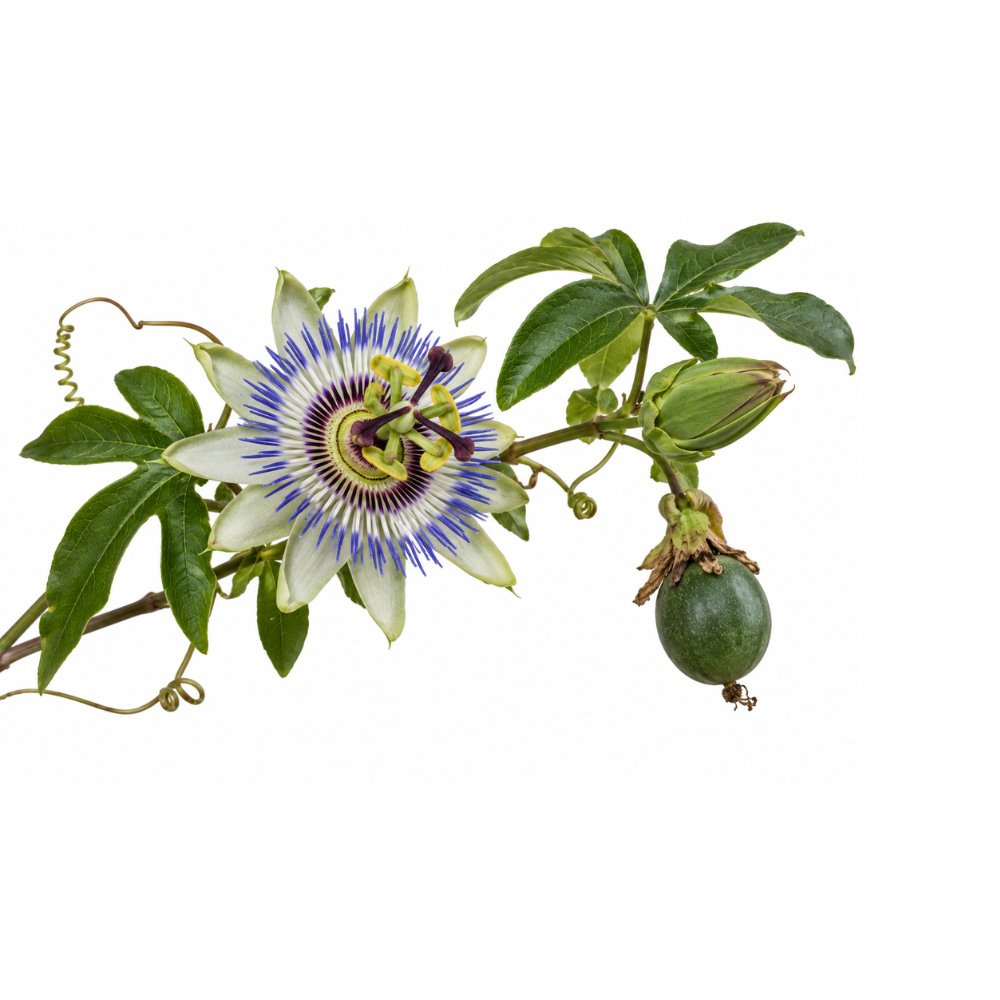
Blue passionflower is a hardy South American passionflower vine, grown around the world as an ornamental for its white flowers banded with blue and purple. The flavone chrysin was identified in this plant as a benzodiazepine-receptor ligand, and its leaves and fruit have been studied for seizures, inflammation and the gut.
What Is Blue Passionflower?
Blue passionflower is a hardy, fast-growing passionflower vine from South America, grown in gardens around the world for its striking flowers. It is the national flower of Paraguay 16Reference 16Passiflora caerulea (blue passionflower) — description, growing conditions, hardiness and toxicity — horticultural databaseView study →.
It is native to Argentina, Brazil, Paraguay and Uruguay 14Reference 14H., & MacDougal, JView study →. It is cold-hardy enough to grow outdoors in much cooler climates than most passionflowers, and it is the passionflower most often seen on garden walls in temperate countries 14,
In 1990, researchers identified the flavone chrysin in this plant and showed that it binds to the benzodiazepine receptor 2Reference 2AnimalChrysin (5,7-di-OH-flavone), a naturally-occurring ligand for benzodiazepine receptors, with anticonvulsant properties — animal modelView study →. Later animal work has studied the leaf and fruit for seizures, inflammation and the gut. No human study has been run on this species.
Blue passionflower is a different species from the medicinal passionflower, P. incarnata. The two can be told apart by their leaves and by their flavonoid profiles 12,
How Is Blue Passionflower Used?
- Aerial parts — taken in South American folk medicine for the gut and as a sedative 2,
5Reference 2AnimalChrysin (5,7-di-OH-flavone), a naturally-occurring ligand for benzodiazepine receptors, with anticonvulsant properties — animal modelView study →Reference 5AnimalBeneficial properties of Passiflora caerulea on experimental colitis — animal modelView study → . - Fruit — edible but bland 16Reference 16Passiflora caerulea (blue passionflower) — description, growing conditions, hardiness and toxicity — horticultural databaseView study →.
- Ornamental — grown on walls, fences and trellises 16Reference 16Passiflora caerulea (blue passionflower) — description, growing conditions, hardiness and toxicity — horticultural databaseView study →.
Other Passionflowers
Passiflora holds roughly 500 species. Four besides this one have their own pages.
- Passionflower (P. incarnata) — the species of the pharmacopoeias, and the one tested in the human anxiety and sleep trials.
- Winged-stem passionflower (P. alata) — Brazil’s official passionflower since 1929, with a flavonoid profile unlike P. incarnata’s.
- Passion fruit (P. edulis) — the fruit crop, with three separate medicines: a sedative leaf, a fruit peel with human blood-sugar data, and a seed rich in stilbenes.
- Stinking passionflower (P. foetida) — a tropical weed used for pain rather than calm.
Traditional Uses
South American Folk Medicine
In Argentina, Paraguay and Uruguay the plant is mburucuyá. It is used in folk medicine as a sedative 2Reference 2AnimalChrysin (5,7-di-OH-flavone), a naturally-occurring ligand for benzodiazepine receptors, with anticonvulsant properties — animal modelView study →.
It is also commonly used for a range of complaints of the gastrointestinal tract 5Reference 5AnimalBeneficial properties of Passiflora caerulea on experimental colitis — animal modelView study →.
Indications
- Nervousness and restlessness [aerial parts; South American folk use]
- Diarrhoea, intestinal cramping and inflamed bowel [aerial parts; South American folk use]
- Seizures [leaf and fruit extracts]
- Inflammation and fever [leaf extract]
- Pain [leaf extract] Caution: Isolated chrysin, one of the plant’s flavones, increased pain sensitivity in mice 7.
Botany
Blue passionflower is a climbing vine in the passionflower family (Passifloraceae) 14Reference 14H., & MacDougal, JView study →. It climbs by tendrils and can reach 3–12 m 16Reference 16Passiflora caerulea (blue passionflower) — description, growing conditions, hardiness and toxicity — horticultural databaseView study →.
Its leaves are deeply divided into (3–)5–7(–9) lobes, 3–10 cm long, with the middle lobe as long as or longer than the side lobes 14Reference 14H., & MacDougal, JView study →. This separates it from P. incarnata and from the hybrid P. × belotii, whose leaves are three-lobed 14Reference 14H., & MacDougal, JView study →.
The flowers are 6–10 cm across, with white sepals and petals 14,
The fruit is an egg-shaped yellow-orange to orange berry, 3–6 cm long 14,
Even without setting seed, the plant can spread locally by suckers from the roots 14Reference 14H., & MacDougal, JView study →.
Distribution
Blue passionflower is native to South America, in Argentina, Brazil, Paraguay and Uruguay 14,
It is grown as an ornamental far beyond that range. In North America it is widely cultivated but naturalised only around Los Angeles, where it grows in disturbed ground, open woodland and chaparral 14Reference 14H., & MacDougal, JView study →. In China it is grown in Guangxi, Jiangxi, Sichuan and Yunnan 15Reference 15E., Jørgensen, PView study →.
Material is cultivated or gathered from garden plants, and there is no wild-collection trade in it.
Growing Conditions
Cultivation snapshot for Blue Passionflower
SunFull sun to partial shade 16Reference 16Passiflora caerulea (blue passionflower) — description, growing conditions, hardiness and toxicity — horticultural databaseView study →.
WaterMoist soil with good drainage; it likes high humidity 16Reference 16Passiflora caerulea (blue passionflower) — description, growing conditions, hardiness and toxicity — horticultural databaseView study →.
SoilClay, loam or sand, at any pH 16Reference 16Passiflora caerulea (blue passionflower) — description, growing conditions, hardiness and toxicity — horticultural databaseView study →.
LifePerennial vine; evergreen in warm climates and deciduous in colder ones 16Reference 16Passiflora caerulea (blue passionflower) — description, growing conditions, hardiness and toxicity — horticultural databaseView study →.
ZoneUSDA 6–10. In the coldest of these it may not flower, because the growing season is short 14,
Grow it yourself
Farm Wiki is our cultivation-focused sister site, also run by Justin Cooke.
Pharmacology & Research
About a dozen studies bear directly on Passiflora caerulea, all of them in animals or in the laboratory. No human trial has been run on this species.
The first line of work is on chrysin, identified in this plant in 1990 as a ligand of the benzodiazepine receptor 1,
-
Best-supported: anticonvulsant activity in two animal models with a mapped benzodiazepine-receptor mechanism 1,
2, ; antioxidant and anti-inflammatory activity across animal and in vitro assays 4,3Reference 1AnimalPossible anxiolytic effects of chrysin, a central benzodiazepine receptor ligand isolated from Passiflora coerulea — animal modelView study →Reference 2AnimalChrysin (5,7-di-OH-flavone), a naturally-occurring ligand for benzodiazepine receptors, with anticonvulsant properties — animal modelView study →Reference 3AnimalPassiflora caerulea L. fruit extract and its metabolites ameliorate epileptic seizure, cognitive deficit and oxidative stress in pilocarpine-induced epileptic mice — animal modelView study → 6Reference 4AnimalBioactivity-guided study of Passiflora caerulea L. leaf extracts — animal model / phytochemistryView study →Reference 6In vitroMetabolic profile of leaves and pulp of Passiflora caerulea L. (Bulgaria) and their biological activities — analytical / in vitroView study → . - Emerging, worth watching: protection in an experimental colitis model, matching the plant’s South American folk use for the gut 5Reference 5AnimalBeneficial properties of Passiflora caerulea on experimental colitis — animal modelView study →.
-
Mechanistically thin: the anxiolytic reputation rests on isolated chrysin, not on any whole-extract behavioural study of this species 1,
9Reference 1AnimalPossible anxiolytic effects of chrysin, a central benzodiazepine receptor ligand isolated from Passiflora coerulea — animal modelView study →Reference 9ReviewPharmacological, neurochemical, and behavioral mechanisms underlying the anxiolytic- and antidepressant-like effects of flavonoid chrysin — reviewView study → . -
The caveat: no human data, no standardised preparation, and a direct contradiction between whole-extract analgesia and isolated chrysin, which is hyperalgesic 4,
7Reference 4AnimalBioactivity-guided study of Passiflora caerulea L. leaf extracts — animal model / phytochemistryView study →Reference 7AnimalChrysin induces hyperalgesia via the GABAA receptor in mice — animal modelView study → .
The receptor work used isolated chrysin, and the whole-extract work comes from single laboratories. Chrysin was given as a pure compound, by injection into the brain in the seizure study, so its results say little about a leaf tea or tincture 1,
1. Anticonvulsant
An aqueous fruit extract at 100 and 200 mg/kg by mouth, daily for 15 days, was tested against pilocarpine-induced seizures in mice, with diazepam as the comparator. The higher dose delayed the onset of convulsions and shortened clonic convulsions. Both doses improved Y-maze performance that pilocarpine had impaired, and the extract reduced oxidative damage, raised cholinergic transmission and lessened neuron loss in the hippocampus 3Reference 3AnimalPassiflora caerulea L. fruit extract and its metabolites ameliorate epileptic seizure, cognitive deficit and oxidative stress in pilocarpine-induced epileptic mice — animal modelView study →.
An ethanolic extract of leaves from plants grown in Egypt was rated at 63% of carbamazepine’s anticonvulsant potency 4Reference 4AnimalBioactivity-guided study of Passiflora caerulea L. leaf extracts — animal model / phytochemistryView study →.
Chrysin from this plant binds competitively to the central benzodiazepine receptor, with a Ki of about 3 µM. Injected into the brain of mice, it prevented pentylenetetrazol-induced tonic-clonic seizures, an effect abolished by the antagonist Ro 15-1788. All treated mice also lost their righting reflex, suggesting muscle relaxation 2Reference 2AnimalChrysin (5,7-di-OH-flavone), a naturally-occurring ligand for benzodiazepine receptors, with anticonvulsant properties — animal modelView study →.
2. Antioxidant
The ethanolic leaf extract reached 71% of vitamin E’s antioxidant effect in the Egyptian study 4Reference 4AnimalBioactivity-guided study of Passiflora caerulea L. leaf extracts — animal model / phytochemistryView study →. In Bulgarian laboratory work, 70% ethanol leaf extracts gave the highest antioxidant values on three of four assays, and 50% ethanol extracts were strongest for the pulp 6Reference 6In vitroMetabolic profile of leaves and pulp of Passiflora caerulea L. (Bulgaria) and their biological activities — analytical / in vitroView study →. In the pilocarpine model the fruit extract lowered oxidative damage in brain tissue 3Reference 3AnimalPassiflora caerulea L. fruit extract and its metabolites ameliorate epileptic seizure, cognitive deficit and oxidative stress in pilocarpine-induced epileptic mice — animal modelView study →.
The leaves carry more phenolics and flavonoids than the flowers, stems or roots, whatever solvent is used 11Reference 11Extraction processes with several solvents on total bioactive compounds in different organs of three medicinal plants — analyticalView study →.
Gap: no human antioxidant data exist, and the strongest readings come from high-ethanol leaf extracts rather than any preparation the plant is consumed as.
3. Anti-Inflammatory
The ethanolic leaf extract was rated at 90% of indomethacin’s anti-inflammatory effect 4Reference 4AnimalBioactivity-guided study of Passiflora caerulea L. leaf extracts — animal model / phytochemistryView study →, and Bulgarian laboratory assays found the leaf more anti-inflammatory than the pulp 6Reference 6In vitroMetabolic profile of leaves and pulp of Passiflora caerulea L. (Bulgaria) and their biological activities — analytical / in vitroView study →.
In an acetic-acid colitis model, an ethanolic extract at 250 mg/kg by mouth reduced the colon weight-to-length ratio, the visible lesion score, TBARS levels and tissue damage under the microscope 5Reference 5AnimalBeneficial properties of Passiflora caerulea on experimental colitis — animal modelView study →.
4. Anxiolytic
Chrysin from P. caerulea was anxiolytic in mice on the elevated plus-maze at 1 mg/kg, and the benzodiazepine antagonist Ro 15-1788 abolished the effect 1Reference 1AnimalPossible anxiolytic effects of chrysin, a central benzodiazepine receptor ligand isolated from Passiflora coerulea — animal modelView study →. Unlike high-dose diazepam, chrysin at the doses tested caused neither sedation on the holeboard test nor muscle relaxation on the horizontal wire test 1Reference 1AnimalPossible anxiolytic effects of chrysin, a central benzodiazepine receptor ligand isolated from Passiflora coerulea — animal modelView study →. Later reviews describe chrysin acting mainly through GABAergic and serotonergic systems 9Reference 9ReviewPharmacological, neurochemical, and behavioral mechanisms underlying the anxiolytic- and antidepressant-like effects of flavonoid chrysin — reviewView study →.
No whole-extract anxiety study has been run in this species. A combined Melissa officinalis and P. caerulea infusion at 200 mg/kg lowered plasma corticosterone in mice under restraint stress, but the design cannot separate the two plants 8Reference 8AnimalMelissa officinalis and Passiflora caerulea infusion as physiological stress decreaser — animal modelView study →.
Gap: the anxiolytic evidence is for isolated chrysin, not the whole plant, and the chrysin content of a tea or tincture has not been measured.
5. Antispasmodic & Gastrointestinal
The ethanolic extract reduced watery stools in castor-oil-induced diarrhoea at 125 mg/kg by mouth. On isolated rat jejunum it reduced contractions caused by acetylcholine and by calcium, in proportion to the dose 5Reference 5AnimalBeneficial properties of Passiflora caerulea on experimental colitis — animal modelView study →.
The study set out to test the plant’s South American folk use for the gut, and found anti-inflammatory, anti-diarrhoeal and antispasmodic activity 5Reference 5AnimalBeneficial properties of Passiflora caerulea on experimental colitis — animal modelView study →.
6. Analgesic
The ethanolic leaf extract was rated at 70% of indomethacin’s analgesic effect 4Reference 4AnimalBioactivity-guided study of Passiflora caerulea L. leaf extracts — animal model / phytochemistryView study →.
Isolated chrysin, however, increased pain sensitivity in mice. Given by injection, it shortened tail-withdrawal time in a dose-dependent way, with an ED50 of about 66 mg/kg, and 75 mg/kg by mouth had the same effect. Flumazenil, bicuculline and picrotoxin blocked it, placing the effect at the GABA-A receptor 7Reference 7AnimalChrysin induces hyperalgesia via the GABAA receptor in mice — animal modelView study →.
Gap: the whole-extract and isolated-chrysin results point in opposite directions. The net effect of a real preparation is unknown.
7. Antipyretic
The ethanolic leaf extract reached 90% of paracetamol’s antipyretic effect in the one comparison made 4Reference 4AnimalBioactivity-guided study of Passiflora caerulea L. leaf extracts — animal model / phytochemistryView study →. No other study has tested it.
8. Antibacterial
In the laboratory, 50% ethanol leaf extracts were more active against Gram-positive bacteria, and 70% ethanol leaf extracts more active against Gram-negative bacteria such as Salmonella enteritidis 6Reference 6In vitroMetabolic profile of leaves and pulp of Passiflora caerulea L. (Bulgaria) and their biological activities — analytical / in vitroView study →. There is no animal infection model.
Mechanisms
Chrysin binds the central benzodiazepine site of the GABA-A receptor. This has been studied for its anxiolytic and anticonvulsant effects, and also for the increased pain sensitivity seen in mice 1,
The whole leaf and fruit extracts carry flavonoids, including C-glycosyl flavones, that have been studied for antioxidant and anti-inflammatory activity. Their effects on the gut have not been traced to a single compound 4,
| Mechanism | Drives | Key compounds |
|---|---|---|
| Central benzodiazepine / GABA-A receptor binding | anticonvulsantanxiolytichyperalgesia | chrysin |
| Oxidative damage ↓, cholinergic transmission ↑ | anticonvulsantantioxidant | fruit polyphenols |
| Myeloperoxidase- and lipid-peroxidation-linked inflammation ↓ | anti-inflammatorygastrointestinal | flavones of the active extract, not resolved to one compound |
| Acetylcholine- and calcium-induced contraction ↓ | antispasmodicantidiarrhoeal | not resolved to a constituent |
Clinical Trials
No clinical trials are registered for Passiflora caerulea. The human passionflower trials were run in P. incarnata.
| Completed | Planned | Terminated | Preclinical |
|---|---|---|---|
| 0 | 0 | 0 | ~10 |
Last checked: September 2026.
Phytochemistry
The leaves carry more phenolics and flavonoids than the flowers, stems or roots 11Reference 11Extraction processes with several solvents on total bioactive compounds in different organs of three medicinal plants — analyticalView study →.
Chrysin was identified in the plant in 1990 2Reference 2AnimalChrysin (5,7-di-OH-flavone), a naturally-occurring ligand for benzodiazepine receptors, with anticonvulsant properties — animal modelView study →. It is also found in many other plants, including P. incarnata and chamomile 7,
From an Egyptian leaf extract, three compounds were isolated from the most active anticonvulsant fraction: lucenin-2 (luteolin 6,8-di-C-glucoside), 4-hydroxycinnamic acid, and chrysin 6-C-β-D-glucoside. The chrysin glucoside made up 0.0184 g per 100 g of dried leaf 4Reference 4AnimalBioactivity-guided study of Passiflora caerulea L. leaf extracts — animal model / phytochemistryView study →.
An Argentine ethanolic extract contained the C-glycosyl flavones isoorientin, vitexin, isovitexin and vicenin-2 5Reference 5AnimalBeneficial properties of Passiflora caerulea on experimental colitis — animal modelView study →. The fruit extract contained naringenin, chrysoeriol 8-C-glucoside, luteolin-6-C-glucoside and apigenin-6,8-di-C-glucoside 3Reference 3AnimalPassiflora caerulea L. fruit extract and its metabolites ameliorate epileptic seizure, cognitive deficit and oxidative stress in pilocarpine-induced epileptic mice — animal modelView study →.
The flowers contain β-carboline alkaloids — norharman, harmane, harmine, harmol, harmaline and harmalol. Their total ranges from 1 to 110 µg/kg, depending on the floral organ and the age of the flower, and is about ten times higher in the anthers 10Reference 10Distribution of photoactive β-carboline alkaloids across Passiflora caerulea floral organs — analyticalView study →.
In Bulgarian material, β-sitosterol was the major sterol of leaf and pulp. Fructose (7.5%) was the main sugar of the pulp, and palmitoleic acid the main fatty acid of both 6Reference 6In vitroMetabolic profile of leaves and pulp of Passiflora caerulea L. (Bulgaria) and their biological activities — analytical / in vitroView study →.
The leaf flavonoids differ in kind and amount between P. caerulea, P. incarnata, P. alata and P. edulis, which lets the species be told apart in commercial material 12,
Constituent Summary
| Constituent | Part | Note |
|---|---|---|
| Chrysin | Aerial parts | Benzodiazepine-receptor ligand, Ki ≈ 3 µM 1, |
| Chrysin 6-C-glucoside | Leaf | 0.0184 g per 100 g of dried leaf; from the active anticonvulsant fraction 4Reference 4AnimalBioactivity-guided study of Passiflora caerulea L. leaf extracts — animal model / phytochemistryView study → |
| Lucenin-2 | Leaf | Luteolin 6,8-di-C-glucoside; from the same fraction 4Reference 4AnimalBioactivity-guided study of Passiflora caerulea L. leaf extracts — animal model / phytochemistryView study → |
| Isoorientin, vitexin, isovitexin | Aerial parts | Identified in the ethanolic extract 5Reference 5AnimalBeneficial properties of Passiflora caerulea on experimental colitis — animal modelView study → |
| Norharman, harmane, harmine, harmol, harmaline, harmalol | Flower | 1–110 µg/kg; about ten times higher in the anthers 10Reference 10Distribution of photoactive β-carboline alkaloids across Passiflora caerulea floral organs — analyticalView study → |
| β-sitosterol | Leaf, pulp | The major sterol 6Reference 6In vitroMetabolic profile of leaves and pulp of Passiflora caerulea L. (Bulgaria) and their biological activities — analytical / in vitroView study → |
| Naringenin, luteolin-6-C-glucoside | Fruit | Among the fruit polyphenols 3Reference 3AnimalPassiflora caerulea L. fruit extract and its metabolites ameliorate epileptic seizure, cognitive deficit and oxidative stress in pilocarpine-induced epileptic mice — animal modelView study → |
Dosage
No human dose has been established for this species, and no traditional preparation has a standard amount. The pharmacopoeial monographs and doses for passionflower describe P. incarnata.
Research Doses
| Indication | Preparation | Dose | Est. dried-herb equivalent | Source |
|---|---|---|---|---|
| Anticonvulsant, cognitive | Aqueous fruit extract, mouse | 100–200 mg/kg daily by mouth, 15 days | — | 3Reference 3AnimalPassiflora caerulea L. fruit extract and its metabolites ameliorate epileptic seizure, cognitive deficit and oxidative stress in pilocarpine-induced epileptic mice — animal modelView study → |
| Anxiolytic | Isolated chrysin, mouse | 1–3 mg/kg | — | 1Reference 1AnimalPossible anxiolytic effects of chrysin, a central benzodiazepine receptor ligand isolated from Passiflora coerulea — animal modelView study → |
| Anticonvulsant | Isolated chrysin, mouse | Injected into the brain | — | 2Reference 2AnimalChrysin (5,7-di-OH-flavone), a naturally-occurring ligand for benzodiazepine receptors, with anticonvulsant properties — animal modelView study → |
| Anti-inflammatory, colitis | Ethanolic extract, rodent | 250 mg/kg by mouth; 125 mg/kg for diarrhoea | — | 5Reference 5AnimalBeneficial properties of Passiflora caerulea on experimental colitis — animal modelView study → |
| Analgesic, antipyretic, antioxidant | Ethanolic leaf extract | Not stated in the summary; the ethyl acetate fraction was most active | — | 4Reference 4AnimalBioactivity-guided study of Passiflora caerulea L. leaf extracts — animal model / phytochemistryView study → |
These are animal doses and isolated-compound doses, so no dried-herb equivalent is given.
Traditional Dosage
| System | Preparation | Dose |
|---|---|---|
| South American folk | Aerial parts; fruit eaten as food | Not quantified |
Safety & Pregnancy
Blue passionflower has not been studied for safety in people. No toxicity was reported in the animal studies.
- No toxicity reported in animal studies of the leaf, aerial parts or fruit 3,
4, .5Reference 3AnimalPassiflora caerulea L. fruit extract and its metabolites ameliorate epileptic seizure, cognitive deficit and oxidative stress in pilocarpine-induced epileptic mice — animal modelView study →Reference 4AnimalBioactivity-guided study of Passiflora caerulea L. leaf extracts — animal model / phytochemistryView study →Reference 5AnimalBeneficial properties of Passiflora caerulea on experimental colitis — animal modelView study → - β-carbolines at trace levels. The flowers contain 1–110 µg/kg in total 10Reference 10Distribution of photoactive β-carboline alkaloids across Passiflora caerulea floral organs — analyticalView study →.
- Cyanogenic glycosides. The leaves and stems are listed as poisonous, with nausea, vomiting, drowsiness and irregular heartbeat as symptoms 16Reference 16Passiflora caerulea (blue passionflower) — description, growing conditions, hardiness and toxicity — horticultural databaseView study →.
- No human safety data. No trial, no established dose and no known safe duration of use.
- Pain. Isolated chrysin from this plant increased pain sensitivity in mice 7Reference 7AnimalChrysin induces hyperalgesia via the GABAA receptor in mice — animal modelView study →.
- Avoid in pregnancy and lactation. Not studied in either.
Full Safety Detail
β-carboline alkaloids. The genus is often discussed as a source of monoamine-oxidase-inhibiting β-carbolines. In this species they have been measured directly: norharman, harmane, harmine, harmol, harmaline and harmalol together run at 1–110 µg/kg across the floral organs, about ten times higher in the anthers 10Reference 10Distribution of photoactive β-carboline alkaloids across Passiflora caerulea floral organs — analyticalView study →.
Cyanogenic glycosides. NC State Extension lists the leaves and stems as poisonous to people and to pets and horses, with cyanogenic glycosides as the toxic principle. The symptoms listed are severe nausea, vomiting, drowsiness and irregular heartbeat 16Reference 16Passiflora caerulea (blue passionflower) — description, growing conditions, hardiness and toxicity — horticultural databaseView study →. The fruit is eaten 16Reference 16Passiflora caerulea (blue passionflower) — description, growing conditions, hardiness and toxicity — horticultural databaseView study →.
Pain. The ethanolic leaf extract scored 70% of indomethacin’s analgesia in one study 4Reference 4AnimalBioactivity-guided study of Passiflora caerulea L. leaf extracts — animal model / phytochemistryView study →, while isolated chrysin increased pain sensitivity in mice through the GABA-A receptor 7Reference 7AnimalChrysin induces hyperalgesia via the GABAA receptor in mice — animal modelView study →.
Identity. Blue passionflower is a different species from the medicinal P. incarnata. The dosing, the trials and the pharmacopoeial quality standards for passionflower were built on P. incarnata, and analytical methods can tell the species apart by their flavonoids 12,
What has not been studied. There is no toxicology study, no genotoxicity work, no pharmacokinetic data and no drug-interaction study for Passiflora caerulea.
No pregnancy or lactation data exist for blue passionflower. With no human data of any kind, it is best avoided in pregnancy and while breastfeeding.
References
- Wolfman, C., Viola, H., Paladini, A., Dajas, F., Medina, J. H. (1994). Possible anxiolytic effects of chrysin, a central benzodiazepine receptor ligand isolated from Passiflora coerulea — animal model. Pharmacol Biochem Behav. https://pubmed.ncbi.nlm.nih.gov/7906886/
- Medina, J. H., Paladini, A. C., Wolfman, C., et al. (1990). Chrysin (5,7-di-OH-flavone), a naturally-occurring ligand for benzodiazepine receptors, with anticonvulsant properties — animal model. Biochem Pharmacol. https://pubmed.ncbi.nlm.nih.gov/2173925/
- Smilin Bell Aseervatham, G., Abbirami, E., Sivasudha, T., Ruckmani, K. (2020). Passiflora caerulea L. fruit extract and its metabolites ameliorate epileptic seizure, cognitive deficit and oxidative stress in pilocarpine-induced epileptic mice — animal model. Metab Brain Dis. https://pubmed.ncbi.nlm.nih.gov/31728889/
- El-Askary, H. I., Haggag, M. Y., Abou-Hussein, D. R., et al. (2017). Bioactivity-guided study of Passiflora caerulea L. leaf extracts — animal model / phytochemistry. Iran J Pharm Res. https://pubmed.ncbi.nlm.nih.gov/29844775/
- Anzoise, M. L., Marrassini, C., Bach, H., Gorzalczany, S. (2016). Beneficial properties of Passiflora caerulea on experimental colitis — animal model. J Ethnopharmacol. https://pubmed.ncbi.nlm.nih.gov/27596328/
- Gerasimova, A., Nikolova, K., Petkova, N., et al. (2024). Metabolic profile of leaves and pulp of Passiflora caerulea L. (Bulgaria) and their biological activities — analytical / in vitro. Plants (Basel). https://pubmed.ncbi.nlm.nih.gov/38999571/
- Zhai, K., Hu, L., Chen, J., Fu, C. Y. (2008). Chrysin induces hyperalgesia via the GABAA receptor in mice — animal model. Planta Med. https://pubmed.ncbi.nlm.nih.gov/18612941/
- Feliú-Hemmelmann, K., Monsalve, F., Rivera, C. (2013). Melissa officinalis and Passiflora caerulea infusion as physiological stress decreaser — animal model. Int J Clin Exp Med. https://pubmed.ncbi.nlm.nih.gov/23844268/
- Rodríguez-Landa, J. F., German-Ponciano, L. J., Puga-Olguín, A., Olmos-Vázquez, O. J. (2022). Pharmacological, neurochemical, and behavioral mechanisms underlying the anxiolytic- and antidepressant-like effects of flavonoid chrysin — review. Molecules. https://pubmed.ncbi.nlm.nih.gov/35684488/
- Ospina-Calvo, B., De Gerónimo, E., Villarruel, F. D., et al. (2024). Distribution of photoactive β-carboline alkaloids across Passiflora caerulea floral organs — analytical. Photochem Photobiol. https://pubmed.ncbi.nlm.nih.gov/37448143/
- Lezoul, N. E. H., Belkadi, M., Habibi, F., Guillén, F. (2020). Extraction processes with several solvents on total bioactive compounds in different organs of three medicinal plants — analytical. Molecules. https://pubmed.ncbi.nlm.nih.gov/33066273/
- Pereira, C. A., Yariwake, J. H., Lanças, F. M., et al. (2004). A HPTLC densitometric determination of flavonoids from Passiflora alata, P. edulis, P. incarnata and P. caerulea and comparison with HPLC method — analytical. Phytochem Anal. https://pubmed.ncbi.nlm.nih.gov/15311844/
- McCullagh, M., Goshawk, J., Eatough, D., et al. (2021). Profiling of the known-unknown Passiflora variant complement by liquid chromatography-ion mobility-mass spectrometry — analytical. Talanta. https://pubmed.ncbi.nlm.nih.gov/33076047/
- Goldman, D. H., & MacDougal, J. M. (n.d.). Passiflora caerulea Linnaeus — species description, habitat and distribution — flora. In Flora of North America Editorial Committee (eds.), Flora of North America North of Mexico, Vol. 6. http://www.efloras.org/florataxon.aspx?flora_id=1&taxon_id=242336197
- Wang, Y., Krosnick, S. E., Jørgensen, P. M., & Hearn, D. (n.d.). Passiflora caerulea Linnaeus — species description and distribution — flora. In Wu, Z. Y., & Raven, P. H. (eds.), Flora of China, Vol. 13. http://www.efloras.org/florataxon.aspx?flora_id=2&taxon_id=242336197
- NC State Extension (n.d.). Passiflora caerulea (blue passionflower) — description, growing conditions, hardiness and toxicity — horticultural database. North Carolina Extension Gardener Plant Toolbox. https://plants.ces.ncsu.edu/plants/passiflora-caerulea/



