
Materia Medica
Stinking Passionflower
Passiflora foetida
Stinking passionflower is a scrambling tropical passionflower vine with strong-smelling leaves and small edible fruit held in a cage of sticky, feathery bracts. It is used in folk medicine for pain, the gut, sleep and the liver, and its flavonoids, including luteolin and vitexin, have been studied for anti-inflammatory activity.
What Is Stinking Passionflower?
Stinking passionflower is a fast-growing tropical vine, named for the strong smell of its crushed leaves. Its small orange or yellow fruit is eaten as a wild food, and the leaves, stems and whole plant are used in folk medicine for pain, the gut, sleep and the liver 2,
Passiflora foetida is native to the Americas, from Texas and Mexico through the West Indies to South America. It has naturalised across tropical Asia, Africa, the Pacific Islands and Australia, where it grows as a weed of roadsides and forest edges 22,
Its leaves and stem bark carry flavonoids, including luteolin, chrysoeriol and vitexin. Its resin holds a group of α-pyrone compounds, the passifloricins, not found in other passionflowers 5,
It is a different plant from the passionflower of Western herbal medicine, Passiflora incarnata.
How Is Stinking Passionflower Used?
The whole plant, leaves, stems and fruit are all used; the root is not 19Reference 19Research on Passiflora foetida L. as a pharmaceutical treatment for neurasthenia in humans — germplasm and rbcL sequencing of Vietnamese accessionsView study →. In Vietnam the plant is taken for sleeplessness and nervous exhaustion, and in Cambodia it is given in decoctions for liver disease 19,
The ripe fruit is eaten raw or made into drinks, and the young leaves are cooked as a vegetable 24Reference 24Passiflora foetida — habit, range, edible and medicinal uses, hazards and cultivation — species databaseView study →. The fruit from Hainan, China, is rich in amino acids, minerals and unsaturated fatty acids 6Reference 6Nutritional composition and antioxidant properties of the fruits of a Chinese wild Passiflora foetida — analyticalView study →.
Other Passionflowers
Four other passionflowers have their own pages:
- Passionflower (P. incarnata) — the species of the pharmacopoeias, and the one used in human anxiety and sleep trials.
- Winged-stem passionflower (P. alata) — Brazil’s official passionflower, used as an anxiolytic and sedative leaf.
- Passion fruit (P. edulis) — the fruit crop, with medicinal uses for its leaf, fruit peel and seed.
- Blue passionflower (P. caerulea) — the hardy ornamental grown on European garden walls.
Traditional Uses
Vietnamese Traditional Medicine
In Vietnam the plant is grown in many parts of the country, most of all in the south and the Mekong Delta, as a raw material for traditional medicine 19Reference 19Research on Passiflora foetida L. as a pharmaceutical treatment for neurasthenia in humans — germplasm and rbcL sequencing of Vietnamese accessionsView study →.
It is used in oriental medicine for insomnia, neurasthenia (nervous exhaustion), heart palpitations and disturbed dreams. It is also used for early menstruation and abdominal pain, to “cool the liver”, and as a support in digestive and respiratory illness 19Reference 19Research on Passiflora foetida L. as a pharmaceutical treatment for neurasthenia in humans — germplasm and rbcL sequencing of Vietnamese accessionsView study →.
The whole plant, leaves, stems and fruit are used; the root is not 19Reference 19Research on Passiflora foetida L. as a pharmaceutical treatment for neurasthenia in humans — germplasm and rbcL sequencing of Vietnamese accessionsView study →.
Khmer Traditional Medicine
In a survey of Khmer traditional healers around Phnom Penh, P. foetida was among the most frequently cited plants for liver disease 20Reference 20Treatment and management of liver diseases by Khmer traditional healers in Phnom Penh area, Cambodia — ethnobotanical surveyView study →.
It was given in multi-ingredient oral decoctions, with each plant chosen for its properties in Khmer medical theory 20Reference 20Treatment and management of liver diseases by Khmer traditional healers in Phnom Penh area, Cambodia — ethnobotanical surveyView study →.
Indian Folk Medicine
Traditional practitioners in Chittoor district, Andhra Pradesh, use the plant mainly for asthma and nervous disorders 18Reference 18Pharmacognostical and preliminary phytochemical studies of Passiflora foetida — pharmacognosyView study →.
Folk Medicine Across the Tropics
The fresh whole plant is boiled and the liquid given to children for intestinal worms, and a decoction of the dried plant is drunk for colds and chest coughs 24Reference 24Passiflora foetida — habit, range, edible and medicinal uses, hazards and cultivation — species databaseView study →.
The leaves are crushed and their juice drunk to bring on sleep 24Reference 24Passiflora foetida — habit, range, edible and medicinal uses, hazards and cultivation — species databaseView study →. The plant has also been used as a sedative and antispasmodic, as an emetic, as a wound dressing and for ulcers 9,
As a Food
The fully ripe fruit is eaten raw, and the sweet, juicy pulp around the seeds is also made into drinks 24Reference 24Passiflora foetida — habit, range, edible and medicinal uses, hazards and cultivation — species databaseView study →. The fruit is gathered wild and eaten locally, and is grown for its fruit in parts of tropical Asia, Africa and the Americas 24Reference 24Passiflora foetida — habit, range, edible and medicinal uses, hazards and cultivation — species databaseView study →.
The young leaves are cooked, and in Benin they go into soups 24Reference 24Passiflora foetida — habit, range, edible and medicinal uses, hazards and cultivation — species databaseView study →.
Indications
- Pain [leaf; folk use]
- Inflammation [leaf and stem bark extracts]
- Diarrhoea [whole plant; folk use]
- Stomach ulcer [whole plant extract]
- Sleeplessness and nervous exhaustion [whole plant; Vietnamese traditional medicine]
- Asthma [plant; Indian folk use]
- Coughs and colds [dried plant decoction; folk use]
- Intestinal worms in children [fresh plant decoction; folk use]
- Liver disease [plant decoction; Khmer traditional medicine]
- Bone loss after menopause [extract fraction]
Botany
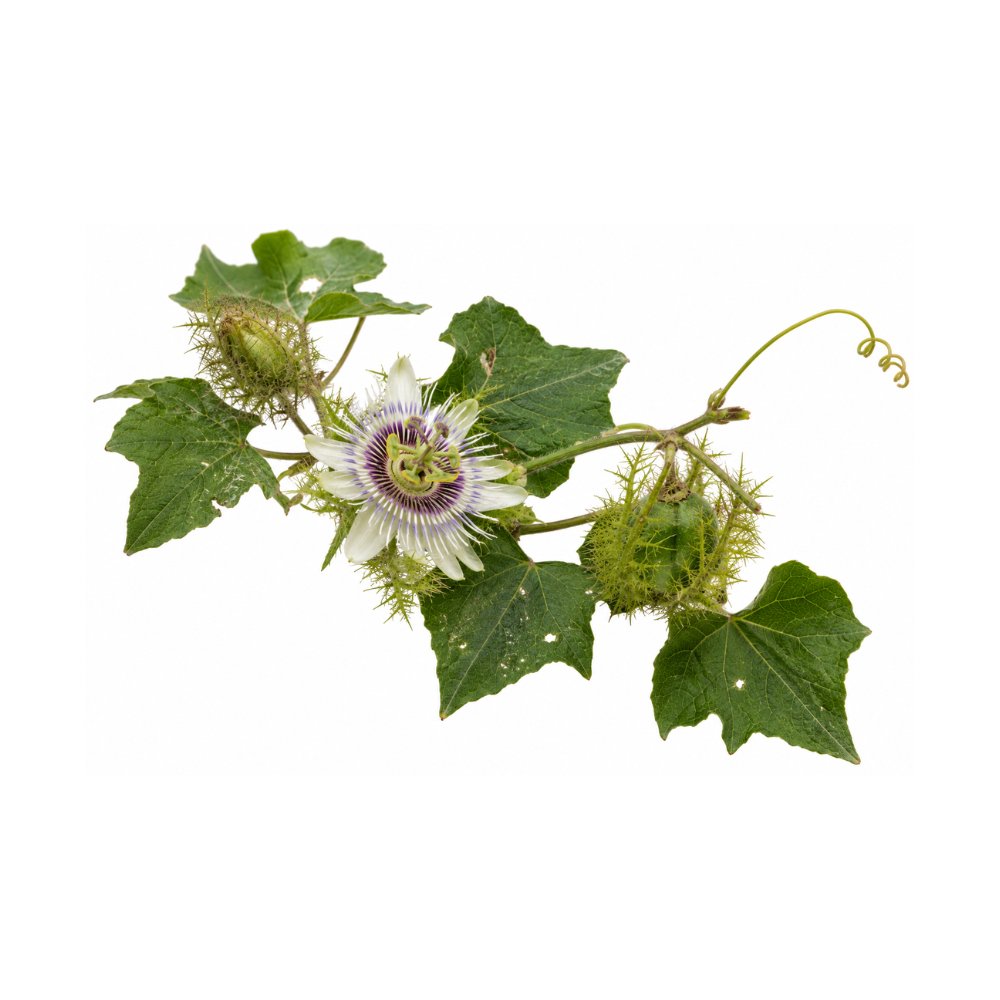
Stinking passionflower is a slender, herbaceous climbing vine with a foul smell 23Reference 23Passiflora foetida Linnaeus — species description and distribution — floraView study →. It grows from a woody rootstock, and its hairy, grooved stems, usually 0.7–3 m long, scramble over the ground or climb by coiling tendrils 23,
The leaves are broadly oval, 4.5–13 cm long, usually three-lobed with a heart-shaped base. They are hairy, with glandular hairs along the edges, and smell pungent when bruised 22,
The flowers grow singly, 2–3 cm across, and are white or pale purple, with a fringe of purple filaments at the centre 23Reference 23Passiflora foetida Linnaeus — species description and distribution — floraView study →. Each flower sits inside three feathery, finely divided bracts tipped with sticky glandular hairs 23Reference 23Passiflora foetida Linnaeus — species description and distribution — floraView study →.
The glandular hairs on the bracts can trap and kill small insects, and the plant is suspected of absorbing nutrients from them 22Reference 22Passiflora foetida Linnaeus and var. gossypiifolia — species description, varieties, habitat and distribution — floraView study →.
The fruit is a round to egg-shaped berry, 2–3 cm across, orange or orange-red when ripe and still wrapped in the bracts 23Reference 23Passiflora foetida Linnaeus — species description and distribution — floraView study →. Some American forms have green to yellow fruit 22Reference 22Passiflora foetida Linnaeus and var. gossypiifolia — species description, varieties, habitat and distribution — floraView study →. The species is very variable, with about 30 varieties 22Reference 22Passiflora foetida Linnaeus and var. gossypiifolia — species description, varieties, habitat and distribution — floraView study →.
Distribution
Stinking passionflower is native to southern North America, Mexico, the West Indies, Central America and South America 22Reference 22Passiflora foetida Linnaeus and var. gossypiifolia — species description, varieties, habitat and distribution — floraView study →. It has been introduced across tropical Asia, Africa, the Pacific Islands and Australia 22Reference 22Passiflora foetida Linnaeus and var. gossypiifolia — species description, varieties, habitat and distribution — floraView study →. In China it is a naturalised weed of grassy slopes, forest margins, roadsides and river banks, from 100 to 1,200 m 23Reference 23Passiflora foetida Linnaeus — species description and distribution — floraView study →.
It is often treated as a weed, and its seeds can stay dormant in the soil for many years 24Reference 24Passiflora foetida — habit, range, edible and medicinal uses, hazards and cultivation — species databaseView study →.
Most of the fruit is gathered from the wild 24Reference 24Passiflora foetida — habit, range, edible and medicinal uses, hazards and cultivation — species databaseView study →. In southern Vietnam the plant is grown as a medicinal crop 19Reference 19Research on Passiflora foetida L. as a pharmaceutical treatment for neurasthenia in humans — germplasm and rbcL sequencing of Vietnamese accessionsView study →. Because wild material is collected across such a wide range, it is worth asking a supplier where it came from. An HPTLC method that measures vitexin has been developed to check the identity of commercial P. foetida products 21Reference 21Development and validation of a high-performance thin-layer chromatographic method for the quantitative analysis of vitexin in Passiflora foetida herbal formulations — analyticalView study →.
Growing Conditions
Cultivation snapshot for Stinking Passionflower
WaterTolerant of both wet and dry spells once established.
SoilUndemanding; it colonises disturbed ground and roadside edges.
Grow it yourself
Farm Wiki is our cultivation-focused sister site, also run by Justin Cooke.
Phytochemistry
The stem bark contains at least ten flavonoids. Of these, luteolin and chrysoeriol were the strongest inhibitors of nitric oxide production in macrophages 5Reference 5In vitroAnti-inflammatory flavonoids isolated from Passiflora foetida — in vitroView study →. The leaf’s butanol fraction yielded vitexin, a C-glycosyl flavone of apigenin, which is the marker used to authenticate commercial products 7,
A flavonoid-rich fraction of the fruit contained five main C-glycosyl flavones, tentatively identified as glycosides of orientin and vitexin and apigenin-6,8-di-C-glucoside 4Reference 4In vitroAnti-inflammatory and gut microbiota modulation potentials of flavonoids extracted from Passiflora foetida fruits — in vitroView study →.
The resin yields three α-pyrone polyketides, the passifloricins, which were not detected in other passionflowers 17Reference 17Passifloricins, polyketides alpha-pyrones from Passiflora foetida resin — phytochemistryView study →. The fruit and flowers yield five fatty-acid lactones, the passifetilactones A–E 14Reference 14In vitroPassifetilactones A-E, fatty acid lactones from the fruit and flowers of Passiflora foetida with cytotoxic activity — in vitroView study →. Passifetilactone D may form during purification rather than in the plant 14Reference 14In vitroPassifetilactones A-E, fatty acid lactones from the fruit and flowers of Passiflora foetida with cytotoxic activity — in vitroView study →.
The ripe fruit carries 65 phenolic compounds: 39 free phenolics, 14 bound as insoluble glycosides and 22 bound as insoluble esters. The bound phenolics showed significant radical-scavenging activity 6Reference 6Nutritional composition and antioxidant properties of the fruits of a Chinese wild Passiflora foetida — analyticalView study →. The fruit also contains pectic polysaccharides, including a mannose-rich heteropolysaccharide and three hetero-galacturonans 11,
In a separate analysis, the flower essential oil was dominated by β-caryophyllene at 17.2%, with cedrol and α-humulene at 11.5% each 7Reference 7In vitroEssential oil composition of Passiflora foetida L. flowers and chemical-biology study of the leaf extracts — in vitroView study →.
Preliminary screening of the leaf detected sterols, flavonoids and carbohydrates 18Reference 18Pharmacognostical and preliminary phytochemical studies of Passiflora foetida — pharmacognosyView study →.
Constituent Summary
From the leaf, stem bark, resin and fruit.
| Constituent | Class | Note |
|---|---|---|
| Luteolin | Flavone | Stem bark; inhibited nitric oxide production at IC50 1.2 µM 5Reference 5In vitroAnti-inflammatory flavonoids isolated from Passiflora foetida — in vitroView study → |
| Chrysoeriol | Methoxyflavone | Stem bark; IC50 3.1 µM in the same assay 5Reference 5In vitroAnti-inflammatory flavonoids isolated from Passiflora foetida — in vitroView study → |
| Vitexin | C-glycosyl flavone | Leaf; the authentication marker 7, |
| Passifloricins | α-pyrone polyketides | Resin; not detected in other passionflowers 17Reference 17Passifloricins, polyketides alpha-pyrones from Passiflora foetida resin — phytochemistryView study → |
| Passifetilactone A – E | Fatty-acid lactones | Fruit and flowers; B and C cytotoxic at IC50 3.7–25.9 µM and 12.2–19.8 µM 14Reference 14In vitroPassifetilactones A-E, fatty acid lactones from the fruit and flowers of Passiflora foetida with cytotoxic activity — in vitroView study → |
| β-sitosterol | Phytosterol | Sterols detected as a class in the leaf 18Reference 18Pharmacognostical and preliminary phytochemical studies of Passiflora foetida — pharmacognosyView study → |
The fruit polysaccharides, the bound phenolic fraction and the flower essential oil are described above.
Pharmacology & Research
No human trials have been published. About twenty primary studies exist, all in animals, cells or chemical assays.
The anti-inflammatory work is the most detailed, with the signalling pathway mapped in macrophages 3,
-
Best-supported: anti-inflammatory action, with a macrophage mechanism worked out — NF-κB, COX-2, MAPK 3,
5Reference 3In vitroAnti-inflammatory effects of Passiflora foetida L. in LPS-stimulated RAW264.7 macrophages — in vitroView study →Reference 5In vitroAnti-inflammatory flavonoids isolated from Passiflora foetida — in vitroView study → — and rodent paw-oedema data 1Reference 1AnimalAnalgesic and anti-inflammatory activities of Passiflora foetida L. — animal modelView study →; broad antioxidant activity across fruit, leaf and stem 6,7, .8, 9Reference 6Nutritional composition and antioxidant properties of the fruits of a Chinese wild Passiflora foetida — analyticalView study →Reference 7In vitroEssential oil composition of Passiflora foetida L. flowers and chemical-biology study of the leaf extracts — in vitroView study →Reference 8In vitroEvaluation of medicinal plants from Central Kalimantan for antimelanogenesis — in vitroView study →Reference 9AnimalAntiulcer and antioxidant activity of ethanolic extract of Passiflora foetida L. — animal modelView study → -
Emerging, worth watching: fruit polysaccharides and flavonoids shift a simulated human gut microbiome and raise short-chain fatty acids 4,
10Reference 4In vitroAnti-inflammatory and gut microbiota modulation potentials of flavonoids extracted from Passiflora foetida fruits — in vitroView study →Reference 10In vitroPrebiotic effect of polysaccharides and flavonoids from Passiflora foetida fruits on the human intestinal microbiota associated with obesity — in vitroView study → ; a butanolic fraction preserved bone in ovariectomised mice without uterine estrogenicity 13Reference 13AnimalEvaluation of anti-osteoporotic activity of butanolic fraction from Passiflora foetida in ovariectomy-induced bone loss in mice — animal modelView study →. -
Mechanistically thin: pain relief has no proposed mechanism and no identified active constituent 1,
2Reference 1AnimalAnalgesic and anti-inflammatory activities of Passiflora foetida L. — animal modelView study →Reference 2In vitroMedicinal potential of Passiflora foetida L. plant extracts: biological and pharmacological activities — animal model / in vitroView study → ; the anticancer and antimicrobial signals rest on isolated constituents or nanoparticle conjugates 14,15, .16Reference 14In vitroPassifetilactones A-E, fatty acid lactones from the fruit and flowers of Passiflora foetida with cytotoxic activity — in vitroView study →Reference 15In vitroChemical analysis and biological activity of crude extracts from leaves of Passiflora foetida — in vitroView study →Reference 16In vitroSynergistic antibacterial and mosquitocidal effect of Passiflora foetida synthesised silver nanoparticles — in vitroView study → - The caveat: no human data exist for any indication, and no standardised extract or dose has been defined.
The studies used solvent extracts, not the traditional preparations. Almost every result comes from an ethanol or methanol extract of the leaf, stem bark or whole plant, which differs from the decoctions and the ripe fruit people actually use.
1. Anti-Inflammatory
In LPS-stimulated RAW264.7 macrophages a methanolic extract suppressed prostaglandin E2 and COX-2 expression and reduced pro-inflammatory cytokines. It also blocked MAPK phosphorylation (ERK1/2, p38, JNK) and NF-κB activation, the last by preventing IκBα breakdown 3Reference 3In vitroAnti-inflammatory effects of Passiflora foetida L. in LPS-stimulated RAW264.7 macrophages — in vitroView study →. A flavonoid-rich fruit fraction reduced nitric oxide, TNF-α and IL-6 and suppressed MAPK, PI3K/Akt and NF-κB signalling in the same cell system 4Reference 4In vitroAnti-inflammatory and gut microbiota modulation potentials of flavonoids extracted from Passiflora foetida fruits — in vitroView study →.
From the stem bark, ten flavonoids were isolated. Luteolin and chrysoeriol were the most potent, inhibiting nitric oxide production at IC50 1.2 µM and 3.1 µM, and they suppressed iNOS expression at the transcription level 5Reference 5In vitroAnti-inflammatory flavonoids isolated from Passiflora foetida — in vitroView study →.
In vivo, an ethanol leaf extract at 100 mg/kg significantly reduced carrageenan- and histamine-induced paw oedema in rats 1Reference 1AnimalAnalgesic and anti-inflammatory activities of Passiflora foetida L. — animal modelView study →.
2. Antioxidant
Antioxidant activity is broad and consistent, and has been measured in chemical and cell assays.
The fruit carries 39 free phenolics plus 36 bound as insoluble glycosides and esters, and the bound fraction showed significant radical-scavenging activity 6Reference 6Nutritional composition and antioxidant properties of the fruits of a Chinese wild Passiflora foetida — analyticalView study →. A butanol leaf fraction reached 70% DPPH inhibition at 100 µg/mL, and vitexin isolated from it reached 75% at the same concentration, measured against ascorbic acid 7Reference 7In vitroEssential oil composition of Passiflora foetida L. flowers and chemical-biology study of the leaf extracts — in vitroView study →.
In an earlier screen the stem extract exceeded 70% DPPH inhibition at 100 µg/mL. Stem and fruit extracts at 300 µg/mL also strongly inhibited melanin production in B16 melanoma cells without significant cytotoxicity 8Reference 8In vitroEvaluation of medicinal plants from Central Kalimantan for antimelanogenesis — in vitroView study →.
In the rat stomach-ulcer model the extract lowered lipid peroxidation and raised reduced glutathione in the stomach tissue 9Reference 9AnimalAntiulcer and antioxidant activity of ethanolic extract of Passiflora foetida L. — animal modelView study →.
3. Analgesic
Two independent studies in mice point the same way.
An ethanol leaf extract gave its strongest effect on hot-plate reaction time at 200 mg/kg 1Reference 1AnimalAnalgesic and anti-inflammatory activities of Passiflora foetida L. — animal modelView study →. In a separate study an ethanol extract inhibited acetic-acid writhing by 68.75% at 500 mg/kg and 30% at 250 mg/kg 2Reference 2In vitroMedicinal potential of Passiflora foetida L. plant extracts: biological and pharmacological activities — animal model / in vitroView study →.
No mechanism has been proposed and no active constituent identified. The passifloricins have not been tested for it.
Gap: no mechanism and no identified analgesic constituent.
4. Antiulcer & Gastroprotective
A whole-plant ethanol extract at 100 and 200 mg/kg reduced the ulcer index and raised gastric pH in both ethanol- and aspirin-induced ulcer models in rats. It also lowered lipid peroxidation and raised reduced glutathione in the stomach 9Reference 9AnimalAntiulcer and antioxidant activity of ethanolic extract of Passiflora foetida L. — animal modelView study →.
The rise in gastric pH suggests the extract could affect drugs that need stomach acid to be absorbed.
5. Antidiarrhoeal
In castor-oil-induced diarrhoea in mice, an ethanol extract at 500 mg/kg delayed the first loose stool to about 1.55 hours and reduced the mean number of stools to 4.4. The effect at 250 mg/kg was smaller (1.17 hours and 5.6 stools) 2Reference 2In vitroMedicinal potential of Passiflora foetida L. plant extracts: biological and pharmacological activities — animal model / in vitroView study →.
This matches the plant’s traditional use for diarrhoea.
6. Prebiotic & Gut Microbiota
Two studies using dynamic simulators of the human gut found a prebiotic effect from the fruit.
A flavonoid-rich fruit fraction promoted Bifidobacterium, Lactobacillus, Enterococcus and Roseburia, and raised short-chain fatty acid production 4Reference 4In vitroAnti-inflammatory and gut microbiota modulation potentials of flavonoids extracted from Passiflora foetida fruits — in vitroView study →. Fruit polysaccharide and flavonoid fractions shifted an obesity-associated microbiota toward a normal-weight profile, changing Alistipes, Bacteroides, Faecalibacterium and Akkermansia and raising propionic acid 10Reference 10In vitroPrebiotic effect of polysaccharides and flavonoids from Passiflora foetida fruits on the human intestinal microbiota associated with obesity — in vitroView study →.
Both are in vitro gut models. Neither has been confirmed in a living animal.
7. Immunomodulatory
The fruit polysaccharides act in the opposite direction to the fruit flavonoids.
A mannose-rich heteropolysaccharide from the fruit increased nitric oxide production and TNF-α and IL-6 secretion in RAW264.7 macrophages 11Reference 11In vitroStructure characterization of a novel polysaccharide from Chinese wild fruits (Passiflora foetida) and its immune-enhancing activity — in vitroView study →. Three hetero-galacturonans from the fruit did the same, in a concentration-dependent way 12Reference 12In vitroStructural features of three hetero-galacturonans from Passiflora foetida fruits and their in vitro immunomodulatory effects — in vitroView study →.
The flavonoid fractions calm the macrophage and the polysaccharide fractions activate it. A water extract and an ethanol extract of the same fruit may therefore behave differently.
8. Anti-Osteoporotic
A butanolic fraction at 50 and 100 mg/kg/day for eight weeks preserved bone microarchitecture and biomechanical strength in ovariectomised mice. The treated mice had more osteoprogenitor cells in the marrow, and the fraction showed no uterine estrogenicity 13Reference 13AnimalEvaluation of anti-osteoporotic activity of butanolic fraction from Passiflora foetida in ovariectomy-induced bone loss in mice — animal modelView study →.
It is a single animal study with no follow-up.
9. Cytotoxic & Anticancer
Five fatty-acid lactones, the passifetilactones A–E, were isolated from the fruit and flowers. Passifetilactones B and C were cytotoxic at IC50 3.7–25.9 µM and 12.2–19.8 µM across six cell lines, including HeLa, A549, PC-3 and two cholangiocarcinoma lines. They were only weakly active against a normal bile-duct cell line, and both induced apoptosis 14Reference 14In vitroPassifetilactones A-E, fatty acid lactones from the fruit and flowers of Passiflora foetida with cytotoxic activity — in vitroView study →.
Separately, the crude ethanol extract killed brine-shrimp nauplii at an LC50 of 80 µg/mL. This is a general bioactivity screen rather than a cancer assay 2Reference 2In vitroMedicinal potential of Passiflora foetida L. plant extracts: biological and pharmacological activities — animal model / in vitroView study →.
Gap: the anticancer signal is confined to isolated lactones against cell lines. No animal tumour model has been run.
10. Antimicrobial & Antiparasitic
A crude leaf extract was most active against Leishmania amazonensis, at a high concentration of 500 µg/mL 15Reference 15In vitroChemical analysis and biological activity of crude extracts from leaves of Passiflora foetida — in vitroView study →.
The antibacterial and mosquito-killing activity often cited for the plant comes from silver nanoparticles made with an aqueous extract, where the silver is the active agent 16Reference 16In vitroSynergistic antibacterial and mosquitocidal effect of Passiflora foetida synthesised silver nanoparticles — in vitroView study →.
Gap: the antibacterial effect belongs to silver nanoparticles, not to any form of the herb a person would use.
Mechanisms
The flavonoids of the leaf, stem bark and fruit have been studied for their effects on inflammatory signalling, including NF-κB, COX-2 and MAPK, and for radical scavenging. No mechanism has been identified for the pain-relieving effect.
The fruit polysaccharides work in the other direction: they stimulate macrophages to release nitric oxide and cytokines.
| Mechanism | Drives | Key compounds |
|---|---|---|
| NF-κB ↓, COX-2 ↓, MAPK (ERK/p38/JNK) ↓, iNOS ↓ | anti-inflammatory | luteolin, chrysoeriol, methanolic extract, fruit flavonoid fraction |
| Prostaglandin E2 and cytokine (TNF-α, IL-6) suppression | anti-inflammatory | methanolic extract, fruit flavonoid fraction |
| Radical scavenging (DPPH/FRAP), glutathione ↑, lipid peroxidation ↓ | antioxidantgastroprotective | vitexin, whole-plant extract |
| Short-chain fatty acids ↑, microbiota shifted | prebioticgut | fruit polysaccharides and flavonoids |
| Macrophage nitric oxide / TNF-α / IL-6 ↑ | immunomodulatory | fruit polysaccharides |
| Apoptosis induction | cytotoxic | passifetilactones |
Clinical Trials
No registered clinical trials were identified. The evidence base is entirely preclinical.
| Completed | Planned | Terminated | Preclinical |
|---|---|---|---|
| 0 | 0 | 0 | ~20 |
Last checked: September 2026.
Dosage
Research Doses
| Effect | Preparation | Dose (animal) | Source |
|---|---|---|---|
| Analgesia | Ethanol leaf extract | 200–500 mg/kg | 1, |
| Anti-inflammatory | Ethanol leaf extract | 100 mg/kg | 1Reference 1AnimalAnalgesic and anti-inflammatory activities of Passiflora foetida L. — animal modelView study → |
| Antidiarrhoeal | Ethanol extract | 250–500 mg/kg | 2Reference 2In vitroMedicinal potential of Passiflora foetida L. plant extracts: biological and pharmacological activities — animal model / in vitroView study → |
| Antiulcer | Whole-plant ethanol extract | 100–200 mg/kg | 9Reference 9AnimalAntiulcer and antioxidant activity of ethanolic extract of Passiflora foetida L. — animal modelView study → |
| Anti-osteoporotic | Butanolic fraction | 50–100 mg/kg/day, 8 weeks | 13Reference 13AnimalEvaluation of anti-osteoporotic activity of butanolic fraction from Passiflora foetida in ovariectomy-induced bone loss in mice — animal modelView study → |
Traditional Dosage
| System | Preparation | Dose |
|---|---|---|
| Vietnamese traditional medicine | Whole plant, leaves, stems or fruit, for insomnia and nervous exhaustion | Not quantified 19Reference 19Research on Passiflora foetida L. as a pharmaceutical treatment for neurasthenia in humans — germplasm and rbcL sequencing of Vietnamese accessionsView study → |
| Tropical folk use | Decoction of the dried plant, for colds and coughs | Not quantified 24Reference 24Passiflora foetida — habit, range, edible and medicinal uses, hazards and cultivation — species databaseView study → |
| Tropical folk use | Fresh whole plant boiled, for worms in children | Not quantified 24Reference 24Passiflora foetida — habit, range, edible and medicinal uses, hazards and cultivation — species databaseView study → |
| Food | Fully ripe fruit, eaten raw or as a drink | A food portion 24Reference 24Passiflora foetida — habit, range, edible and medicinal uses, hazards and cultivation — species databaseView study → |
Safety & Pregnancy
Stinking passionflower has not been studied for safety in people or in mammals. The ripe fruit is a wild food; the unripe fruit is not.
- The ripe fruit is a wild food. It is eaten raw and made into drinks across the tropics 6,
24Reference 6Nutritional composition and antioxidant properties of the fruits of a Chinese wild Passiflora foetida — analyticalView study →Reference 24Passiflora foetida — habit, range, edible and medicinal uses, hazards and cultivation — species databaseView study → . - Do not eat unripe fruit. It contains cyanogenic glycosides and alkaloids 24Reference 24Passiflora foetida — habit, range, edible and medicinal uses, hazards and cultivation — species databaseView study →.
- A possible stomach-acid interaction. The extract raised gastric pH in rats 9Reference 9AnimalAntiulcer and antioxidant activity of ethanolic extract of Passiflora foetida L. — animal modelView study →.
- No safety studies in people. There is no mammalian toxicity study and no herb–drug interaction study.
- Best avoided in pregnancy and while breastfeeding. There are no reproductive data.
Full Safety Detail
Unripe fruit. The unripe fruit contains toxic cyanogenic glycosides and alkaloids, and only the fully ripe fruit should be eaten 24Reference 24Passiflora foetida — habit, range, edible and medicinal uses, hazards and cultivation — species databaseView study →. Reports of poisoning in grazing livestock are few 24Reference 24Passiflora foetida — habit, range, edible and medicinal uses, hazards and cultivation — species databaseView study →.
Toxicity data. The only toxicity figure for the whole extract is a brine-shrimp LC50 of 80 µg/mL, from a screening assay used to rank extracts for further work 2Reference 2In vitroMedicinal potential of Passiflora foetida L. plant extracts: biological and pharmacological activities — animal model / in vitroView study →. No mammalian toxicity, genotoxicity or human safety study has been published.
Leaf and fruit differ. The long record of eating the ripe fruit applies to the fruit. The pharmacology comes from ethanol or methanol extracts of the leaf, stem bark and whole plant 1,
Stomach acid. The whole-plant extract raised gastric pH in rats 9Reference 9AnimalAntiulcer and antioxidant activity of ethanolic extract of Passiflora foetida L. — animal modelView study →. Drugs that need an acid stomach to be absorbed, including some antifungals and some tyrosine-kinase inhibitors, may be affected. This is inferred from an animal study and has not been measured in people.
Identity. The WHO, ESCOP, EMA/HMPC and Commission E passionflower monographs cover P. incarnata, not this species. An HPTLC method measuring vitexin has been developed for authenticating P. foetida products 21Reference 21Development and validation of a high-performance thin-layer chromatographic method for the quantitative analysis of vitexin in Passiflora foetida herbal formulations — analyticalView study →.
Best avoided. There are no data on use in pregnancy or while breastfeeding, and the plant has not been studied in people.
References
- Sasikala, V., Saravanan, S., Parimelazhagan, T. (2011). Analgesic and anti-inflammatory activities of Passiflora foetida L. — animal model. Asian Pac J Trop Med. https://pubmed.ncbi.nlm.nih.gov/21914535/
- Asadujjaman, M., Mishuk, A. U., Hossain, M. A., Karmakar, U. K. (2014). Medicinal potential of Passiflora foetida L. plant extracts: biological and pharmacological activities — animal model / in vitro. J Integr Med. https://pubmed.ncbi.nlm.nih.gov/24666678/
- Park, J. W., Kwon, O. K., Ryu, H. W., et al. (2018). Anti-inflammatory effects of Passiflora foetida L. in LPS-stimulated RAW264.7 macrophages — in vitro. Int J Mol Med. https://pubmed.ncbi.nlm.nih.gov/29532853/
- Han, X., Song, Y., Huang, R., et al. (2023). Anti-inflammatory and gut microbiota modulation potentials of flavonoids extracted from Passiflora foetida fruits — in vitro. Foods. https://pubmed.ncbi.nlm.nih.gov/37569158/
- Nguyen, T. Y., To, D. C., Tran, M. H., et al. (2015). Anti-inflammatory flavonoids isolated from Passiflora foetida — in vitro. Nat Prod Commun. https://pubmed.ncbi.nlm.nih.gov/26197519/
- Song, Y., Wei, X. Q., Li, M. Y., et al. (2018). Nutritional composition and antioxidant properties of the fruits of a Chinese wild Passiflora foetida — analytical. Molecules. https://pubmed.ncbi.nlm.nih.gov/29463053/
- Thomas, P. S., Essien, E. E., Andy, N. A., et al. (2025). Essential oil composition of Passiflora foetida L. flowers and chemical-biology study of the leaf extracts — in vitro. Nat Prod Res. https://pubmed.ncbi.nlm.nih.gov/38738697/
- Arung, E. T., Kusuma, I. W., Christy, E. O., et al. (2009). Evaluation of medicinal plants from Central Kalimantan for antimelanogenesis — in vitro. J Nat Med. https://pubmed.ncbi.nlm.nih.gov/19618251/
- Sathish, R., Sahu, A., Natarajan, K. (2011). Antiulcer and antioxidant activity of ethanolic extract of Passiflora foetida L. — animal model. Indian J Pharmacol. https://pubmed.ncbi.nlm.nih.gov/21713043/
- Song, Y., Zhu, M., Martínez-Cuesta, M. C., Requena, T. (2025). Prebiotic effect of polysaccharides and flavonoids from Passiflora foetida fruits on the human intestinal microbiota associated with obesity — in vitro. Foods. https://pubmed.ncbi.nlm.nih.gov/41008195/
- Song, Y., Zhu, M., Hao, H., et al. (2019). Structure characterization of a novel polysaccharide from Chinese wild fruits (Passiflora foetida) and its immune-enhancing activity — in vitro. Int J Biol Macromol. https://pubmed.ncbi.nlm.nih.gov/31202849/
- Song, Y., Wen, P., Hao, H., et al. (2020). Structural features of three hetero-galacturonans from Passiflora foetida fruits and their in vitro immunomodulatory effects — in vitro. Polymers (Basel). https://pubmed.ncbi.nlm.nih.gov/32182663/
- Ahmad, N., Chillara, R., Kushwaha, P., et al. (2017). Evaluation of anti-osteoporotic activity of butanolic fraction from Passiflora foetida in ovariectomy-induced bone loss in mice — animal model. Biomed Pharmacother. https://pubmed.ncbi.nlm.nih.gov/28160755/
- Ponsuwan, K., Nathabumroong, S., Lekphrom, R., et al. (2024). Passifetilactones A-E, fatty acid lactones from the fruit and flowers of Passiflora foetida with cytotoxic activity — in vitro. J Nat Prod. https://pubmed.ncbi.nlm.nih.gov/38787359/
- Santos de Oliveira, O. L., da Silva Neto, O. C., Rodrigues Conceição, G., et al. (2026). Chemical analysis and biological activity of crude extracts from leaves of Passiflora foetida — in vitro. Nat Prod Res. https://pubmed.ncbi.nlm.nih.gov/39987578/
- Palanisamy, D. S., Gounder, B. S., Selvaraj, K., et al. (2023). Synergistic antibacterial and mosquitocidal effect of Passiflora foetida synthesised silver nanoparticles — in vitro. Braz J Biol. https://pubmed.ncbi.nlm.nih.gov/36651434/
- Echeverri, F., Arango, V., Quiñones, W., et al. (2001). Passifloricins, polyketides alpha-pyrones from Passiflora foetida resin — phytochemistry. Phytochemistry. https://pubmed.ncbi.nlm.nih.gov/11324922/
- Krishnaveni, A., Thaakur, S. R. (2008). Pharmacognostical and preliminary phytochemical studies of Passiflora foetida — pharmacognosy. Anc Sci Life. https://pubmed.ncbi.nlm.nih.gov/22557273/
- Do, V. M., Thieu, V. D., Mai, V. H. (2023). Research on Passiflora foetida L. as a pharmaceutical treatment for neurasthenia in humans — germplasm and rbcL sequencing of Vietnamese accessions. Pak J Biol Sci. https://pubmed.ncbi.nlm.nih.gov/38110555/
- Chassagne, F., Deharo, E., Punley, H., Bourdy, G. (2017). Treatment and management of liver diseases by Khmer traditional healers in Phnom Penh area, Cambodia — ethnobotanical survey. J Ethnopharmacol. https://pubmed.ncbi.nlm.nih.gov/28284791/
- Foudah, A. I., Alam, P., Kamal, Y. T., et al. (2019). Development and validation of a high-performance thin-layer chromatographic method for the quantitative analysis of vitexin in Passiflora foetida herbal formulations — analytical. Saudi Pharm J. https://pubmed.ncbi.nlm.nih.gov/31885475/
- Goldman, D. H., & MacDougal, J. M. (2015). Passiflora foetida Linnaeus and var. gossypiifolia — species description, varieties, habitat and distribution — flora. In Flora of North America Editorial Committee (eds.), Flora of North America North of Mexico, Vol. 6. http://www.efloras.org/florataxon.aspx?flora_id=1&taxon_id=250031972
- Wang, Y., Krosnick, S. E., Jørgensen, P. M., & Hearn, D. (2007). Passiflora foetida Linnaeus — species description and distribution — flora. In Wu, Z. Y., & Raven, P. H. (eds.), Flora of China, Vol. 13. http://www.efloras.org/florataxon.aspx?flora_id=2&taxon_id=242336203
- Fern, K. (2026). Passiflora foetida — habit, range, edible and medicinal uses, hazards and cultivation — species database. Useful Tropical Plants Database. https://tropical.theferns.info/viewtropical.php?id=Passiflora+foetida



