
Materia Medica
Passion Fruit
Passiflora edulis
Passion fruit is a tropical climbing vine grown for its aromatic fruit. Its leaf is a traditional sedative in Brazil, its dried fruit peel is studied for blood sugar, and its seed yields the stilbene piceatannol.
What Is Passion Fruit?
Passion fruit is a vigorous climbing vine grown across the tropics and subtropics for its aromatic fruit. In Brazil and much of Latin America its leaves and twigs are also a folk medicine, taken for anxiety and nervousness 4Reference 4AnimalCycloartane triterpenoid saponins from water soluble of Passiflora edulis Sims and their antidepressant-like effects — animal modelView study →.
Passiflora edulis is native to Brazil, Paraguay and northern Argentina, where it grows at the edges of rain forests 22Reference 22Passiflora edulis — habit, range, habitat and cultivationView study →. It climbs by coiling tendrils and is the most widely cultivated of all the passion fruits 22Reference 22Passiflora edulis — habit, range, habitat and cultivationView study →.
Three parts of the plant are used for three different purposes. The leaf is the traditional sedative. The dried fruit peel, a by-product of juice-making, has been studied for blood sugar and blood pressure. The seed yields piceatannol, a stilbene sold as a supplement 6,
Passion fruit is a different species from passionflower (P. incarnata). In Brazil it shares the name maracujá with winged-stem passionflower (P. alata), and these two are the country’s commercially valued medicinal passionflowers 14Reference 14AnimalAssessment of sedative effects of Passiflora edulis f. flavicarpa and Passiflora alata extracts in mice, measured by telemetry — animal modelView study →. P. alata has been in the Brazilian Pharmacopoeia since 1929 23Reference 23In vitroCytotoxic, antitumor and toxicological profile of Passiflora alata leaf extract — in vitro and in vivo (mouse)View study →.
Stinking passionflower (P. foetida) and blue passionflower (P. caerulea) are other members of the genus. Blue passionflower is the plant in which chrysin was identified as a flavone that binds the brain’s benzodiazepine receptors 24Reference 24AnimalChrysin (5,7-di-OH-flavone), a naturally-occurring ligand for benzodiazepine receptors, with anticonvulsant properties — isolation and in vivo (mouse)View study →.
How Is Passion Fruit Used?
- Leaf — the leaves and twigs are taken as an infusion for anxiety, nervousness and restlessness 4,
8Reference 4AnimalCycloartane triterpenoid saponins from water soluble of Passiflora edulis Sims and their antidepressant-like effects — animal modelView study →Reference 8AnimalThe aqueous extracts of Passiflora alata and Passiflora edulis reduce anxiety-related behaviors without affecting memory process in rats — rat, intraperitonealView study → . - Fruit peel — dried and milled into a flour, and taken for blood-sugar control 15,
16Reference 15Effect of the yellow passion fruit peel flour (Passiflora edulis f. flavicarpa deg.) in insulin sensitivity in type 2 diabetes mellitus patients — uncontrolled before-and-after trial, n=43View study →Reference 16RCTCost-effectiveness of passion fruit albedo versus turmeric in the glycemic and lipaemic control of people with type 2 diabetes — randomised clinical trialView study → . - Seed — the source of piceatannol-rich extracts sold as supplements 6,
17Reference 6RCTThe effect of piceatannol from passion fruit (Passiflora edulis) seeds on metabolic health in humans — randomised, placebo-controlledView study →Reference 17RCTEffect of passion fruit seed extract rich in piceatannol on the skin of women — randomised, placebo-controlled, double-blind trialView study → . - Fruit — the juice and pulp are eaten as food.
Traditional Uses
Brazilian & Latin American Folk Medicine
The leaves and twigs are taken as an infusion for anxiety and nervousness across Brazil and much of Latin America 4Reference 4AnimalCycloartane triterpenoid saponins from water soluble of Passiflora edulis Sims and their antidepressant-like effects — animal modelView study →. Passion fruit is also used as a sedative for difficult sleep 3Reference 3AnimalNeuropharmacological activity of the pericarp of Passiflora edulis flavicarpa degener: putative involvement of C-glycosylflavonoids — animal modelView study →.
The plant shares the name maracujá with P. alata, and both are used as sedatives and tranquillisers 8,
The leaf is also used for inflamed skin and for intermittent fever 7Reference 7AnimalEvidence of anti-inflammatory effects of Passiflora edulis in an inflammation model — mouse, intraperitonealView study →.
The fruit itself is eaten as food.
Botany
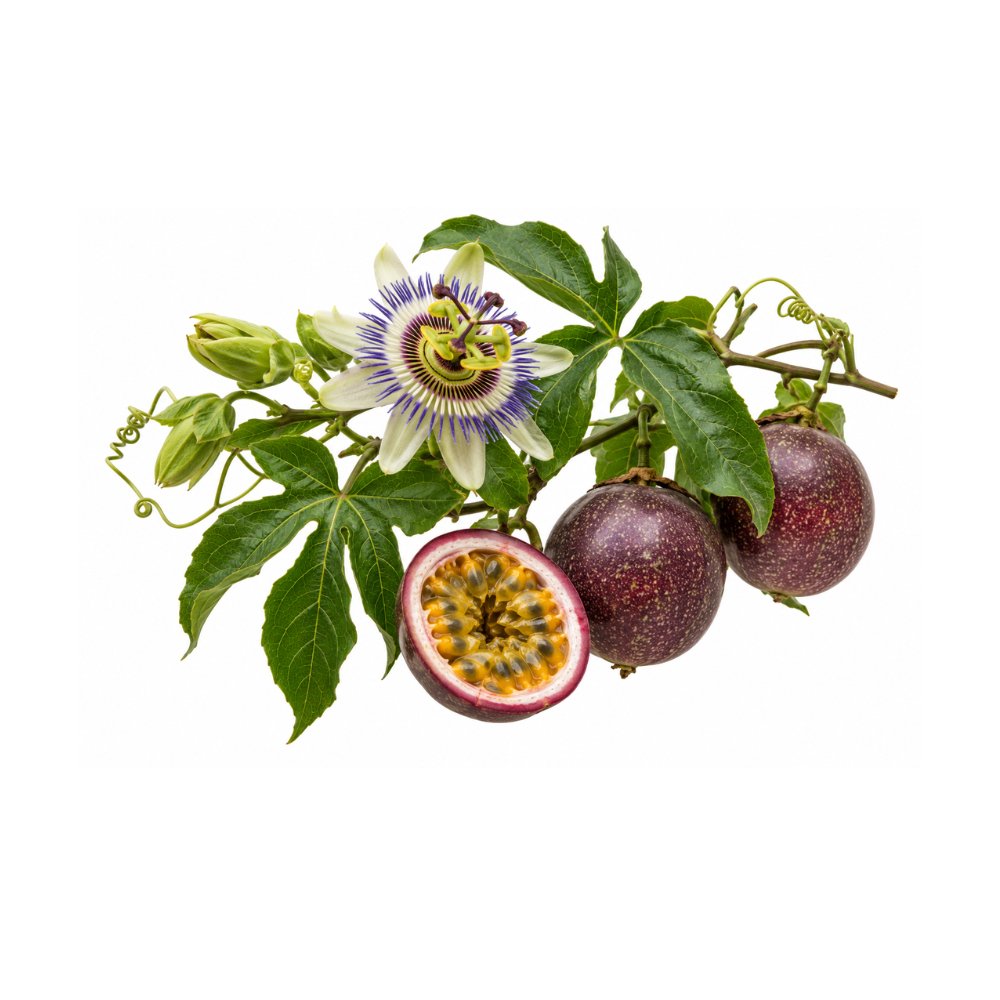
Passion fruit is an evergreen climbing vine that is woody at the base. Its stems usually reach about 6 m, and sometimes 9 m or more 21,
The leaves are 6–13 cm long and deeply three-lobed, with finely toothed, glandular margins 21Reference 21Passiflora edulis Sims — species description and distributionView study →.
The flowers are 4–7 cm across and grow singly, opposite a tendril. Their corona is made of several rows of filaments, light green at the base, purple in the middle and white at the tip 21Reference 21Passiflora edulis Sims — species description and distributionView study →.
The fruit is an egg-shaped berry 3–4 cm across, purple when ripe in the typical form, with a tough skin and many seeds 21,
Distribution
Passion fruit grows wild in Brazil, Paraguay and northern Argentina 22Reference 22Passiflora edulis — habit, range, habitat and cultivationView study →. It is now cultivated from the warm temperate zone to the tropics, from sea level to 900 m in the subtropics and at 900–2,000 m in the tropics 22Reference 22Passiflora edulis — habit, range, habitat and cultivationView study →. In China it is grown in the south and has escaped into mountain forests at 100–1,900 m 21Reference 21Passiflora edulis Sims — species description and distributionView study →.
It naturalises readily, and it has become invasive in some countries, including New Zealand and South Africa 22Reference 22Passiflora edulis — habit, range, habitat and cultivationView study →.
Passion fruit sold as food or medicine is cultivated. The medicinal peel is a by-product of the juice industry 9Reference 9AnimalHypoglycemic and vasorelaxant effect of Passiflora edulis fruit peel by-product — animal modelView study →, so it comes from the same fruit crop rather than a separate harvest. For peel flour or leaf, it is worth asking where it was grown and how it was dried and processed.
Growing Conditions
Cultivation snapshot for Passion Fruit
WaterRegular and consistent; fruit drop follows drought stress.
LifePerennial vine, with a commercial lifespan of 3–6 years 22Reference 22Passiflora edulis — habit, range, habitat and cultivationView study →.
ZoneUSDA 9–11 for the purple form, 10–11 for the yellow.
Leaf flavonoid content changes with growing conditions. Inoculating seedlings with mycorrhizal fungi raised leaf vitexin by about 64%, and Acaulospora longula also raised total flavonoids and saponins 13Reference 13Production of biomolecules of interest to the anxiolytic herbal medicine industry in yellow passionfruit leaves promoted by mycorrhizal inoculation — agronomicView study →.
Grow it yourself
Farm Wiki is our cultivation-focused sister site, also run by Justin Cooke.
Indications
- Type 2 diabetes, alongside usual treatment [peel flour] Caution: One of the two trials had no control group. In the placebo-controlled trial, a turmeric-and-piperine arm lowered triglycerides and insulin resistance more 15,
16 . - Anxiety, nervousness and restlessness [leaf; Brazilian folk use]
- Difficulty sleeping [leaf; Brazilian folk use]
- Inflamed skin and intermittent fever [leaf; Brazilian folk use]
- Raised blood pressure [peel extract; seed piceatannol] Caution: The peel has been tested only in rats. The one human result came from isolated seed piceatannol, and only in overweight men 6,
10 . - Insulin resistance [seed piceatannol] Caution: The benefit appeared only in overweight men, 10 of the 39 people in the trial 6.
- Dry skin [seed extract] Caution: Skin moisture rose from baseline. Against placebo, the difference showed only in the women with the driest skin 17.
Pharmacology & Research
Four small human trials have been published: two of the dried fruit peel for blood sugar in type 2 diabetes, and two of seed piceatannol, for metabolic health and for dry skin 6,
The leaf, the traditional sedative, has been studied in rats and mice. Its extracts reduce anxiety-like behaviour and, at higher doses, cause sedation 1,
Across the plant, more than 110 compounds have been identified, most of them flavonoids and triterpenoids 12Reference 12ReviewPassiflora edulis: an insight into current researches on phytochemistry and pharmacology — reviewView study →.
-
Best-supported: fruit peel flour for glycemic control, on one placebo-controlled trial, one uncontrolled trial and a meta-analysis 5,
15, .16Reference 5Meta-analysisEffectiveness of passion fruit peel flour (Passiflora edulis L.) versus turmeric flour (Curcuma longa L.) on glycemic control — systematic review and meta-analysisView study →Reference 15Effect of the yellow passion fruit peel flour (Passiflora edulis f. flavicarpa deg.) in insulin sensitivity in type 2 diabetes mellitus patients — uncontrolled before-and-after trial, n=43View study →Reference 16RCTCost-effectiveness of passion fruit albedo versus turmeric in the glycemic and lipaemic control of people with type 2 diabetes — randomised clinical trialView study → -
Emerging, worth watching: peel extracts for blood pressure in rats 9,
10Reference 9AnimalHypoglycemic and vasorelaxant effect of Passiflora edulis fruit peel by-product — animal modelView study →Reference 10AnimalCardiovascular effects induced by fruit peels from Passiflora edulis in hypertensive rats and fingerprint analysis by HPLC-ESI-MSn — animal modelView study → ; seed-derived piceatannol for insulin sensitivity and for skin, each with one small human trial 6,17Reference 6RCTThe effect of piceatannol from passion fruit (Passiflora edulis) seeds on metabolic health in humans — randomised, placebo-controlledView study →Reference 17RCTEffect of passion fruit seed extract rich in piceatannol on the skin of women — randomised, placebo-controlled, double-blind trialView study → . -
Mechanistically thin: the antioxidant and antidepressant claims rest on isolated constituents, cell work and single animal studies 4,
18Reference 4AnimalCycloartane triterpenoid saponins from water soluble of Passiflora edulis Sims and their antidepressant-like effects — animal modelView study →Reference 18In vitroThe protective effects of piceatannol from passion fruit (Passiflora edulis) seeds in UVB-irradiated keratinocytes — in vitroView study → . - The caveat: the leaf, the traditional medicine, has not been tested in people.
Each part of the plant is a separate preparation. The leaf, the peel and the seed have different chemistry, and a finding for one does not carry over to the others.
1. Glycemic Control
The dried fruit peel, a by-product of the juice industry, is the part of this plant with the most human data.
In an uncontrolled trial, 43 people with type 2 diabetes took 30 g/day of yellow passion fruit peel flour for two months alongside their usual treatment. Fasting glucose, HbA1c and HOMA-IR fell (HOMA-IR p = 0.005), and HOMA-beta rose 15Reference 15Effect of the yellow passion fruit peel flour (Passiflora edulis f. flavicarpa deg.) in insulin sensitivity in type 2 diabetes mellitus patients — uncontrolled before-and-after trial, n=43View study →.
A randomised, placebo-controlled trial in 89 patients over 120 days compared albedo-flour capsules (500 mg three times daily) with turmeric plus piperine. Fasting glucose fell 5.9% on albedo flour against a 9% rise on placebo, and HbA1c fell by 0.8% in both active groups. The turmeric arm lowered triglycerides and HOMA-IR more, and was judged more cost-effective 16Reference 16RCTCost-effectiveness of passion fruit albedo versus turmeric in the glycemic and lipaemic control of people with type 2 diabetes — randomised clinical trialView study →.
A 2020 systematic review of 11 studies of passion fruit peel flour and turmeric flour found a significant HbA1c effect for both. The effect size was 0.32 (CI 0.23–0.45) for peel flour and 0.73 for turmeric 5Reference 5Meta-analysisEffectiveness of passion fruit peel flour (Passiflora edulis L.) versus turmeric flour (Curcuma longa L.) on glycemic control — systematic review and meta-analysisView study →.
In rats on a high-fat diet, peel flour raised GLP-1 and glucose-dependent insulinotropic polypeptide, raised adiponectin, lowered leptin and body fat, and improved insulin sensitivity, with higher hypothalamic CART expression 11Reference 11AnimalPassiflora edulis peel intake improves insulin sensitivity, increasing incretins and hypothalamic satietogenic neuropeptide in rats on a high-fat diet — animal modelView study →. The aqueous peel extract contains pectin, a soluble fibre 9Reference 9AnimalHypoglycemic and vasorelaxant effect of Passiflora edulis fruit peel by-product — animal modelView study →.
2. Anxiolytic & Sedative
The leaf and aerial parts have been tested in rats and mice.
In mice, extracts of the aerial parts were anxiolytic on the elevated plus-maze at 100–400 mg/kg depending on the fraction, and sedative at higher doses. The aqueous extract, which contained little flavonoid, was also anxiolytic, so flavonoids do not explain the whole effect. Isoorientin alone was anxiolytic at 20 mg/kg and sedative at 40–80 mg/kg 1Reference 1AnimalAnxiolytic and sedative activities of Passiflora edulis f. flavicarpa — animal modelView study →.
A bioguided fractionation of an aqueous extract isolated a luteolin glycoside that reduced anxiety-like behaviour without impairing movement. The whole flavonoid fraction did impair it 2Reference 2AnimalNeuropharmacological evaluation of the putative anxiolytic effects of Passiflora edulis Sims, its sub-fractions and flavonoid constituents — animal modelView study →.
Injected aqueous extracts were anxiolytic in rats at 50–150 mg/kg and left memory intact, whereas diazepam disrupted it 8Reference 8AnimalThe aqueous extracts of Passiflora alata and Passiflora edulis reduce anxiety-related behaviors without affecting memory process in rats — rat, intraperitonealView study →.
An aqueous extract of the fruit pericarp was anxiolytic in the light–dark box in mice and deepened ether-induced sleep 3Reference 3AnimalNeuropharmacological activity of the pericarp of Passiflora edulis flavicarpa degener: putative involvement of C-glycosylflavonoids — animal modelView study →. Measured by telemetry, aqueous extracts of pericarp and leaf both reduced movement in mice, and the pericarp extracts had the stronger effect 14Reference 14AnimalAssessment of sedative effects of Passiflora edulis f. flavicarpa and Passiflora alata extracts in mice, measured by telemetry — animal modelView study →.
Gap: no human trial has tested any P. edulis preparation for anxiety or sleep.
3. Anti-Inflammatory
In mice with carrageenan-induced pleurisy, an aqueous leaf extract injected at 250 mg/kg reduced leukocyte migration, myeloperoxidase, nitric oxide, TNF-α and IL-1β. At 250–500 mg/kg it also reduced leukocytes in pleurisy induced by bradykinin, histamine or substance P 7Reference 7AnimalEvidence of anti-inflammatory effects of Passiflora edulis in an inflammation model — mouse, intraperitonealView study →.
In a 2026 mouse model of allergic asthma, a diet containing 3% purple passion fruit peel lowered IgE, IL-4 and IL-5 and raised antioxidant enzyme activity 20Reference 20AnimalDietary intervention with purple passion fruit peel in asthma: insights into Th2-mediated responses in an ovalbumin-induced murine model — animal modelView study →.
All of this is animal work.
4. Antihypertensive & Cardiovascular
A hydroethanolic peel extract relaxed isolated mesenteric artery rings, mainly by opening potassium channels 9Reference 9AnimalHypoglycemic and vasorelaxant effect of Passiflora edulis fruit peel by-product — animal modelView study →.
In hypertensive rats, 28 days of peel extract lowered blood pressure, reduced vascular hypercontractility and improved endothelium-dependent relaxation. Nitric oxide bioavailability and glutathione rose, malondialdehyde fell, and plasma IL-10 rose 10Reference 10AnimalCardiovascular effects induced by fruit peels from Passiflora edulis in hypertensive rats and fingerprint analysis by HPLC-ESI-MSn — animal modelView study →. Orientin and isoorientin were identified in the peel extracts 9Reference 9AnimalHypoglycemic and vasorelaxant effect of Passiflora edulis fruit peel by-product — animal modelView study →.
The one human cardiovascular signal comes from the seed: isolated piceatannol lowered blood pressure and heart rate in overweight men over eight weeks 6Reference 6RCTThe effect of piceatannol from passion fruit (Passiflora edulis) seeds on metabolic health in humans — randomised, placebo-controlledView study →.
Gap: the animal data are from the peel, and the human blood-pressure signal is from an isolated seed stilbene. No trial has tested the peel for blood pressure in people.
5. Metabolic & Insulin Sensitivity
Seed-derived piceatannol, a stilbene related to resveratrol, was tested at 20 mg/day for eight weeks against placebo in 39 adults. Overweight men showed lower fasting insulin, HOMA-IR, blood pressure and heart rate. Non-overweight men, and women of either weight, showed no change 6Reference 6RCTThe effect of piceatannol from passion fruit (Passiflora edulis) seeds on metabolic health in humans — randomised, placebo-controlledView study →.
The company that makes the capsules supplied them and employed two of the authors 6Reference 6RCTThe effect of piceatannol from passion fruit (Passiflora edulis) seeds on metabolic health in humans — randomised, placebo-controlledView study →.
In rats on a high-fat diet, peel flour improved insulin sensitivity through incretin and satiety pathways 11Reference 11AnimalPassiflora edulis peel intake improves insulin sensitivity, increasing incretins and hypothalamic satietogenic neuropeptide in rats on a high-fat diet — animal modelView study →.
Gap: the human result is a subgroup finding in a small trial, and it tested an isolated constituent rather than the herb.
6. Dermatologic
In a randomised, placebo-controlled, double-blind trial, 32 Japanese women aged 35–54 with dry skin took a piceatannol-rich passion fruit seed extract (5 mg piceatannol) for eight weeks. Skin moisture rose significantly from baseline at four and eight weeks. Against placebo, the difference was significant only in the women with the driest skin 17Reference 17RCTEffect of passion fruit seed extract rich in piceatannol on the skin of women — randomised, placebo-controlled, double-blind trialView study →.
In cultured keratinocytes, piceatannol and the seed extract raised glutathione and reduced UVB-induced reactive oxygen species 18Reference 18In vitroThe protective effects of piceatannol from passion fruit (Passiflora edulis) seeds in UVB-irradiated keratinocytes — in vitroView study →.
Gap: the trial was small, three of its four authors worked for the extract’s manufacturer, and it tested an isolated seed extract 17Reference 17RCTEffect of passion fruit seed extract rich in piceatannol on the skin of women — randomised, placebo-controlled, double-blind trialView study →.
7. Antioxidant
Reviews of the species report antioxidant activity across its parts 12Reference 12ReviewPassiflora edulis: an insight into current researches on phytochemistry and pharmacology — reviewView study →. In keratinocytes, seed piceatannol raised glutathione and reduced UVB-induced reactive oxygen species 18Reference 18In vitroThe protective effects of piceatannol from passion fruit (Passiflora edulis) seeds in UVB-irradiated keratinocytes — in vitroView study →.
The one human trial that measured oxidative-stress markers, of seed piceatannol, found no change in them 6Reference 6RCTThe effect of piceatannol from passion fruit (Passiflora edulis) seeds on metabolic health in humans — randomised, placebo-controlledView study →.
8. Antidepressant
In mice, seven days of stem or leaf ethanol extract reduced immobility in the forced swim and tail suspension tests, an antidepressant-like signal. Two isolated cyclopassiflosides, IX and XI, had the same effect 4Reference 4AnimalCycloartane triterpenoid saponins from water soluble of Passiflora edulis Sims and their antidepressant-like effects — animal modelView study →.
This is a single study. It has not been replicated or tested in people.
Mechanisms
The leaf’s C-glycosyl flavones, including isoorientin and a luteolin glycoside, and its cycloartane saponins have been studied for anxiolytic, sedative and antidepressant-like activity in rodents 1,
The seed’s piceatannol is a stilbene with a separate line of research, on insulin sensitivity and skin 6,
| Mechanism | Drives | Key compounds |
|---|---|---|
| Flavonoid- and saponin-mediated CNS depression | anxiolyticsedativeantidepressant | isoorientin, luteolin glycoside, cyclopassiflosides |
| ↓ TNF-α, IL-1β, myeloperoxidase and nitric oxide; ↓ leukocyte migration | anti-inflammatory | aqueous leaf extract |
| K⁺-channel opening, ↑ nitric oxide bioavailability, ↓ malondialdehyde | antihypertensive | peel extract (orientin, isoorientin) |
| ↑ Incretins (GLP-1, GIP), ↑ adiponectin, ↓ leptin | glycemic control | peel flour, pectin |
| Stilbene effects on insulin signalling and reactive oxygen species | metabolicdermatologic | piceatannol |
Clinical Trials
Four small human trials have been published: one uncontrolled and one placebo-controlled trial of peel or albedo flour for blood sugar 15,
| Completed | Planned | Terminated | Preclinical |
|---|---|---|---|
| 4 | 0 | 0 | ~20 |
Last checked: September 2026.
Phytochemistry
More than 110 compounds have been identified across the plant’s parts, most of them flavonoids and triterpenoids 12Reference 12ReviewPassiflora edulis: an insight into current researches on phytochemistry and pharmacology — reviewView study →.
The fruit pericarp contains C-glycosyl flavones: isoorientin, vicenin-2, spinosin and 6,8-di-C-glycosylchrysin 3Reference 3AnimalNeuropharmacological activity of the pericarp of Passiflora edulis flavicarpa degener: putative involvement of C-glycosylflavonoids — animal modelView study →. Orientin and isoorientin have been identified in fruit-peel extracts, and the aqueous peel extract also contains pectin 9Reference 9AnimalHypoglycemic and vasorelaxant effect of Passiflora edulis fruit peel by-product — animal modelView study →.
The stems and leaves contain cycloartane triterpenoids and their saponins, the cyclopassiflosides 4Reference 4AnimalCycloartane triterpenoid saponins from water soluble of Passiflora edulis Sims and their antidepressant-like effects — animal modelView study →. The leaf also contains vitexin, whose level rises with mycorrhizal inoculation 13Reference 13Production of biomolecules of interest to the anxiolytic herbal medicine industry in yellow passionfruit leaves promoted by mycorrhizal inoculation — agronomicView study →. A luteolin 7-O-rhamnosylglucoside has been isolated from an aqueous extract of the plant 2Reference 2AnimalNeuropharmacological evaluation of the putative anxiolytic effects of Passiflora edulis Sims, its sub-fractions and flavonoid constituents — animal modelView study →.
The seed contains piceatannol and its dimer, scirpusin B 18Reference 18In vitroThe protective effects of piceatannol from passion fruit (Passiflora edulis) seeds in UVB-irradiated keratinocytes — in vitroView study →.
Constituent Summary
The main constituents by plant part.
| Constituent | Part | Note |
|---|---|---|
| Isoorientin | Aerial parts, pericarp, peel | Anxiolytic at 20 mg/kg and sedative at 40–80 mg/kg in mice 1Reference 1AnimalAnxiolytic and sedative activities of Passiflora edulis f. flavicarpa — animal modelView study → |
| Vicenin-2, spinosin | Pericarp | Identified in the anxiolytic pericarp extract 3Reference 3AnimalNeuropharmacological activity of the pericarp of Passiflora edulis flavicarpa degener: putative involvement of C-glycosylflavonoids — animal modelView study → |
| Orientin | Fruit peel | Identified in peel extracts 9Reference 9AnimalHypoglycemic and vasorelaxant effect of Passiflora edulis fruit peel by-product — animal modelView study → |
| Vitexin | Leaf | Rose by about 64% with mycorrhizal inoculation 13Reference 13Production of biomolecules of interest to the anxiolytic herbal medicine industry in yellow passionfruit leaves promoted by mycorrhizal inoculation — agronomicView study → |
| Luteolin | Aqueous extract | Its 7-O-rhamnosylglucoside is anxiolytic without motor impairment 2Reference 2AnimalNeuropharmacological evaluation of the putative anxiolytic effects of Passiflora edulis Sims, its sub-fractions and flavonoid constituents — animal modelView study → |
| Cyclopassiflosides | Stem, leaf | Cycloartane saponins; antidepressant-like in mice 4Reference 4AnimalCycloartane triterpenoid saponins from water soluble of Passiflora edulis Sims and their antidepressant-like effects — animal modelView study → |
| Pectin | Fruit peel | Soluble fibre in the aqueous peel extract 9Reference 9AnimalHypoglycemic and vasorelaxant effect of Passiflora edulis fruit peel by-product — animal modelView study → |
| Piceatannol | Seed | A stilbene, sold as an isolated supplement 6, |
The cyclopassiflosides and the C-glycosyl flavones as a class are compound groups rather than discrete tagged molecules and are described above.
Dosage
Research Doses
| Preparation | Dose | Evidence |
|---|---|---|
| Yellow peel flour | 30 g/day for 2 months | Uncontrolled human trial in type 2 diabetes 15Reference 15Effect of the yellow passion fruit peel flour (Passiflora edulis f. flavicarpa deg.) in insulin sensitivity in type 2 diabetes mellitus patients — uncontrolled before-and-after trial, n=43View study → |
| Albedo flour, capsules | 500 mg three times daily, 120 days | Placebo-controlled human trial 16Reference 16RCTCost-effectiveness of passion fruit albedo versus turmeric in the glycemic and lipaemic control of people with type 2 diabetes — randomised clinical trialView study → |
| Seed piceatannol | 20 mg/day, 8 weeks | Placebo-controlled human trial 6Reference 6RCTThe effect of piceatannol from passion fruit (Passiflora edulis) seeds on metabolic health in humans — randomised, placebo-controlledView study → |
| Piceatannol-rich seed extract | 5 mg piceatannol/day, 8 weeks | Placebo-controlled human skin trial 17Reference 17RCTEffect of passion fruit seed extract rich in piceatannol on the skin of women — randomised, placebo-controlled, double-blind trialView study → |
| Leaf | No human dose established (animal 50–400 mg/kg) | Animal work only 1, |
The peel and albedo doses are weights of the whole dried material. The seed doses are amounts of piceatannol, not of seed.
Traditional Dosage
| System | Preparation | Dose |
|---|---|---|
| Brazilian / Latin American folk | Leaf and twig infusion | Not quantified |
Safety & Pregnancy
The fruit is a food, and a review of the species reports that eating it at ordinary amounts is safe 12Reference 12ReviewPassiflora edulis: an insight into current researches on phytochemistry and pharmacology — reviewView study →. The peel flour has been taken for two to four months in trials 15,
The leaf is the part to treat with care. It is sedative in animals at doses that also reduce movement 1,
- The fruit is food. A review of the species reports daily consumption at ordinary amounts as safe 12Reference 12ReviewPassiflora edulis: an insight into current researches on phytochemistry and pharmacology — reviewView study →.
- Peel flour has been taken in trials. 30 g/day for two months, and capsules for four months 15,
16Reference 15Effect of the yellow passion fruit peel flour (Passiflora edulis f. flavicarpa deg.) in insulin sensitivity in type 2 diabetes mellitus patients — uncontrolled before-and-after trial, n=43View study →Reference 16RCTCost-effectiveness of passion fruit albedo versus turmeric in the glycemic and lipaemic control of people with type 2 diabetes — randomised clinical trialView study → . - Low toxicity in animals. An aqueous leaf extract caused no deaths in rats at single doses up to 2,000 mg/kg 19Reference 19AnimalEffect of aqueous extract of Passiflora edulis on biochemical and hematological parameters of Wistar albino rats — animal modelView study →.
- The leaf is a sedative. Keep it apart from other sedatives, alcohol and driving 1,
14Reference 1AnimalAnxiolytic and sedative activities of Passiflora edulis f. flavicarpa — animal modelView study →Reference 14AnimalAssessment of sedative effects of Passiflora edulis f. flavicarpa and Passiflora alata extracts in mice, measured by telemetry — animal modelView study → . - Interactions have not been studied. Added sedation is the likely one.
- Pregnancy and breastfeeding have not been studied for the leaf or peel preparations.
Full Safety Detail
Leaf toxicity. In rats, single oral doses of aqueous leaf extract up to 2,000 mg/kg caused no deaths and no neurological or behavioural signs. Seven days at 100–400 mg/kg left blood counts, liver enzymes, kidney markers and organ weights unchanged 19Reference 19AnimalEffect of aqueous extract of Passiflora edulis on biochemical and hematological parameters of Wistar albino rats — animal modelView study →. Longer use has not been tested.
Sedation. The leaf reduces movement in animals at doses in the same range as its anxiolytic ones 1,
Interactions. No human drug-interaction, pharmacokinetic or CYP450 study exists for any preparation of the plant. Added sedation alongside other sedatives is the interaction most likely to matter.
Not established for the medicinal parts. The fruit is a food and needs no restriction at normal amounts.
The leaf and peel preparations have not been studied in pregnancy or breastfeeding. Because the leaf is sedative, it is best avoided in pregnancy.
References
- Deng, J., Zhou, Y., Bai, M., et al. (2010). Anxiolytic and sedative activities of Passiflora edulis f. flavicarpa — animal model. J Ethnopharmacol. https://pubmed.ncbi.nlm.nih.gov/20051259/
- Coleta, M., Batista, M. T., Campos, M. G., et al. (2006). Neuropharmacological evaluation of the putative anxiolytic effects of Passiflora edulis Sims, its sub-fractions and flavonoid constituents — animal model. Phytother Res. https://pubmed.ncbi.nlm.nih.gov/17009209/
- Sena, L. M., Zucolotto, S. M., Reginatto, F. H., et al. (2009). Neuropharmacological activity of the pericarp of Passiflora edulis flavicarpa degener: putative involvement of C-glycosylflavonoids — animal model. Exp Biol Med (Maywood). https://pubmed.ncbi.nlm.nih.gov/19491371/
- Wang, C., Xu, F. Q., Shang, J. H., et al. (2013). Cycloartane triterpenoid saponins from water soluble of Passiflora edulis Sims and their antidepressant-like effects — animal model. J Ethnopharmacol. https://pubmed.ncbi.nlm.nih.gov/23702036/
- Sousa, D. F., Veras, V. S., Freire, V. E. C. S., et al. (2020). Effectiveness of passion fruit peel flour (Passiflora edulis L.) versus turmeric flour (Curcuma longa L.) on glycemic control — systematic review and meta-analysis. Curr Diabetes Rev. https://pubmed.ncbi.nlm.nih.gov/31738145/
- Kitada, M., Ogura, Y., Maruki-Uchida, H., et al. (2017). The effect of piceatannol from passion fruit (Passiflora edulis) seeds on metabolic health in humans — randomised, placebo-controlled. Nutrients. https://pubmed.ncbi.nlm.nih.gov/29057795/
- Montanher, A. B., Zucolotto, S. M., Schenkel, E. P., Fröde, T. S. (2007). Evidence of anti-inflammatory effects of Passiflora edulis in an inflammation model — mouse, intraperitoneal. J Ethnopharmacol. https://pubmed.ncbi.nlm.nih.gov/16949230/
- Barbosa, P. R., Valvassori, S. S., Bordignon, C. L. Jr., et al. (2008). The aqueous extracts of Passiflora alata and Passiflora edulis reduce anxiety-related behaviors without affecting memory process in rats — rat, intraperitoneal. J Med Food. https://pubmed.ncbi.nlm.nih.gov/18598170/
- Cabral, B., Bortolin, R. H., Gonçalves, T. A. F., et al. (2021). Hypoglycemic and vasorelaxant effect of Passiflora edulis fruit peel by-product — animal model. Plant Foods Hum Nutr. https://pubmed.ncbi.nlm.nih.gov/34581915/
- Cabral, B., Gonçalves, T. A. F., Abreu, L. S., et al. (2022). Cardiovascular effects induced by fruit peels from Passiflora edulis in hypertensive rats and fingerprint analysis by HPLC-ESI-MSn — animal model. Planta Med. https://pubmed.ncbi.nlm.nih.gov/34344056/
- Lima, G. C., Vuolo, M. M., Batista, Â. G., et al. (2016). Passiflora edulis peel intake improves insulin sensitivity, increasing incretins and hypothalamic satietogenic neuropeptide in rats on a high-fat diet — animal model. Nutrition. https://pubmed.ncbi.nlm.nih.gov/27138107/
- He, X., Luan, F., Yang, Y., et al. (2020). Passiflora edulis: an insight into current researches on phytochemistry and pharmacology — review. Front Pharmacol. https://pubmed.ncbi.nlm.nih.gov/32508631/
- de Oliveira, P. T. F., Dos Santos, E. L., da Silva, W. A. V., et al. (2019). Production of biomolecules of interest to the anxiolytic herbal medicine industry in yellow passionfruit leaves promoted by mycorrhizal inoculation — agronomic. J Sci Food Agric. https://pubmed.ncbi.nlm.nih.gov/30666655/
- Klein, N., Gazola, A. C., de Lima, T. C., et al. (2014). Assessment of sedative effects of Passiflora edulis f. flavicarpa and Passiflora alata extracts in mice, measured by telemetry — animal model. Phytother Res. https://pubmed.ncbi.nlm.nih.gov/23893399/
- de Queiroz, M. do S., Janebro, D. I., da Cunha, M. A., et al. (2012). Effect of the yellow passion fruit peel flour (Passiflora edulis f. flavicarpa deg.) in insulin sensitivity in type 2 diabetes mellitus patients — uncontrolled before-and-after trial, n=43. Nutr J. https://pubmed.ncbi.nlm.nih.gov/23088514/
- Sousa, D. F., Araújo, M. F. M., de Mello, V. D., et al. (2021). Cost-effectiveness of passion fruit albedo versus turmeric in the glycemic and lipaemic control of people with type 2 diabetes — randomised clinical trial. J Am Coll Nutr. https://pubmed.ncbi.nlm.nih.gov/33141635/
- Maruki-Uchida, H., Morita, M., Yonei, Y., Sai, M. (2018). Effect of passion fruit seed extract rich in piceatannol on the skin of women — randomised, placebo-controlled, double-blind trial. J Nutr Sci Vitaminol (Tokyo). https://pubmed.ncbi.nlm.nih.gov/29491276/
- Maruki-Uchida, H., Kurita, I., Sugiyama, K., Sai, M. (2013). The protective effects of piceatannol from passion fruit (Passiflora edulis) seeds in UVB-irradiated keratinocytes — in vitro. Biol Pharm Bull. https://pubmed.ncbi.nlm.nih.gov/23649341/
- Devaki, K., Beulah, U., Akila, G., Gopalakrishnan, V. K. (2012). Effect of aqueous extract of Passiflora edulis on biochemical and hematological parameters of Wistar albino rats — animal model. Toxicol Int. https://pubmed.ncbi.nlm.nih.gov/22736906/
- Fonseca, A. M. A., de Paula do Nascimento, R., Bellinazzi, L., et al. (2026). Dietary intervention with purple passion fruit peel in asthma: insights into Th2-mediated responses in an ovalbumin-induced murine model — animal model. Food Res Int. https://pubmed.ncbi.nlm.nih.gov/42270229/
- Wang, Y., Krosnick, S. E., Jørgensen, P. M., & Hearn, D. (2007). Passiflora edulis Sims — species description and distribution. In Flora of China, Vol. 13, Passifloraceae. eFloras.org. http://www.efloras.org/florataxon.aspx?flora_id=2&taxon_id=200014476
- Fern, K. (2014). Passiflora edulis — habit, range, habitat and cultivation. Useful Tropical Plants Database. https://tropical.theferns.info/viewtropical.php?id=Passiflora+edulis
- Amaral, R. G., Gomes, S. V. F., Andrade, L. N., et al. (2020). Cytotoxic, antitumor and toxicological profile of Passiflora alata leaf extract — in vitro and in vivo (mouse). Molecules, 25(20), 4814. https://pubmed.ncbi.nlm.nih.gov/33092066/
- Medina, J. H., Paladini, A. C., Wolfman, C., et al. (1990). Chrysin (5,7-di-OH-flavone), a naturally-occurring ligand for benzodiazepine receptors, with anticonvulsant properties — isolation and in vivo (mouse). Biochemical Pharmacology, 40(10), 2227–2231. https://pubmed.ncbi.nlm.nih.gov/2173925/



