
Materia Medica
Mugo Pine
Pinus mugo
Mugo pine is a low, sprawling mountain pine of central and southern Europe. Its needles and twigs are distilled into dwarf pine oil, a European Pharmacopoeia oil that is inhaled for colds and rubbed on for muscle and joint pain.
What Is Mugo Pine?
Mugo pine is a low, sprawling mountain pine of central and southern Europe, valued for the oil distilled from its needles and twigs. Dwarf pine oil, Pini pumilionis aetheroleum, is a European Pharmacopoeia oil that is inhaled for colds and rubbed on for aching muscles and joints 15,
Pinus mugo grows at and above the timberline in the mountains from the Alps and Carpathians to the Balkans, at 1,400–2,500 m 1Reference 1Pinus mugo — species description, growth habit, distribution, taxonomy of the mugo complex, conservation status and ethnobotany — reference databaseView study →. It is usually a shrub of 1–3 m, with curved trunks and branches that lie along the ground under the winter snow 1Reference 1Pinus mugo — species description, growth habit, distribution, taxonomy of the mugo complex, conservation status and ethnobotany — reference databaseView study →. It has been used in folk medicine for coughs, chest complaints, rheumatic pain and wounds 2,
The oil is led by Δ-3-carene and α-pinene 3Reference 3Essential oil composition variability among natural populations of Pinus mugo Turra in Kosovo — analyticalView study →. About a dozen laboratory studies have explored its antimicrobial, antioxidant, anti-inflammatory and anticancer activity, and no study in people has been published 4,
Mugo pine is easily confused with its sister species, Pinus uncinata. The two have long been treated sometimes as one species and sometimes as two, and they hybridise in the wild 1Reference 1Pinus mugo — species description, growth habit, distribution, taxonomy of the mugo complex, conservation status and ethnobotany — reference databaseView study →.
How Is Mugo Pine Used?
- Essential oil — distilled from the fresh, crushed twigs with their needles 15Reference 15Mountain pine (Pinus mugo Turra) — medicinal use, dosage, side effects and warnings — reference databaseView study →. It is inhaled from hot water for colds and catarrh, and applied diluted to the skin for muscle, joint and nerve pain 15Reference 15Mountain pine (Pinus mugo Turra) — medicinal use, dosage, side effects and warnings — reference databaseView study →.
- Bath oil — added to a warm bath 15Reference 15Mountain pine (Pinus mugo Turra) — medicinal use, dosage, side effects and warnings — reference databaseView study →.
- Rubs and balms — dwarf pine oil is an ingredient in cold balms, rubbing alcohols and body-care products 17Reference 17Latschenkiefer [Mountain pine] — reference databaseView study →.
- Needle tea — the needles are drunk as a herbal tea in Bulgaria 1Reference 1Pinus mugo — species description, growth habit, distribution, taxonomy of the mugo complex, conservation status and ethnobotany — reference databaseView study →.
Traditional Uses
European Folk Medicine
In the Italian Alps, mugo pine is used as an expectorant in Valmalenco 12Reference 12ObservationalUsing medicinal plants in Valmalenco (Italian Alps): from tradition to scientific approaches — ethnobotanical survey (observational)View study →, and it is among the most-cited medicinal plants in an ethnobotanical survey of Trentino 13Reference 13ObservationalWalking around the Autonomous Province of Trento (Italy): an ethnobotanical investigation — ethnobotanical survey (observational)View study →.
Folk records from across its range describe it for wound healing, for coughs, and for rheumatic and lung complaints 2,
In Bulgaria the needles are brewed as a herbal tea 1Reference 1Pinus mugo — species description, growth habit, distribution, taxonomy of the mugo complex, conservation status and ethnobotany — reference databaseView study →.
European and American Pharmacy
The British Pharmacopoeia of 1898 made the oil of this pine, then called Pinus pumilio, its official pine oil, and it was later recognised in the ninth United States Pharmacopoeia as “oil of dwarf pine needles” 16Reference 16Oleum Pini Pumilionis, U.S. — oil of dwarf pine needles — pharmacopoeial commentaryView study →.
It was prized as an inhalant for chronic bronchitis, with a few drops placed in boiling water and the vapour breathed in. It was also given for chronic rheumatism 16Reference 16Oleum Pini Pumilionis, U.S. — oil of dwarf pine needles — pharmacopoeial commentaryView study →.
In German-speaking phytotherapy the oil is used on the skin for rheumatic complaints and nerve pain, and inhaled for colds of the upper airways 15Reference 15Mountain pine (Pinus mugo Turra) — medicinal use, dosage, side effects and warnings — reference databaseView study →.
Indications
- Colds and catarrh of the upper airways [essential oil, inhaled] Caution: No study has tested the inhaled oil in people with a cold. The support is laboratory antimicrobial work on the oil, including its vapour 6,
9 . - Coughs and chest complaints [essential oil, inhaled; European folk use and pharmacy]
- Rheumatic, muscle and joint pain [essential oil, rubbed in]
- Nerve pain [essential oil, rubbed in]
- Wounds [European folk use]
Botany
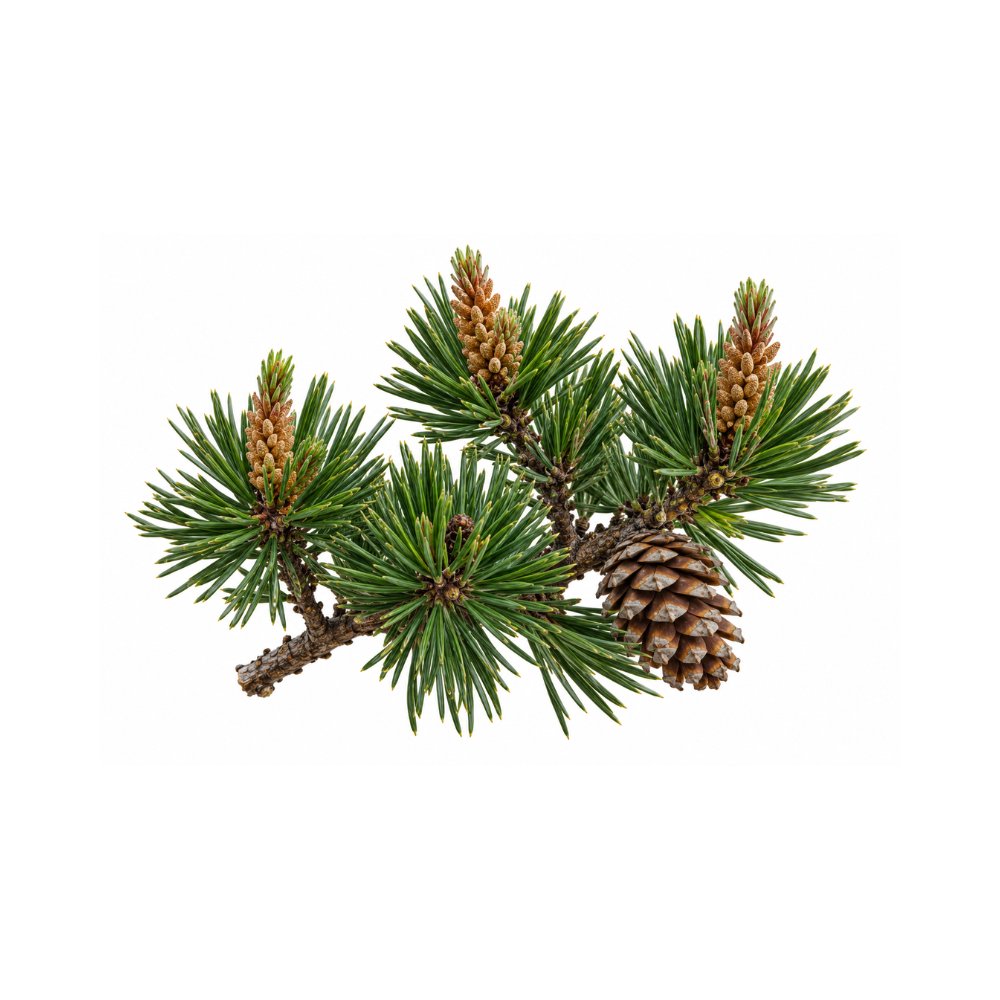
Mugo pine is an evergreen shrub, usually 1–3 m tall and occasionally up to 5 m. It grows from one or more curved trunks, and rarely forms a small tree 1Reference 1Pinus mugo — species description, growth habit, distribution, taxonomy of the mugo complex, conservation status and ethnobotany — reference databaseView study →.
Its branches lie along the ground for up to 10 m from the base, with the tips turning upward. This low, bowed growth is an adaptation to deep snow and avalanches: the weight of snow presses the branch ends flat in winter, and they spring upright again in the thaw. The Bulgarian name klek, “knee”, refers to this shape 1Reference 1Pinus mugo — species description, growth habit, distribution, taxonomy of the mugo complex, conservation status and ethnobotany — reference databaseView study →.
The bark is thin and grey-brown to blackish, and breaks into scaly plates on old stems. The buds are very resinous 1Reference 1Pinus mugo — species description, growth habit, distribution, taxonomy of the mugo complex, conservation status and ethnobotany — reference databaseView study →.
The needles grow in pairs, and rarely in threes around the tip of a strong shoot. They are 23–75 mm long, bright to dark green, and stay on the branch for four to nine years 1Reference 1Pinus mugo — species description, growth habit, distribution, taxonomy of the mugo complex, conservation status and ethnobotany — reference databaseView study →.
The cones are small, 18–55 mm long, and ripen to a dull dark brown 15–17 months after pollination. The seeds are black, 3–4 mm long, with a wing of 7–12 mm 1Reference 1Pinus mugo — species description, growth habit, distribution, taxonomy of the mugo complex, conservation status and ethnobotany — reference databaseView study →.
Mugo pine belongs to a complex of closely related mountain pines. Botanists have treated it and P. uncinata as two species or as one for about 200 years, and molecular studies show them to be sister species 1Reference 1Pinus mugo — species description, growth habit, distribution, taxonomy of the mugo complex, conservation status and ethnobotany — reference databaseView study →. It hybridises in the wild with P. uncinata, Scots pine (P. sylvestris), P. nigra and P. heldreichii, and more than a hundred taxa have been named within the complex 1,
Distribution
Mugo pine grows in the mountains of central and southeastern Europe, in Albania, Austria, Bosnia and Herzegovina, Bulgaria, Croatia, the Czech Republic, France, Germany, Italy, North Macedonia, Montenegro, Poland, Romania, Serbia, Slovakia, Slovenia, Switzerland and Ukraine 1Reference 1Pinus mugo — species description, growth habit, distribution, taxonomy of the mugo complex, conservation status and ethnobotany — reference databaseView study →. It grows at 1,400–2,500 m, and reaches at least 2,700 m in the Pirin Mountains of southwestern Bulgaria 1Reference 1Pinus mugo — species description, growth habit, distribution, taxonomy of the mugo complex, conservation status and ethnobotany — reference databaseView study →.
It covers large areas at and above the treeline, where it protects the soil against erosion and slows avalanches 1Reference 1Pinus mugo — species description, growth habit, distribution, taxonomy of the mugo complex, conservation status and ethnobotany — reference databaseView study →. It is widely planted as an ornamental, and it has naturalised in parts of Canada and the northern United States 1Reference 1Pinus mugo — species description, growth habit, distribution, taxonomy of the mugo complex, conservation status and ethnobotany — reference databaseView study →.
The species is not of conservation concern across its range. It is rare in Croatia, where it is legally protected 1Reference 1Pinus mugo — species description, growth habit, distribution, taxonomy of the mugo complex, conservation status and ethnobotany — reference databaseView study →.
The oil is distilled from wild stands. In Kosovo, the populations studied as an oil resource grow inside two national parks 3Reference 3Essential oil composition variability among natural populations of Pinus mugo Turra in Kosovo — analyticalView study →. When buying dwarf pine oil, it is worth looking for one that names the species and its origin.
Growing Conditions
Cultivation snapshot for Mugo Pine
Zoneextremely cold-hardy, to USDA zone 3 1Reference 1Pinus mugo — species description, growth habit, distribution, taxonomy of the mugo complex, conservation status and ethnobotany — reference databaseView study →.
Habitathigh mountain slopes at the treeline, and moors and bogs at the foot of the mountains, where it can grow into a tree of up to 10 m 1,
Soiltolerates poor, acidic ground, including peat 1Reference 1Pinus mugo — species description, growth habit, distribution, taxonomy of the mugo complex, conservation status and ethnobotany — reference databaseView study →.
Longevitylong-lived; the oldest dated specimen, from the Swiss National Park, was 283 years old 1Reference 1Pinus mugo — species description, growth habit, distribution, taxonomy of the mugo complex, conservation status and ethnobotany — reference databaseView study →.
Grow it yourself
Farm Wiki is our cultivation-focused sister site, also run by Justin Cooke.
Pharmacology & Research
No study of mugo pine in people has been published. The research consists of about a dozen laboratory studies of the distilled oil, looking at antimicrobial, antioxidant, anti-inflammatory and anticancer activity 4,
The best-characterised findings are antioxidant activity in fat-based test systems and antibacterial activity, including in the vapour phase 5,
-
Best-supported: antibacterial activity of the oil, with the vapour phase more active than the liquid 6,
9Reference 6In vitroLiquid and vapour phase of four conifer-derived essential oils: chemical compositions and antimicrobial and antioxidant properties — in vitroView study →Reference 9In vitroAntimicrobial activities of essential oils of different Pinus species from Bosnia and Herzegovina — in vitroView study → ; antioxidant activity, strongest in fat-based systems 5,6Reference 5In vitroAntioxidative properties of the essential oil from Pinus mugo — in vitroView study →Reference 6In vitroLiquid and vapour phase of four conifer-derived essential oils: chemical compositions and antimicrobial and antioxidant properties — in vitroView study → . - Emerging, worth watching: in prostate cancer cells the oil blocks STAT3 signalling, triggers cell death and works together with cisplatin 10Reference 10In vitroPinus mugo essential oil impairs STAT3 activation through oxidative stress and induces apoptosis in prostate cancer cells — in vitroView study →.
- Mechanistically thin: the respiratory and rheumatic uses have never been tested for efficacy.
- The caveat: every result is from cells or test tubes, at concentrations far above anything an inhalation delivers.
Every finding comes from laboratory work on the concentrated oil. No study has tested an inhalation, a rub or a bath in a person.
1. Antimicrobial
Garzoli and colleagues tested the liquid and vapour phases of mugo needle oil alongside the oils of three other conifers, against three Gram-negative and two Gram-positive bacteria. The vapour phase of every oil was more active than the liquid 6Reference 6In vitroLiquid and vapour phase of four conifer-derived essential oils: chemical compositions and antimicrobial and antioxidant properties — in vitroView study →.
⚠ The lowest inhibitory concentrations in that study, about 13 mg/mL, belonged to the Norway spruce and silver fir oils, not to mugo 6Reference 6In vitroLiquid and vapour phase of four conifer-derived essential oils: chemical compositions and antimicrobial and antioxidant properties — in vitroView study →.
A 2024 study of four Pinus species from Bosnia and Herzegovina tested needle and green-cone oils against bacteria and Candida albicans 9Reference 9In vitroAntimicrobial activities of essential oils of different Pinus species from Bosnia and Herzegovina — in vitroView study →. ⚠ The strongest oils were those of Scots pine cones and Aleppo pine, and the synergy with gentamicin was found for those oils and black pine cones, not for mugo 9Reference 9In vitroAntimicrobial activities of essential oils of different Pinus species from Bosnia and Herzegovina — in vitroView study →.
In antifungal screening against Penicillium species, mugo oil was among the oils that killed the fungi, with results varying between strains 11Reference 11In vitroAntifungal activity of selected volatile essential oils against Penicillium sp. — in vitroView study →.
Gap: every result is in vitro, at concentrations far above anything a steam inhalation delivers to an airway.
2. Antioxidant
Grassmann and colleagues tested mugo oil in several biochemical systems 5Reference 5In vitroAntioxidative properties of the essential oil from Pinus mugo — in vitroView study →.
The oil showed weak to moderate activity in water-based assays, such as the Fenton system and xanthine-oxidase superoxide generation. It showed good activity in fat-based systems, protecting LDL from copper-induced oxidation and damping the oxidative burst of activated neutrophils in whole blood 5Reference 5In vitroAntioxidative properties of the essential oil from Pinus mugo — in vitroView study →.
The individual constituents tested — Δ-3-carene, camphene, α-pinene, limonene and terpinolene — were weak or inactive in water. Some were effective in the fat-based systems, and terpinolene, a minor component, gave marked protection against LDL oxidation 5Reference 5In vitroAntioxidative properties of the essential oil from Pinus mugo — in vitroView study →.
In a comparison of four conifer needle oils, mugo oil had the strongest radical-scavenging activity in the DPPH and ABTS assays 6Reference 6In vitroLiquid and vapour phase of four conifer-derived essential oils: chemical compositions and antimicrobial and antioxidant properties — in vitroView study →.
Gap: the activity is in the fat phase and weak in water, and no study has measured it in a living body.
3. Anti-Inflammatory
Basholli-Salihu and colleagues exposed lipopolysaccharide-stimulated macrophages to needle, twig and cone oils of mugo pine and two other pines, at oil concentrations of 0.0001–0.2% for three hours 4Reference 4In vitroPhytochemical composition, anti-inflammatory activity and cytotoxic effects of essential oils from three Pinus spp. — in vitroView study →.
The oils reduced secretion of the inflammatory cytokine IL-6, by up to 60% at 0.01% 4Reference 4In vitroPhytochemical composition, anti-inflammatory activity and cytotoxic effects of essential oils from three Pinus spp. — in vitroView study →. The mugo oil in that study was led by Δ-3-carene, α-pinene and linalyl acetate 4Reference 4In vitroPhytochemical composition, anti-inflammatory activity and cytotoxic effects of essential oils from three Pinus spp. — in vitroView study →.
Gap: this is a single cell-based assay, with no test in tissue, in an animal or in a person.
4. Cytotoxicity
In the Basholli-Salihu study, the oils reduced the viability of HeLa, CaCo-2 and MCF-7 cancer cells by up to 90% at a concentration of 0.1% 4Reference 4In vitroPhytochemical composition, anti-inflammatory activity and cytotoxic effects of essential oils from three Pinus spp. — in vitroView study →.
Thalappil and colleagues found that mugo oil blocks the constant STAT3 activation in DU145 prostate cancer cells. It caused a fast drop in glutathione and a rise in reactive oxygen species, and the resulting mild oxidative stress stopped the cells migrating and triggered cell death. The oil also worked together with cisplatin 10Reference 10In vitroPinus mugo essential oil impairs STAT3 activation through oxidative stress and induces apoptosis in prostate cancer cells — in vitroView study →.
Pre-treatment with the antioxidant N-acetylcysteine reversed the STAT3 effect, which ties it to the oxidative stress 10Reference 10In vitroPinus mugo essential oil impairs STAT3 activation through oxidative stress and induces apoptosis in prostate cancer cells — in vitroView study →.
Gap: ⚠⚠ this is a concentrated oil applied directly to cultured cells. Mugo oil is not taken internally, and nothing here bears on cancer in a person.
5. Respiratory
Inhalation for colds of the upper airways is the oil’s main use, and the oil’s quality is set by the European Pharmacopoeia 15Reference 15Mountain pine (Pinus mugo Turra) — medicinal use, dosage, side effects and warnings — reference databaseView study →.
The vapour-phase antibacterial data fit that route of use 6Reference 6In vitroLiquid and vapour phase of four conifer-derived essential oils: chemical compositions and antimicrobial and antioxidant properties — in vitroView study →. Two Alpine ethnobotanical surveys record the respiratory use as current practice 12,
Gap: ⚠⚠ there is no human data for the use the oil is best known for. No study asks whether inhaling the vapour shortens a cold, loosens catarrh or eases a cough.
Mechanisms
The oil is mostly monoterpenes, led by Δ-3-carene and α-pinene, with a smaller sesquiterpene fraction 3,
In cancer cells, the whole oil has been studied for depleting glutathione and blocking STAT3 signalling.
| Mechanism | Drives | Key compounds |
|---|---|---|
| Lipid-phase radical scavenging; LDL oxidation ↓, neutrophil oxidative burst ↓ | antioxidant | alpha-pinene, delta-3-carene, limonene, terpinolene |
| IL-6 ↓ in LPS-stimulated macrophages | anti-inflammatory | whole oil, Δ-3-carene- and α-pinene-rich |
| Antibacterial effect, stronger in the vapour phase | antimicrobial | alpha-pinene, beta-pinene, limonene |
| STAT3 phosphorylation ↓ through glutathione depletion and reactive-oxygen rise | cytotoxicity in cell lines | whole oil |
Clinical Trials
No registered trial of Pinus mugo was identified, and no human study of any design has been published.
| Completed | Planned | Terminated | Preclinical |
|---|---|---|---|
| 0 | 0 | 0 | ~12 |
Last checked: September 2026.
Phytochemistry
Dwarf pine oil is about 70% monoterpene hydrocarbons, including the pinenes, Δ-3-carene, myrcene and limonene 15Reference 15Mountain pine (Pinus mugo Turra) — medicinal use, dosage, side effects and warnings — reference databaseView study →. Bornyl acetate is the main oxygenated monoterpene, and the sesquiterpenes include caryophyllene, longifolene and β-cubebene 15Reference 15Mountain pine (Pinus mugo Turra) — medicinal use, dosage, side effects and warnings — reference databaseView study →.
The international standard for the commercial oil (ISO 21093) sets ranges for its main constituents, including 10–30% α-pinene, 5–25% Δ-3-carene, 8–17% β-phellandrene and 8–14% limonene 3Reference 3Essential oil composition variability among natural populations of Pinus mugo Turra in Kosovo — analyticalView study →.
Each part of the plant gives a different oil. In six wild populations in Kosovo, the twigs yielded the most oil, 1.0–2.4%, against 0.3–0.8% from the needles 3Reference 3Essential oil composition variability among natural populations of Pinus mugo Turra in Kosovo — analyticalView study →. The twig oil carried 24.0–51.6% Δ-3-carene, the needle oil 16.9–24.5% α-pinene, and the cone oil 10.3–26.9% caryophyllene 3Reference 3Essential oil composition variability among natural populations of Pinus mugo Turra in Kosovo — analyticalView study →. Germacrene D reached up to about 12% in the cones 3Reference 3Essential oil composition variability among natural populations of Pinus mugo Turra in Kosovo — analyticalView study →.
The populations did not group by geography. Their differences seemed to reflect local conditions rather than location 3Reference 3Essential oil composition variability among natural populations of Pinus mugo Turra in Kosovo — analyticalView study →.
The seeds contain a fatty oil. In an analysis of 21 pine taxa, mugo seed oil had the highest share of pinolenic acid, 28.3% of its fatty acids, above Korean pine 14Reference 14Fatty acid profiling in the genus Pinus in relation to its chemotaxonomy and nutritional or pharmaceutical properties — analyticalView study →.
Constituent Summary
The main compounds of the oil, with ranges from the ISO standard and from wild Kosovo populations.
Monoterpene8 compounds8 with data
Sesquiterpene2 compounds2 with data
Fatty Acid1 compound1 with data
Longifolene and β-cubebene are minor sesquiterpenes of the oil 15Reference 15Mountain pine (Pinus mugo Turra) — medicinal use, dosage, side effects and warnings — reference databaseView study →.
Dosage
- Inhalation — 2–3 drops of oil in 1 litre of hot water, with the steam breathed in several times a day 15Reference 15Mountain pine (Pinus mugo Turra) — medicinal use, dosage, side effects and warnings — reference databaseView study →.
- Bath — 5 g of oil in a full bath at 35–38 °C, for 10–20 minutes 15Reference 15Mountain pine (Pinus mugo Turra) — medicinal use, dosage, side effects and warnings — reference databaseView study →.
- On the skin — as a diluted oil, ointment, cream or rubbing alcohol 15Reference 15Mountain pine (Pinus mugo Turra) — medicinal use, dosage, side effects and warnings — reference databaseView study →.
- The oil is for external use and inhalation only 15Reference 15Mountain pine (Pinus mugo Turra) — medicinal use, dosage, side effects and warnings — reference databaseView study →.
Traditional Dosage
| System | Preparation | Dose |
|---|---|---|
| US Dispensatory (1918) | Oil inhaled from boiling water, for chronic bronchitis | A few drops 16Reference 16Oleum Pini Pumilionis, U.S. — oil of dwarf pine needles — pharmacopoeial commentaryView study → |
| German phytotherapy | Oil inhaled from hot water, for colds | 2–3 drops in 1 L, several times daily 15Reference 15Mountain pine (Pinus mugo Turra) — medicinal use, dosage, side effects and warnings — reference databaseView study → |
| German phytotherapy | Oil as a bath additive | 5 g per full bath, 10–20 minutes 15Reference 15Mountain pine (Pinus mugo Turra) — medicinal use, dosage, side effects and warnings — reference databaseView study → |
| Bulgarian folk use | Needle infusion, drunk as a tea | Not quantified |
Safety & Pregnancy
The oil is used on the skin and inhaled, and its cautions concern small children, asthma and aged oil.
- Irritation of the skin and mucous membranes is the listed side effect of the oil 15Reference 15Mountain pine (Pinus mugo Turra) — medicinal use, dosage, side effects and warnings — reference databaseView study →.
- Never apply the oil to the face of infants and young children. In children up to 2 years old it can trigger spasm of the larynx, in the worst case stopping breathing. It is not recommended under 4 years 15Reference 15Mountain pine (Pinus mugo Turra) — medicinal use, dosage, side effects and warnings — reference databaseView study →.
- Do not use in bronchial asthma or whooping cough, and keep it away from the eyes 15Reference 15Mountain pine (Pinus mugo Turra) — medicinal use, dosage, side effects and warnings — reference databaseView study →.
- Oxidised oil is a skin sensitiser. Δ-3-carene forms hydroperoxides as the oil ages in air, and these were the main sensitiser in Scandinavian turpentine 8Reference 8ReviewOne hundred years of allergic contact dermatitis due to oxidized terpenes: what we can learn from old research on turpentine allergy — reviewView study →.
- For external use and inhalation only 15Reference 15Mountain pine (Pinus mugo Turra) — medicinal use, dosage, side effects and warnings — reference databaseView study →.
- Avoid in pregnancy and breastfeeding 17Reference 17Latschenkiefer [Mountain pine] — reference databaseView study →.
Full Safety Detail
Infants and young children. In children up to 2 years old, mountain pine oil can cause spasm of the larynx, in the worst case with respiratory arrest, so it is never applied to the face. It is not recommended under 4 years of age 15Reference 15Mountain pine (Pinus mugo Turra) — medicinal use, dosage, side effects and warnings — reference databaseView study →. Swiss product guidance lists children and adolescents as a contraindication 17Reference 17Latschenkiefer [Mountain pine] — reference databaseView study →.
Asthma and whooping cough. The oil is not used in either condition, and not near the eyes 15Reference 15Mountain pine (Pinus mugo Turra) — medicinal use, dosage, side effects and warnings — reference databaseView study →.
Baths. Oil baths are avoided with large skin wounds, inflammatory skin disease, fever, heart failure and high blood pressure 15Reference 15Mountain pine (Pinus mugo Turra) — medicinal use, dosage, side effects and warnings — reference databaseView study →. The oil is not applied to broken or diseased skin 17Reference 17Latschenkiefer [Mountain pine] — reference databaseView study →.
Aged oil. The old Scandinavian turpentine allergy was traced to the air-oxidation products of the terpenes, above all Δ-3-carene hydroperoxides 8Reference 8ReviewOne hundred years of allergic contact dermatitis due to oxidized terpenes: what we can learn from old research on turpentine allergy — reviewView study →. Mugo oil is rich in Δ-3-carene 3Reference 3Essential oil composition variability among natural populations of Pinus mugo Turra in Kosovo — analyticalView study →. The 1918 US Dispensatory advised keeping the oil in well-stoppered amber bottles, cool and away from light, because it resinifies on exposure 16Reference 16Oleum Pini Pumilionis, U.S. — oil of dwarf pine needles — pharmacopoeial commentaryView study →. Fresh oil, stored cool and dark, is the safer choice for the skin.
Interactions. None are known 15Reference 15Mountain pine (Pinus mugo Turra) — medicinal use, dosage, side effects and warnings — reference databaseView study →, and none has been studied.
Avoid. Swiss product guidance lists pregnancy and breastfeeding as contraindications for mountain pine oil 17Reference 17Latschenkiefer [Mountain pine] — reference databaseView study →. No study has looked at any mugo preparation in pregnancy or lactation.
References
- Earle, C. J. (ed.) (2023). Pinus mugo — species description, growth habit, distribution, taxonomy of the mugo complex, conservation status and ethnobotany — reference database. The Gymnosperm Database. https://www.conifers.org/pi/Pinus_mugo.php
- Manzione, M. G., Vitalini, S., Sharopov, F., Capó, X., Iriti, M., Martorell, M., & Pezzani, R. (2024). Pinus mugo Turra and its therapeutic potential — narrative review. Natural Product Communications, 19(8). https://journals.sagepub.com/doi/10.1177/1934578X241265934
- Hajdari, A., Mustafa, B., Ahmeti, G., Pulaj, B., Lukas, B., & Ibraliu, A. (2015). Essential oil composition variability among natural populations of Pinus mugo Turra in Kosovo — analytical. SpringerPlus, 4, 828. https://pubmed.ncbi.nlm.nih.gov/26753115/
- Basholli-Salihu, M., Schuster, R., Hajdari, A., Mulla, D., Viernstein, H., & Mustafa, B. (2017). Phytochemical composition, anti-inflammatory activity and cytotoxic effects of essential oils from three Pinus spp. — in vitro. Pharmaceutical Biology, 55(1), 1553–1560. https://pubmed.ncbi.nlm.nih.gov/28385055/
- Grassmann, J., Hippeli, S., Vollmann, R., & Elstner, E. F. (2003). Antioxidative properties of the essential oil from Pinus mugo — in vitro. Journal of Agricultural and Food Chemistry, 51(26), 7576–7582. https://pubmed.ncbi.nlm.nih.gov/14664510/
- Garzoli, S., Masci, V. L., Caradonna, V., Tiezzi, A., Giacomello, P., & Ovidi, E. (2021). Liquid and vapour phase of four conifer-derived essential oils: chemical compositions and antimicrobial and antioxidant properties — in vitro. Pharmaceuticals, 14(2), 134. https://pubmed.ncbi.nlm.nih.gov/33567501/
- Sikora, J., & Celiński, K. (2024). Exploring taxonomic and genetic relationships in the Pinus mugo complex using genome skimming data — molecular phylogenetics. International Journal of Molecular Sciences, 25(18), 10178. https://pubmed.ncbi.nlm.nih.gov/39337663/
- Karlberg, A. T., & Lepoittevin, J. P. (2021). One hundred years of allergic contact dermatitis due to oxidized terpenes: what we can learn from old research on turpentine allergy — review. Contact Dermatitis, 85(6), 627–636. https://pubmed.ncbi.nlm.nih.gov/34453446/
- Mirković, S., Tadić, V., Milenković, M. T., et al. (2024). Antimicrobial activities of essential oils of different Pinus species from Bosnia and Herzegovina — in vitro. Pharmaceutics, 16(10), 1331. https://pubmed.ncbi.nlm.nih.gov/39458660/
- Thalappil, M. A., Butturini, E., Carcereri de Prati, A., et al. (2022). Pinus mugo essential oil impairs STAT3 activation through oxidative stress and induces apoptosis in prostate cancer cells — in vitro. Molecules, 27(15), 4834. https://pubmed.ncbi.nlm.nih.gov/35956786/
- Felšöciová, S., Vukovic, N., Jeżowski, P., et al. (2020). Antifungal activity of selected volatile essential oils against Penicillium sp. — in vitro. Open Life Sciences, 15(1), 511–521. https://pubmed.ncbi.nlm.nih.gov/33817239/
- Bottoni, M., Milani, F., Colombo, L., et al. (2020). Using medicinal plants in Valmalenco (Italian Alps): from tradition to scientific approaches — ethnobotanical survey (observational). Molecules, 25(18), 4144. https://pubmed.ncbi.nlm.nih.gov/32927742/
- Cavalloro, V., Robustelli Della Cuna, F. S., Quai, E., et al. (2022). Walking around the Autonomous Province of Trento (Italy): an ethnobotanical investigation — ethnobotanical survey (observational). Plants, 11(17), 2246. https://pubmed.ncbi.nlm.nih.gov/36079629/
- Lahlou, A., Lyashenko, S., Chileh-Chelh, T., Belarbi, E. H., & Torres-García, I. (2023). Fatty acid profiling in the genus Pinus in relation to its chemotaxonomy and nutritional or pharmaceutical properties — analytical. Phytochemistry, 206, 113517. https://pubmed.ncbi.nlm.nih.gov/36442579/
- Kooperation Phytopharmaka (n.d.). Mountain pine (Pinus mugo Turra) — medicinal use, dosage, side effects and warnings — reference database. Arzneipflanzenlexikon (Medicinal Plant Lexicon). https://www.arzneipflanzenlexikon.info/en/mountain-pine.php
- Remington, J. P., & Wood, H. C. (eds.) (1918). Oleum Pini Pumilionis, U.S. — oil of dwarf pine needles — pharmacopoeial commentary. The Dispensatory of the United States of America (20th ed.). https://www.henriettes-herb.com/eclectic/usdisp/pinus-pumi_oleu.html
- Vögtli, A. (2025). Latschenkiefer [Mountain pine] — reference database. PharmaWiki. https://www.pharmawiki.ch/wiki/index.php?wiki=Latschenkiefer



